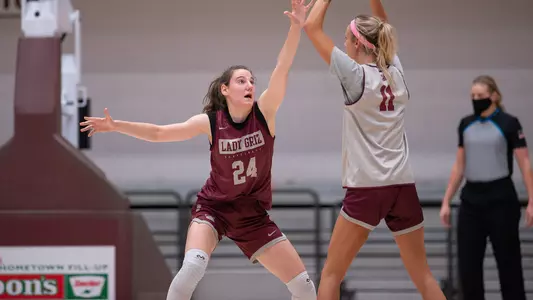
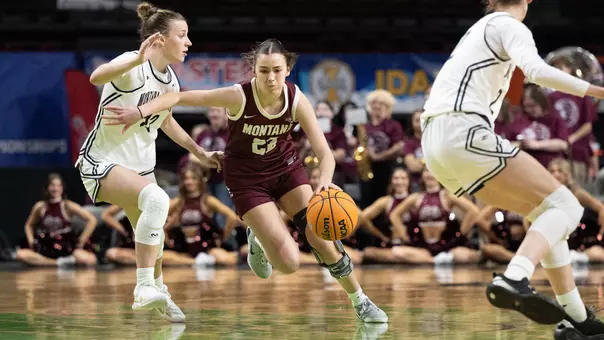
Photo by: Derek Johnson
Freshman Orientation with Lisa Kiefer
12/10/2021 4:06:00 PM | Women's Basketball
Lady Griz basketball coach Brian Holsinger best layer up before he continues reading. We're entering goose-bump territory here and somewhat uncharted grounds.
There is a freshman on a Division I women's basketball team who has played in just three of nine games this season, a total of 12 minutes. And she's fine with that.
(Built-in break for gasps of amazement, of befuddlement. Okay, go on reading.)
There is no complaining, no questioning of why this teammate is getting this or that teammate is getting that. She harbors no fantasies about transfer portals and all the greener grass that must be out there.
It's almost un-American, in this athletics age of what-about-me-ism, when self-awareness takes a backseat to self-aggrandizement, when everyone is an all-star, if only they had a chance to prove it.
Then again, Lisa Kiefer isn't American. She joined the Lady Griz from Marburg, Germany, land of stoic pragmatism. But she isn't all German. She was born in France, her mom French, her dad German.
They moved to his homeland, the three of them and Lisa's older sister Emma, when she was four.
And now she's in the U.S., in her first year at Montana, and she's not playing very much. And she's fine with that. And not just fine. She agrees with it.
"I know that I'm not ready for it yet. I trust my coach to know when I'm ready to play," she says in mostly flawless English, her second language. She also knows Spanish and Latin.
(Someone please get Coach Holsinger a pullover. I trust my coach to know when I'm ready to play? Bring on the goosebumps. That's like coaching catnip.)
"I know I have so much to learn yet," she continues. "I just have to keep developing and be ready to play. I know I have to get better at everything."
For as confusing as the German basketball system can be to an outsider, it helped create this I'll wait my turn and trust that it's coming mindset.
Marburg, a city of 80,000 or so, has youth teams. U11, U13 and so on. There are also state teams, for the best of the youth teams.
And Marburg has a third-division professional team, mostly made up of local women. And then it has its first-division team, BC Marburg, which plays in the Damen-Basketball-Bundesliga.
(It also has a second division, or where former Lady Griz McKenzie Johnston is playing, for Falcons Bad Homburger TG.)
Kiefer started on the youth teams, has played for her state team, then the third-division team before finally getting an invitation to start practicing with the first-division squad.
She was, quite literally, a girl among women despite being 6-foot-3 and long, a hand-me-down from her dad, 6-foot-5, and her mom, 5-foot-11 or six-feet, depending on her choice of footwear that day.
"It was kind of the same situation (as here), with better players than me. You just have to keep working, keep practicing, keep doing all the stuff the coaches tell you, and the time will come," she says.
She joined a team at Montana with established front-court players in redshirt senior Abby Anderson and redshirt junior Carmen Gfeller, both of whom were All-Big Sky Conference last season.
"It's hard to compare an 18-year-old kid from Europe to a 22-year-old who's been here and been through the battles," said Holsinger. "It's a totally different experience."
And then there is senior Kylie Frohlich and freshman Dani Bartsch, who has played herself into an important role off the bench. That personnel group has bumped Kiefer down the depth chart.
"Patience," is what Holsinger says he'd tell people if they asked about Kiefer, who they see at the games, on the bench, but rarely in the games. For now, at least, all we have are tales from practice.
"What she can do defensively is really exciting," says assistant coach Jordan Sullivan. "She is long and can move her feet.
"Abby has had some days with big frustrations getting blocked by Lisa. It's Abby's job to block people, and all of a sudden she's getting blocked. Lisa is getting respect from her teammates that way."
Offensively she is a bit out of her comfort zone, playing mostly with her back to the basket, as someone who was brought up in the game always facing it.
"In my club, we never had this kind of person playing with the back to the basket," she says. "We were all guard-ish, so we were playing outside."
The first-division team had a more traditional post presence, but it wasn't going to be Kiefer, not at her age, not surrounded by women who had been in her shoes sometimes a decade or more earlier.
"When I was playing for the women's team, they were just way bigger and stronger. I never had a chance, so I was always outside," she says. But she's willing to learn a new skillset.
"With all the movements, it's definitely a challenge, but I like getting more versatile. I would love to be a player who could do everything, whether it's posting up or facing the basket or shooting."
It's just another problem to solve, for the player who has never met a chemistry or biology or physics course she hasn't loved.
The career she most wishes she could have? As a Nobel-prize-winning scientist, perhaps the first Lady Griz to ever have that as a goal?
"I just think it's fascinating to learn how everything works and the details behind our everyday life," she says. "I like to think about finding solutions for our problems today. It's kind of fun to me."
Maybe it's in the water in Marburg, or maybe it's because she grew up in what is the hub of Germany's pharmaceutical industry.
The Marburg Castle, built in the 11th century and serving as an imposing sentinel above town, may be the city's signature landmark, but it's a building just outside of town that's more relevant to the present.
It was at Pharma Park Marburg that BioNTech produced its first Covid-19 vaccine. In the first half of 2021, the facility produced more than 250 million vaccine doses. It's capacity: 750 million annually.
Without the arrival of Covid-19 and the resulting shutdowns that affected the entire globe, Kiefer likely wouldn't be in Missoula wearing a Lady Griz uniform.
She knew players who had done it, had gone to the U.S. to play college basketball and earn their degree, but she never pictured that for herself. Until one day …
"This woman approached me. She organizes trips to the United States to play in basketball tournaments where scouts would have been that could have offered you a scholarship," she says.
Robert Kiefer, Lisa's dad, maybe could have played is the U.S. He had the size and the skills and the basketball jones.
He also loved the drums. And Celine, his future wife, who balled a little herself, played the viola. And they met at a camp for musicians. And their song began being composed.
"It's actually a pretty sweet story. They got to know each other and liked each other and kept in contact," says Lisa.
They lived first in France, then Germany, then back in France, where the girls were born, then moved to Germany, where Robert works as a sales manager for a company that sells engine parts.
Given the chance to at least entertain the idea of playing college basketball in the U.S., Kiefer had her doubts.
"I don't know," she told the woman. "I'm happy at my hometown. But the more I thought about it, the more I talked to people, the more interested I got.
"I just thought it would be this great opportunity to see how they play here and experience college basketball. The more I thought about it, the more I was getting excited."
Dad? He was an easy sell. "He was thinking about going here when he was younger, so he was really supportive," she says.
"If you don't do it, you'll never know. Maybe it could be super exciting and the best thing you could have done in your life."
Mom? That was a tougher sell, as moms can be. "She was really supportive as well, but I think for her it was scary too, sending me abroad the first time this far away from home."
Those tournaments, in front of college scouts? Yeah, they were shut down, courtesy of the coronavirus.
So that woman, who knows Holsinger and other college coaches, reached out and sold the merits of the 6-foot-3 player with guard skills from Marburg.
It was late in the recruiting cycle, in the spring of 2021, and at a time of transition for Holsinger, who learned of Kiefer when he was still an assistant at Oregon State.
Then he got the job at Montana, right about the time another mid-major offered Kiefer. "When I got it, I told her I wanted her here. I went all in with her," says Holsinger.
He was a coach in his first weeks leading his first Division I program, and he was talking to a player who would not be able to visit campus before committing. So he just did what he does.
"I felt when I was talking to Brian that he's a really good person and I felt like we had a connection," she says. "I agreed with everything he was saying and really liked the way he talked about this program.
"It felt right, and I thought this could be a really good opportunity. I want to do that."
It's easy to just jump from the decision to the season at hand and assume everything was smooth and easy, but that would be to overlook the transition and the difficulty inherent in such a move.
Because raise your hand if you'd do the same. Anyone? Anyone?
To a new country, to a new primary language, to a new city, to a university, to a coaching staff you've never met, teammates you haven't spent a day with.
"The beginning was really, really hard," she says, "with everything being new. Living on my own, taking care of myself, living with a roommate I don't know.
"You're in a town you don't know where to go. And then you're at the university. You don't know how it works and it's the first time you're having lessons in English."
To add to the complexity: a new team, a new style of playing the game she grew up loving. The one thing that should have felt like home, basketball, just didn't.
"It's different compared to Europe," she says. "They are looking for different things, so you don't really know what your role is, what position you're playing.
"And you're going through this without your family or friends being here. It's a hard thing to go through and get adjusted.
"The more I settle down and get comfortable with the whole situation here, the more I practice with the team, the more comfortable I get, the more I can develop."
Compare that to Sullivan, who moved across the state, from Sidney to Missoula, to play for the program she grew up cheering for, to play for the team coached by her uncle.
"Like every freshman, she's getting used to it and finding ways to get by," said Sullivan. "When you're not seeing court time and you're away from your family for the first time, that's hard."
Kiefer shared all of it, her hopes and dreams and fears, with her teammates at Montana's preseason retreat in September.
"She opened up a lot. I know she misses her family a lot, and I know it's hard for her to be away from them," said Sullivan. "She's got one of the purest hearts on the team, just a kind, kind soul."
The best thing she has going for her? Having fellow freshman Lamprini Polymeni, who's from Thessaloniki, Greece, as a roommate.
"That's been a blessing for her. It's someone she can share the homesickness with, someone who can relate to it. I'm glad those two have each other," said Sullivan.
She's starting to stand out in practice for her rebounding, which is one way to win Holsinger's heart (and his minutes). Same with her defense.
And she'll bring some European flair to the floor every once in a while, like the day she made a behind-the-back pass in transition that had everyone stopping and saying, wait, what just happened?
She wouldn't have been ready to step into Thursday's game against Utah Valley, not with 6-foot-5 center Josie Williams, who isn't comfortable on the court unless she's leaning on someone.
That takes some getting used to, no matter where you're from.
"The area of physical development will be gigantic for her going forward. She needs to get stronger to compete, but she's coming," said Holsinger.
"We just say, hey, stay positive, because she has a bright future in our program. She has a gigantic ceiling. We're excited to see where she goes."
There is a freshman on a Division I women's basketball team who has played in just three of nine games this season, a total of 12 minutes. And she's fine with that.
(Built-in break for gasps of amazement, of befuddlement. Okay, go on reading.)
There is no complaining, no questioning of why this teammate is getting this or that teammate is getting that. She harbors no fantasies about transfer portals and all the greener grass that must be out there.
It's almost un-American, in this athletics age of what-about-me-ism, when self-awareness takes a backseat to self-aggrandizement, when everyone is an all-star, if only they had a chance to prove it.
Then again, Lisa Kiefer isn't American. She joined the Lady Griz from Marburg, Germany, land of stoic pragmatism. But she isn't all German. She was born in France, her mom French, her dad German.
They moved to his homeland, the three of them and Lisa's older sister Emma, when she was four.
And now she's in the U.S., in her first year at Montana, and she's not playing very much. And she's fine with that. And not just fine. She agrees with it.
"I know that I'm not ready for it yet. I trust my coach to know when I'm ready to play," she says in mostly flawless English, her second language. She also knows Spanish and Latin.
(Someone please get Coach Holsinger a pullover. I trust my coach to know when I'm ready to play? Bring on the goosebumps. That's like coaching catnip.)
"I know I have so much to learn yet," she continues. "I just have to keep developing and be ready to play. I know I have to get better at everything."
For as confusing as the German basketball system can be to an outsider, it helped create this I'll wait my turn and trust that it's coming mindset.
Marburg, a city of 80,000 or so, has youth teams. U11, U13 and so on. There are also state teams, for the best of the youth teams.
And Marburg has a third-division professional team, mostly made up of local women. And then it has its first-division team, BC Marburg, which plays in the Damen-Basketball-Bundesliga.
(It also has a second division, or where former Lady Griz McKenzie Johnston is playing, for Falcons Bad Homburger TG.)
Kiefer started on the youth teams, has played for her state team, then the third-division team before finally getting an invitation to start practicing with the first-division squad.
She was, quite literally, a girl among women despite being 6-foot-3 and long, a hand-me-down from her dad, 6-foot-5, and her mom, 5-foot-11 or six-feet, depending on her choice of footwear that day.
"It was kind of the same situation (as here), with better players than me. You just have to keep working, keep practicing, keep doing all the stuff the coaches tell you, and the time will come," she says.
She joined a team at Montana with established front-court players in redshirt senior Abby Anderson and redshirt junior Carmen Gfeller, both of whom were All-Big Sky Conference last season.
"It's hard to compare an 18-year-old kid from Europe to a 22-year-old who's been here and been through the battles," said Holsinger. "It's a totally different experience."
And then there is senior Kylie Frohlich and freshman Dani Bartsch, who has played herself into an important role off the bench. That personnel group has bumped Kiefer down the depth chart.
"Patience," is what Holsinger says he'd tell people if they asked about Kiefer, who they see at the games, on the bench, but rarely in the games. For now, at least, all we have are tales from practice.
"What she can do defensively is really exciting," says assistant coach Jordan Sullivan. "She is long and can move her feet.
"Abby has had some days with big frustrations getting blocked by Lisa. It's Abby's job to block people, and all of a sudden she's getting blocked. Lisa is getting respect from her teammates that way."
Offensively she is a bit out of her comfort zone, playing mostly with her back to the basket, as someone who was brought up in the game always facing it.
"In my club, we never had this kind of person playing with the back to the basket," she says. "We were all guard-ish, so we were playing outside."
The first-division team had a more traditional post presence, but it wasn't going to be Kiefer, not at her age, not surrounded by women who had been in her shoes sometimes a decade or more earlier.
"When I was playing for the women's team, they were just way bigger and stronger. I never had a chance, so I was always outside," she says. But she's willing to learn a new skillset.
"With all the movements, it's definitely a challenge, but I like getting more versatile. I would love to be a player who could do everything, whether it's posting up or facing the basket or shooting."
It's just another problem to solve, for the player who has never met a chemistry or biology or physics course she hasn't loved.
The career she most wishes she could have? As a Nobel-prize-winning scientist, perhaps the first Lady Griz to ever have that as a goal?
"I just think it's fascinating to learn how everything works and the details behind our everyday life," she says. "I like to think about finding solutions for our problems today. It's kind of fun to me."
Maybe it's in the water in Marburg, or maybe it's because she grew up in what is the hub of Germany's pharmaceutical industry.
The Marburg Castle, built in the 11th century and serving as an imposing sentinel above town, may be the city's signature landmark, but it's a building just outside of town that's more relevant to the present.
It was at Pharma Park Marburg that BioNTech produced its first Covid-19 vaccine. In the first half of 2021, the facility produced more than 250 million vaccine doses. It's capacity: 750 million annually.
Without the arrival of Covid-19 and the resulting shutdowns that affected the entire globe, Kiefer likely wouldn't be in Missoula wearing a Lady Griz uniform.
She knew players who had done it, had gone to the U.S. to play college basketball and earn their degree, but she never pictured that for herself. Until one day …
"This woman approached me. She organizes trips to the United States to play in basketball tournaments where scouts would have been that could have offered you a scholarship," she says.
Robert Kiefer, Lisa's dad, maybe could have played is the U.S. He had the size and the skills and the basketball jones.
He also loved the drums. And Celine, his future wife, who balled a little herself, played the viola. And they met at a camp for musicians. And their song began being composed.
"It's actually a pretty sweet story. They got to know each other and liked each other and kept in contact," says Lisa.
They lived first in France, then Germany, then back in France, where the girls were born, then moved to Germany, where Robert works as a sales manager for a company that sells engine parts.
Given the chance to at least entertain the idea of playing college basketball in the U.S., Kiefer had her doubts.
"I don't know," she told the woman. "I'm happy at my hometown. But the more I thought about it, the more I talked to people, the more interested I got.
"I just thought it would be this great opportunity to see how they play here and experience college basketball. The more I thought about it, the more I was getting excited."
Dad? He was an easy sell. "He was thinking about going here when he was younger, so he was really supportive," she says.
"If you don't do it, you'll never know. Maybe it could be super exciting and the best thing you could have done in your life."
Mom? That was a tougher sell, as moms can be. "She was really supportive as well, but I think for her it was scary too, sending me abroad the first time this far away from home."
Those tournaments, in front of college scouts? Yeah, they were shut down, courtesy of the coronavirus.
So that woman, who knows Holsinger and other college coaches, reached out and sold the merits of the 6-foot-3 player with guard skills from Marburg.
It was late in the recruiting cycle, in the spring of 2021, and at a time of transition for Holsinger, who learned of Kiefer when he was still an assistant at Oregon State.
Then he got the job at Montana, right about the time another mid-major offered Kiefer. "When I got it, I told her I wanted her here. I went all in with her," says Holsinger.
He was a coach in his first weeks leading his first Division I program, and he was talking to a player who would not be able to visit campus before committing. So he just did what he does.
"I felt when I was talking to Brian that he's a really good person and I felt like we had a connection," she says. "I agreed with everything he was saying and really liked the way he talked about this program.
"It felt right, and I thought this could be a really good opportunity. I want to do that."
It's easy to just jump from the decision to the season at hand and assume everything was smooth and easy, but that would be to overlook the transition and the difficulty inherent in such a move.
Because raise your hand if you'd do the same. Anyone? Anyone?
To a new country, to a new primary language, to a new city, to a university, to a coaching staff you've never met, teammates you haven't spent a day with.
"The beginning was really, really hard," she says, "with everything being new. Living on my own, taking care of myself, living with a roommate I don't know.
"You're in a town you don't know where to go. And then you're at the university. You don't know how it works and it's the first time you're having lessons in English."
To add to the complexity: a new team, a new style of playing the game she grew up loving. The one thing that should have felt like home, basketball, just didn't.
"It's different compared to Europe," she says. "They are looking for different things, so you don't really know what your role is, what position you're playing.
"And you're going through this without your family or friends being here. It's a hard thing to go through and get adjusted.
"The more I settle down and get comfortable with the whole situation here, the more I practice with the team, the more comfortable I get, the more I can develop."
Compare that to Sullivan, who moved across the state, from Sidney to Missoula, to play for the program she grew up cheering for, to play for the team coached by her uncle.
"Like every freshman, she's getting used to it and finding ways to get by," said Sullivan. "When you're not seeing court time and you're away from your family for the first time, that's hard."
Kiefer shared all of it, her hopes and dreams and fears, with her teammates at Montana's preseason retreat in September.
"She opened up a lot. I know she misses her family a lot, and I know it's hard for her to be away from them," said Sullivan. "She's got one of the purest hearts on the team, just a kind, kind soul."
The best thing she has going for her? Having fellow freshman Lamprini Polymeni, who's from Thessaloniki, Greece, as a roommate.
"That's been a blessing for her. It's someone she can share the homesickness with, someone who can relate to it. I'm glad those two have each other," said Sullivan.
She's starting to stand out in practice for her rebounding, which is one way to win Holsinger's heart (and his minutes). Same with her defense.
And she'll bring some European flair to the floor every once in a while, like the day she made a behind-the-back pass in transition that had everyone stopping and saying, wait, what just happened?
She wouldn't have been ready to step into Thursday's game against Utah Valley, not with 6-foot-5 center Josie Williams, who isn't comfortable on the court unless she's leaning on someone.
That takes some getting used to, no matter where you're from.
"The area of physical development will be gigantic for her going forward. She needs to get stronger to compete, but she's coming," said Holsinger.
"We just say, hey, stay positive, because she has a bright future in our program. She has a gigantic ceiling. We're excited to see where she goes."
Players Mentioned

F
/ Women's Basketball
F
/ Women's Basketball
F
/ Women's Basketball
F
/ Women's Basketball
G
/ Women's Basketball
F
/ Women's Basketball
G
/ Women's BasketballLady Griz Basketball Locker Room Unveiling - 5/1/26
Friday, May 01
Griz Track & Field - Montana Open Highlights - 4/25/26
Friday, May 01
Griz Softball vs. Idaho State Game-Winning Hit - 3/25/26
Friday, May 01
Griz Softball Championship Series Promo
Friday, May 01