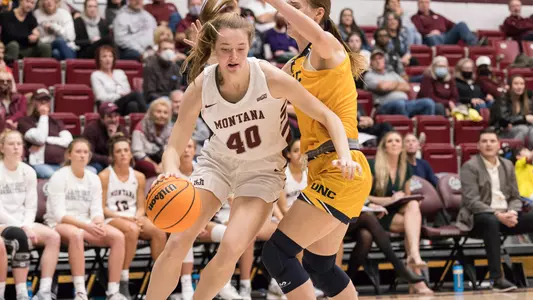
Freshman Orientation with Dani Bartsch
12/23/2021 6:39:00 PM | Women's Basketball
Dani Bartsch had the floor for maybe 10 minutes. All to herself. All the attention was hers and hers alone. Then Paige, her twin sister, was born.
"Dani always lived in Paige's shadow because Dani was always more serious. Paige is more gregarious and loud," says their mom, Anne. "Paige can walk in and just demand the room. So Dani's always kind of been in the background."
Their mom revealed that on Wednesday, two days after Dani spent more than 50 minutes leading a mostly unscripted interview in all sorts of directions, all of it unplugged. Reserved? Hardly.
"I love Christmastime, but it's not my favorite holiday," she said. And what is? "It's second-best behind Fourth of July. We go hard."
It's a three-day crescendo: July 2 at home, as a warmup. July 3 with relatives in Butte. July 4 in Helena at her uncle's place, with fireworks not purchased at a local, temporary pop-up tent on an empty lot but out of state. You know, the good stuff.
It's led to just "minimal injuries" over the years. "Nothing too severe," she says. And you may ask yourself, how did we get here in an interview about basketball? But you let it go because she's on a roll.
Her dad, Kevin, played football at Montana in the 80s, a linebacker, played in the very first game ever held inside Washington-Grizzly Stadium.
Her mom, then Anne Tarleton, played on some of the powerhouse Griz volleyball teams under Dick Scott. Her senior year was 1990, Montana's first trip to the NCAA tournament.
"My mom wasn't that interested (in my dad). Thought he was boring. But he had a car," she says. "I think my dad's pretty awesome personally. He's a good-looking guy!"
Dani was always more serious? Seriously?
"I'd say he's probably up there at 8 or 9," she says of her dad's sense of humor. "Morgan, Paige and my dad have witty personalities. Me, Amanda and my mom, we can't just roll it out."
You forget by this point what the original question even was or how it got to rating her family's ability to make you laugh. But this is good stuff, so you let her go. "He's got some pretty good banter. You're not going to win a fight against him."
May we now get around to introducing Amanda, the oldest of the Bartschs' four daughters. The Montana grad works for PayneWest in Helena. And Morgan, next in line, also a UM grad. She works for PwC, the global PricewaterhouseCoopers in Seattle.
They played sports, but not like Paige, a Gatorade Montana Volleyball Player of the Year who just finished up her first year at Boise State, where she was named the Mountain West Conference Freshman of the Year, and Dani, the Gatorade Montana Girls Basketball Player of the Year.
"They always joke that they donated their athleticism to Paige and me. I appreciate it," Dani says.
The two youngest Bartsch sisters led Capital High to three straight Class AA volleyball state championships, ending their run on a 71-match winning streak that no one can ever end. It's theirs forever.
Their basketball team shared the state title in 2020 (assist: COVID), won it when they were seniors.
Their dad prepped at Helena High, two words Dani can barely get herself to say out loud, like they are taboo. Or worse. She doesn't care for it? "It's just the worst school is all."
Which somehow leads to her telling you it takes seven minutes, 13 seconds to get from the family home to Capital High, "but you can't leave past 7:35. Otherwise you're going to get stuck behind the school bus that stops about five times."
If this is Dani, what would it be like to interview Paige, the more social and loquacious one?
Dani segues back to her dad, who was 6-foot-2, 232 pounds as a senior at Montana. "He's still strong. It's a dad bod."
Then she takes you on another path, about her early disdain for YMCA volleyball. "You didn't even keep score. You didn't serve. You just threw the ball over. And then you got candy after. I was like, this is stupid. This is a waste of my time."
She was in the third grade.
And again, you may ask yourself, how did we get here? How? It's because Dani Bartsch has stepped out of the shadows and into the spotlight for the first time in her life. She's no longer constrained, no longer part 1B to Paige's 1A, or vice versa. She's just Dani. And she seems to like it.
"Dani and Paige are pretty different kids in their whole demeanor. Dani is more reserved. Paige is more outgoing," says Kevin. "The one who's benefitted the most is Dani. She's really blossomed and kind of come into her own."
Maybe it was always there, just hidden from view, waiting for a time like this, an opportunity like this. Whatever happened, the lid has been lifted. And there is probably no going back. Her true nature has finally had a chance to reveal itself.
"It's been awesome. It's been so fun to watch her. She's thriving in Missoula. She loves everything. I think this is the happiest she's ever been," says Anne.
Again, how did we get here? I mean really get here?
It goes deeper than the twins, when two embryos were formed and Anne was told five months in that she was going from two kids to four. "I cried and I laughed," she says.
It goes deeper than Kevin's split chin that wouldn't heal and Anne's bum shoulder that needed constant attention and their meeting in the training room at Montana as they waited to get made whole again.
Dani's story can start with the Talking Heads, the American rock band, which formed in 1975 in New York City, about the time a young Linda Delk interviewed to become the volleyball coach at Northern Colorado.
Or about the time Jeff Mozzochi was playing volleyball at UC Santa Barbara, then Cal, then turning his attention to coaching the sport. His first stop: Portland State.
In February 1981, the Talking Heads released "Once in a Lifetime," which has the money line, "And you may ask yourself, 'Well, how did I get here?' This is how it came to be.
That fall, Delk, then in her sixth year at Northern Colorado, led the Bears to 44 wins and a third-place finish at AIAW nationals in Colorado Springs.
Of course a volleyball player growing up in Littleton, Colo., would have her ears perk up when Delk tapped that player's shoulder and invited her to Greeley. It was still the infancy of women's collegiate athletics, and Delk was at the forefront.
But first Anne Tarleton wanted to make a visit to Alaska-Anchorage.
"(Delk) offered me a full ride, but I was still going to Alaska on a recruiting trip. She told me if I decided I didn't want to go there to call her and she'd drive me my letter of intent," Anne says. That's how badly Delk wanted her.
She visited UAA, discovered a team that didn't get along, that didn't have the right chemistry, returned home and called Delk. She wanted to be a Bear. "She said, 'Okay, I'll put it in the mail.'"
How did we get here? In the amount of time it took an envelope with a letter of intent to go from Greeley to Littleton. How did we get here? In the mind of a high schooler who had been told the coach would personally deliver that piece of paper, then opted to mail it instead.
And if Delk had done as she said and driven to Littleton, would Anne have signed with Northern Colorado, become a Bear and never met Kevin Bartsch? "Oh yeah, totally. Funny how things work out."
The envelope arrived, the letter of intent inside just waiting to be inked. And it sat there for a day, then two. She's still not sure why she didn't sign it. But she didn't, and then Dick Scott called.
He was calling Anne Tarleton because Kari Kockler had told him no. The Helena High grad, who was one year behind Kevin Bartsch, was wooed by Mozzochi, who led Portland State to Division II national championships in 1984 and '85, and how could a girl turn that down?
The middle blocker who would be voted all-America as a junior and senior would help Mozzochi win his third national championship as a junior in 1988.
And you may ask yourself, well, how did we get here? Just like that: Delk mailed the letter of intent instead of hand-delivering it, and Kockler picked Portland State over Montana. And here we are.
Tarleton visited and it was done. "I loved the team and I loved Missoula. It worked out for all of us," she said.
"We've seen Kari a number of times. She's a physical therapist here in (Helena)," says Kevin. "Her decision to decline Montana's offer really impacted my life and our lives so deeply."
Letting the days go by, water flowing underground
Kevin Bartsch arrived in Missoula as a freshman in the fall of 1985, or what would be the final year for Larry Donovan as head football coach of the Grizzlies.
Then one day in walked his new coach: Don Read. And most of the Grizzlies had never experienced such a force of nature.
"He was so enthusiastic and had so much energy. He changed the whole culture," says Bartsch. "The attitude and expectations changed, just his whole approach to practice and to games was quite a bit different. He was a fun coach to play for."
He learned it firsthand, living as he did across the street from Read. His new coach would be out working on his lawn, "which was impeccable," when it turned dark and be out there when the sun rose, tending to it like he did his team, with great care, love and attention. "I think he slept about two hours a day."
Five games into his sophomore season, in 1986, Bartsch and his teammates ran into Washington-Grizzly Stadium for a game for the first time, a program-changing upgrade from the off-campus Dornblaser Field.
They knew it was a big deal at the time but had no idea that it would be monumental or what would become of it down the road, from the championships to the additions that now have the potential seating north of 26,000.
"The guys from Seattle and California, they would look at (Dornblaser) and say my high school stadium was better than this," Bartsch says.
"Everybody recognized the importance of bringing football on campus, but I don't think anybody at the time had any sense that it was going to blossom into what it has become. It sure is fun to look back and see how it's grown over the course of time."
Montana would go 6-4, then 6-5 in Read's first two years, then break through and make the I-AA playoffs in 1988, Bartsch's senior year.
What the football team was becoming was what the volleyball program already was: relevant on the national stage.
That was the golden age for the Grizzlies. Montana wouldn't finish lower than third in its conference for a full decade, between 1985 and 1994, and make three trips to the NCAA tournament.
Tarleton redshirted as a freshman in 1986, was honorable mention All-Big Sky as a third-year sophomore in 1988 and suffered a shoulder injury in 1989 that would require offseason arthroscopic surgery.
The rehabilitation required frequent trips to the training room, which is where Bartsch kept going after a split chin wouldn't stay shut. "We started dating a little bit and one thing led to another, and here we are, 29 years in marriage, 33 together overall," says Kevin.
He returned to Helena and started working for the Montana State Fund as a claims manager. She, an elementary education major, moved to Helena to student teach and got on full time in the district, taking early retirement after the 2019-20 school year, after three decades.
Under the rocks and stones, there is water underground
Amanda arrived, then Morgan. And it's not what most people may have anticipated, the offspring of two successful Division I athletes.
Both girls played sports but …
"Morgan has not one competitive bone in her body. She didn't have that drive that Paige and Dani have always had," says Anne. "And Amanda, she played sports and liked it but it was never a huge thing she wanted to do."
And then arrived the twins. And things have never been the same.
"I don't know that we were thinking we'd have that many kids, but it's certainly been a blessing in our lives. I wouldn't have it any other way," says Kevin.
Of course, he says that now. Back then, when he came home that day and was asked by his wife to walk into their bedroom, while she followed with a camera and Amanda and Morgan raced around, barely able to keep themselves from blurting out the news, you can forgive him for his reaction.
They had made little signs and laid out little onesies telling dad the big news: twins! "It was total deer in the headlights," says Anne of her husband. Today? "The four girls part doesn't bother me a bit," he says. "I'm not sure it wasn't better for me."
They did with Dani and Paige what they did with the older girls: give them a shot at everything and see what worked and what didn't, what held their interest and what could go in the Don't Ever Try That Again! file.
For Paige, volleyball was love at first kill. For Dani, the sport was more on and off again. Mostly off, at least at the start.
"Dani always had to be on the move. The volleyball we did at the Y was, you'd catch and you'd toss to the setter. The setter would catch it and toss it and the hitter tried to hit it," says Anne. "That was volleyball, and it was so boring for her. It didn't surprise me at all that she didn't like it."
Basketball? "They let me dribble at least," says Dani, who finally fell for volleyball in seventh grade, when, you know, they keep score and there are winners and losers. But basketball was always there.
All she needed was herself, a ball and a hoop somewhere. It's one of the few team sports you can go about solo and get what you need, even if no one else is around.
"For it to be a job, which college sports is, you have to enjoy doing what it is, and I could always work out a lot easier for basketball," she says.
"For volleyball, you can't really go to the gym by yourself, but basketball is constant shooting. I like the grind a lot more for basketball than I did for volleyball."
Paige found her outlet in volleyball. "She always had a better work ethic for volleyball than I did. When I was in the gym, I'd give it my best effort, but she'd put tape at the level of the net on our garage door, then she'd go out and just hit."
Paige was the first one to get recruited. She was a freshman – a freshman! – when one Mountain West school put her on the clock – as a freshman! The clock was ticking, time to make a decision.
"That felt wrong," says Anne. "That was one of the reasons Paige really liked (Boise State coach Shawn Garus, who has a son and a daughter). When she talked to him, she was very calm with him.
"He talked to us and said, 'I want to offer her a full ride when you're ready for us to offer her a full ride. He said, 'I wouldn't want my daughter making this decision right now,' which we so appreciated."
Dani had an offer to play volleyball at Montana State, though not on scholarship. Instead she committed to play basketball at Montana during the most tumultuous period in a program that had never before done tumultuous.
She committed to play for Shannon Schweyen as a junior. Not long after she committed, Schweyen, who is a family friend, was let go, replaced on an interim basis by Mike Petrino.
"It happens. It's college basketball," says Bartsch, ever pragmatic. "That's kind of the life of the game."
She was comfortable with her decision, because she was going to go to school at Montana no matter what. She had even considered not playing sports at all.
There is another life out there, of the nonathlete, someone who has the flexibility and freedom to get a job, to gain some experience.
"I wanted to be able to have a first job. I've never had a job in my life," says the accounting major. "I wanted to fill out an actual W-4 form. I'm going into accounting, so I feel like I should know those things.
"Basketball was going to end at some point. Do I just end it now and move on?" We can all be thankful she stuck with it and opted in.
She didn't need to be re-recruited by new Lady Griz coach Brian Holsinger, who reached out last April, not long after he'd been hired. It's just a bonus that he said all the right things, hit her heart in all the right spots.
"My first thought was, I love it. It was a very good first impression. I was going to like him," says Bartsch, who says quarantine, when the entire Bartsch gang, all six of them, was stuck together under one roof for weeks on end was about as good as it gets. "That was my stuff. I loved that."
Yeah, she's into family, just like her new coach, whether that be the team or immediate.
"He said he was very family-oriented, and I like that in a coach. It's good to understand we have families outside of basketball. That's an important part of it," she says.
What Holsinger got when Bartsch arrived on campus last June for summer workouts was a combination of some remarkable traits.
She liked basketball but didn't need it, which brings with it a particular freedom. The sport didn't define her after all.
And she had a healthy perspective on what to expect, as a college athlete, as a freshman, lessons coming from both her parents and a family friend who had thrown javelin at North Dakota State. High school sports were an activity. This would be different.
She had grown up being one of the best at everything she tried. State titles across multiple sports. Winning streaks. Now she was joining a team that had 12 others just like her. And she'd be going up against teams made up of even more players just like her.
She went from being the big fish to a minnow just like that.
"Dani was prepared for that," says Kevin. "We talked a lot about the difficulty in that shift of going from being a pretty dominant player on about every team you've ever been on to all of a sudden there is a challenging shift.
"Now you've got an entire team and an entire team you're opposing who were all the best players on their teams, so now you're another one in a mix of really good players."
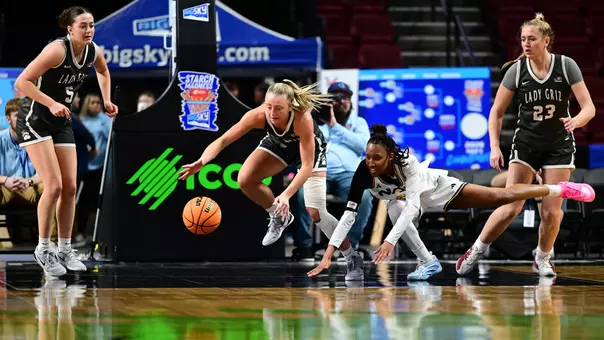
Here is how that's all presented itself: If you've seen the Lady Griz play this year, you've seen Bartsch walk on the court and play not like a true freshman but as someone who belongs, both in skill and mindset.
And yet if you talk to her about it, she says she is surprised that she is getting minutes at all. "I didn't think I'd play much, and that's fine. I'm a freshman. Whatever Brian wants to do, I trust him," she says. "I could play 20 minutes or I can play zero and I'd be happy."
It's all incongruous and seemingly at odds, this contentment to get a DNP on the box score but also taking the minutes she is given, the opportunities, and making the most of them, playing like she believes she should be out there.
It's hard to wrap your head around or even explain it.
"It comes from this: You might be hard-pressed to find a person, certainly any of our kids, that is more competitive or internally driven than Dani," says her dad.
"She's very quiet about it, but she wants to do well and is willing to work hard to do it. The at-odds part might be that she was prepared to be happy with being on the team and contributing, but when she gets in there, she's competitive. That's where the fearlessness comes out."
It's what Holsinger has discovered over the months he's been here, of what he has on his hands in Bartsch, a mixture of all these things: someone who's never only played just basketball, someone who's comfortable in whatever role she's given, but someone who is driven to succeed.
She is just scratching the surface of who she is, both as a person and as a basketball player.
"She has no idea. When she learns, my goodness, she's going to be really good," Holsinger says. "I hope she wants to be great, and I think that she does."
This is Dani Bartsch: There was a day at practice early in the season when the Lady Griz were not very good. Holsinger told them to go over there and get it figured out. It was a test on his part. He wanted to see who stood up, who was willing to have her voice be heard.
It wasn't any of the seniors. Or juniors. Or sophomores. It was Bartsch. She hadn't yet played a minute of college basketball.
"There was no hesitation. She's willing to say things to the team. We need to do this or get better at that," says Holsinger.
"A lot of times freshmen come in and don't know what to say, so they won't say anything at all because they don't want to say the wrong thing. She's just who she is, and there is a lot of power in that. I thought, okay, this kid is unique. She's going to be a leader for this program, no question about it."
For as much as she disliked volleyball in third grade, a decade later the sport is one of the reasons she is getting on the basketball court as a freshman. It's why multisport athletes are so attractive to college coaches, because some skills just transfer over.
Holsinger loves rebounding, knows its impact on winning and losing, and loves players who do it well. And Bartsch does it well, partly because she applies the elements of anticipation, of reading the play one or two steps ahead, like she did on the volleyball court.
She doesn't react to the ball coming off the rim. She reads the play and is on the move while you're standing still, watching and waiting.
In her second career game, against Gonzaga, she grabbed two offensive rebounds. The next game out, at North Dakota, she played 12 minutes and grabbed nine rebounds, five on the offensive end. They led to her scoring nine points, a near double-double in her third career game.
Was that the volleyball player in her? "Probably. Get your feet to the ball. Find it. Brian was a big part of that too. One of his big, big keys is rebounding. That's more my thing, so it's perfect for me."
But where's the glory in that? "I don't want to be a flashy person." She's asked what the opposite of a flashy person is, as it relates to the basketball court. "Dirty work. Doing the dirty work."
"She goes in and is a spark and does what she can do," says assistant coach Jordan Sullivan. "Offensive rebounding is a spark you need off the bench, and you know Dani is going to go in and get some O boards for us and make something happen on that end immediately.
"That's big, that role as a freshman coming off the bench. She needs to continue to grasp that because it is such an important piece for us."
She's got the size at 6-foot-2 and strength to play inside but also the skills that may have her better suited in the future to playing on the wing. She has a smooth stroke from the 3-point line, and if you look at the season stats through the team's 9-2 start, she has twice as many assists as she has turnovers.
She ranks fourth on the team in assists despite playing less than 16 minutes per game. In the extended statistics, averaged out to 40 minutes, she would rank second on the team behind only Sophia Stiles.
And she would rank first in rebounding. Those are two areas that warm a coach's heart.
"Credit to the coaches who recruited her, because she was not an obvious one," says Holsinger, who was hired months after Bartsch signed her national letter of intent. "She was a multi-sport kid who's never really concentrated on basketball but has some unique abilities.
"She has a great feel for the game, she is relentless on the rebounds, and she can really pass. She can really pass. To be able to see the defense, read the defense and make a quick pass on the money, that's a skill that is so unique at her size. She can be as good as she wants to be."
She is roommates with fellow freshman Haley Huard, who has gotten her Lady Griz career off to just as good a start, if not better. She has moved into the starting lineup while giving Montana something it hasn't had in a while: a reliable outside shooter.
Huard is hitting 54.2 percent overall and is 17 for 32 (.531) from the 3-point line.
"Both Haley and Dani are winners. You can just tell they are used to winning," said Holsinger. "They brought that to us."
It's no slight to Huard, who was raised in the Seattle area before moving to Colorado for her final year of high school, but there is something special about having a Montanan in a Lady Griz uniform. All get supported, but when it's local it means something a little different, the connection is a little stronger.
"She is a very good representation of what the Lady Griz are, of who and what we want from the state. She is a talented kid who is sold out for the state. She's the epitome of why we want other Montanans to be here and why it's special," said Holsinger.
It's already halfway through the short Christmas break for the Lady Griz, who played on the 20th and have practice on the evening of the 26th. They typically get only a handful of days off before returning to campus to prepare for their late-December games and the resumption of their season.
Being from Helena helps. She was home on Monday night after the game. She can be there until Sunday afternoon.
But not all the players get to go home. There just isn't enough time for the likes of Lisa Kiefer, who is from Germany, to consider making that long trek.
So she is reliant on the big hearts of her teammates, on someone who would be willing to open their home, make available their family. Once again it was a freshman who spoke first, inviting Kiefer to the Bartsch home for a few days.
She even reached out to Robert and Celine Kiefer to find out what would make the best Christmas experience for their daughter. Who does that?
"I'm having my sisters make some German desserts. The common decoration is angels for Germans. Didn't know that. They open gifts on Christmas Eve. I didn't know that either," says Dani.
While Kevin Bartsch did a phone interview on Wednesday afternoon, he talked while in the other room Kiefer and Paige were putting decorations on the tree.
"That's the kind of stuff that makes you so proud as a coach, because she cares about her teammates that way," says Sullivan. "They are compassionate people who care about others. That's a direct reflection of how she was raised."
How did we get here? In the end it really doesn't matter, just that we are here, blessed as Lady Griz fans with players like Dani Bartsch.
"Dani always lived in Paige's shadow because Dani was always more serious. Paige is more gregarious and loud," says their mom, Anne. "Paige can walk in and just demand the room. So Dani's always kind of been in the background."
Their mom revealed that on Wednesday, two days after Dani spent more than 50 minutes leading a mostly unscripted interview in all sorts of directions, all of it unplugged. Reserved? Hardly.
"I love Christmastime, but it's not my favorite holiday," she said. And what is? "It's second-best behind Fourth of July. We go hard."
It's a three-day crescendo: July 2 at home, as a warmup. July 3 with relatives in Butte. July 4 in Helena at her uncle's place, with fireworks not purchased at a local, temporary pop-up tent on an empty lot but out of state. You know, the good stuff.
It's led to just "minimal injuries" over the years. "Nothing too severe," she says. And you may ask yourself, how did we get here in an interview about basketball? But you let it go because she's on a roll.
Her dad, Kevin, played football at Montana in the 80s, a linebacker, played in the very first game ever held inside Washington-Grizzly Stadium.
Her mom, then Anne Tarleton, played on some of the powerhouse Griz volleyball teams under Dick Scott. Her senior year was 1990, Montana's first trip to the NCAA tournament.
"My mom wasn't that interested (in my dad). Thought he was boring. But he had a car," she says. "I think my dad's pretty awesome personally. He's a good-looking guy!"
Dani was always more serious? Seriously?
"I'd say he's probably up there at 8 or 9," she says of her dad's sense of humor. "Morgan, Paige and my dad have witty personalities. Me, Amanda and my mom, we can't just roll it out."
You forget by this point what the original question even was or how it got to rating her family's ability to make you laugh. But this is good stuff, so you let her go. "He's got some pretty good banter. You're not going to win a fight against him."
May we now get around to introducing Amanda, the oldest of the Bartschs' four daughters. The Montana grad works for PayneWest in Helena. And Morgan, next in line, also a UM grad. She works for PwC, the global PricewaterhouseCoopers in Seattle.
They played sports, but not like Paige, a Gatorade Montana Volleyball Player of the Year who just finished up her first year at Boise State, where she was named the Mountain West Conference Freshman of the Year, and Dani, the Gatorade Montana Girls Basketball Player of the Year.
"They always joke that they donated their athleticism to Paige and me. I appreciate it," Dani says.
The two youngest Bartsch sisters led Capital High to three straight Class AA volleyball state championships, ending their run on a 71-match winning streak that no one can ever end. It's theirs forever.
Their basketball team shared the state title in 2020 (assist: COVID), won it when they were seniors.
Their dad prepped at Helena High, two words Dani can barely get herself to say out loud, like they are taboo. Or worse. She doesn't care for it? "It's just the worst school is all."
Which somehow leads to her telling you it takes seven minutes, 13 seconds to get from the family home to Capital High, "but you can't leave past 7:35. Otherwise you're going to get stuck behind the school bus that stops about five times."
If this is Dani, what would it be like to interview Paige, the more social and loquacious one?
Dani segues back to her dad, who was 6-foot-2, 232 pounds as a senior at Montana. "He's still strong. It's a dad bod."
Then she takes you on another path, about her early disdain for YMCA volleyball. "You didn't even keep score. You didn't serve. You just threw the ball over. And then you got candy after. I was like, this is stupid. This is a waste of my time."
She was in the third grade.
And again, you may ask yourself, how did we get here? How? It's because Dani Bartsch has stepped out of the shadows and into the spotlight for the first time in her life. She's no longer constrained, no longer part 1B to Paige's 1A, or vice versa. She's just Dani. And she seems to like it.
"Dani and Paige are pretty different kids in their whole demeanor. Dani is more reserved. Paige is more outgoing," says Kevin. "The one who's benefitted the most is Dani. She's really blossomed and kind of come into her own."
Maybe it was always there, just hidden from view, waiting for a time like this, an opportunity like this. Whatever happened, the lid has been lifted. And there is probably no going back. Her true nature has finally had a chance to reveal itself.
"It's been awesome. It's been so fun to watch her. She's thriving in Missoula. She loves everything. I think this is the happiest she's ever been," says Anne.
Again, how did we get here? I mean really get here?
It goes deeper than the twins, when two embryos were formed and Anne was told five months in that she was going from two kids to four. "I cried and I laughed," she says.
It goes deeper than Kevin's split chin that wouldn't heal and Anne's bum shoulder that needed constant attention and their meeting in the training room at Montana as they waited to get made whole again.
Dani's story can start with the Talking Heads, the American rock band, which formed in 1975 in New York City, about the time a young Linda Delk interviewed to become the volleyball coach at Northern Colorado.
Or about the time Jeff Mozzochi was playing volleyball at UC Santa Barbara, then Cal, then turning his attention to coaching the sport. His first stop: Portland State.
In February 1981, the Talking Heads released "Once in a Lifetime," which has the money line, "And you may ask yourself, 'Well, how did I get here?' This is how it came to be.
That fall, Delk, then in her sixth year at Northern Colorado, led the Bears to 44 wins and a third-place finish at AIAW nationals in Colorado Springs.
Of course a volleyball player growing up in Littleton, Colo., would have her ears perk up when Delk tapped that player's shoulder and invited her to Greeley. It was still the infancy of women's collegiate athletics, and Delk was at the forefront.
But first Anne Tarleton wanted to make a visit to Alaska-Anchorage.
"(Delk) offered me a full ride, but I was still going to Alaska on a recruiting trip. She told me if I decided I didn't want to go there to call her and she'd drive me my letter of intent," Anne says. That's how badly Delk wanted her.
She visited UAA, discovered a team that didn't get along, that didn't have the right chemistry, returned home and called Delk. She wanted to be a Bear. "She said, 'Okay, I'll put it in the mail.'"
How did we get here? In the amount of time it took an envelope with a letter of intent to go from Greeley to Littleton. How did we get here? In the mind of a high schooler who had been told the coach would personally deliver that piece of paper, then opted to mail it instead.
And if Delk had done as she said and driven to Littleton, would Anne have signed with Northern Colorado, become a Bear and never met Kevin Bartsch? "Oh yeah, totally. Funny how things work out."
The envelope arrived, the letter of intent inside just waiting to be inked. And it sat there for a day, then two. She's still not sure why she didn't sign it. But she didn't, and then Dick Scott called.
He was calling Anne Tarleton because Kari Kockler had told him no. The Helena High grad, who was one year behind Kevin Bartsch, was wooed by Mozzochi, who led Portland State to Division II national championships in 1984 and '85, and how could a girl turn that down?
The middle blocker who would be voted all-America as a junior and senior would help Mozzochi win his third national championship as a junior in 1988.
And you may ask yourself, well, how did we get here? Just like that: Delk mailed the letter of intent instead of hand-delivering it, and Kockler picked Portland State over Montana. And here we are.
Tarleton visited and it was done. "I loved the team and I loved Missoula. It worked out for all of us," she said.
"We've seen Kari a number of times. She's a physical therapist here in (Helena)," says Kevin. "Her decision to decline Montana's offer really impacted my life and our lives so deeply."
Letting the days go by, water flowing underground
Kevin Bartsch arrived in Missoula as a freshman in the fall of 1985, or what would be the final year for Larry Donovan as head football coach of the Grizzlies.
Then one day in walked his new coach: Don Read. And most of the Grizzlies had never experienced such a force of nature.
"He was so enthusiastic and had so much energy. He changed the whole culture," says Bartsch. "The attitude and expectations changed, just his whole approach to practice and to games was quite a bit different. He was a fun coach to play for."
He learned it firsthand, living as he did across the street from Read. His new coach would be out working on his lawn, "which was impeccable," when it turned dark and be out there when the sun rose, tending to it like he did his team, with great care, love and attention. "I think he slept about two hours a day."
Five games into his sophomore season, in 1986, Bartsch and his teammates ran into Washington-Grizzly Stadium for a game for the first time, a program-changing upgrade from the off-campus Dornblaser Field.
They knew it was a big deal at the time but had no idea that it would be monumental or what would become of it down the road, from the championships to the additions that now have the potential seating north of 26,000.
"The guys from Seattle and California, they would look at (Dornblaser) and say my high school stadium was better than this," Bartsch says.
"Everybody recognized the importance of bringing football on campus, but I don't think anybody at the time had any sense that it was going to blossom into what it has become. It sure is fun to look back and see how it's grown over the course of time."
Montana would go 6-4, then 6-5 in Read's first two years, then break through and make the I-AA playoffs in 1988, Bartsch's senior year.
What the football team was becoming was what the volleyball program already was: relevant on the national stage.
That was the golden age for the Grizzlies. Montana wouldn't finish lower than third in its conference for a full decade, between 1985 and 1994, and make three trips to the NCAA tournament.
Tarleton redshirted as a freshman in 1986, was honorable mention All-Big Sky as a third-year sophomore in 1988 and suffered a shoulder injury in 1989 that would require offseason arthroscopic surgery.
The rehabilitation required frequent trips to the training room, which is where Bartsch kept going after a split chin wouldn't stay shut. "We started dating a little bit and one thing led to another, and here we are, 29 years in marriage, 33 together overall," says Kevin.
He returned to Helena and started working for the Montana State Fund as a claims manager. She, an elementary education major, moved to Helena to student teach and got on full time in the district, taking early retirement after the 2019-20 school year, after three decades.
Under the rocks and stones, there is water underground
Amanda arrived, then Morgan. And it's not what most people may have anticipated, the offspring of two successful Division I athletes.
Both girls played sports but …
"Morgan has not one competitive bone in her body. She didn't have that drive that Paige and Dani have always had," says Anne. "And Amanda, she played sports and liked it but it was never a huge thing she wanted to do."
And then arrived the twins. And things have never been the same.
"I don't know that we were thinking we'd have that many kids, but it's certainly been a blessing in our lives. I wouldn't have it any other way," says Kevin.
Of course, he says that now. Back then, when he came home that day and was asked by his wife to walk into their bedroom, while she followed with a camera and Amanda and Morgan raced around, barely able to keep themselves from blurting out the news, you can forgive him for his reaction.
They had made little signs and laid out little onesies telling dad the big news: twins! "It was total deer in the headlights," says Anne of her husband. Today? "The four girls part doesn't bother me a bit," he says. "I'm not sure it wasn't better for me."
They did with Dani and Paige what they did with the older girls: give them a shot at everything and see what worked and what didn't, what held their interest and what could go in the Don't Ever Try That Again! file.
For Paige, volleyball was love at first kill. For Dani, the sport was more on and off again. Mostly off, at least at the start.
"Dani always had to be on the move. The volleyball we did at the Y was, you'd catch and you'd toss to the setter. The setter would catch it and toss it and the hitter tried to hit it," says Anne. "That was volleyball, and it was so boring for her. It didn't surprise me at all that she didn't like it."
Basketball? "They let me dribble at least," says Dani, who finally fell for volleyball in seventh grade, when, you know, they keep score and there are winners and losers. But basketball was always there.
All she needed was herself, a ball and a hoop somewhere. It's one of the few team sports you can go about solo and get what you need, even if no one else is around.
"For it to be a job, which college sports is, you have to enjoy doing what it is, and I could always work out a lot easier for basketball," she says.
"For volleyball, you can't really go to the gym by yourself, but basketball is constant shooting. I like the grind a lot more for basketball than I did for volleyball."
Paige found her outlet in volleyball. "She always had a better work ethic for volleyball than I did. When I was in the gym, I'd give it my best effort, but she'd put tape at the level of the net on our garage door, then she'd go out and just hit."
Paige was the first one to get recruited. She was a freshman – a freshman! – when one Mountain West school put her on the clock – as a freshman! The clock was ticking, time to make a decision.
"That felt wrong," says Anne. "That was one of the reasons Paige really liked (Boise State coach Shawn Garus, who has a son and a daughter). When she talked to him, she was very calm with him.
"He talked to us and said, 'I want to offer her a full ride when you're ready for us to offer her a full ride. He said, 'I wouldn't want my daughter making this decision right now,' which we so appreciated."
Dani had an offer to play volleyball at Montana State, though not on scholarship. Instead she committed to play basketball at Montana during the most tumultuous period in a program that had never before done tumultuous.
She committed to play for Shannon Schweyen as a junior. Not long after she committed, Schweyen, who is a family friend, was let go, replaced on an interim basis by Mike Petrino.
"It happens. It's college basketball," says Bartsch, ever pragmatic. "That's kind of the life of the game."
She was comfortable with her decision, because she was going to go to school at Montana no matter what. She had even considered not playing sports at all.
There is another life out there, of the nonathlete, someone who has the flexibility and freedom to get a job, to gain some experience.
"I wanted to be able to have a first job. I've never had a job in my life," says the accounting major. "I wanted to fill out an actual W-4 form. I'm going into accounting, so I feel like I should know those things.
"Basketball was going to end at some point. Do I just end it now and move on?" We can all be thankful she stuck with it and opted in.
She didn't need to be re-recruited by new Lady Griz coach Brian Holsinger, who reached out last April, not long after he'd been hired. It's just a bonus that he said all the right things, hit her heart in all the right spots.
"My first thought was, I love it. It was a very good first impression. I was going to like him," says Bartsch, who says quarantine, when the entire Bartsch gang, all six of them, was stuck together under one roof for weeks on end was about as good as it gets. "That was my stuff. I loved that."
Yeah, she's into family, just like her new coach, whether that be the team or immediate.
"He said he was very family-oriented, and I like that in a coach. It's good to understand we have families outside of basketball. That's an important part of it," she says.
What Holsinger got when Bartsch arrived on campus last June for summer workouts was a combination of some remarkable traits.
She liked basketball but didn't need it, which brings with it a particular freedom. The sport didn't define her after all.
And she had a healthy perspective on what to expect, as a college athlete, as a freshman, lessons coming from both her parents and a family friend who had thrown javelin at North Dakota State. High school sports were an activity. This would be different.
She had grown up being one of the best at everything she tried. State titles across multiple sports. Winning streaks. Now she was joining a team that had 12 others just like her. And she'd be going up against teams made up of even more players just like her.
She went from being the big fish to a minnow just like that.
"Dani was prepared for that," says Kevin. "We talked a lot about the difficulty in that shift of going from being a pretty dominant player on about every team you've ever been on to all of a sudden there is a challenging shift.
"Now you've got an entire team and an entire team you're opposing who were all the best players on their teams, so now you're another one in a mix of really good players."
Here is how that's all presented itself: If you've seen the Lady Griz play this year, you've seen Bartsch walk on the court and play not like a true freshman but as someone who belongs, both in skill and mindset.
And yet if you talk to her about it, she says she is surprised that she is getting minutes at all. "I didn't think I'd play much, and that's fine. I'm a freshman. Whatever Brian wants to do, I trust him," she says. "I could play 20 minutes or I can play zero and I'd be happy."
It's all incongruous and seemingly at odds, this contentment to get a DNP on the box score but also taking the minutes she is given, the opportunities, and making the most of them, playing like she believes she should be out there.
It's hard to wrap your head around or even explain it.
"It comes from this: You might be hard-pressed to find a person, certainly any of our kids, that is more competitive or internally driven than Dani," says her dad.
"She's very quiet about it, but she wants to do well and is willing to work hard to do it. The at-odds part might be that she was prepared to be happy with being on the team and contributing, but when she gets in there, she's competitive. That's where the fearlessness comes out."
It's what Holsinger has discovered over the months he's been here, of what he has on his hands in Bartsch, a mixture of all these things: someone who's never only played just basketball, someone who's comfortable in whatever role she's given, but someone who is driven to succeed.
She is just scratching the surface of who she is, both as a person and as a basketball player.
"She has no idea. When she learns, my goodness, she's going to be really good," Holsinger says. "I hope she wants to be great, and I think that she does."
This is Dani Bartsch: There was a day at practice early in the season when the Lady Griz were not very good. Holsinger told them to go over there and get it figured out. It was a test on his part. He wanted to see who stood up, who was willing to have her voice be heard.
It wasn't any of the seniors. Or juniors. Or sophomores. It was Bartsch. She hadn't yet played a minute of college basketball.
"There was no hesitation. She's willing to say things to the team. We need to do this or get better at that," says Holsinger.
"A lot of times freshmen come in and don't know what to say, so they won't say anything at all because they don't want to say the wrong thing. She's just who she is, and there is a lot of power in that. I thought, okay, this kid is unique. She's going to be a leader for this program, no question about it."
For as much as she disliked volleyball in third grade, a decade later the sport is one of the reasons she is getting on the basketball court as a freshman. It's why multisport athletes are so attractive to college coaches, because some skills just transfer over.
Holsinger loves rebounding, knows its impact on winning and losing, and loves players who do it well. And Bartsch does it well, partly because she applies the elements of anticipation, of reading the play one or two steps ahead, like she did on the volleyball court.
She doesn't react to the ball coming off the rim. She reads the play and is on the move while you're standing still, watching and waiting.
In her second career game, against Gonzaga, she grabbed two offensive rebounds. The next game out, at North Dakota, she played 12 minutes and grabbed nine rebounds, five on the offensive end. They led to her scoring nine points, a near double-double in her third career game.
Was that the volleyball player in her? "Probably. Get your feet to the ball. Find it. Brian was a big part of that too. One of his big, big keys is rebounding. That's more my thing, so it's perfect for me."
But where's the glory in that? "I don't want to be a flashy person." She's asked what the opposite of a flashy person is, as it relates to the basketball court. "Dirty work. Doing the dirty work."
"She goes in and is a spark and does what she can do," says assistant coach Jordan Sullivan. "Offensive rebounding is a spark you need off the bench, and you know Dani is going to go in and get some O boards for us and make something happen on that end immediately.
"That's big, that role as a freshman coming off the bench. She needs to continue to grasp that because it is such an important piece for us."
She's got the size at 6-foot-2 and strength to play inside but also the skills that may have her better suited in the future to playing on the wing. She has a smooth stroke from the 3-point line, and if you look at the season stats through the team's 9-2 start, she has twice as many assists as she has turnovers.
She ranks fourth on the team in assists despite playing less than 16 minutes per game. In the extended statistics, averaged out to 40 minutes, she would rank second on the team behind only Sophia Stiles.
And she would rank first in rebounding. Those are two areas that warm a coach's heart.
"Credit to the coaches who recruited her, because she was not an obvious one," says Holsinger, who was hired months after Bartsch signed her national letter of intent. "She was a multi-sport kid who's never really concentrated on basketball but has some unique abilities.
"She has a great feel for the game, she is relentless on the rebounds, and she can really pass. She can really pass. To be able to see the defense, read the defense and make a quick pass on the money, that's a skill that is so unique at her size. She can be as good as she wants to be."
She is roommates with fellow freshman Haley Huard, who has gotten her Lady Griz career off to just as good a start, if not better. She has moved into the starting lineup while giving Montana something it hasn't had in a while: a reliable outside shooter.
Huard is hitting 54.2 percent overall and is 17 for 32 (.531) from the 3-point line.
"Both Haley and Dani are winners. You can just tell they are used to winning," said Holsinger. "They brought that to us."
It's no slight to Huard, who was raised in the Seattle area before moving to Colorado for her final year of high school, but there is something special about having a Montanan in a Lady Griz uniform. All get supported, but when it's local it means something a little different, the connection is a little stronger.
"She is a very good representation of what the Lady Griz are, of who and what we want from the state. She is a talented kid who is sold out for the state. She's the epitome of why we want other Montanans to be here and why it's special," said Holsinger.
It's already halfway through the short Christmas break for the Lady Griz, who played on the 20th and have practice on the evening of the 26th. They typically get only a handful of days off before returning to campus to prepare for their late-December games and the resumption of their season.
Being from Helena helps. She was home on Monday night after the game. She can be there until Sunday afternoon.
But not all the players get to go home. There just isn't enough time for the likes of Lisa Kiefer, who is from Germany, to consider making that long trek.
So she is reliant on the big hearts of her teammates, on someone who would be willing to open their home, make available their family. Once again it was a freshman who spoke first, inviting Kiefer to the Bartsch home for a few days.
She even reached out to Robert and Celine Kiefer to find out what would make the best Christmas experience for their daughter. Who does that?
"I'm having my sisters make some German desserts. The common decoration is angels for Germans. Didn't know that. They open gifts on Christmas Eve. I didn't know that either," says Dani.
While Kevin Bartsch did a phone interview on Wednesday afternoon, he talked while in the other room Kiefer and Paige were putting decorations on the tree.
"That's the kind of stuff that makes you so proud as a coach, because she cares about her teammates that way," says Sullivan. "They are compassionate people who care about others. That's a direct reflection of how she was raised."
How did we get here? In the end it really doesn't matter, just that we are here, blessed as Lady Griz fans with players like Dani Bartsch.
Players Mentioned

F
/ Women's Basketball
G
/ Women's Basketball
F
/ Women's Basketball
G
/ Women's BasketballLady Griz Basketball Locker Room Unveiling - 5/1/26
Friday, May 01
Griz Track & Field - Montana Open Highlights - 4/25/26
Friday, May 01
Griz Softball vs. Idaho State Game-Winning Hit - 3/25/26
Friday, May 01
Griz Softball Championship Series Promo
Friday, May 01