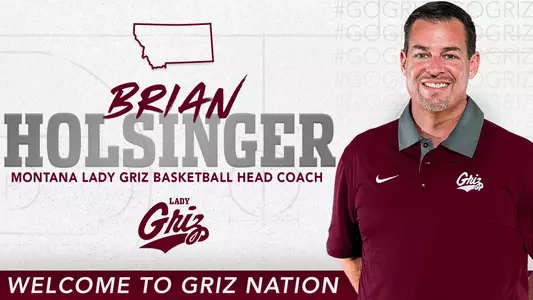
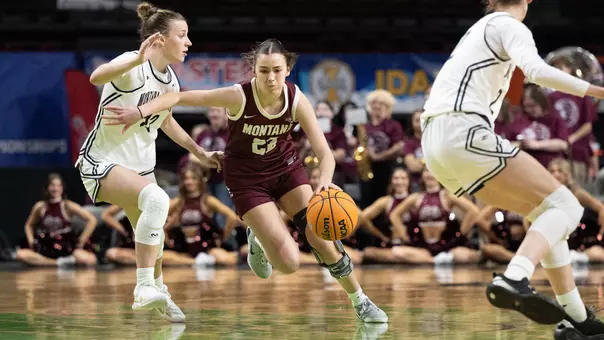
Photo by: Karl Maasdam
Brian Holsinger was born for this
4/14/2021 5:58:00 AM | Women's Basketball
He just didn't know it at the time. He didn't know about the ashes that would be scattered atop the waters of the mountain lake. How Butte would win him over. How coaching would do the same thing.
He didn't know any of it. What he did know was that he had the MCATs to prepare for. Medical schools to look into.
"I'm a science nerd," says the new coach of the Lady Griz, a 1999 graduate of Western Washington with dual degrees in biology and chemistry. "Not your typical coaching pedigree."
He played college basketball for one season, at Division III Pacific University in Forest Grove, Ore. Before that he went on a basketball-playing tour of Europe. Now the coach from that trip was reaching out.
He was at The Master's College, a school with NAIA athletics in Santa Clarita, Calif., up the San Fernando Valley from downtown Los Angeles. And he thought Holsinger would be a great coach.
And did Holsinger want to move to Southern California and become his assistant? Sure, why not? "I thought, huh, maybe I'll go check this out. I went down there with the expectation I'd try it for a year," he says.
That was more than two decades of coaching ago.
It's been a career centered around basketball, but if you think it's all about the sport, about winning and losing, you don't know Brian Holsinger. That's just the vehicle, the incubator that takes in a freshman and four or five years later pops out a strong, confident, young woman ready to take on the world.
For as embattled as the model is, he still believes in it.
"I'm all about young people, shaping and helping young people. I want to impact people, and the game of basketball gives me a great platform to do that," he says.
"It's a tool to teach young women through their successes and adversity. You learn through both, how to grow and change and develop into great young people. I'm a people person, a relationship-driven person, so it was the perfect thing for me."
They would coach the Mustangs to 132 wins, turn them into a top-10 program, take them to four NAIA national tournaments.
In his down time, he convinced Stacey, now his wife, to leave the soccer program at Gonzaga, in her hometown of Spokane, and finish her career at the school where he was coaching. He had learned his on-the-job lessons well.
"I was the best recruiter ever for the women's soccer program at Master's because she ended up being an all-American there. She was a big-time player," he says.
Of all the places they thought coaching might take the family, Butte didn't make the list. But his dad, who had been born in Lewistown, called. Told him about an opening at Montana Tech. He knew what the state meant to the family, even if his son hadn't realized it yet.
He looked into it, saw the Orediggers had gone 6-24 the season before. He wasn't impressed.
But he was still the grandson of Irving Holsinger, who ran track and played basketball at Rocky Mountain, then spent 23 years of his life coaching and teaching in the state, the smaller the place the better.
Absarokee. White Sulphur Springs. Box Elder. The type of places only those familiar with the backroads of Montana would know about.
He accepted the job. Butte, America. It was like it was beckoning him to come home, where home had never been.
"We felt like we were called to go there. I've coached all over the West Coast, in almost every state now, and it's as unique a place as any place I've ever been," he says. "The Butte people are fantastic."
He went 6-23 his first year as a head coach. The next season, a 10-game flip, to 16-13. The Orediggers hit New Year's Day that season with a record of 12-2. On Jan. 3: a national ranking. No. 25.
Up the interstate that winter, in Missoula, a guy named Selvig was upstaging him. He had a team that would go 27-2 through the regular season. Lost one at Weber State, the other at Ohio State. Everything else: W.
"It's the first time I got to know Lady Griz basketball and what it meant to the state," he says.
Didn't matter what he did in recruiting or how hard he went after someone. If Selvig tapped you, if he wanted you, the book was closed.
"If the Lady Griz called, if Robin called, it was a done deal. It didn't matter who else you were talking to. You were going to the University of Montana," he says.
That spring June Daugherty was let go at Washington. Her coaching sin: going 191-139 and taking the Huskies to the NCAA tournament six times in 11 years.
It wasn't good enough for the AD. He wanted more. What he got: three NCAA tournaments over the next 14 seasons.
Washington's loss was Washington State's gain. Thirty days after being let go by the Huskies, Daugherty was scooped up by the Cougars. Holsinger joined her staff.
One month into his first season as a first-time Division I assistant, Washington State visited Missoula. He says that doesn't ring a bell. It sounds like he's being truthful. We'll believe him.
Maybe his mind has erased all memories. Even with Mandy Morales sidelined, the Lady Griz shot 48.1 percent, held WSU to 31.8 percent shooting and sent the Cougars home with a 74-54 loss.
The game was played on a Tuesday night in mid-December. It drew more than 3,100 fans. He may not remember it but it would have been like nothing he'd seen, something special, something magical, a symbiotic relationship between fans and program, tethered together in the deal, both benefitting.
They returned to Pullman. Got to work. But these things take time, measured in years when you start near the bottom.
The young, energetic recruiting coordinator began to learn what worked, what didn't. He started getting players to Pullman that could change the narrative.
By 2013-14, Washington State was a borderline NCAA tournament team. Unheard of. But the Cougars were not chosen. The next best thing: the WNIT, the program's first postseason appearance since 1991.
They put in a bid to host, listing their average home attendance of 1,046 that season. Montana put in a bid to host, averaging nearly three times as much. The WNIT followed the money.
Washington State was sent to Montana, which had lost at North Dakota in the Big Sky tournament championship game the weekend before and had lost point guard Torry Hill, the team leader in assists, the second-leading scorer, in the process to a knee injury.
Selvig had two days to prepare, to figure things out, to patch things up and try to make it whole. Holsinger, Washington State's de facto defensive coordinator, put together his own plan.
Maggie Rickman hit a 3-pointer on Montana's first possession, Kellie Cole on the team's second and it was over. The Lady Griz never trailed. Selvig's shorthanded gang put up 90 in a 12-point win, the team's second-highest output the entire season.
That game? That one Holsinger remembers.
"I remember coming here. It was an intimidating, tough place. Then you go against a Robin-coached team that was disciplined, played together and was tough," he says. "It helped me realize how special of a place this is."
Selvig would have been in postseason form that night. On his feet from the first possession, living and dying, at least looking like it, on each possession, each call, each errant pass.
Some people didn't get it. They saw what they saw and judged Selvig on it. How could you ever play for a guy like that, they'd ask the players.
Holsinger got it. He knew that Selvig had unlocked the secret over the years. When he yelled at his players, they didn't cower in fear. It emboldened them. He earned that over time, by caring every other minute of their lives.
"When players know you have their back, it allows you to coach them really hard and hold them accountable," Holsinger says. "That's the biggest challenge in coaching, the key to coaching, and he did that masterfully."
A reward for his breakthrough: After seven seasons at Washington State, with elevated returns, Holsinger was promoted to associate head coach at a Power 5 school. He was on an upward trajectory, a rising star.
The Cougars returned to the WNIT the next season, won 17 games, seven in the Pac-12.
Then the shocker: He pulled the plug. He embodied the Dave Barry quote, You should never confuse your career with your life. One was overwhelming the other. He would make the uncommon choice.
He and Stacey had had three kids in four years. "It was craziness," he says. Coaching colleagues asked him the same thing for getting out: Are you nuts? The profession was like a carousel. Once you give up your spot and step away, there are no guarantees you'll get to rejoin the ride.
They moved to Boise, nearer to his family. His one season away was Selvig's final year as coach of the Lady Griz. He needed to step away from the all-consuming craziness. He, too, had his family in mind. He wanted more of it, more of them.
But Holsinger wasn't done. With his home life settling down, he listened when Northwest Nazarene, nearby in Nampa, Idaho, called. He accepted their offer in the spring of 2016, with one condition. There were a handful of other schools, that if they called, he was dropping everything and leaving.
One was Oregon State, which that spring had gone to the Final Four under Scott Rueck, a longtime friend of Holsinger's. He had turned Rueck down before. Four months into the job at Northwest Nazarene, Rueck tried him again.
"He said, 'Are you coming this time or what? What's the deal?'" This time Holsinger couldn't refuse.
He had tried to get Katie Baker, the former Lady Griz standout, to join his coaching staff at Northwest Nazarene. When he got to Oregon State, he dropped her name to Rueck.
Her resume didn't scream: DIVISION I ASSISTANT, but Holsinger knew the person, from when he was recruiting her out of Coeur d'Alene for Washington State. (Another one lost to Selvig.) And he'll always bet on people he believes in.
"She's as talented a coach as there is at that age," he says of the now Katie Faulkner. "Her future in coaching is unbelievable. It was an honor to coach with her."
Before there was ever a job opening at Montana, Holsinger was immersed in all things Grizzly. That's what happens when Wayne Tinkle is the men's coach at your school, his wife the former Lisa McLeod, one of the greatest Lady Griz ever.
And Faulkner wore it on her sleeve. She'll carry what she learned over four years from Selvig for life. It's what she brought into coaching. It's why her own future is limitless. She's embodied the lessons, made them her own, uses them for the betterment of the Beavers.
"She's given me the vision of what Robin did more than anybody," says Holsinger. "It still means a ton to her. It's her program and she's passionate about it.
"How it impacted her is exactly what I want to do for the young women who are there now and will be there in the future."
If he stuck to his word, Holsinger called Selvig on Tuesday, not long after it was announced that he was the new Lady Griz head coach. "I have the utmost respect for him and who he is and what he's done. Any advice I can get from him will be welcomed."
What his teams look like on the court remains to be seen. But Holsinger already has a lot of Selvig in him. Selvig was wooed time and time again. The money and brighter lights were no match for love of place.
He was connected, to the university, to the state. He wanted to raise his boys here. He never was able to figure out how to put a price tag on the ability to leave his driveway and be on a mountain bike trail in less than five minutes, disconnected from the world. Those things mattered.
He truly had the best of both worlds, living how he wanted to live while creating a dynasty, an easy drive down the Rattlesnake Valley from his house. Now Holsinger steps in to try to regain the magic.
"If it doesn't scare you a little bit, you're not human," he says. "But I think that's a good thing. It's healthy. It drives you. It makes you want to do great things. And I've never been afraid of a challenge. The expectations are high, and I wouldn't want it any other way.
"I'm thrilled. It's a huge honor. I think my journey in coaching has prepared me uniquely. I understand the position. I understand the state. I've had experiences at the highest level. I feel like all of it has prepared me to carry on the tradition of the Lady Griz."
The knee-jerk reaction when you read that an associate head coach from a Power 5 is dropping down to a mid-major for a head job is that the clock has started, that the coach is using it as experience to get back in the game, the big-time one, the one with the bright lights that Selvig had no need for.
Holsinger understands. He would never make any promises, but he does want to reassure you.
"This is a position I'd like to be in for a long time," he says. "I'm not looking to use this as a stepping stone. That's not my goal at all. I've had opportunities to leave the Northwest many times, and I just don't want to do it. Family is too important to me."
He doesn't mean just his immediate family, though Stacey came with him on his on-campus interview last week. "We do this together. She'll be every bit a part of what we're doing," he says.
He means her family, which is mostly still in Spokane. He means his dad, the one who got him to look at Montana Tech, who teared up on Monday when his son told him he'd been offered the Lady Griz job.
"It means a lot to him. He said my grandfather would be so proud."
Of the 23 years Irving Holsinger spent teaching and coaching in Montana, 16 were lived in Moore, a 20-minute drive from Lewistown. Summers were for working for the U.S. Forest Service as fireguards at Crystal Lake, a spot of such perfection and beauty in the Snowy Mountains it will take your breath away.
They would eventually leave Montana for a job in Washington, then retire in Spokane. Irving died in 2000. Gwendolyn, his wife, passed away in 2017.
Their ashes were scattered across the waters of Crystal Lake. Home had always been calling. Now their grandson, the new coach of the Lady Griz, has it as well, something that can't be shaken. "Once Montana is part of you, it's always part of you."
And isn't that who you'd want leading your favorite women's basketball program?
He didn't know any of it. What he did know was that he had the MCATs to prepare for. Medical schools to look into.
"I'm a science nerd," says the new coach of the Lady Griz, a 1999 graduate of Western Washington with dual degrees in biology and chemistry. "Not your typical coaching pedigree."
He played college basketball for one season, at Division III Pacific University in Forest Grove, Ore. Before that he went on a basketball-playing tour of Europe. Now the coach from that trip was reaching out.
He was at The Master's College, a school with NAIA athletics in Santa Clarita, Calif., up the San Fernando Valley from downtown Los Angeles. And he thought Holsinger would be a great coach.
And did Holsinger want to move to Southern California and become his assistant? Sure, why not? "I thought, huh, maybe I'll go check this out. I went down there with the expectation I'd try it for a year," he says.
That was more than two decades of coaching ago.
It's been a career centered around basketball, but if you think it's all about the sport, about winning and losing, you don't know Brian Holsinger. That's just the vehicle, the incubator that takes in a freshman and four or five years later pops out a strong, confident, young woman ready to take on the world.
For as embattled as the model is, he still believes in it.
"I'm all about young people, shaping and helping young people. I want to impact people, and the game of basketball gives me a great platform to do that," he says.
"It's a tool to teach young women through their successes and adversity. You learn through both, how to grow and change and develop into great young people. I'm a people person, a relationship-driven person, so it was the perfect thing for me."
They would coach the Mustangs to 132 wins, turn them into a top-10 program, take them to four NAIA national tournaments.
In his down time, he convinced Stacey, now his wife, to leave the soccer program at Gonzaga, in her hometown of Spokane, and finish her career at the school where he was coaching. He had learned his on-the-job lessons well.
"I was the best recruiter ever for the women's soccer program at Master's because she ended up being an all-American there. She was a big-time player," he says.
Of all the places they thought coaching might take the family, Butte didn't make the list. But his dad, who had been born in Lewistown, called. Told him about an opening at Montana Tech. He knew what the state meant to the family, even if his son hadn't realized it yet.
He looked into it, saw the Orediggers had gone 6-24 the season before. He wasn't impressed.
But he was still the grandson of Irving Holsinger, who ran track and played basketball at Rocky Mountain, then spent 23 years of his life coaching and teaching in the state, the smaller the place the better.
Absarokee. White Sulphur Springs. Box Elder. The type of places only those familiar with the backroads of Montana would know about.
He accepted the job. Butte, America. It was like it was beckoning him to come home, where home had never been.
"We felt like we were called to go there. I've coached all over the West Coast, in almost every state now, and it's as unique a place as any place I've ever been," he says. "The Butte people are fantastic."
He went 6-23 his first year as a head coach. The next season, a 10-game flip, to 16-13. The Orediggers hit New Year's Day that season with a record of 12-2. On Jan. 3: a national ranking. No. 25.
Up the interstate that winter, in Missoula, a guy named Selvig was upstaging him. He had a team that would go 27-2 through the regular season. Lost one at Weber State, the other at Ohio State. Everything else: W.
"It's the first time I got to know Lady Griz basketball and what it meant to the state," he says.
Didn't matter what he did in recruiting or how hard he went after someone. If Selvig tapped you, if he wanted you, the book was closed.
"If the Lady Griz called, if Robin called, it was a done deal. It didn't matter who else you were talking to. You were going to the University of Montana," he says.
That spring June Daugherty was let go at Washington. Her coaching sin: going 191-139 and taking the Huskies to the NCAA tournament six times in 11 years.
It wasn't good enough for the AD. He wanted more. What he got: three NCAA tournaments over the next 14 seasons.
Washington's loss was Washington State's gain. Thirty days after being let go by the Huskies, Daugherty was scooped up by the Cougars. Holsinger joined her staff.
One month into his first season as a first-time Division I assistant, Washington State visited Missoula. He says that doesn't ring a bell. It sounds like he's being truthful. We'll believe him.
Maybe his mind has erased all memories. Even with Mandy Morales sidelined, the Lady Griz shot 48.1 percent, held WSU to 31.8 percent shooting and sent the Cougars home with a 74-54 loss.
The game was played on a Tuesday night in mid-December. It drew more than 3,100 fans. He may not remember it but it would have been like nothing he'd seen, something special, something magical, a symbiotic relationship between fans and program, tethered together in the deal, both benefitting.
They returned to Pullman. Got to work. But these things take time, measured in years when you start near the bottom.
The young, energetic recruiting coordinator began to learn what worked, what didn't. He started getting players to Pullman that could change the narrative.
By 2013-14, Washington State was a borderline NCAA tournament team. Unheard of. But the Cougars were not chosen. The next best thing: the WNIT, the program's first postseason appearance since 1991.
They put in a bid to host, listing their average home attendance of 1,046 that season. Montana put in a bid to host, averaging nearly three times as much. The WNIT followed the money.
Washington State was sent to Montana, which had lost at North Dakota in the Big Sky tournament championship game the weekend before and had lost point guard Torry Hill, the team leader in assists, the second-leading scorer, in the process to a knee injury.
Selvig had two days to prepare, to figure things out, to patch things up and try to make it whole. Holsinger, Washington State's de facto defensive coordinator, put together his own plan.
Maggie Rickman hit a 3-pointer on Montana's first possession, Kellie Cole on the team's second and it was over. The Lady Griz never trailed. Selvig's shorthanded gang put up 90 in a 12-point win, the team's second-highest output the entire season.
That game? That one Holsinger remembers.
"I remember coming here. It was an intimidating, tough place. Then you go against a Robin-coached team that was disciplined, played together and was tough," he says. "It helped me realize how special of a place this is."
Selvig would have been in postseason form that night. On his feet from the first possession, living and dying, at least looking like it, on each possession, each call, each errant pass.
Some people didn't get it. They saw what they saw and judged Selvig on it. How could you ever play for a guy like that, they'd ask the players.
Holsinger got it. He knew that Selvig had unlocked the secret over the years. When he yelled at his players, they didn't cower in fear. It emboldened them. He earned that over time, by caring every other minute of their lives.
"When players know you have their back, it allows you to coach them really hard and hold them accountable," Holsinger says. "That's the biggest challenge in coaching, the key to coaching, and he did that masterfully."
A reward for his breakthrough: After seven seasons at Washington State, with elevated returns, Holsinger was promoted to associate head coach at a Power 5 school. He was on an upward trajectory, a rising star.
The Cougars returned to the WNIT the next season, won 17 games, seven in the Pac-12.
Then the shocker: He pulled the plug. He embodied the Dave Barry quote, You should never confuse your career with your life. One was overwhelming the other. He would make the uncommon choice.
He and Stacey had had three kids in four years. "It was craziness," he says. Coaching colleagues asked him the same thing for getting out: Are you nuts? The profession was like a carousel. Once you give up your spot and step away, there are no guarantees you'll get to rejoin the ride.
They moved to Boise, nearer to his family. His one season away was Selvig's final year as coach of the Lady Griz. He needed to step away from the all-consuming craziness. He, too, had his family in mind. He wanted more of it, more of them.
But Holsinger wasn't done. With his home life settling down, he listened when Northwest Nazarene, nearby in Nampa, Idaho, called. He accepted their offer in the spring of 2016, with one condition. There were a handful of other schools, that if they called, he was dropping everything and leaving.
One was Oregon State, which that spring had gone to the Final Four under Scott Rueck, a longtime friend of Holsinger's. He had turned Rueck down before. Four months into the job at Northwest Nazarene, Rueck tried him again.
"He said, 'Are you coming this time or what? What's the deal?'" This time Holsinger couldn't refuse.
He had tried to get Katie Baker, the former Lady Griz standout, to join his coaching staff at Northwest Nazarene. When he got to Oregon State, he dropped her name to Rueck.
Her resume didn't scream: DIVISION I ASSISTANT, but Holsinger knew the person, from when he was recruiting her out of Coeur d'Alene for Washington State. (Another one lost to Selvig.) And he'll always bet on people he believes in.
"She's as talented a coach as there is at that age," he says of the now Katie Faulkner. "Her future in coaching is unbelievable. It was an honor to coach with her."
Before there was ever a job opening at Montana, Holsinger was immersed in all things Grizzly. That's what happens when Wayne Tinkle is the men's coach at your school, his wife the former Lisa McLeod, one of the greatest Lady Griz ever.
And Faulkner wore it on her sleeve. She'll carry what she learned over four years from Selvig for life. It's what she brought into coaching. It's why her own future is limitless. She's embodied the lessons, made them her own, uses them for the betterment of the Beavers.
"She's given me the vision of what Robin did more than anybody," says Holsinger. "It still means a ton to her. It's her program and she's passionate about it.
"How it impacted her is exactly what I want to do for the young women who are there now and will be there in the future."
If he stuck to his word, Holsinger called Selvig on Tuesday, not long after it was announced that he was the new Lady Griz head coach. "I have the utmost respect for him and who he is and what he's done. Any advice I can get from him will be welcomed."
What his teams look like on the court remains to be seen. But Holsinger already has a lot of Selvig in him. Selvig was wooed time and time again. The money and brighter lights were no match for love of place.
He was connected, to the university, to the state. He wanted to raise his boys here. He never was able to figure out how to put a price tag on the ability to leave his driveway and be on a mountain bike trail in less than five minutes, disconnected from the world. Those things mattered.
He truly had the best of both worlds, living how he wanted to live while creating a dynasty, an easy drive down the Rattlesnake Valley from his house. Now Holsinger steps in to try to regain the magic.
"If it doesn't scare you a little bit, you're not human," he says. "But I think that's a good thing. It's healthy. It drives you. It makes you want to do great things. And I've never been afraid of a challenge. The expectations are high, and I wouldn't want it any other way.
"I'm thrilled. It's a huge honor. I think my journey in coaching has prepared me uniquely. I understand the position. I understand the state. I've had experiences at the highest level. I feel like all of it has prepared me to carry on the tradition of the Lady Griz."
The knee-jerk reaction when you read that an associate head coach from a Power 5 is dropping down to a mid-major for a head job is that the clock has started, that the coach is using it as experience to get back in the game, the big-time one, the one with the bright lights that Selvig had no need for.
Holsinger understands. He would never make any promises, but he does want to reassure you.
"This is a position I'd like to be in for a long time," he says. "I'm not looking to use this as a stepping stone. That's not my goal at all. I've had opportunities to leave the Northwest many times, and I just don't want to do it. Family is too important to me."
He doesn't mean just his immediate family, though Stacey came with him on his on-campus interview last week. "We do this together. She'll be every bit a part of what we're doing," he says.
He means her family, which is mostly still in Spokane. He means his dad, the one who got him to look at Montana Tech, who teared up on Monday when his son told him he'd been offered the Lady Griz job.
"It means a lot to him. He said my grandfather would be so proud."
Of the 23 years Irving Holsinger spent teaching and coaching in Montana, 16 were lived in Moore, a 20-minute drive from Lewistown. Summers were for working for the U.S. Forest Service as fireguards at Crystal Lake, a spot of such perfection and beauty in the Snowy Mountains it will take your breath away.
They would eventually leave Montana for a job in Washington, then retire in Spokane. Irving died in 2000. Gwendolyn, his wife, passed away in 2017.
Their ashes were scattered across the waters of Crystal Lake. Home had always been calling. Now their grandson, the new coach of the Lady Griz, has it as well, something that can't be shaken. "Once Montana is part of you, it's always part of you."
And isn't that who you'd want leading your favorite women's basketball program?
Players Mentioned

F
/ Women's BasketballThis Is Montana Grizzly Football
Monday, June 01
Lady Griz Basketball Locker Room Unveiling - 5/1/26
Friday, May 01
Griz Track & Field - Montana Open Highlights - 4/25/26
Friday, May 01
Griz Softball vs. Idaho State Game-Winning Hit - 3/25/26
Friday, May 01