8/27/2021 7:58:00 PM | Women's Basketball
Carmen Gfeller brought Sophia Stiles to tears at a recent Lady Griz practice. And what comes to mind? What are you picturing?
That the two were matched up in a post-defense drill and Gfeller scored over, around and through Stiles so many times in a row that Stiles, competitive as competitive gets but not Gfeller-strong, finally cracked? That she got bullied to the ground one time too often and just stayed there?
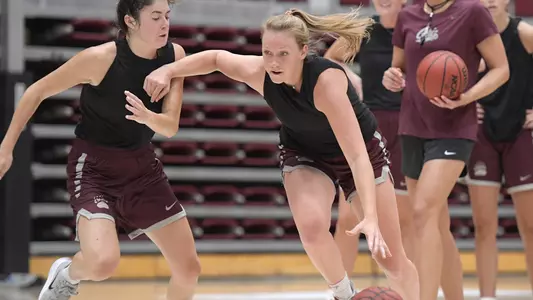
Nah, it's nothing like that. In fact it didn't even happen during practice. It came after the balls were put away, after post-workout drinks had been finished, when the team, what was there of it that summer day, had gathered in a circle at mid-court of a quiet Dahlberg Arena, prowling grizzly bear underfoot.
It's where the team starts every practice now -- call it the circle of (ever-growing) trust -- and the coaches have the voice at this one. They set the agenda, the tone, then they go over the focus of the day, the intention. It might be improved communication, a heightened energy level.
Then the Lady Griz get after it in a way that's different now. Their new coach isn't a yeller. At least not now, in the summer. He's a teacher at heart, someone who might shed a few tears himself talking about relationships and how they drive him.
They are the foundation of his program, those relationships, whether they're between him and his staff or him and his players. He'd rather pull you aside, teach you one-on-one, than he would call anyone out in front of her teammates. And that creates a trust, a bond that's strengthening by the day.
He doesn't coach using fear or intimidation. He's a builder, of trust, of camaraderie, of confidence, of belief, both in yourself and in your teammates. He knows that once that's in place, he can lead them anywhere, to places they never thought possible. E pluribus unum on a basketball court.
When they return to that circle after practice, after the sweat has been invested, after their communication has been improved just a little bit more, after that energy level has been dialed up one more notch, after the attention to detail has gotten even finer, it's the players' turn.
If pre-practice is a time of intention, post-practice is for reflection, of the hour just spent, of the week past, of the summer so far. And on this day, Carmen Gfeller just had to say something. When she was done, she had her teammate in tears. Possibly teammates.
Stiles has always been popular. It comes with being the star of the team in a basketball-mad city like Malta, where they take their hoops as seriously as any small town in Montana. Girls wanted to be around her. Boys wanted to be with her. Kids wanted to be her. And they followed, out of devotion.
But popularity is not the same thing as leadership. She discovered that her freshman year at Montana, when she started to watch Jace Henderson, how she would bring everyone together and move them forward in lockstep, never focused on herself but on what was best for the group.
For all of Stiles' gifts, it's one she didn't possess at the level she wanted.
"I watched how much Jace put her team before herself. It's something I really respected and wanted to be like one day," she says. "I've seen how much a strong leader can impact the whole team and make the whole experience a lot better."
Her coaches have all told her the same thing over the years: Your teammates are going to look to you. They are ready to follow you. You have to be ready to lead them.
She let her play do the talking, her work rate set the standard. And that's one way to lead, but it's not what she saw Henderson do. She wanted to do more. But that can be a difficult transformation if something doesn't change, if people are used to seeing you a particular way, if roles are established.
She was the athletic one, the lockdown defender, the one who could run the floor like no other, fun Sophie, the great teammate. But no one saw her as a Henderson-level leader, which is what she desired to be.
Her opening came when Brian Holsinger was named the new coach of the Lady Griz last spring. He didn't know Stiles. He didn't know the dynamics of the team. It was a fresh start, the chance to have a rebirth, an opportunity to become something she'd never been.
At the team's very first meeting, Stiles spoke up. Said she wanted to be more of a leader. So she and Holsinger got to work. They talked about what that meant, what that looked like on a day-to-day basis, the small changes she would have to make.
She was always a hard worker. But what if, instead of warming up with bestie Abby Anderson, she went to another basket and shot with Dani Bartsch or Haley Huard? What kind of impact would that have? How much more inclusive would that make the team, senior wrapping her arm around freshman?
What if, instead of doing the mandatory lifts and practices, she and Anderson and fellow senior Kylie Frohlich organized the team even more? What if they got together for extra shooting sessions? What if, instead of breaking up for the weekend, they got together for Fridays at The Catalyst Café?
"When you're younger, you might think (leadership) is just about your performance and opening your mouth sometimes," says Holsinger.
"To me, it's about your consistent actions day in and day out, your consistent attitude and hard work. Then it's about your willingness to give of yourself, maybe to put what's best for you at the moment aside. Those things make a difference for everybody around you, and that's leadership."
When the team gathered up that day not long ago, at center court after practice, Gfeller spoke up. Her reflection was on Stiles and how impressed she was at the leader her teammate was becoming. And Sophia Stiles wept.
"Sophie is somebody that throughout the summer consistently showed up with a positive attitude, competed in every drill and made everybody around her play better," Gfeller said this week.
"I think it's easy for us as her teammates to take her consistency for granted because we're so used to it. She leads by example in that way because no matter how much this program has gone through, she always makes the most of each day."
Stiles has always been a self-assured athlete. But not like this. She has taken to her new role, like she was a born leader that she never knew she was, and it's insinuated itself into her very game, her very persona.
"This is the most vocal I've ever seen her on the court, the most confident," says Anderson. "She came into summer workouts and set a tone for herself. Nobody's going to be able to stop this girl. She has the attitude that she's not going to hold anything back. She's going to kill it this season."
But this isn't a story about Stiles. It's about the change that's taking place in real time, with each lift, each practice, with each pre- and post-practice circle, little things adding up to big changes.
Watching the Lady Griz now, it's hard to believe it was just five and a half months ago that they walked off the court in Boise, a first-round knockout victim at the hands of previously two-win Sacramento State, a team with no postseason pedigree taking down the one that used to own March.
It was the fourth time in five seasons Montana had gone one-and-done at the Big Sky Conference tournament, an event the Lady Griz used to dominate, and for all the pearl-clutching, the loss to the Hornets was a surprise but no shock.
Montana, which used to be the sole resident of the penthouse, with other programs coming and going on the levels below, was years ago summarily booted out, the vacancy now filled by teams from Pocatello, Moscow, Bozeman. What would have been unthinkable is now a matter of routine.
That necessitated a change.
Holsinger doesn't want to be called a savior -- after all, he has zero wins as a Division I head coach -- but he was the right person at the right time, an outsider who was able to see the Lady Griz for what they were and could be again, not what they were -- broken, defeated -- in Boise in March.
"Brian came in not really knowing the history, or I guess you could say the drama, that this program has had the last couple of years," said Anderson. "And that was really refreshing. He had no ties to it, so he saw everything from a fresh perspective."
The team had eight weeks of available practice time over the summer. If the players viewed them as workouts to get better, Holsinger and his staff knew they were 10 times more important than a series of drills or competitions.
Every day, every interaction, would start to establish a new culture, a new set of expectations. With everything at its infancy, so delicate and fragile, everything had to be thought out and done with a purpose. It had to be done right, to such a degree that the workouts were simply the vehicle.
They only had one shot at this.
"It was all about laying the foundation for our culture and what we want here," says Holsinger. "We as a staff sat down and said, this, this, this and this is what we want to be about. So how do we go about doing that in these short workouts?"
No detail was too small. How you walk into the gym. How you circle up before and after practice. How you communicate. How you treat recruits when they come onto campus.
"We talked about how we encourage, how we motivate, and we worked a lot on confidence. All of that comes together to start to form the culture you want to have. No matter who the players were, that was the main thing, and I think we accomplished that this summer," Holsinger says.
When he says "we," he means his staff. And nothing he did in the weeks after he was hired was going to be more important than the assistants with whom he surrounded himself. Nothing had more potential to make his charge -- to make Montana Montana again -- easier or more challenging.
He started with what was widely hailed as a home-run hire: He retained Jordan Sullivan, who has blood in the Lady Griz program. Her mom played here. Her uncle won 865 games here. She played here. She went through the ups and downs of the last few years, which has only emboldened her.
"Her connection with the program is gigantic for us. It's deep, so it's different for her," says Holsinger. "She's lived it, so she can speak to it a different way. She is ultra-talented, hard-working and so good at connecting with young people."
The next hires would be more tricky. With two pieces of the puzzle in place, Holsinger had to keep in mind how the next one would fit. Certainly it wouldn't be a Sullivan-type hire. Perhaps a double into the gap. But Holsinger did it again, hiring Nate Harris. Funny, smart, personable. He circled the bases. Again.
A walk-off home run would be expecting too much, right? Except Holsinger was feeling it. And his final hire made the biggest splash of all: Joslyn Tinkle.
Of course it meant different things to different people. To some: OMG, JOS IS BACK! But Holsinger didn't make the hire for the clicks, though they will always be an ancillary bonus when anyone named Tinkle is connected to anything named Montana.
He bet on the person, not the name. "She is super dynamic," he says. "Who doesn't like being around her? She makes you feel like a million dollars. She has tons of energy and a humble spirit that makes you love to be around her."
And he bet on her experience. What her resume lacks in collegiate coaching, it's gilded with beneficial associations. Her dad needs no introduction. Neither does her college coach, the all-time winningest women's basketball coach down at Stanford.
"She knows the game well, and she's learning how to communicate that," Holsinger said. "I'm excited to get into the basketball things more and more."
Just try being the parent of a big-time recruit, visiting Montana and going to breakfast or dinner with this staff and saying no to their offer. Holsinger's assistants will sell this place even better than those 24 championship banners hanging in the rafters, though those certainly help.
"First and foremost, it's just their ability to connect with people," says Holsinger. "They have a lot of fun together, and it's just infectious. It's something you can't fake. They are genuinely excited about being around one another and excited about people.
"I'm a relationship-driven person, and they exemplify that as well as any staff I've been around."
Of course the players had no idea what was going to happen last spring, as a national search to find their new coach was underway.
Anderson arrived on campus in the fall of 2017, knowing she had found her new home. She is on her third coach, but don't think for a second that she ever thought about bailing on the program. Her heart is here, will be even if she's not, Tinkle-style.
"I've just always loved being here, no matter who the coach has been. I love my team, the community, the school. I love Montana. From the beginning I knew I was going to finish here and that this was my place," she says.
"Shannon (Schweyen) leaving was really sad for me. Mike (Petrino) leaving was really sad for me, but I still want to accomplish something really big while I'm here, and I have one last chance to do it."
Stiles admits she checked out for a while after the season. She had to for her own good, her own mental health. Everyone wanted to know what was happening with the program, who the new coach was going to be. It could have consumed her. But she didn't let it.
"It was a crazy experience, but I have a strong faith in God, and I figured whatever happened was supposed to happen and it's going to be a good experience," she said. "I told myself, it doesn't matter who the new coach is. You can control what you can control, no matter what."
How apropos, this talk about controlling what you can control. The team this month is reading "Pound the Stone," and it was Stiles' task this week to report on one of the chapters of the book dealing with confidence and how having it is mostly up to you but can so easily stolen by someone else.
Holsinger knows it. That's why he's been so intentional about building it up within the Lady Griz players. If there is one thing you'll notice when the season commences, it's a newfound belief in who they are, what they're doing and what they are capable of. You're going to be enthralled by the changes.
"You feel the confidence he has in you, which makes you more confident in yourself," says Stiles. And it's led to a revelation time and time again.
Start with Anderson, who the last time you saw her was known as a defensive menace in the paint and an effective scorer from the low post. She's 6-foot-2. Why wouldn't she be tethered to the lane, like it was the only place she belonged?
You might remember her stepping out to the elbow and trying to get something high-low going with Gfeller, a plan compromised more often than not by her defender not having to guard her at any distance beyond eight feet from the rim, which would just muck up Gfeller's ability to get to work.
Holsinger, before he was even offered the job, watched every minute of the team's games last season. He didn't think about how he could use Anderson as she was. He wanted to create something new. He wanted to expand her game, create a brand-new player, keeping the old and adding on.
By the end of the summer, Anderson was shooting 75 percent on shots from 15 to 17 feet. And just think: When Holsinger first mentioned it to Anderson, her instinct was to introduce herself and say, "Hello, yeah, I'm a center. I don't shoot that."
"My whole life I've been told to stick with what I'm good at or comfortable with, which is a short turnaround," Anderson says. "This summer Brian said, 'People can't guard you 10 feet off. That's not going to work in our offense. That's not going to help anyone.'
"He said, 'You're going to get this 15 footer down,' and I did. It was a different perspective than I've ever heard. I was never confident enough before, I guess. Now when I'm 17 feet out, my player isn't going to double Carmen anymore. I want Carmen to score 25 a game this year. It's been a huge win for me."
She is doing ball-handling drills with the guards. She's defending on the 3-point line like she's got the quickness of Stiles but with arms that are half a foot longer. She's a butterfly emerging from a cocoon of limitations she's previously been bound by.
"Brian came in with really high standards that a lot of us weren't used to," Anderson says. "I feel like I haven't been pushed as much as I have this summer my four years here. It's scary, but I couldn't be more excited about it.
"It's just a whole different perspective, and I'm gaining a lot of confidence from it. He's pushing me to do these things, and I'm just growing as a player."
It's done with an enthusiasm, an if-I-can-believe-in-you-why-can't-you? approach. And the culture solidifies itself just a little more each day.
"When we first met him, he was all about being goal-oriented and focused. The excitement that came from him was huge. He brought that from Day 1, and everyone picked up on it," says Frohlich, who didn't need to be taught the ways of Holsinger's desired culture. She was already playing like it.
"Every day she brings the effort and the energy. She makes the extra-effort play all the time," says Holsinger. "Her actions say, this is how we play. This is what we do every day.
"When it's consistent, people notice, then it becomes infectious and people want to do it with you. Then you become a good team."
He knows once he has their trust, he can start to push them, and no sooner. So it's small steps, like pulling people out of their comfort zones, whether that be Anderson getting used to the idea of shooting with confidence from 15 feet out or Willa Albrecht finding her voice.
Albrecht is the player who scored 14 points in her collegiate debut last winter -- the Silent Assassin! -- then totaled just 27 more the rest of the season -- what happened to Willa!?
She's not a big talker, but that won't work for Holsinger, and she's way too good of a player to have her minutes limited because of the lack of a voice. So he finds ways to help her find it.
"He'll do this thing where he'll pull someone out of a drill and stand next to him and help him coach, which is extremely uncomfortable," says Anderson, laughing. "You don't want to be standing next to your head coach helping him coach your teammates."
Holsinger does it with Albrecht, gets her talking, gets her more comfortable using her voice and expressing herself. She does and it gives everyone a jolt of energy, seeing another player emerge, transform into a better version of their former selves, like Stiles, like Anderson.
"She speaks her mind more because of it," says Anderson, who seems amazed, like she thought she'd never see the day. "They've just stressed that if you're not talking on the court, that's selfish, and Willa took to that immediately. This is the new standard, so I've got to do it.
"Everyone is thinking to themselves, am I going to be the selfish player on this team, with how good our chemistry is right now? Nobody is going to do that. Nobody wants to let anyone else down."
The feeling has become contagious. Players never fail to point to a teammate after a good pass. They don't miss high-fives or any other chance to acknowledge a teammate. "That's the standard Brian has set," says Anderson.
He has them practicing, even in the summer, at game speed and intensity, because otherwise this is all for show. They don't do it because he demands it, like an authoritative coach with a booming voice. They do it because the trust is already there. They believe they're going somewhere special together.
It's about the details and not just going through the motions, of how your feet are set when a pass is arriving, how that pass is delivered and where it hits the receiver. It's simple stuff. Take your time. Be on balance. Make good moves without wasted dribbles. Make the smart play every time.
Simple stuff that can be hard to learn when everything is happening at full speed.
"I feel like we've always been told to practice how you're going to play," says Anderson. "As much as I'd like to say from my freshman year that I did that, I didn't do that. With Brian, that's not something he's going to get lazy about." It's important to note she says this with thankfulness, not resentment.
She wants to be pushed. They all do. She wants to be challenged. They all do. She wants things to be different next season, as they all do, and she knows there is no other way to do that than to get comfortable with being uncomfortable.
"Every practice is on par for the exact standard of how a game should be. He lets that be known throughout the whole practice. How on top of that he is is different than what we've had," she says.
The season ahead still feels like a long way off, March and Boise even further in the distance. But last March and last season's trip to Boise? It feels like it was years and years ago as a new era begins, the gap between then and now widening by the day.
That the two were matched up in a post-defense drill and Gfeller scored over, around and through Stiles so many times in a row that Stiles, competitive as competitive gets but not Gfeller-strong, finally cracked? That she got bullied to the ground one time too often and just stayed there?
Nah, it's nothing like that. In fact it didn't even happen during practice. It came after the balls were put away, after post-workout drinks had been finished, when the team, what was there of it that summer day, had gathered in a circle at mid-court of a quiet Dahlberg Arena, prowling grizzly bear underfoot.
It's where the team starts every practice now -- call it the circle of (ever-growing) trust -- and the coaches have the voice at this one. They set the agenda, the tone, then they go over the focus of the day, the intention. It might be improved communication, a heightened energy level.
Then the Lady Griz get after it in a way that's different now. Their new coach isn't a yeller. At least not now, in the summer. He's a teacher at heart, someone who might shed a few tears himself talking about relationships and how they drive him.
They are the foundation of his program, those relationships, whether they're between him and his staff or him and his players. He'd rather pull you aside, teach you one-on-one, than he would call anyone out in front of her teammates. And that creates a trust, a bond that's strengthening by the day.
He doesn't coach using fear or intimidation. He's a builder, of trust, of camaraderie, of confidence, of belief, both in yourself and in your teammates. He knows that once that's in place, he can lead them anywhere, to places they never thought possible. E pluribus unum on a basketball court.
When they return to that circle after practice, after the sweat has been invested, after their communication has been improved just a little bit more, after that energy level has been dialed up one more notch, after the attention to detail has gotten even finer, it's the players' turn.
If pre-practice is a time of intention, post-practice is for reflection, of the hour just spent, of the week past, of the summer so far. And on this day, Carmen Gfeller just had to say something. When she was done, she had her teammate in tears. Possibly teammates.
Stiles has always been popular. It comes with being the star of the team in a basketball-mad city like Malta, where they take their hoops as seriously as any small town in Montana. Girls wanted to be around her. Boys wanted to be with her. Kids wanted to be her. And they followed, out of devotion.
But popularity is not the same thing as leadership. She discovered that her freshman year at Montana, when she started to watch Jace Henderson, how she would bring everyone together and move them forward in lockstep, never focused on herself but on what was best for the group.
For all of Stiles' gifts, it's one she didn't possess at the level she wanted.
"I watched how much Jace put her team before herself. It's something I really respected and wanted to be like one day," she says. "I've seen how much a strong leader can impact the whole team and make the whole experience a lot better."
Her coaches have all told her the same thing over the years: Your teammates are going to look to you. They are ready to follow you. You have to be ready to lead them.
She let her play do the talking, her work rate set the standard. And that's one way to lead, but it's not what she saw Henderson do. She wanted to do more. But that can be a difficult transformation if something doesn't change, if people are used to seeing you a particular way, if roles are established.
She was the athletic one, the lockdown defender, the one who could run the floor like no other, fun Sophie, the great teammate. But no one saw her as a Henderson-level leader, which is what she desired to be.
Her opening came when Brian Holsinger was named the new coach of the Lady Griz last spring. He didn't know Stiles. He didn't know the dynamics of the team. It was a fresh start, the chance to have a rebirth, an opportunity to become something she'd never been.
At the team's very first meeting, Stiles spoke up. Said she wanted to be more of a leader. So she and Holsinger got to work. They talked about what that meant, what that looked like on a day-to-day basis, the small changes she would have to make.
She was always a hard worker. But what if, instead of warming up with bestie Abby Anderson, she went to another basket and shot with Dani Bartsch or Haley Huard? What kind of impact would that have? How much more inclusive would that make the team, senior wrapping her arm around freshman?
What if, instead of doing the mandatory lifts and practices, she and Anderson and fellow senior Kylie Frohlich organized the team even more? What if they got together for extra shooting sessions? What if, instead of breaking up for the weekend, they got together for Fridays at The Catalyst Café?
"When you're younger, you might think (leadership) is just about your performance and opening your mouth sometimes," says Holsinger.
"To me, it's about your consistent actions day in and day out, your consistent attitude and hard work. Then it's about your willingness to give of yourself, maybe to put what's best for you at the moment aside. Those things make a difference for everybody around you, and that's leadership."
When the team gathered up that day not long ago, at center court after practice, Gfeller spoke up. Her reflection was on Stiles and how impressed she was at the leader her teammate was becoming. And Sophia Stiles wept.
"Sophie is somebody that throughout the summer consistently showed up with a positive attitude, competed in every drill and made everybody around her play better," Gfeller said this week.
"I think it's easy for us as her teammates to take her consistency for granted because we're so used to it. She leads by example in that way because no matter how much this program has gone through, she always makes the most of each day."
Stiles has always been a self-assured athlete. But not like this. She has taken to her new role, like she was a born leader that she never knew she was, and it's insinuated itself into her very game, her very persona.
"This is the most vocal I've ever seen her on the court, the most confident," says Anderson. "She came into summer workouts and set a tone for herself. Nobody's going to be able to stop this girl. She has the attitude that she's not going to hold anything back. She's going to kill it this season."
But this isn't a story about Stiles. It's about the change that's taking place in real time, with each lift, each practice, with each pre- and post-practice circle, little things adding up to big changes.
Watching the Lady Griz now, it's hard to believe it was just five and a half months ago that they walked off the court in Boise, a first-round knockout victim at the hands of previously two-win Sacramento State, a team with no postseason pedigree taking down the one that used to own March.
It was the fourth time in five seasons Montana had gone one-and-done at the Big Sky Conference tournament, an event the Lady Griz used to dominate, and for all the pearl-clutching, the loss to the Hornets was a surprise but no shock.
Montana, which used to be the sole resident of the penthouse, with other programs coming and going on the levels below, was years ago summarily booted out, the vacancy now filled by teams from Pocatello, Moscow, Bozeman. What would have been unthinkable is now a matter of routine.
That necessitated a change.
Holsinger doesn't want to be called a savior -- after all, he has zero wins as a Division I head coach -- but he was the right person at the right time, an outsider who was able to see the Lady Griz for what they were and could be again, not what they were -- broken, defeated -- in Boise in March.
"Brian came in not really knowing the history, or I guess you could say the drama, that this program has had the last couple of years," said Anderson. "And that was really refreshing. He had no ties to it, so he saw everything from a fresh perspective."
The team had eight weeks of available practice time over the summer. If the players viewed them as workouts to get better, Holsinger and his staff knew they were 10 times more important than a series of drills or competitions.
Every day, every interaction, would start to establish a new culture, a new set of expectations. With everything at its infancy, so delicate and fragile, everything had to be thought out and done with a purpose. It had to be done right, to such a degree that the workouts were simply the vehicle.
They only had one shot at this.
"It was all about laying the foundation for our culture and what we want here," says Holsinger. "We as a staff sat down and said, this, this, this and this is what we want to be about. So how do we go about doing that in these short workouts?"
No detail was too small. How you walk into the gym. How you circle up before and after practice. How you communicate. How you treat recruits when they come onto campus.
"We talked about how we encourage, how we motivate, and we worked a lot on confidence. All of that comes together to start to form the culture you want to have. No matter who the players were, that was the main thing, and I think we accomplished that this summer," Holsinger says.
When he says "we," he means his staff. And nothing he did in the weeks after he was hired was going to be more important than the assistants with whom he surrounded himself. Nothing had more potential to make his charge -- to make Montana Montana again -- easier or more challenging.
He started with what was widely hailed as a home-run hire: He retained Jordan Sullivan, who has blood in the Lady Griz program. Her mom played here. Her uncle won 865 games here. She played here. She went through the ups and downs of the last few years, which has only emboldened her.
"Her connection with the program is gigantic for us. It's deep, so it's different for her," says Holsinger. "She's lived it, so she can speak to it a different way. She is ultra-talented, hard-working and so good at connecting with young people."
The next hires would be more tricky. With two pieces of the puzzle in place, Holsinger had to keep in mind how the next one would fit. Certainly it wouldn't be a Sullivan-type hire. Perhaps a double into the gap. But Holsinger did it again, hiring Nate Harris. Funny, smart, personable. He circled the bases. Again.
A walk-off home run would be expecting too much, right? Except Holsinger was feeling it. And his final hire made the biggest splash of all: Joslyn Tinkle.
Of course it meant different things to different people. To some: OMG, JOS IS BACK! But Holsinger didn't make the hire for the clicks, though they will always be an ancillary bonus when anyone named Tinkle is connected to anything named Montana.
He bet on the person, not the name. "She is super dynamic," he says. "Who doesn't like being around her? She makes you feel like a million dollars. She has tons of energy and a humble spirit that makes you love to be around her."
And he bet on her experience. What her resume lacks in collegiate coaching, it's gilded with beneficial associations. Her dad needs no introduction. Neither does her college coach, the all-time winningest women's basketball coach down at Stanford.
"She knows the game well, and she's learning how to communicate that," Holsinger said. "I'm excited to get into the basketball things more and more."
Just try being the parent of a big-time recruit, visiting Montana and going to breakfast or dinner with this staff and saying no to their offer. Holsinger's assistants will sell this place even better than those 24 championship banners hanging in the rafters, though those certainly help.
"First and foremost, it's just their ability to connect with people," says Holsinger. "They have a lot of fun together, and it's just infectious. It's something you can't fake. They are genuinely excited about being around one another and excited about people.
"I'm a relationship-driven person, and they exemplify that as well as any staff I've been around."
Of course the players had no idea what was going to happen last spring, as a national search to find their new coach was underway.
Anderson arrived on campus in the fall of 2017, knowing she had found her new home. She is on her third coach, but don't think for a second that she ever thought about bailing on the program. Her heart is here, will be even if she's not, Tinkle-style.
"I've just always loved being here, no matter who the coach has been. I love my team, the community, the school. I love Montana. From the beginning I knew I was going to finish here and that this was my place," she says.
"Shannon (Schweyen) leaving was really sad for me. Mike (Petrino) leaving was really sad for me, but I still want to accomplish something really big while I'm here, and I have one last chance to do it."
Stiles admits she checked out for a while after the season. She had to for her own good, her own mental health. Everyone wanted to know what was happening with the program, who the new coach was going to be. It could have consumed her. But she didn't let it.
"It was a crazy experience, but I have a strong faith in God, and I figured whatever happened was supposed to happen and it's going to be a good experience," she said. "I told myself, it doesn't matter who the new coach is. You can control what you can control, no matter what."
How apropos, this talk about controlling what you can control. The team this month is reading "Pound the Stone," and it was Stiles' task this week to report on one of the chapters of the book dealing with confidence and how having it is mostly up to you but can so easily stolen by someone else.
Holsinger knows it. That's why he's been so intentional about building it up within the Lady Griz players. If there is one thing you'll notice when the season commences, it's a newfound belief in who they are, what they're doing and what they are capable of. You're going to be enthralled by the changes.
"You feel the confidence he has in you, which makes you more confident in yourself," says Stiles. And it's led to a revelation time and time again.
Start with Anderson, who the last time you saw her was known as a defensive menace in the paint and an effective scorer from the low post. She's 6-foot-2. Why wouldn't she be tethered to the lane, like it was the only place she belonged?
You might remember her stepping out to the elbow and trying to get something high-low going with Gfeller, a plan compromised more often than not by her defender not having to guard her at any distance beyond eight feet from the rim, which would just muck up Gfeller's ability to get to work.
Holsinger, before he was even offered the job, watched every minute of the team's games last season. He didn't think about how he could use Anderson as she was. He wanted to create something new. He wanted to expand her game, create a brand-new player, keeping the old and adding on.
By the end of the summer, Anderson was shooting 75 percent on shots from 15 to 17 feet. And just think: When Holsinger first mentioned it to Anderson, her instinct was to introduce herself and say, "Hello, yeah, I'm a center. I don't shoot that."
"My whole life I've been told to stick with what I'm good at or comfortable with, which is a short turnaround," Anderson says. "This summer Brian said, 'People can't guard you 10 feet off. That's not going to work in our offense. That's not going to help anyone.'
"He said, 'You're going to get this 15 footer down,' and I did. It was a different perspective than I've ever heard. I was never confident enough before, I guess. Now when I'm 17 feet out, my player isn't going to double Carmen anymore. I want Carmen to score 25 a game this year. It's been a huge win for me."
She is doing ball-handling drills with the guards. She's defending on the 3-point line like she's got the quickness of Stiles but with arms that are half a foot longer. She's a butterfly emerging from a cocoon of limitations she's previously been bound by.
"Brian came in with really high standards that a lot of us weren't used to," Anderson says. "I feel like I haven't been pushed as much as I have this summer my four years here. It's scary, but I couldn't be more excited about it.
"It's just a whole different perspective, and I'm gaining a lot of confidence from it. He's pushing me to do these things, and I'm just growing as a player."
It's done with an enthusiasm, an if-I-can-believe-in-you-why-can't-you? approach. And the culture solidifies itself just a little more each day.
"When we first met him, he was all about being goal-oriented and focused. The excitement that came from him was huge. He brought that from Day 1, and everyone picked up on it," says Frohlich, who didn't need to be taught the ways of Holsinger's desired culture. She was already playing like it.
"Every day she brings the effort and the energy. She makes the extra-effort play all the time," says Holsinger. "Her actions say, this is how we play. This is what we do every day.
"When it's consistent, people notice, then it becomes infectious and people want to do it with you. Then you become a good team."
He knows once he has their trust, he can start to push them, and no sooner. So it's small steps, like pulling people out of their comfort zones, whether that be Anderson getting used to the idea of shooting with confidence from 15 feet out or Willa Albrecht finding her voice.
Albrecht is the player who scored 14 points in her collegiate debut last winter -- the Silent Assassin! -- then totaled just 27 more the rest of the season -- what happened to Willa!?
She's not a big talker, but that won't work for Holsinger, and she's way too good of a player to have her minutes limited because of the lack of a voice. So he finds ways to help her find it.
"He'll do this thing where he'll pull someone out of a drill and stand next to him and help him coach, which is extremely uncomfortable," says Anderson, laughing. "You don't want to be standing next to your head coach helping him coach your teammates."
Holsinger does it with Albrecht, gets her talking, gets her more comfortable using her voice and expressing herself. She does and it gives everyone a jolt of energy, seeing another player emerge, transform into a better version of their former selves, like Stiles, like Anderson.
"She speaks her mind more because of it," says Anderson, who seems amazed, like she thought she'd never see the day. "They've just stressed that if you're not talking on the court, that's selfish, and Willa took to that immediately. This is the new standard, so I've got to do it.
"Everyone is thinking to themselves, am I going to be the selfish player on this team, with how good our chemistry is right now? Nobody is going to do that. Nobody wants to let anyone else down."
The feeling has become contagious. Players never fail to point to a teammate after a good pass. They don't miss high-fives or any other chance to acknowledge a teammate. "That's the standard Brian has set," says Anderson.
He has them practicing, even in the summer, at game speed and intensity, because otherwise this is all for show. They don't do it because he demands it, like an authoritative coach with a booming voice. They do it because the trust is already there. They believe they're going somewhere special together.
It's about the details and not just going through the motions, of how your feet are set when a pass is arriving, how that pass is delivered and where it hits the receiver. It's simple stuff. Take your time. Be on balance. Make good moves without wasted dribbles. Make the smart play every time.
Simple stuff that can be hard to learn when everything is happening at full speed.
"I feel like we've always been told to practice how you're going to play," says Anderson. "As much as I'd like to say from my freshman year that I did that, I didn't do that. With Brian, that's not something he's going to get lazy about." It's important to note she says this with thankfulness, not resentment.
She wants to be pushed. They all do. She wants to be challenged. They all do. She wants things to be different next season, as they all do, and she knows there is no other way to do that than to get comfortable with being uncomfortable.
"Every practice is on par for the exact standard of how a game should be. He lets that be known throughout the whole practice. How on top of that he is is different than what we've had," she says.
The season ahead still feels like a long way off, March and Boise even further in the distance. But last March and last season's trip to Boise? It feels like it was years and years ago as a new era begins, the gap between then and now widening by the day.
Players Mentioned

F
/ Women's Basketball
F
/ Women's Basketball
F
/ Women's Basketball
F
/ Women's Basketball
F
/ Women's Basketball
G
/ Women's Basketball
G
/ Women's BasketballTuesday, October 20
Tuesday, October 20
Monday, October 19
Saturday, October 17