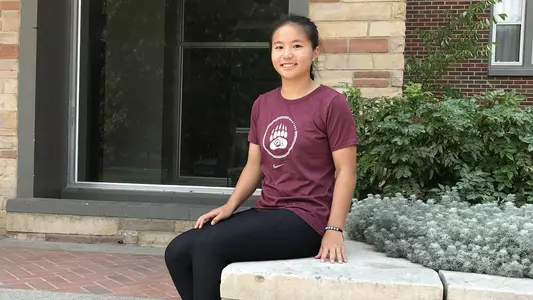
The Craig Hall Chronicles :: Lena Beaufait
8/6/2021 6:48:00 PM | Soccer
There is any number of routes a soccer player can take to get from there, wherever that happens to be, to here, meaning a spot on the roster at Montana.
That's what makes the Craig Hall Chronicles so fun and interesting, their variety.
While the particulars may change with every player, many of those journeys follow a similar, big-picture path: rec soccer, club soccer, college soccer.
One leads to the next, which leads to the next, a climbing of the ladder, each step requiring a little more commitment, both time and financial, with room for fewer and fewer players on the rung as the top nears.
Indeed: Many are called, few are chosen.
The first step, rec soccer, introduces them to the game, at a time when it's still mostly about having fun, and allows a love for the sport to begin to take hold.
The second, should they choose to pursue it, brings out their talent through better coaching and demands more and more competitiveness. After all, the most sought-after teams are called "select" for a reason.
It's where higher-level techniques and tactics are taught, those that prepare future Division I athletes for the college game, AP courses that are designed to make the transition easier.
And then there is Lena Beaufait, whose story is unlike any other, a sui generis tale that begins far, far away and belies the traditional pathway of getting from there to here.
Even her new coach, Chris Citowicki, doesn't know it completely, which is why he's as interested to read this as anyone.
He knows she has a history of playing for the Pacific Northwest Soccer Club, and that was always enough for him. After all, the club has rarely let him down. It's one of the region's gold standards for producing Division I talent. It's one he buddied up with early on in his coaching tenure at Montana.
So when Citowicki saw Beaufait again last month at Montana's ID camp, he just assumed he was watching the result of the club in action, of doing what it does best, which is sending girls out into the Division I world with games that are college-ready.
He credits the outside back with "cerebral defending."
"For some people, defending is a physical thing. For her, it's: I'll beat you with my intellect. That's what she does very well," he says.
"Her defending doesn't come from this high level of intensity. She is just constantly calculating everything in her head. It must be like a million miles an hour, and then she just makes the correct decision.
"She'll just wait and give you some space. And when you do something, all of a sudden she's blocked you and then she's taking the ball away from you. It's like, you do what you have to do, but I'm fully in control of this whole thing."
He goes on to say how he sees the Pac Northwest influence in her game, and the club deserves some of the credit, but this is where her story goes a different way than most.
She figures it was when she was about the age of 11 when she first asked her dad if she could play in one of the pickup games, informally scheduled for early Saturday and Sunday mornings, at a field near their home in West Seattle.
"I wanted to play more than I was playing in club, because, I mean, five days a week isn't enough," she says.
That sounded fine until he learned the particulars. It was almost exclusively men, mainly guys who had played collegiately and now were in their 20s or 70s and every age in between.
"Most of them outweighed her 3-to-1. She was by far the youngest and one of the only girls almost all the time," her dad, Mark, says. "It was three hours of fast and furious."
There was some hesitancy among the men, some skepticism as well. But they let her join in that first weekend, and she just kept going back.
It was played on half a soccer field, with lacrosse nets for the goals but without a true goalkeeper. Arrive early enough and a person could get a spot in the preferred eight-on-eight game. Get there late and other games could reach 15-on-15 or 20-on-20 depending on the day and the turnout.
She'd been going to organized soccer practices for years, where positions are assigned and roles are defined, where teams are structured and in predictable formations. Formulaic drills are done, then repeated.
And then she would show up to the park early on a Saturday morning. "The way I like to describe it is, it's just pure chaos," she says. "They were bigger, they were faster, so that's really where I learned how to 1-v-1 defend.
"You had people making all sorts of runs on you, and you couldn't necessarily guarantee that you were going to have a center back covering you or any of that. So it was figuring out what you could do about what was happening at that moment."
She thinks faster and is a step ahead now because she had to back then just to survive.
"Pac Northwest taught me, obviously, the technical side and the tactical side for elevens, and it taught me the framework of soccer, but those pickup games really developed me and my individual way of playing," she says.
At club practice, attacks, even counters, would occur at a relatively slow pace. There was time to evaluate and process. On the weekend, things could change just like that.
"So many times it would be 2-v-1, 3-v-1, 4-v 1 situations. You learned how to prioritize your press," she says. "You couldn't just step to the ball, because if they played it behind you, there was no one else there."
But you also had to be aware of shooters and step to them to block any shots, because the net was mostly unguarded, unless a teammate happened to slide behind you. It was a lot to take in.
"It was a small space with lots of people and no formation whatsoever. It was completely different than in club. In club you have to know your space and you have to be aware of the other team's formation at all times. It was simpler because I know I have my wide winger that I have to track every single time."
Now it makes sense, what Citowicki says. "She is just constantly calculating everything in her head. It must be like a million miles an hour, and then she just makes the correct decision."
She's smart enough and holds enough game savvy and knowledge that she could cut corners here and there at club practices. She knew what the forwards had been taught. She knew the opposing defenders weren't going to play a long ball, because Pac Northwest is all about building from the back.
At pickup games, on the contrary, she had no idea what was coming at any time. There was no cheating the game on the weekends.
"You would go up against people who weren't taught to attack the same way we were taught to attack," she says. "In club, there was never that big diagonal ball across the field. No one at that age can really hit that big diagonal ball.
"When you're playing with older guys who have been hitting that big diagonal ball for 20 years, you learn to become aware of that earlier. And then when people started doing it in club, I was like, I've been playing with people who do this already."
Her mom, Andrea, was her first coach, when Beaufait was three. The bribes to play up top came in the form of a Slurpee, for every goal scored, but the coach's daughter was born to play the back line.
"I feel like I have a greater desire to get the ball from someone and not let them have the ball than I do to go and attack myself. Defending just came naturally," she says. "Making a massive tackle or a big block feels so much better than scoring. When I score I don't know what to do.
"My dad says he loves watching me defend because I'll tackle someone and put them on the ground and pop up and get the ball and he's like, that's the one time that I ever see you smile on the field. That's the only thing that triggers the smiling response.
"Well, that's because I did something that genuinely makes me happy."
She's played up front before, in fact in her first time playing for Pac Northwest, as a guest player. The coach didn't know who he was getting, so he put her in an attacking position.
"He put her up top because that's probably less risk than putting a kid you don't know very well in defense," says Andrea. "She made the first and only goal that sent the team on to the next level.
"She made her mark and was invited to join the club in mid-season, which doesn't always happen."
It's Pac Northwest that hosts the Winter Classic each January, at the 12-field Starfire Sports Complex in Tukwila, just south of Seattle. It's where a former Montana assistant first saw this player that Citowicki, then Montana's first-year coach, just had to see.
"I was already interested in Pac Northwest, and (Katie Benz) comes into the office one day and says there is this kid on the Pac team that we really need to watch," says Citowicki.
"Katie goes out to an ECNL event and comes back and says she's legit and going to be a really good player. She sees her at another event, same thing. I invite her to our ID camp, and she did very well. We just had to make it happen at that point."
She remembers her first phone call with Citowicki. Practice was over at the Starfire Complex. She repaired to an empty conference room. She was as nervous as she'd ever been in her life.
She called. Citowicki answered and asked if they could talk in 15 minutes. He was running late and still putting his kids to bed. That tends to take the edge off.
"This guy's, like, actually a person," Beaufait thought. "That put me much more at ease. Some of the other coaches I talked to were kind of cold, and that made for a very awkward conversation.
"Talking to Chris was one of the most positive experiences, if not the most positive. He was just himself. Very energetic, very welcoming over the phone. His first question was, are you nervous? Definitely. Don't be. This is just a conversation between two people. You don't need to worry about it."
It was her official visit that sealed the deal. She went to a practice and experienced the energy, felt it. "Everyone was almost hyper-competitive, but at the same time they were there to support each other," she says.
As they would find out over time, the Grizzlies had an in with Beaufait. Her dad grew up in Missoula, raised on Siesta Drive in the upper Rattlesnake, not far from that area's popular trailhead.
That led to a way of life that trickled down to his daughter, whose loves outside of soccer aren't other organized sports but fishing, backpacking, skiing and scrambling, a cross between hiking and rock climbing.
He would graduate from Hellgate High, head to the East Coast for school at MIT, move to the West Coast to add a law degree from Cal, then land in Port Townsend near Seattle to begin practicing.
Andrea grew up in Blackfoot, Idaho, just north of Pocatello. "Two grocery stores in the whole thing," says Lena as a courtesy for those who have never been.
She earned a degree in chemical engineering at Idaho and eventually ended up in Seattle. And their only child climbed the soccer ladder, rung by rung. It's how she got from there to here.
But how she got to Seattle is another story unto itself.
She was born in Xuan'en County in the Hubei province of China, in January 2003. The country's one-child policy was loosening but still in effect. The policy impacted newborn girls in particular.
"Multi-generational homes were still a thing," says Lena. A young man would marry but remain at home to take care of his parents as they aged. A young woman, after getting married, would move out of her home and in with the man's family.
It was a numbers game. With a one-child policy, a daughter meant the eventual loss of social security for her parents. "A son is a form of insurance," says Beaufait.
It's estimated that two million children, a majority of them infant girls, were given up as a sort of do-over during the era of the one-child policy, with most of them landing in orphanages.
Lena Beaufait is one of them. Shortly after she was born, she was placed to be found, in a basket, wrapped in two new blankets, a hat on her head and with a supply of formula. She was loved. But she wasn't a son.
She was found, brought to an orphanage in Wuhan and given the name MinXian, which means "loved by the people." It's still her middle name.
Approximately 120,000 of those two million who ended up in orphanages over the years were adopted by parents outside of China. Mark and Andrea were two of them.
"There were a lot of little girls in China that needed a home. And I guess I wanted a little girl," says Andrea.
In the spring of 2004, Mark, Andrea and Andrea's mother traveled to Wuhan and met their daughter for the first time.
"There was a lot of crying. We're all crying because we're happy, and she's crying because she's being handed to a stranger," says Andrea.
The family would soon bond, none tighter than father and new daughter. For 15 months she'd been cared for by women. Now she had a dude in her life. And she loved it.
She was reserved at first, even withdrawn. They had yet to even see her walk.
One day while the family was still in Wuhan, she was sitting on her grandma's lap. In walked Mark. She slid off her grandma's legs and didn't just walk but ran to greet her dad at the door.
"The stories from China make it very clear that my dad was instantly my favorite," Lena says.
If Mark got the early attention, Andrea got the gift of picking the name. She went with Lena, the name of her paternal grandmother.
"She traveled from upstate New York to the West all by herself in 1910 to become a teacher. She was really bright, an intelligent woman and adventurous."
It fits.
That's what makes the Craig Hall Chronicles so fun and interesting, their variety.
While the particulars may change with every player, many of those journeys follow a similar, big-picture path: rec soccer, club soccer, college soccer.
One leads to the next, which leads to the next, a climbing of the ladder, each step requiring a little more commitment, both time and financial, with room for fewer and fewer players on the rung as the top nears.
Indeed: Many are called, few are chosen.
The first step, rec soccer, introduces them to the game, at a time when it's still mostly about having fun, and allows a love for the sport to begin to take hold.
The second, should they choose to pursue it, brings out their talent through better coaching and demands more and more competitiveness. After all, the most sought-after teams are called "select" for a reason.
It's where higher-level techniques and tactics are taught, those that prepare future Division I athletes for the college game, AP courses that are designed to make the transition easier.
And then there is Lena Beaufait, whose story is unlike any other, a sui generis tale that begins far, far away and belies the traditional pathway of getting from there to here.
Even her new coach, Chris Citowicki, doesn't know it completely, which is why he's as interested to read this as anyone.
He knows she has a history of playing for the Pacific Northwest Soccer Club, and that was always enough for him. After all, the club has rarely let him down. It's one of the region's gold standards for producing Division I talent. It's one he buddied up with early on in his coaching tenure at Montana.
So when Citowicki saw Beaufait again last month at Montana's ID camp, he just assumed he was watching the result of the club in action, of doing what it does best, which is sending girls out into the Division I world with games that are college-ready.
He credits the outside back with "cerebral defending."
"For some people, defending is a physical thing. For her, it's: I'll beat you with my intellect. That's what she does very well," he says.
"Her defending doesn't come from this high level of intensity. She is just constantly calculating everything in her head. It must be like a million miles an hour, and then she just makes the correct decision.
"She'll just wait and give you some space. And when you do something, all of a sudden she's blocked you and then she's taking the ball away from you. It's like, you do what you have to do, but I'm fully in control of this whole thing."
He goes on to say how he sees the Pac Northwest influence in her game, and the club deserves some of the credit, but this is where her story goes a different way than most.
She figures it was when she was about the age of 11 when she first asked her dad if she could play in one of the pickup games, informally scheduled for early Saturday and Sunday mornings, at a field near their home in West Seattle.
"I wanted to play more than I was playing in club, because, I mean, five days a week isn't enough," she says.
That sounded fine until he learned the particulars. It was almost exclusively men, mainly guys who had played collegiately and now were in their 20s or 70s and every age in between.
"Most of them outweighed her 3-to-1. She was by far the youngest and one of the only girls almost all the time," her dad, Mark, says. "It was three hours of fast and furious."
There was some hesitancy among the men, some skepticism as well. But they let her join in that first weekend, and she just kept going back.
It was played on half a soccer field, with lacrosse nets for the goals but without a true goalkeeper. Arrive early enough and a person could get a spot in the preferred eight-on-eight game. Get there late and other games could reach 15-on-15 or 20-on-20 depending on the day and the turnout.
She'd been going to organized soccer practices for years, where positions are assigned and roles are defined, where teams are structured and in predictable formations. Formulaic drills are done, then repeated.
And then she would show up to the park early on a Saturday morning. "The way I like to describe it is, it's just pure chaos," she says. "They were bigger, they were faster, so that's really where I learned how to 1-v-1 defend.
"You had people making all sorts of runs on you, and you couldn't necessarily guarantee that you were going to have a center back covering you or any of that. So it was figuring out what you could do about what was happening at that moment."
She thinks faster and is a step ahead now because she had to back then just to survive.
"Pac Northwest taught me, obviously, the technical side and the tactical side for elevens, and it taught me the framework of soccer, but those pickup games really developed me and my individual way of playing," she says.
At club practice, attacks, even counters, would occur at a relatively slow pace. There was time to evaluate and process. On the weekend, things could change just like that.
"So many times it would be 2-v-1, 3-v-1, 4-v 1 situations. You learned how to prioritize your press," she says. "You couldn't just step to the ball, because if they played it behind you, there was no one else there."
But you also had to be aware of shooters and step to them to block any shots, because the net was mostly unguarded, unless a teammate happened to slide behind you. It was a lot to take in.
"It was a small space with lots of people and no formation whatsoever. It was completely different than in club. In club you have to know your space and you have to be aware of the other team's formation at all times. It was simpler because I know I have my wide winger that I have to track every single time."
Now it makes sense, what Citowicki says. "She is just constantly calculating everything in her head. It must be like a million miles an hour, and then she just makes the correct decision."
She's smart enough and holds enough game savvy and knowledge that she could cut corners here and there at club practices. She knew what the forwards had been taught. She knew the opposing defenders weren't going to play a long ball, because Pac Northwest is all about building from the back.
At pickup games, on the contrary, she had no idea what was coming at any time. There was no cheating the game on the weekends.
"You would go up against people who weren't taught to attack the same way we were taught to attack," she says. "In club, there was never that big diagonal ball across the field. No one at that age can really hit that big diagonal ball.
"When you're playing with older guys who have been hitting that big diagonal ball for 20 years, you learn to become aware of that earlier. And then when people started doing it in club, I was like, I've been playing with people who do this already."
Her mom, Andrea, was her first coach, when Beaufait was three. The bribes to play up top came in the form of a Slurpee, for every goal scored, but the coach's daughter was born to play the back line.
"I feel like I have a greater desire to get the ball from someone and not let them have the ball than I do to go and attack myself. Defending just came naturally," she says. "Making a massive tackle or a big block feels so much better than scoring. When I score I don't know what to do.
"My dad says he loves watching me defend because I'll tackle someone and put them on the ground and pop up and get the ball and he's like, that's the one time that I ever see you smile on the field. That's the only thing that triggers the smiling response.
"Well, that's because I did something that genuinely makes me happy."
She's played up front before, in fact in her first time playing for Pac Northwest, as a guest player. The coach didn't know who he was getting, so he put her in an attacking position.
"He put her up top because that's probably less risk than putting a kid you don't know very well in defense," says Andrea. "She made the first and only goal that sent the team on to the next level.
"She made her mark and was invited to join the club in mid-season, which doesn't always happen."
It's Pac Northwest that hosts the Winter Classic each January, at the 12-field Starfire Sports Complex in Tukwila, just south of Seattle. It's where a former Montana assistant first saw this player that Citowicki, then Montana's first-year coach, just had to see.
"I was already interested in Pac Northwest, and (Katie Benz) comes into the office one day and says there is this kid on the Pac team that we really need to watch," says Citowicki.
"Katie goes out to an ECNL event and comes back and says she's legit and going to be a really good player. She sees her at another event, same thing. I invite her to our ID camp, and she did very well. We just had to make it happen at that point."
She remembers her first phone call with Citowicki. Practice was over at the Starfire Complex. She repaired to an empty conference room. She was as nervous as she'd ever been in her life.
She called. Citowicki answered and asked if they could talk in 15 minutes. He was running late and still putting his kids to bed. That tends to take the edge off.
"This guy's, like, actually a person," Beaufait thought. "That put me much more at ease. Some of the other coaches I talked to were kind of cold, and that made for a very awkward conversation.
"Talking to Chris was one of the most positive experiences, if not the most positive. He was just himself. Very energetic, very welcoming over the phone. His first question was, are you nervous? Definitely. Don't be. This is just a conversation between two people. You don't need to worry about it."
It was her official visit that sealed the deal. She went to a practice and experienced the energy, felt it. "Everyone was almost hyper-competitive, but at the same time they were there to support each other," she says.
As they would find out over time, the Grizzlies had an in with Beaufait. Her dad grew up in Missoula, raised on Siesta Drive in the upper Rattlesnake, not far from that area's popular trailhead.
That led to a way of life that trickled down to his daughter, whose loves outside of soccer aren't other organized sports but fishing, backpacking, skiing and scrambling, a cross between hiking and rock climbing.
He would graduate from Hellgate High, head to the East Coast for school at MIT, move to the West Coast to add a law degree from Cal, then land in Port Townsend near Seattle to begin practicing.
Andrea grew up in Blackfoot, Idaho, just north of Pocatello. "Two grocery stores in the whole thing," says Lena as a courtesy for those who have never been.
She earned a degree in chemical engineering at Idaho and eventually ended up in Seattle. And their only child climbed the soccer ladder, rung by rung. It's how she got from there to here.
But how she got to Seattle is another story unto itself.
She was born in Xuan'en County in the Hubei province of China, in January 2003. The country's one-child policy was loosening but still in effect. The policy impacted newborn girls in particular.
"Multi-generational homes were still a thing," says Lena. A young man would marry but remain at home to take care of his parents as they aged. A young woman, after getting married, would move out of her home and in with the man's family.
It was a numbers game. With a one-child policy, a daughter meant the eventual loss of social security for her parents. "A son is a form of insurance," says Beaufait.
It's estimated that two million children, a majority of them infant girls, were given up as a sort of do-over during the era of the one-child policy, with most of them landing in orphanages.
Lena Beaufait is one of them. Shortly after she was born, she was placed to be found, in a basket, wrapped in two new blankets, a hat on her head and with a supply of formula. She was loved. But she wasn't a son.
She was found, brought to an orphanage in Wuhan and given the name MinXian, which means "loved by the people." It's still her middle name.
Approximately 120,000 of those two million who ended up in orphanages over the years were adopted by parents outside of China. Mark and Andrea were two of them.
"There were a lot of little girls in China that needed a home. And I guess I wanted a little girl," says Andrea.
In the spring of 2004, Mark, Andrea and Andrea's mother traveled to Wuhan and met their daughter for the first time.
"There was a lot of crying. We're all crying because we're happy, and she's crying because she's being handed to a stranger," says Andrea.
The family would soon bond, none tighter than father and new daughter. For 15 months she'd been cared for by women. Now she had a dude in her life. And she loved it.
She was reserved at first, even withdrawn. They had yet to even see her walk.
One day while the family was still in Wuhan, she was sitting on her grandma's lap. In walked Mark. She slid off her grandma's legs and didn't just walk but ran to greet her dad at the door.
"The stories from China make it very clear that my dad was instantly my favorite," Lena says.
If Mark got the early attention, Andrea got the gift of picking the name. She went with Lena, the name of her paternal grandmother.
"She traveled from upstate New York to the West all by herself in 1910 to become a teacher. She was really bright, an intelligent woman and adventurous."
It fits.

Players Mentioned

D
/ SoccerThursday, June 04
Friday, May 01
Friday, May 01
Friday, May 01