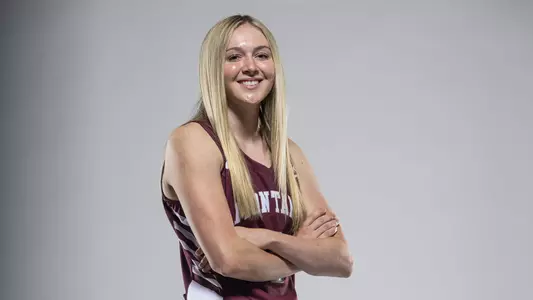
Freshman Orientation :: Draya Wacker
10/22/2022 7:07:00 PM | Women's Basketball
Draya Wacker tore her ACL in September, the one running through her left knee.
It happened in practice. She got the ball on the right wing, drove across the lane for a finish on the left side of the basket. Not a layup but something a few feet away, like there was a shot-blocker guarding the rim.
Maybe it's habit, from all those years of playing against the boys at the Melstone gym, from having to create space for herself, to attack the hoop guardedly, aggressively but with the knowledge that no one was going to take it easy on her just because she happened to be the only girl on the court.
It was a baller's move, a baller's imagination and vision, a baller's finish, something few of her teammates would have attempted, something few women's basketball players would have tried. Or even thought of. For Wacker, it was just natural. She saw the floor, the spacing and made her move.
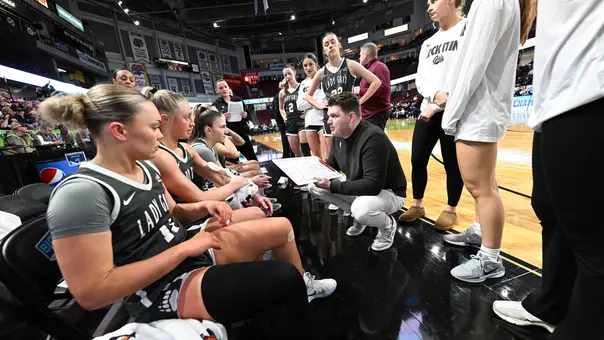
"She does things that girls don't generally do," says Lady Griz coach Brian Holsinger, who has been coaching women's basketball at the college level for more than two decades now, from California to Montana to Washington to Idaho to Oregon and finally back to Montana.
Wacker grew up in Melstone, population 100 and change, one of those towns that dot the ranch land of eastern Montana, a railroad stop, a hub for the ranching families that provide the life support for the school. Her graduating class was six. The high school, grades nine through 12, usually hovers around 30.
It's the type of place that has to co-op with Custer and Hysham just to compete in six-man football.
So, when a girl needs to hoop, she pretty much has to accept the fact it's going to be against the boys. And it's going to be physical, pick-up physical, where foul calls are rare and a girl needs to figure out how to adapt her game simply to survive.
"In my experience, any time a girl has played a lot in her career, she's played with boys, and the amount Draya has played is off the charts. She has a unique love for the game," says Holsinger.
"Pick-up basketball tends to bring creativity. You're playing and figuring things out and you're learning. If you play against better athletes, you have to be creative in finding ways to score or to get by somebody. Those players tend to be better with the ball."
She comes from a place, a land, a lifestyle, with a simple credo: If you can, you do.
It's why her mom, Tamaira, was in Missoula this weekend, coaching the Melstone Broncs at the Montana state cross country championships. Why Tamaira's dad, at the age of 83 and a rancher until he no longer can, is still a brand inspector.
If you don't know: no livestock crosses the Musselshell County border without being inspected, to prevent theft. There he was one month this fall, checking 10,000 head of cattle, give or take a few, from a single ranch. And not a sampling, one out of 10 or a handful out of 100, but every single one of them.
You do the job and you do it right. It's why he received the Western Heritage Award from the Montana Pro Rodeo Hall and Wall of Fame in April.
And why Draya Wacker followed in the footsteps of her dad, Jody, her two older brothers and her older sister and rodeoed on a serious level until she was in eighth grade. Barrel racing, flag racing, goat-tying, pole bending, "all the works," she says.
It's the kind of place where she raced for her mom as a freshman, placing 13th at the Class C state cross country meet as a freshman. After practice she would run over to the gym for volleyball practice. Her team was coached by her older brother, Brayden.
Where BreElle, her older sister, owns the school track and field records in the 800, 1,600 and 3,200 meters and was a Division I prospect until her own ACL injury. Where Draya owns the school records in the long jump and javelin.
The former was set in May, at the Class C state meet, when she went 17-2 to break the previous school record, which was held by her coach, who happened to be her mom.
They are not larger than life in Melstone, the Wackers aren't, they are emblematic of the collective. And it's been that way for a while. A long, long while. Ancestors on Tamaira's side of the family settled the land they are on today in 1885. That's four years before Montana earned statehood.
Jody's out the door every morning before the sun rises. There is work to do, no matter the day of the week, no matter the month of the year. They own 2,500 acres, lease another 7,500. He returns for lunch, then is back out again until sunset.
Tamaira is one of those necessary and selfless godsends who helps a small school run efficiently. She teaches business and music, coaches everything that needs coaching and does everything else that needs doing. She, too, arrives home not on a schedule but when the work is done.
"I never saw anything but hard work. I grew up around it and grew acclimated to it. Don't get me wrong. There are days I'd feel lazy. My parents would just say, get after it," Draya says.
She started trying to help on the ranch when she was six or seven, started moving cows by herself at eight or nine, became an integral part of what made it all work by the time she was 12.
"They instilled in me a mindset of, when it's done, it's done. You've just got to do it. There might be things you don't want to do, but it's got to be done. That's exactly how it is on the ranch. You don't want to go fencing or move cows for six miles, but it has to be done, so you do it."
It's the genesis of her basketball story. Every Sunday: church, home for lunch, then to the school, where Tamaira caught up on correcting schoolwork and assignments while the kids had the run of the gym. Shay, Brayden, BreElle, then Draya, five years younger than any of them.
"Some of the best players I've ever coached have had older brothers," says Holsinger.
It's the type of school where everyone is under one roof, kindergartners running the same hallways as 12th graders. Everyone knows everyone. It's how and why Ole Eike knew what was coming his way on his high school team. He just needed Draya Wacker to age up. Way up.
They'll gladly take any eighth grader on the high school team if she is good enough, but he still had to sit and wait on Wacker.
"You could see in Draya even in the first grade, wow, this kid can handle the ball. She was just advanced. It was just uncanny the way she could handle the basketball. Then everywhere she went, she had a ball. She took it with her everywhere," he says.
He's Melstone to the core as well. Raised there by parents who had been raised there by grandparents who had been raised there themselves. He was a freshman on the Melstone boys' team that made it to state in 1995, a first for the Broncs, a second if you factor in the girls' appearance in 1977.
He and his teammates traveled to Bozeman for the Class C state tournament, to Brick Breeden Fieldhouse, in a scene that could have come straight out of Hoosiers. The coach could have measured the distance of the free throw line and the height of the rim with a tape measure.
"It was a whole new world to us. We were kind of intimidated. A lot of us had never been in a gym that big before. The world was a smaller place back then. It was a big deal for sure," he says.
A decade later, in 2006, his brother was an all-state player on the Melstone team that finally won the whole thing. The coach of that team? Their cousin. "We've got a lot of family here," says Eike, who teaches high school history and PE.
They've gone about making Melstone and basketball synonymous, two things that go hand in hand. "Melstone is one of those Class C schools known for basketball. There are maybe eight or 10 schools in Class C like that. Melstone is one that will come into the conversation."
How is a girl supposed to turn her back on the sport when the entire school goes into basketball mode on game days, when Little Bronc Basketball starts before the middle school and high school games, with drill work, then games on clip-on hoops that bring the goal down to seven and a half feet?
How does a girl not get sucked up in the excitement, not see herself playing on the middle school team, on the varsity? How could she not fall hard for basketball?
"Everybody in the school has a game that day. We try to give them every opportunity coming up to become basketball players," says Eike, who knows well the realities of basketball at the Class C level, at a school the size of Melstone.
"The numbers pose challenges for sure. We hover right around 30 (in 9th through 12th grades). Some years it's 15 and 15, some years it's 20 boys and 10 girls and maybe only eight of those girls go out for the team. It's challenging. You just do what you can with what you have, it's as simple as that," he says.
"You have your ups and downs. There are times you're not going to be competitive, when the tallest player on your team might be 5-8. You just get used to shifting your expectations from year to year based on what you have available to you."
It's why they'll put eighth graders on the varsity. It's why Wacker was a starter as an eighth grader, because she had taken that love of basketball and, over the years, used her experiences to develop the game that separates her from most others.
"I recognized early on that she had a special talent. When I inherited her in the eighth grade, I was very careful about putting any limitations on her like shot selection," says Eike.
"Over time we worked on those things, but early on I was very careful not to discipline her if she took a questionable shot or tried to create something off the dribble. I let her do her thing because I didn't want to take any confidence away from her."
In exchange for that freedom came a burden: "A responsibility to score. She knew she had to score for us to be really competitive," Eike says.
As an eighth grader she was five feet tall, 95 pounds, maybe 100 if she'd eaten a large enough breakfast. She took the game that she had forged playing against all those boys over the years and tried it out against more level competition.
Still, this wasn't pick-up ball. Opposing defenses could make life miserable for her with a box-and-one defensive set or constant double teams that forced the ball out of her hands. "At that age, I wasn't skilled enough to find ways for us to win. That was hard, to lose if I had a bad game."
She watched that night, back in 2016, when BreElle hit 12 3-pointers, a state record, and scored 47 points. Now, as a sophomore, it was Draya's turn to make the game her own, to take those skills and apply them to winning basketball.
The Broncs won their first 20-some games and advanced to the Class C state tournament, their first appearance since that team in 1977.
She did it all those days, including exiting the postgame locker room in full uniform to get to the pep band and the drums so the warmups for the upcoming boys' game could have their proper soundtrack. A rodeo announcer had one time given her the name Dr. Dray. Fit for the drums as well.
"She is a crazy, crazy good drummer, a wild drummer," says her mom, who's been around music her whole life, one of four girls to parents who were in a traveling band to make some extra money on the weekends that ranching didn't supply. When the girls were old enough, they joined as well.
Those genes trickled down, to Shay and Brayden, who formed a band, Fast Forward, that could go an entire summer without an open weekend, with its mix of old-time country and rock.
"Draya could drum for Shay's band. She has a good voice but she'd rather rap than sing country music. She liked all the rap music growing up," says Tamaira, who ended up in her current life against her mom's wishes.
"I clearly remember my mom telling me, for the love of God, if you don't do anything else, never marry a rancher," she says. Oops.
It was never Jody's intention. He was into rodeo, which he did at both Montana Western and Montana State, but after he graduated from MSU with a degree in finance, the siren call of the what he'd always known beckoned him back.
She took her marketing degree from Montana State and they set up in a single-wide trailer in Delphia, midway between Roundup and Melstone. He returned to the ranch life, she started coaching basketball and substitute teaching, and life happened.
They moved to Melstone in 2000, across Highway 12 from the house she grew up in. "I never dreamt in a million years we'd be back here," Tamaira says, perhaps a bit of resignation in her voice but mostly satisfaction at how things have turned out. It's a good life.
Shay, who rodeoed at Montana Western, helps Jody and works in the oil industry while commuting from Billings, where his fiancée is a nurse. Brayden, who played basketball at Rocky Mountain, recently moved to Hawaii. BreElle graduated from MSU Billings and teaches in Baker.
And Draya had just led her sophomore-year team to the state tournament and now was going to try something completely different. She was going to trade in Class C for some letters that carried a lot more weight when it came to college coaches: AAU.
She joined ECI, a team out of North Dakota, and spent the summer traveling the six hours to Bismarck for practice and going around the country for tournaments. They played in the championship game of one of the lower brackets at a major tournament in Des Moines.
"It was a culture shock for me to play in that atmosphere," she says. Eike says it was something she had to do, just to remove that scarlet letter that hung on her like a millstone: C, as in Class C.
Wacker would score 2,300 career points, the fourth most in state history, but there was always that sense of doubt from college coaches. Yeah, but who did she play against?
"It's something the best Class C basketball players are fighting against all the time," he says. "Oh, this player scored 30 last night. So what? Who were they playing against?
"(That summer) was another level of competition for her. Once the competition got better and she was still having that kind of success, that's when college coaches began to recognize she was actually that good."
What had been smaller colleges now included schools like Stephen F. Austin, Wyoming, Colorado State, Montana State, Dixie State, the Lady Griz.
If Melstone was going to finally win a state championship on the girls' side, her junior year was it. And it would have to come in classic Class C style.
"We weren't deep. We had one person off the bench, but our starting five was really solid. We got pretty good at what we had. We shot the three-ball probably the best in the state. I think we had a huge shot to win the state championship," she says.
In late January, the Broncs were 10-1 and ranked No. 3 in the state. Wacker was averaging more than 25 points per game, with a high of 40 in a home win over Jordan.
Everything was going right. Until it wasn't.
When Melstone hosted Wibaux on January 30, 2021, Wacker intercepted a pass and led the charge toward the other end. She pulled up for a short jumper and never got up in the air. Her right ACL was shot.
She watched the rest of the game from the stage. Well-wishers came up and told her everything would be all right, but she knew. Shay had torn one, BreElle two. "I remember her telling me about the pop, and I remember feeling that," Draya says.
Just six days prior, on the previous Sunday night, Wacker had sat through a Zoom recruiting pitch from Montana's former coaching staff, plus Sophia Stiles, small-town legend herself. The offer they made sat there in midair, without a response from Wacker.
"We hung up and I said, you have to explain this to me. I thought this is what you really wanted," says Tamaira. "Where is your mind at? What's holding you back? Is something not right with your gut? She said, I want to, I just don't know how to say it.
"All you have to say is, I'm ready. This feels right and I want to do this. Let's call him right back and get this done. Stop letting this weigh you down. She said she'd wait until the next Sunday's Zoom call. She didn't want to do it over the phone. She literally tears it that Saturday. It was like, what have I done?"
Nothing will send college coaches fleeing like an ACL tear, like an ACL tear in a family that has a history of them, like an ACL tear in a family that has a history of them and a girl with a slight build. "After I got hurt, all of the out-of-state interest faded away," she says.
As if the injury and the loss of basketball wasn't enough in itself, now her future, or what she thought it might be, was being threatened.
She went to practices when she could, went to the games, but it only made things worse. "The mental part of it was really hard, watching them play," she says. "You realize how much you take it for granted. The college part was hard too. I didn't know where anything was at."
She watched as Melstone returned to the state tournament, not quite without her but because of her.
"She was instrumental in elevating the play of everybody around her. I used her to motivate our other players. If you can guard Draya, who are you going to face that you should be fearful of?" asks Eike.
"She gave our other kids so much confidence, just to practice against her every day. It was hard. She's a handful and tough to guard. More often than not, she would have her way with whoever was trying to guard her. But if they had some success against her, who would be better than that?"
The summer that followed was the low point. It came one year after she'd had the best basketball experience of her life, playing with other Division I talent. Then she'd applied the confidence she'd gained to her team at Melstone.
Summers in previous years had followed a cycle as predictable as ranch life. Help her dad, go to the gym for pick-up. Repeat, repeat and repeat. It's never work if you love what you're doing.
"If you're passionate about something, you're going to be willing to put in the time and the effort," says her mom. "I think that's the way she is with the game."
That summer, her ACL injury had also broken her love of the game. If she couldn't play it full-strength, what was the point?
"It was hard watching her struggle like that," says Tamaira, "watching her second-guess. That's what made her what she was as a player. She never second-guessed anything, from a crazy pass she'd make, driving all the way inside, launching a half-courter, she never second-guessed anything.
"I'd never seen that ever. How on earth does this rectify itself?"
Stiles would prove to be a light that helped lead Wacker out of the darkness she found herself in. She, too, had suffered an ACL injury, as a freshman at Montana. She came back and became an All-Big Sky Conference performer by her senior year.
Her advice: Give up the burden to someone else, someone more equipped to handle it.
"She told her, Draya, I'm just going to tell you it's out of your hands," Tamaira recalls. "You need to pray about it, and if it's meant to be for you to come here, you're going to know."
A few days later, Brian Holsinger called.
Like a lot of families with players dreaming about the Lady Griz, the Wackers kept close tabs on the coaching situation at Montana, as it evolved from an interim staff to a national search to the hiring of Holsinger in April 2021.
If her head was spinning from the injury, Holsinger's world was as well. "When I first got here, I was overwhelmed," he admits. He was told about this player from small-town Montana who had torn her ACL. And how, he asked, was he supposed to evaluate her if he couldn't see her play?
He was given video of Wacker's performance the previous summer for ECI, hit start and couldn't take his eyes off her.
"She was playing against good competition and she was dominant offensively," Holsinger says. "She's unique offensively. She has a determination, a confidence, that she's going to make it. She's just fearless.
"She has a knack for getting by people and making shots. She has a creativity that not everybody has and it makes her stand out."
As for first impressions? He called with his 509 area code of a phone number and Wacker promptly blew it off as bogus call. She was on the bus traveling to the state track and field meet, so she passed her phone off to a friend. They answered for her.
Hi, this is Brian Holsinger, the women's basketball coach at the University of Montana. I'm trying to reach Draya. Yeah, Draya, you should probably take this. "They handed it back to me. I was pretty excited," she says.
And then Holsinger did what he does best: He contacted everybody he could within Wacker's tight, influential circle and won them over as well.
"I've never talked to somebody like him before," says Tamaira. "He's so full of energy and vigor. It was a great conversation. I'd never met him, didn't know anything about him but had this really good vibe."
He got them on campus in June, made Wacker's face light up when she walked into the locker room and saw a No. 3 uniform, her potential uniform, hanging there, then he brought Jody and Tamaira to tears when he led them to his office and offered their daughter a scholarship.
"Getting to talk to mom and dad, they fit the culture I want here," Holsinger says. "You never know how a certain family fits, but the values of small town they have and who they want their daughter to be around and what they want her experience to be, it was just an easy fit.
"I liked her game and was willing to take a risk with her injury."
What had been lost was now found, regained. The offer was made and … Draya Wacker sat there, silently, stoically. Holsinger wanted her. Her parents wanted her to be a Lady Griz. The one person who could complete the verbal commitment, the transaction, didn't finalize the deal.
The Wackers walked out, and the coaches met. Why didn't she commit, they wondered? The family walked outside the Adams Center. Jody and Tamaira wondered the same thing.
"What are you doing? I am so confused," Tamaira told Draya. "We drove all this way. I saw the way your eyes lit up when you saw that No. 3 jersey. Everything is right."
It was the Zoom indecisiveness all over again. "She said, I don't know what to say."
They texted the coaches. No replies. They called the coaches. No answers. They bumped into a Griz volleyball coach and asked her to tell any of the Lady Griz coaches that Draya needs to talk to them.
Then they heard a coach calling from across campus. Draya! What's up? "I just want to tell you I want to come here," Tamaira recalls her saying. "(Brian) picked her up and swung her around in a big ol' circle." She will go down in history as Holsinger's first Lady Griz commit.
But that's not the storybook ending. She was still less than five months out from her injury, and returning home to Melstone brought some of the darkness back. She had what she wanted, a college opportunity, and she couldn't put her all into pursuing it, into preparing for it.
"I didn't want to be around it because I knew how long it would be until I got to play again," she says.
She returned for her senior year, but she wasn't the full Draya. (She was going to be Andrea, then Drea, then they finally landed on Draya.)
She was tentative, as anyone would be, of putting her knee to the test. "It took some games to get her into the swing of things. Even at the end, she wasn't taking shots. She wasn't driving because she was nervous and unsure if it would hold up. She didn't want to take any chances," Tamaira says.
But a baller is a baller, even if she changes her game. Of the 10 school records she holds, one is the 138 assists she dished out last season. And Melstone made its third consecutive trip to the Class C state tournament.
This past summer, Wacker found her bliss. Full access to a basketball court, this one in a gym a bit larger than Melstone's, and a group of freshmen in the dorms who are wired just like her.
"Wake up, go to lift, we all had one class, come to practice, eat too much fast food, then we'd always come in and shoot late at night, because our dorms were so hot we couldn't sleep. It was so much fun," she says. "I loved it."
She was back, playing the best basketball of her life, being challenged by her teammates in a way she never had before and still rising to the occasion, her game helping her stand out. She was exceeding everyone's expectations.
Then one afternoon in September she surveyed the floor, the positioning of the defenders and made a strong drive from the right wing to the left side of the basket. She landed and immediately screamed, in pain, in immediate recognition that it had happened again, of what it meant.
So, she's out, sidelined once again, watching while her teammates continue preparing for the season ahead. She's not being left behind, they won't allow it, but she's not doing the one thing that brings her so much joy, the one thing that will one day bring Dahlberg Arena to its feet.
"When I got hurt, I was playing the best basketball I ever had, so I'm just trying to stay positive," she says. "Knowing I did it once and came back and was playing the best basketball I ever had, it makes it a lot easier to know I can do it again, but it's going to be hard to see everything I'm missing out on."
She's asked: What would make this all worth it, going through a second ACL tear?
"Just getting to play in front of this fan base, for these coaches," she says. "I don't know if everyone is like this, but I genuinely love playing basketball. There is nothing I'd rather do. Small drills, five on five, anything super competitive, I just crave it.
"Being able to get those moments again, it would be worth it." And so begins what we can only hope, years from now, will be one of the greatest Lady Griz stories ever told.
It happened in practice. She got the ball on the right wing, drove across the lane for a finish on the left side of the basket. Not a layup but something a few feet away, like there was a shot-blocker guarding the rim.
Maybe it's habit, from all those years of playing against the boys at the Melstone gym, from having to create space for herself, to attack the hoop guardedly, aggressively but with the knowledge that no one was going to take it easy on her just because she happened to be the only girl on the court.
It was a baller's move, a baller's imagination and vision, a baller's finish, something few of her teammates would have attempted, something few women's basketball players would have tried. Or even thought of. For Wacker, it was just natural. She saw the floor, the spacing and made her move.
"She does things that girls don't generally do," says Lady Griz coach Brian Holsinger, who has been coaching women's basketball at the college level for more than two decades now, from California to Montana to Washington to Idaho to Oregon and finally back to Montana.
Wacker grew up in Melstone, population 100 and change, one of those towns that dot the ranch land of eastern Montana, a railroad stop, a hub for the ranching families that provide the life support for the school. Her graduating class was six. The high school, grades nine through 12, usually hovers around 30.
It's the type of place that has to co-op with Custer and Hysham just to compete in six-man football.
So, when a girl needs to hoop, she pretty much has to accept the fact it's going to be against the boys. And it's going to be physical, pick-up physical, where foul calls are rare and a girl needs to figure out how to adapt her game simply to survive.
"In my experience, any time a girl has played a lot in her career, she's played with boys, and the amount Draya has played is off the charts. She has a unique love for the game," says Holsinger.
"Pick-up basketball tends to bring creativity. You're playing and figuring things out and you're learning. If you play against better athletes, you have to be creative in finding ways to score or to get by somebody. Those players tend to be better with the ball."
She comes from a place, a land, a lifestyle, with a simple credo: If you can, you do.
It's why her mom, Tamaira, was in Missoula this weekend, coaching the Melstone Broncs at the Montana state cross country championships. Why Tamaira's dad, at the age of 83 and a rancher until he no longer can, is still a brand inspector.
If you don't know: no livestock crosses the Musselshell County border without being inspected, to prevent theft. There he was one month this fall, checking 10,000 head of cattle, give or take a few, from a single ranch. And not a sampling, one out of 10 or a handful out of 100, but every single one of them.
You do the job and you do it right. It's why he received the Western Heritage Award from the Montana Pro Rodeo Hall and Wall of Fame in April.
And why Draya Wacker followed in the footsteps of her dad, Jody, her two older brothers and her older sister and rodeoed on a serious level until she was in eighth grade. Barrel racing, flag racing, goat-tying, pole bending, "all the works," she says.
It's the kind of place where she raced for her mom as a freshman, placing 13th at the Class C state cross country meet as a freshman. After practice she would run over to the gym for volleyball practice. Her team was coached by her older brother, Brayden.
Where BreElle, her older sister, owns the school track and field records in the 800, 1,600 and 3,200 meters and was a Division I prospect until her own ACL injury. Where Draya owns the school records in the long jump and javelin.
The former was set in May, at the Class C state meet, when she went 17-2 to break the previous school record, which was held by her coach, who happened to be her mom.
They are not larger than life in Melstone, the Wackers aren't, they are emblematic of the collective. And it's been that way for a while. A long, long while. Ancestors on Tamaira's side of the family settled the land they are on today in 1885. That's four years before Montana earned statehood.
Jody's out the door every morning before the sun rises. There is work to do, no matter the day of the week, no matter the month of the year. They own 2,500 acres, lease another 7,500. He returns for lunch, then is back out again until sunset.
Tamaira is one of those necessary and selfless godsends who helps a small school run efficiently. She teaches business and music, coaches everything that needs coaching and does everything else that needs doing. She, too, arrives home not on a schedule but when the work is done.
"I never saw anything but hard work. I grew up around it and grew acclimated to it. Don't get me wrong. There are days I'd feel lazy. My parents would just say, get after it," Draya says.
She started trying to help on the ranch when she was six or seven, started moving cows by herself at eight or nine, became an integral part of what made it all work by the time she was 12.
"They instilled in me a mindset of, when it's done, it's done. You've just got to do it. There might be things you don't want to do, but it's got to be done. That's exactly how it is on the ranch. You don't want to go fencing or move cows for six miles, but it has to be done, so you do it."
It's the genesis of her basketball story. Every Sunday: church, home for lunch, then to the school, where Tamaira caught up on correcting schoolwork and assignments while the kids had the run of the gym. Shay, Brayden, BreElle, then Draya, five years younger than any of them.
"Some of the best players I've ever coached have had older brothers," says Holsinger.
It's the type of school where everyone is under one roof, kindergartners running the same hallways as 12th graders. Everyone knows everyone. It's how and why Ole Eike knew what was coming his way on his high school team. He just needed Draya Wacker to age up. Way up.
They'll gladly take any eighth grader on the high school team if she is good enough, but he still had to sit and wait on Wacker.
"You could see in Draya even in the first grade, wow, this kid can handle the ball. She was just advanced. It was just uncanny the way she could handle the basketball. Then everywhere she went, she had a ball. She took it with her everywhere," he says.
He's Melstone to the core as well. Raised there by parents who had been raised there by grandparents who had been raised there themselves. He was a freshman on the Melstone boys' team that made it to state in 1995, a first for the Broncs, a second if you factor in the girls' appearance in 1977.
He and his teammates traveled to Bozeman for the Class C state tournament, to Brick Breeden Fieldhouse, in a scene that could have come straight out of Hoosiers. The coach could have measured the distance of the free throw line and the height of the rim with a tape measure.
"It was a whole new world to us. We were kind of intimidated. A lot of us had never been in a gym that big before. The world was a smaller place back then. It was a big deal for sure," he says.
A decade later, in 2006, his brother was an all-state player on the Melstone team that finally won the whole thing. The coach of that team? Their cousin. "We've got a lot of family here," says Eike, who teaches high school history and PE.
They've gone about making Melstone and basketball synonymous, two things that go hand in hand. "Melstone is one of those Class C schools known for basketball. There are maybe eight or 10 schools in Class C like that. Melstone is one that will come into the conversation."
How is a girl supposed to turn her back on the sport when the entire school goes into basketball mode on game days, when Little Bronc Basketball starts before the middle school and high school games, with drill work, then games on clip-on hoops that bring the goal down to seven and a half feet?
How does a girl not get sucked up in the excitement, not see herself playing on the middle school team, on the varsity? How could she not fall hard for basketball?
"Everybody in the school has a game that day. We try to give them every opportunity coming up to become basketball players," says Eike, who knows well the realities of basketball at the Class C level, at a school the size of Melstone.
"The numbers pose challenges for sure. We hover right around 30 (in 9th through 12th grades). Some years it's 15 and 15, some years it's 20 boys and 10 girls and maybe only eight of those girls go out for the team. It's challenging. You just do what you can with what you have, it's as simple as that," he says.
"You have your ups and downs. There are times you're not going to be competitive, when the tallest player on your team might be 5-8. You just get used to shifting your expectations from year to year based on what you have available to you."
It's why they'll put eighth graders on the varsity. It's why Wacker was a starter as an eighth grader, because she had taken that love of basketball and, over the years, used her experiences to develop the game that separates her from most others.
"I recognized early on that she had a special talent. When I inherited her in the eighth grade, I was very careful about putting any limitations on her like shot selection," says Eike.
"Over time we worked on those things, but early on I was very careful not to discipline her if she took a questionable shot or tried to create something off the dribble. I let her do her thing because I didn't want to take any confidence away from her."
In exchange for that freedom came a burden: "A responsibility to score. She knew she had to score for us to be really competitive," Eike says.
As an eighth grader she was five feet tall, 95 pounds, maybe 100 if she'd eaten a large enough breakfast. She took the game that she had forged playing against all those boys over the years and tried it out against more level competition.
Still, this wasn't pick-up ball. Opposing defenses could make life miserable for her with a box-and-one defensive set or constant double teams that forced the ball out of her hands. "At that age, I wasn't skilled enough to find ways for us to win. That was hard, to lose if I had a bad game."
She watched that night, back in 2016, when BreElle hit 12 3-pointers, a state record, and scored 47 points. Now, as a sophomore, it was Draya's turn to make the game her own, to take those skills and apply them to winning basketball.
The Broncs won their first 20-some games and advanced to the Class C state tournament, their first appearance since that team in 1977.
She did it all those days, including exiting the postgame locker room in full uniform to get to the pep band and the drums so the warmups for the upcoming boys' game could have their proper soundtrack. A rodeo announcer had one time given her the name Dr. Dray. Fit for the drums as well.
"She is a crazy, crazy good drummer, a wild drummer," says her mom, who's been around music her whole life, one of four girls to parents who were in a traveling band to make some extra money on the weekends that ranching didn't supply. When the girls were old enough, they joined as well.
Those genes trickled down, to Shay and Brayden, who formed a band, Fast Forward, that could go an entire summer without an open weekend, with its mix of old-time country and rock.
"Draya could drum for Shay's band. She has a good voice but she'd rather rap than sing country music. She liked all the rap music growing up," says Tamaira, who ended up in her current life against her mom's wishes.
"I clearly remember my mom telling me, for the love of God, if you don't do anything else, never marry a rancher," she says. Oops.
It was never Jody's intention. He was into rodeo, which he did at both Montana Western and Montana State, but after he graduated from MSU with a degree in finance, the siren call of the what he'd always known beckoned him back.
She took her marketing degree from Montana State and they set up in a single-wide trailer in Delphia, midway between Roundup and Melstone. He returned to the ranch life, she started coaching basketball and substitute teaching, and life happened.
They moved to Melstone in 2000, across Highway 12 from the house she grew up in. "I never dreamt in a million years we'd be back here," Tamaira says, perhaps a bit of resignation in her voice but mostly satisfaction at how things have turned out. It's a good life.
Shay, who rodeoed at Montana Western, helps Jody and works in the oil industry while commuting from Billings, where his fiancée is a nurse. Brayden, who played basketball at Rocky Mountain, recently moved to Hawaii. BreElle graduated from MSU Billings and teaches in Baker.
And Draya had just led her sophomore-year team to the state tournament and now was going to try something completely different. She was going to trade in Class C for some letters that carried a lot more weight when it came to college coaches: AAU.
She joined ECI, a team out of North Dakota, and spent the summer traveling the six hours to Bismarck for practice and going around the country for tournaments. They played in the championship game of one of the lower brackets at a major tournament in Des Moines.
"It was a culture shock for me to play in that atmosphere," she says. Eike says it was something she had to do, just to remove that scarlet letter that hung on her like a millstone: C, as in Class C.
Wacker would score 2,300 career points, the fourth most in state history, but there was always that sense of doubt from college coaches. Yeah, but who did she play against?
"It's something the best Class C basketball players are fighting against all the time," he says. "Oh, this player scored 30 last night. So what? Who were they playing against?
"(That summer) was another level of competition for her. Once the competition got better and she was still having that kind of success, that's when college coaches began to recognize she was actually that good."
What had been smaller colleges now included schools like Stephen F. Austin, Wyoming, Colorado State, Montana State, Dixie State, the Lady Griz.
If Melstone was going to finally win a state championship on the girls' side, her junior year was it. And it would have to come in classic Class C style.
"We weren't deep. We had one person off the bench, but our starting five was really solid. We got pretty good at what we had. We shot the three-ball probably the best in the state. I think we had a huge shot to win the state championship," she says.
In late January, the Broncs were 10-1 and ranked No. 3 in the state. Wacker was averaging more than 25 points per game, with a high of 40 in a home win over Jordan.
Everything was going right. Until it wasn't.
When Melstone hosted Wibaux on January 30, 2021, Wacker intercepted a pass and led the charge toward the other end. She pulled up for a short jumper and never got up in the air. Her right ACL was shot.
She watched the rest of the game from the stage. Well-wishers came up and told her everything would be all right, but she knew. Shay had torn one, BreElle two. "I remember her telling me about the pop, and I remember feeling that," Draya says.
Just six days prior, on the previous Sunday night, Wacker had sat through a Zoom recruiting pitch from Montana's former coaching staff, plus Sophia Stiles, small-town legend herself. The offer they made sat there in midair, without a response from Wacker.
"We hung up and I said, you have to explain this to me. I thought this is what you really wanted," says Tamaira. "Where is your mind at? What's holding you back? Is something not right with your gut? She said, I want to, I just don't know how to say it.
"All you have to say is, I'm ready. This feels right and I want to do this. Let's call him right back and get this done. Stop letting this weigh you down. She said she'd wait until the next Sunday's Zoom call. She didn't want to do it over the phone. She literally tears it that Saturday. It was like, what have I done?"
Nothing will send college coaches fleeing like an ACL tear, like an ACL tear in a family that has a history of them, like an ACL tear in a family that has a history of them and a girl with a slight build. "After I got hurt, all of the out-of-state interest faded away," she says.
As if the injury and the loss of basketball wasn't enough in itself, now her future, or what she thought it might be, was being threatened.
She went to practices when she could, went to the games, but it only made things worse. "The mental part of it was really hard, watching them play," she says. "You realize how much you take it for granted. The college part was hard too. I didn't know where anything was at."
She watched as Melstone returned to the state tournament, not quite without her but because of her.
"She was instrumental in elevating the play of everybody around her. I used her to motivate our other players. If you can guard Draya, who are you going to face that you should be fearful of?" asks Eike.
"She gave our other kids so much confidence, just to practice against her every day. It was hard. She's a handful and tough to guard. More often than not, she would have her way with whoever was trying to guard her. But if they had some success against her, who would be better than that?"
The summer that followed was the low point. It came one year after she'd had the best basketball experience of her life, playing with other Division I talent. Then she'd applied the confidence she'd gained to her team at Melstone.
Summers in previous years had followed a cycle as predictable as ranch life. Help her dad, go to the gym for pick-up. Repeat, repeat and repeat. It's never work if you love what you're doing.
"If you're passionate about something, you're going to be willing to put in the time and the effort," says her mom. "I think that's the way she is with the game."
That summer, her ACL injury had also broken her love of the game. If she couldn't play it full-strength, what was the point?
"It was hard watching her struggle like that," says Tamaira, "watching her second-guess. That's what made her what she was as a player. She never second-guessed anything, from a crazy pass she'd make, driving all the way inside, launching a half-courter, she never second-guessed anything.
"I'd never seen that ever. How on earth does this rectify itself?"
Stiles would prove to be a light that helped lead Wacker out of the darkness she found herself in. She, too, had suffered an ACL injury, as a freshman at Montana. She came back and became an All-Big Sky Conference performer by her senior year.
Her advice: Give up the burden to someone else, someone more equipped to handle it.
"She told her, Draya, I'm just going to tell you it's out of your hands," Tamaira recalls. "You need to pray about it, and if it's meant to be for you to come here, you're going to know."
A few days later, Brian Holsinger called.
Like a lot of families with players dreaming about the Lady Griz, the Wackers kept close tabs on the coaching situation at Montana, as it evolved from an interim staff to a national search to the hiring of Holsinger in April 2021.
If her head was spinning from the injury, Holsinger's world was as well. "When I first got here, I was overwhelmed," he admits. He was told about this player from small-town Montana who had torn her ACL. And how, he asked, was he supposed to evaluate her if he couldn't see her play?
He was given video of Wacker's performance the previous summer for ECI, hit start and couldn't take his eyes off her.
"She was playing against good competition and she was dominant offensively," Holsinger says. "She's unique offensively. She has a determination, a confidence, that she's going to make it. She's just fearless.
"She has a knack for getting by people and making shots. She has a creativity that not everybody has and it makes her stand out."
As for first impressions? He called with his 509 area code of a phone number and Wacker promptly blew it off as bogus call. She was on the bus traveling to the state track and field meet, so she passed her phone off to a friend. They answered for her.
Hi, this is Brian Holsinger, the women's basketball coach at the University of Montana. I'm trying to reach Draya. Yeah, Draya, you should probably take this. "They handed it back to me. I was pretty excited," she says.
And then Holsinger did what he does best: He contacted everybody he could within Wacker's tight, influential circle and won them over as well.
"I've never talked to somebody like him before," says Tamaira. "He's so full of energy and vigor. It was a great conversation. I'd never met him, didn't know anything about him but had this really good vibe."
He got them on campus in June, made Wacker's face light up when she walked into the locker room and saw a No. 3 uniform, her potential uniform, hanging there, then he brought Jody and Tamaira to tears when he led them to his office and offered their daughter a scholarship.
"Getting to talk to mom and dad, they fit the culture I want here," Holsinger says. "You never know how a certain family fits, but the values of small town they have and who they want their daughter to be around and what they want her experience to be, it was just an easy fit.
"I liked her game and was willing to take a risk with her injury."
What had been lost was now found, regained. The offer was made and … Draya Wacker sat there, silently, stoically. Holsinger wanted her. Her parents wanted her to be a Lady Griz. The one person who could complete the verbal commitment, the transaction, didn't finalize the deal.
The Wackers walked out, and the coaches met. Why didn't she commit, they wondered? The family walked outside the Adams Center. Jody and Tamaira wondered the same thing.
"What are you doing? I am so confused," Tamaira told Draya. "We drove all this way. I saw the way your eyes lit up when you saw that No. 3 jersey. Everything is right."
It was the Zoom indecisiveness all over again. "She said, I don't know what to say."
They texted the coaches. No replies. They called the coaches. No answers. They bumped into a Griz volleyball coach and asked her to tell any of the Lady Griz coaches that Draya needs to talk to them.
Then they heard a coach calling from across campus. Draya! What's up? "I just want to tell you I want to come here," Tamaira recalls her saying. "(Brian) picked her up and swung her around in a big ol' circle." She will go down in history as Holsinger's first Lady Griz commit.
But that's not the storybook ending. She was still less than five months out from her injury, and returning home to Melstone brought some of the darkness back. She had what she wanted, a college opportunity, and she couldn't put her all into pursuing it, into preparing for it.
"I didn't want to be around it because I knew how long it would be until I got to play again," she says.
She returned for her senior year, but she wasn't the full Draya. (She was going to be Andrea, then Drea, then they finally landed on Draya.)
She was tentative, as anyone would be, of putting her knee to the test. "It took some games to get her into the swing of things. Even at the end, she wasn't taking shots. She wasn't driving because she was nervous and unsure if it would hold up. She didn't want to take any chances," Tamaira says.
But a baller is a baller, even if she changes her game. Of the 10 school records she holds, one is the 138 assists she dished out last season. And Melstone made its third consecutive trip to the Class C state tournament.
This past summer, Wacker found her bliss. Full access to a basketball court, this one in a gym a bit larger than Melstone's, and a group of freshmen in the dorms who are wired just like her.
"Wake up, go to lift, we all had one class, come to practice, eat too much fast food, then we'd always come in and shoot late at night, because our dorms were so hot we couldn't sleep. It was so much fun," she says. "I loved it."
She was back, playing the best basketball of her life, being challenged by her teammates in a way she never had before and still rising to the occasion, her game helping her stand out. She was exceeding everyone's expectations.
Then one afternoon in September she surveyed the floor, the positioning of the defenders and made a strong drive from the right wing to the left side of the basket. She landed and immediately screamed, in pain, in immediate recognition that it had happened again, of what it meant.
So, she's out, sidelined once again, watching while her teammates continue preparing for the season ahead. She's not being left behind, they won't allow it, but she's not doing the one thing that brings her so much joy, the one thing that will one day bring Dahlberg Arena to its feet.
"When I got hurt, I was playing the best basketball I ever had, so I'm just trying to stay positive," she says. "Knowing I did it once and came back and was playing the best basketball I ever had, it makes it a lot easier to know I can do it again, but it's going to be hard to see everything I'm missing out on."
She's asked: What would make this all worth it, going through a second ACL tear?
"Just getting to play in front of this fan base, for these coaches," she says. "I don't know if everyone is like this, but I genuinely love playing basketball. There is nothing I'd rather do. Small drills, five on five, anything super competitive, I just crave it.
"Being able to get those moments again, it would be worth it." And so begins what we can only hope, years from now, will be one of the greatest Lady Griz stories ever told.
Players Mentioned

G
/ Women's Basketball
G
/ Women's BasketballFriday, June 19
Thursday, June 04
Friday, May 01
Friday, May 01