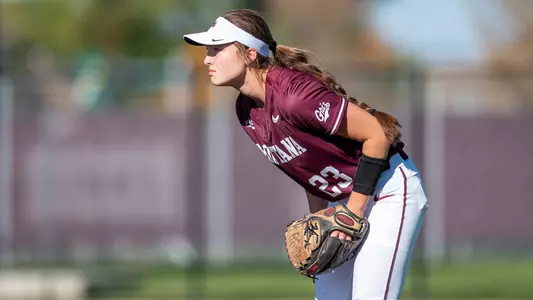
Photo by: Derek Johnson
Origin Stories :: Hannah Jablonski
2/4/2022 5:40:00 PM | Softball
Hannah Jablonski loves math. Loves the order of it, the structure, that if you put in the time and the effort, you can come up with the right answer. For the most part, it's black and white, binary, without a lot of grey area or subjectivity.
It fits her personality. She's a perfectionist with the drive to reach that end point more often than not. Math, as a subject, unlike something like English literature, allows for it. If you mess up, you can figure out why, fix it and never make the same mistake again. You can work at it until you master it.
When she was a freshman in high school, she put together a vision board, the kind of thing over-achievers create to remind themselves on a daily basis that they're working toward something. It also serves as a warning that if they didn't win the day, they've fallen behind.
"She put up everything she wanted to accomplish that year. One of them was to make varsity, one of them was to go to state, one of them was to get a 4.0," says her mom, Kristie, who isn't sure how her daughter ended up being wired quite like she is. It certainly didn't come from her.
"There are a lot of times I look at her and go, okay, you didn't get this from me," she says. "I wish I could go back and be more like her and have that drive to have those goals to try to achieve. She's really good at that."
That freshman year? She made varsity. She pitched Kamiakin High to state. And she got that 4.0. She essentially solved an equation. Talent + hard work + focus = winning. It worked for anything she applied it toward that year.
Of course, there can be some danger in that, of always reaching the goals you've set out before you, especially at that age. Because losing and coming up short once in a while, and learning how to handle those situations and setbacks, can be just as beneficial in a person's development.
That's where Kristie has stepped in. She played volleyball growing up, "but it was mostly for fun," she says. "I was more in it to be with my friends." As a mother, she then became the yin to Hannah's yang, complementary forces.
"My whole thing is balance. I try to bring that to the table in our conversations," says Kristie, a fourth-grade teacher in Kennewick, Wash. "It's not that she doesn't go with the flow, but she wants it so bad.
"When she was in middle school, I had a hard time understanding why she couldn't let something go if she didn't do well or if they didn't win. Her drive is amazing and I respect it completely, but you also learn through failure and when things are tough. You don't learn when things come easily."
Jablonski is playing second base for Montana this season, behind Kendall Curtis. The position where she has more experience is shortstop, which is held down by Maygen McGrath, an all-region player who pitchers got the better of last season more often than she got the better of them.
That's just the math, even when you hit an amazing .410.
That's just softball and for the most part sports in general. The person who fails the fewest times is usually going to win, but there is always going to be failure. That's a certainty.
That's been the round-peg-in-a-square-hole reality for Jablonski, who is seeking perfection in a sport where that possibility is usually out the window by the end of the first inning. Let's just say it's an on-going battle, of a girl who won't be defeated against a sport that can't be topped, at least in that way.
"I think that's something Hannah has been challenged with," says her dad, Ron, who can more easily relate to higher-level athletics than can Kristie.
He was a pitcher. Played two years of baseball at Columbia Basin Community College in his hometown of the Tri-Cities. Gave it a shot at Washington State for a year, where he redshirted the final season of the program under legendary coach Bobo Brayton.
Knowing baseball wasn't his future but that electrical engineering was, he spent his last two years playing at Central Washington and earning his degree.
He gets it. "It's something Hannah has been challenged with. When you're younger, you can have some success just by working like she did. But when you get into more competitive levels, sometimes you just get beat.
"A pitcher is going to throw a ball by you and get the best of you. It was hard for her and it still is hard for her. I don't think anybody ever really gets a grasp on failing. But being able to get a handle on it and move on to the next at-bat, I think she's gotten better at it."
And if all that makes Hannah Jablonski appear more android than flesh and blood in your mind, more automaton than former Washington Angel, then this article isn't getting the job done. But we needed to lay some groundwork, to get the foundation in place before we start giving the picture some color.
But you now at least know who we're dealing with.
She was born in Vancouver, Wash., moved to the Tri-Cities when she was 4, the hometown of that branch of the Jablonski family tree ever since Ron's dad, who had been building nuclear submarines in Newport News, Va., answered the call of Horace Greeley.
"He wanted to be the hunter, the fisherman, so he dreamed about coming out West," says Ron. "With his nuclear emphasis, it was going to be one of two places, either Washington Public Power Supply System in the Tri-Cities or the Trojan (Nuclear Power Plant) in Oregon.
"Work brought him out here, but that's because he wanted to come out here. We're the only Jablonskis out here. Everybody else is back on the East Coast. I'm glad he did. The Northwest is a special place."
Ron fell for baseball not because he was a natural but because it didn't put an emphasis on size and speed the way the other games of his youth, football and basketball, did.
An average Joe could do just fine. "I was never really gifted from a physical standpoint. I was never very big, never very tall. Baseball was one of those sports where size really didn't matter. That's why I found more success and probably why I stuck with it."
The oldest of Ron and Kristie's two children tried everything growing up, but it always came back to softball. You ask her why and she says she still hasn't quite figured it out herself, but the draw has always been there and never wavered.
"I still don't have the perfect answer," she says. "Maybe because I'm competitive but not aggressive, that type of thing. Maybe that's why I clicked more with softball. That and the energy of the game."
Most parents, at least those of Division I-level athletes, can recall that moment of enlightenment, when participation in a sport became something different, when their child separated themselves from their peers, started making it look easier, became dominant.
"That happened for me when Hannah was in second or third grade," says Kristie. "She had broken her arm at the beginning of her rec softball season, so we didn't know what she could do.
"She finally got to play in a tournament. She was a pitcher at the time and just kept striking out all these girls and she didn't have any pitching experience. She went up there with so much confidence. I remember sitting there thinking, oh my gosh, look at Hannah! It was just this ah-ha moment."
And here you're probably thinking, okay, her dad was a college-level pitcher, so of course his daughter is going to follow in those footsteps and become a softball pitcher.
Except it wasn't like that. "I realized how different the two sports can really be, especially when you start getting up to the higher levels," says Ron. "You realized at some point you have to turn them over. She had to learn from people who knew the game of softball."
But early on it was just the two of them, huddling in front of a computer screen, watching YouTube videos. When she started taking pitching lessons, he was the catcher, soaking up tricks of the trade along the way and taking them into their backyard sessions.
"He knew absolutely nothing about softball pitching. We both learned together about how to pitch," says Hannah, who is now a middle infielder, but we'll get there.
Her dad's ah-ha moment? That wouldn't come until Hannah's freshman year. The senior who would have been the staff ace opted to graduate early and enroll in college, giving up her final year at Kamiakin High.
That left Jablonski and a sophomore, with the weight of expectation falling more on the young shoulders of the freshman.
"It was a stressful time because she was the only freshman who made varsity," says Kristie. "The upperclassmen were stressed out thinking they weren't going to make it to state."
The postseason began and the freshman, who had it on her vision board, pitched her team right to the state tournament.
"She was just so in her element. She was so happy and so relaxed and playing because she loved it and was fighting for her team. That was a game I watched with tears in my eyes," says her mom.
"Here were all these girls thinking they weren't going to make it to state, and Hannah pitched them to state."
That's when Ron knew he might have something special on his hands.
"I knew she was a good softball player. At that point I knew she had it mentally. There are lots and lots of good players out there, but do they have it mentally to play? That's when I thought, okay, you might have something here. You might have a future in this above high school," he says.
Today, after a rule change a couple years ago, coaches can't communicate with players until Sept. 1 of their junior year. Back when Jablonski was finishing middle school and starting high school, it was mostly unregulated, which meant she had peers committing, some as early as eighth grade.
And don't you think that did a number on a high-achiever, whose big-picture vision board told her every time she looked at it that she would only be a success if she became a Division I softball player?
And every time she logged on, there was someone else on social media, for all to see, committing to this place or that player announcing she's accepted an offer to go over there.
It was angst, then multiplied for someone like Jablonski. They were reaching the goal before she did, checking it off their big board before she even had reason to take the cap off her permanent marker.
"That was the hard part of the process, seeing these girls living your dream and finding their fit," she says. "Feeling like, wow, why haven't I found my school yet? What's wrong with me? It was total anxiety."
When it came to travel ball, it was no longer playing for the love of the game. It was playing to be recruited, to be seen, to look around and notice who might be watching and wondering if they are going to like what they see. It was one eye on the field, one eye off.
What does that coach's shirt say? Where are they from? Are they Division I?
"I just put so much pressure on myself to want to do so good in front of all these coaches and find my fit, but it got to the point where I started to lose my love for the game because of it," she says.
"It's hard not to look in the stands and see who's all there watching. My sophomore year it really overtook me."
Says her dad, "It was tough. There is nothing that's fun about the recruitment process, at least that I've seen. It's a very stressful time. You watch your child who's devoted her entire life to this sport, and it's out of your control.
"Is she going to reach her dreams that she set or not? It was very painful to go through it and watch."
Add COVID and shutdowns to those recruiting tournaments and you might think it was too much for Hannah Jablonski, to not be in control of the situation when that's what she craves, to be able to make things perfect, or at least have the chance to. Now she didn't.
"Honestly it helped her. She almost relaxed a little bit because everybody was in the same boat," Kristie says. "I thought she was going to be way more stressed when COVID hit because that was her junior year and she wasn't playing.
"I really tried to focus on her that God does have a plan for you and we have to have faith that that's going to happen."
From the mysterious ways file: In 2016 a new elementary school opened in the Tri-Cities. Kristie came on as a teacher. The teacher next door: Julie O'Brien, mother of Sarah O'Brien, who would join Montana's staff as an assistant coach in the summer of 2019.
"She was totally my mentor," Kristie says about raising a college-level softball player. Sarah came first, then more than a decade later Hannah, tracking the same path, with the Washington Angels travel-ball program and Kamiakin High. Then college.
"With Sarah being a coach at Montana, we just heard great things about (coach Melanie Meuchel) and the program and how they're a family, and Hannah is very family-oriented. She needs to feel that community and sense of support within her team."
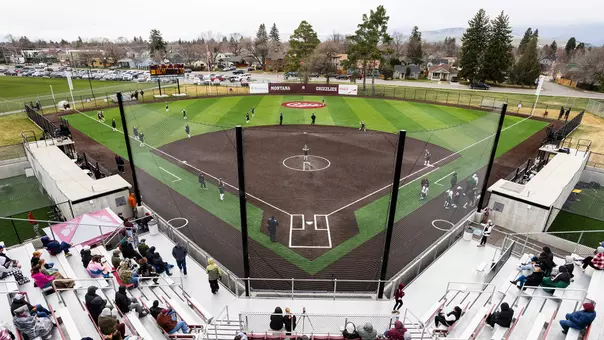
That plot of artificial green, down at South Campus? It soon became Hannah Jablonski's Field of Dreams.
"The first time I saw the field at Montana, there was just something about it. I could picture myself being there," she says. "Once I learned more about Griz Nation and started following along, I just knew I wanted to be a Griz softball player.
"I liked their culture and liked all their values and how everything was run here. I was the one to reach out and send them my highlights. It was definitely me showing the interest."
Those highlights no longer included anything with her pitching, which she gave up after her junior year. She looked at everything objectively – because of course she did – and came to the conclusion that she wanted to be a middle infielder in college.
"I felt like if I wanted to be a dominant Division I pitcher, I would have to put all my time and focus on pitching. I would not work on hitting as much and not work on infield as much as I like to," she says.
"And I love the infield too much to sacrifice that. I just love taking ground balls, probably more than I love taking (batting practice). I made coaches aware of (my pitching background), but it wasn't something I wanted to showcase. It's just something I have in my toolbox."
Of course, now that she's here, at Montana, she has a brand-new set of issues to deal with. How can you be perfect when you're starting at the bottom of the totem pole? And do the veterans think she's worthy of a spot on the team? And what if she makes a mistake, even one? What will they think?
Do the coaches think they made the right decision to bring her here? What did they think of that last play? Was it good enough for them? They didn't say anything. Is that good or bad?
It's not easy being Hannah Jablonski, but she's working on it.
"It puts a new kind of stress on you, and I tend to get stressed very easily but in a good way because I care a lot," she says. "But sometimes I get a little too stressed.
"It's a new kind of stress, of wanting to prove to my coaches that I should be here and that they made the right decision, and prove to my teammates that I deserve to be here."
And that can be a lot of weight to carry onto the field every afternoon.
She's competing with Curtis for time at second base, but this is what family does: Curtis recognized something in Jablonski – and really, aren't they all the same type of person or they wouldn't be here in the first place? – and recommended a book that she thought would help the freshman.
Joshua Metcalf's "Chop Wood Carry Water."
"It's about how to fall in love with the process of becoming great. I get caught up in the result, whether I made an error or made the play. You can't fall in love with the process of being great if all you're worried about is the outcome."
It takes a grinder's mentality, not a perfectionist's. Take 100 ground balls and field and throw 95 cleanly and that's not five mistakes. That's just a pretty good day so that tomorrow it might be 96. And if it's 92, it's all part of the process, repetition so that it feels routine in a game.
"I have 17 other girls on the field who want to win just as badly as I do, and I know they're going to support me no matter what. Everybody makes mistakes," she says.
See? She's getting there already, step by step.
"I've told her, honey, for as much pressure as you put on yourself, you've picked a game of failure," says Kristie. "You're going to fail more times than you succeed when you're up to bat.
"She has grown so much from having Mel as her coach and mentor. She's really taken everything Mel has said and processed everything. Having Mel in her life has been good."
For most freshmen who join Montana, they need to get used to a new speed of the game. Everything happens an nth degree faster and with a bit more intensity than travel ball. They need to catch up or risk falling behind.
For Jablonski, it's been the opposite. She has had to learn to slow things down. That stress she mentioned? The need to prove herself? It has her playing faster than she needs to, has her overthinking things, her mind going 90 miles an hour when she'll play better at 60.
"She plays the game faster than it needs to be played currently," says Meuchel. "I see growth in her every single day. Once she can figure out the speed of the game …"
The sentence goes uncompleted. It's left to the imagination. It's three dots, waiting to be filled in with potential, a formula awaiting an answer.
It fits her personality. She's a perfectionist with the drive to reach that end point more often than not. Math, as a subject, unlike something like English literature, allows for it. If you mess up, you can figure out why, fix it and never make the same mistake again. You can work at it until you master it.
When she was a freshman in high school, she put together a vision board, the kind of thing over-achievers create to remind themselves on a daily basis that they're working toward something. It also serves as a warning that if they didn't win the day, they've fallen behind.
"She put up everything she wanted to accomplish that year. One of them was to make varsity, one of them was to go to state, one of them was to get a 4.0," says her mom, Kristie, who isn't sure how her daughter ended up being wired quite like she is. It certainly didn't come from her.
"There are a lot of times I look at her and go, okay, you didn't get this from me," she says. "I wish I could go back and be more like her and have that drive to have those goals to try to achieve. She's really good at that."
That freshman year? She made varsity. She pitched Kamiakin High to state. And she got that 4.0. She essentially solved an equation. Talent + hard work + focus = winning. It worked for anything she applied it toward that year.
Of course, there can be some danger in that, of always reaching the goals you've set out before you, especially at that age. Because losing and coming up short once in a while, and learning how to handle those situations and setbacks, can be just as beneficial in a person's development.
That's where Kristie has stepped in. She played volleyball growing up, "but it was mostly for fun," she says. "I was more in it to be with my friends." As a mother, she then became the yin to Hannah's yang, complementary forces.
"My whole thing is balance. I try to bring that to the table in our conversations," says Kristie, a fourth-grade teacher in Kennewick, Wash. "It's not that she doesn't go with the flow, but she wants it so bad.
"When she was in middle school, I had a hard time understanding why she couldn't let something go if she didn't do well or if they didn't win. Her drive is amazing and I respect it completely, but you also learn through failure and when things are tough. You don't learn when things come easily."
Jablonski is playing second base for Montana this season, behind Kendall Curtis. The position where she has more experience is shortstop, which is held down by Maygen McGrath, an all-region player who pitchers got the better of last season more often than she got the better of them.
That's just the math, even when you hit an amazing .410.
That's just softball and for the most part sports in general. The person who fails the fewest times is usually going to win, but there is always going to be failure. That's a certainty.
That's been the round-peg-in-a-square-hole reality for Jablonski, who is seeking perfection in a sport where that possibility is usually out the window by the end of the first inning. Let's just say it's an on-going battle, of a girl who won't be defeated against a sport that can't be topped, at least in that way.
"I think that's something Hannah has been challenged with," says her dad, Ron, who can more easily relate to higher-level athletics than can Kristie.
He was a pitcher. Played two years of baseball at Columbia Basin Community College in his hometown of the Tri-Cities. Gave it a shot at Washington State for a year, where he redshirted the final season of the program under legendary coach Bobo Brayton.
Knowing baseball wasn't his future but that electrical engineering was, he spent his last two years playing at Central Washington and earning his degree.
He gets it. "It's something Hannah has been challenged with. When you're younger, you can have some success just by working like she did. But when you get into more competitive levels, sometimes you just get beat.
"A pitcher is going to throw a ball by you and get the best of you. It was hard for her and it still is hard for her. I don't think anybody ever really gets a grasp on failing. But being able to get a handle on it and move on to the next at-bat, I think she's gotten better at it."
And if all that makes Hannah Jablonski appear more android than flesh and blood in your mind, more automaton than former Washington Angel, then this article isn't getting the job done. But we needed to lay some groundwork, to get the foundation in place before we start giving the picture some color.
But you now at least know who we're dealing with.
She was born in Vancouver, Wash., moved to the Tri-Cities when she was 4, the hometown of that branch of the Jablonski family tree ever since Ron's dad, who had been building nuclear submarines in Newport News, Va., answered the call of Horace Greeley.
"He wanted to be the hunter, the fisherman, so he dreamed about coming out West," says Ron. "With his nuclear emphasis, it was going to be one of two places, either Washington Public Power Supply System in the Tri-Cities or the Trojan (Nuclear Power Plant) in Oregon.
"Work brought him out here, but that's because he wanted to come out here. We're the only Jablonskis out here. Everybody else is back on the East Coast. I'm glad he did. The Northwest is a special place."
Ron fell for baseball not because he was a natural but because it didn't put an emphasis on size and speed the way the other games of his youth, football and basketball, did.
An average Joe could do just fine. "I was never really gifted from a physical standpoint. I was never very big, never very tall. Baseball was one of those sports where size really didn't matter. That's why I found more success and probably why I stuck with it."
The oldest of Ron and Kristie's two children tried everything growing up, but it always came back to softball. You ask her why and she says she still hasn't quite figured it out herself, but the draw has always been there and never wavered.
"I still don't have the perfect answer," she says. "Maybe because I'm competitive but not aggressive, that type of thing. Maybe that's why I clicked more with softball. That and the energy of the game."
Most parents, at least those of Division I-level athletes, can recall that moment of enlightenment, when participation in a sport became something different, when their child separated themselves from their peers, started making it look easier, became dominant.
"That happened for me when Hannah was in second or third grade," says Kristie. "She had broken her arm at the beginning of her rec softball season, so we didn't know what she could do.
"She finally got to play in a tournament. She was a pitcher at the time and just kept striking out all these girls and she didn't have any pitching experience. She went up there with so much confidence. I remember sitting there thinking, oh my gosh, look at Hannah! It was just this ah-ha moment."
And here you're probably thinking, okay, her dad was a college-level pitcher, so of course his daughter is going to follow in those footsteps and become a softball pitcher.
Except it wasn't like that. "I realized how different the two sports can really be, especially when you start getting up to the higher levels," says Ron. "You realized at some point you have to turn them over. She had to learn from people who knew the game of softball."
But early on it was just the two of them, huddling in front of a computer screen, watching YouTube videos. When she started taking pitching lessons, he was the catcher, soaking up tricks of the trade along the way and taking them into their backyard sessions.
"He knew absolutely nothing about softball pitching. We both learned together about how to pitch," says Hannah, who is now a middle infielder, but we'll get there.
Her dad's ah-ha moment? That wouldn't come until Hannah's freshman year. The senior who would have been the staff ace opted to graduate early and enroll in college, giving up her final year at Kamiakin High.
That left Jablonski and a sophomore, with the weight of expectation falling more on the young shoulders of the freshman.
"It was a stressful time because she was the only freshman who made varsity," says Kristie. "The upperclassmen were stressed out thinking they weren't going to make it to state."
The postseason began and the freshman, who had it on her vision board, pitched her team right to the state tournament.
"She was just so in her element. She was so happy and so relaxed and playing because she loved it and was fighting for her team. That was a game I watched with tears in my eyes," says her mom.
"Here were all these girls thinking they weren't going to make it to state, and Hannah pitched them to state."
That's when Ron knew he might have something special on his hands.
"I knew she was a good softball player. At that point I knew she had it mentally. There are lots and lots of good players out there, but do they have it mentally to play? That's when I thought, okay, you might have something here. You might have a future in this above high school," he says.
Today, after a rule change a couple years ago, coaches can't communicate with players until Sept. 1 of their junior year. Back when Jablonski was finishing middle school and starting high school, it was mostly unregulated, which meant she had peers committing, some as early as eighth grade.
And don't you think that did a number on a high-achiever, whose big-picture vision board told her every time she looked at it that she would only be a success if she became a Division I softball player?
And every time she logged on, there was someone else on social media, for all to see, committing to this place or that player announcing she's accepted an offer to go over there.
It was angst, then multiplied for someone like Jablonski. They were reaching the goal before she did, checking it off their big board before she even had reason to take the cap off her permanent marker.
"That was the hard part of the process, seeing these girls living your dream and finding their fit," she says. "Feeling like, wow, why haven't I found my school yet? What's wrong with me? It was total anxiety."
When it came to travel ball, it was no longer playing for the love of the game. It was playing to be recruited, to be seen, to look around and notice who might be watching and wondering if they are going to like what they see. It was one eye on the field, one eye off.
What does that coach's shirt say? Where are they from? Are they Division I?
"I just put so much pressure on myself to want to do so good in front of all these coaches and find my fit, but it got to the point where I started to lose my love for the game because of it," she says.
"It's hard not to look in the stands and see who's all there watching. My sophomore year it really overtook me."
Says her dad, "It was tough. There is nothing that's fun about the recruitment process, at least that I've seen. It's a very stressful time. You watch your child who's devoted her entire life to this sport, and it's out of your control.
"Is she going to reach her dreams that she set or not? It was very painful to go through it and watch."
Add COVID and shutdowns to those recruiting tournaments and you might think it was too much for Hannah Jablonski, to not be in control of the situation when that's what she craves, to be able to make things perfect, or at least have the chance to. Now she didn't.
"Honestly it helped her. She almost relaxed a little bit because everybody was in the same boat," Kristie says. "I thought she was going to be way more stressed when COVID hit because that was her junior year and she wasn't playing.
"I really tried to focus on her that God does have a plan for you and we have to have faith that that's going to happen."
From the mysterious ways file: In 2016 a new elementary school opened in the Tri-Cities. Kristie came on as a teacher. The teacher next door: Julie O'Brien, mother of Sarah O'Brien, who would join Montana's staff as an assistant coach in the summer of 2019.
"She was totally my mentor," Kristie says about raising a college-level softball player. Sarah came first, then more than a decade later Hannah, tracking the same path, with the Washington Angels travel-ball program and Kamiakin High. Then college.
"With Sarah being a coach at Montana, we just heard great things about (coach Melanie Meuchel) and the program and how they're a family, and Hannah is very family-oriented. She needs to feel that community and sense of support within her team."
That plot of artificial green, down at South Campus? It soon became Hannah Jablonski's Field of Dreams.
"The first time I saw the field at Montana, there was just something about it. I could picture myself being there," she says. "Once I learned more about Griz Nation and started following along, I just knew I wanted to be a Griz softball player.
"I liked their culture and liked all their values and how everything was run here. I was the one to reach out and send them my highlights. It was definitely me showing the interest."
Those highlights no longer included anything with her pitching, which she gave up after her junior year. She looked at everything objectively – because of course she did – and came to the conclusion that she wanted to be a middle infielder in college.
"I felt like if I wanted to be a dominant Division I pitcher, I would have to put all my time and focus on pitching. I would not work on hitting as much and not work on infield as much as I like to," she says.
"And I love the infield too much to sacrifice that. I just love taking ground balls, probably more than I love taking (batting practice). I made coaches aware of (my pitching background), but it wasn't something I wanted to showcase. It's just something I have in my toolbox."
Of course, now that she's here, at Montana, she has a brand-new set of issues to deal with. How can you be perfect when you're starting at the bottom of the totem pole? And do the veterans think she's worthy of a spot on the team? And what if she makes a mistake, even one? What will they think?
Do the coaches think they made the right decision to bring her here? What did they think of that last play? Was it good enough for them? They didn't say anything. Is that good or bad?
It's not easy being Hannah Jablonski, but she's working on it.
"It puts a new kind of stress on you, and I tend to get stressed very easily but in a good way because I care a lot," she says. "But sometimes I get a little too stressed.
"It's a new kind of stress, of wanting to prove to my coaches that I should be here and that they made the right decision, and prove to my teammates that I deserve to be here."
And that can be a lot of weight to carry onto the field every afternoon.
She's competing with Curtis for time at second base, but this is what family does: Curtis recognized something in Jablonski – and really, aren't they all the same type of person or they wouldn't be here in the first place? – and recommended a book that she thought would help the freshman.
Joshua Metcalf's "Chop Wood Carry Water."
"It's about how to fall in love with the process of becoming great. I get caught up in the result, whether I made an error or made the play. You can't fall in love with the process of being great if all you're worried about is the outcome."
It takes a grinder's mentality, not a perfectionist's. Take 100 ground balls and field and throw 95 cleanly and that's not five mistakes. That's just a pretty good day so that tomorrow it might be 96. And if it's 92, it's all part of the process, repetition so that it feels routine in a game.
"I have 17 other girls on the field who want to win just as badly as I do, and I know they're going to support me no matter what. Everybody makes mistakes," she says.
See? She's getting there already, step by step.
"I've told her, honey, for as much pressure as you put on yourself, you've picked a game of failure," says Kristie. "You're going to fail more times than you succeed when you're up to bat.
"She has grown so much from having Mel as her coach and mentor. She's really taken everything Mel has said and processed everything. Having Mel in her life has been good."
For most freshmen who join Montana, they need to get used to a new speed of the game. Everything happens an nth degree faster and with a bit more intensity than travel ball. They need to catch up or risk falling behind.
For Jablonski, it's been the opposite. She has had to learn to slow things down. That stress she mentioned? The need to prove herself? It has her playing faster than she needs to, has her overthinking things, her mind going 90 miles an hour when she'll play better at 60.
"She plays the game faster than it needs to be played currently," says Meuchel. "I see growth in her every single day. Once she can figure out the speed of the game …"
The sentence goes uncompleted. It's left to the imagination. It's three dots, waiting to be filled in with potential, a formula awaiting an answer.
Players Mentioned



This Is Montana Grizzly Football
Monday, June 01
Lady Griz Basketball Locker Room Unveiling - 5/1/26
Friday, May 01
Griz Track & Field - Montana Open Highlights - 4/25/26
Friday, May 01
Griz Softball vs. Idaho State Game-Winning Hit - 3/25/26
Friday, May 01