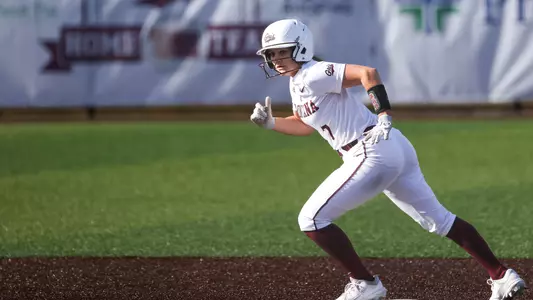
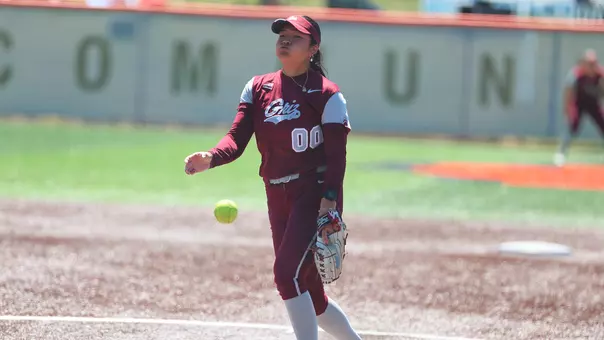
Photo by: Derek Johnson
Origin Stories :: Presley Jantzi
3/18/2022 6:12:00 PM | Softball
"Ask her about her summer job." That's Montana softball coach Melanie Meuchel's advice to employ as an icebreaker when sitting down with Presley Jantzi for the first time in preparation for this article.
So you do, and it doesn't take long to learn that Jantzi needs no icebreaker. She'll tell you whatever you want to know and then some, a lot of it unprompted and off topic. And it's a blast.
"Presley is more outgoing, talkative," says her dad, Rod, when asked to compare his two softball-playing daughters. "Kennedy is more reserved. Presley will make friends with anybody. She can talk. That's my Pres."
Back to that job. In the summer of 2020, with softball for the most part canceled, outside of the family's basement hitting cage and backyard in Albany, Ore., that leads to nothing but open fields, practice areas that never closed, Jantzi started driving a combine. She was 16.
It's what her dad grew up doing, working on his uncle's farm. He thought it would be good for his daughter to experience the work and the lifestyle. And there is a lot of work and combining to be done in the Willamette Valley, home of 1,300-some farms in the Grass Seed Capital of the World.
She got five hours of supervised training her first day, then she was on her own the rest of the summer, just her, the combine, her Netflix and rolling farmland. "It's not that hard. It's a couple of buttons. You just have to learn how to stay in a straight line and focus on rows and you're good," she says.
"You start on a field and it could take 11 hours and you could still not finish the field." She keeps going, how on a warm day you go 3.2 miles per hour but on cooler or wet days, 2.4 is the max if you want the best results. "It feels weird to get back in your car at the end of the day."
Then she'd drive home, to the family house at the end of the road outside Albany, the one without anyone nearby, at least close enough to meddle. "My dad's not a big neighbor guy," Jantzi offers, likely at the end of a discussion that began with a question that had nothing to do with neighbors.
But you want to know more than stories about combines or where the family home is located. You want to know how it all came to be that she is here, at Montana, leading the team in hitting as a true freshman at .362, the Big Sky Conference leader in doubles.
And not just the how of her recruiting story, but that's fun too. How she was playing for the Northwest Bullets and how there was a recruiting showcase at Jesuit High in Beaverton and how Jantzi was just being herself when she threw a ball from the outfield fence back to the infield, probably on a dime.
Meuchel was there. She was hooked on the potential of the player. But she needed to learn more about the person, so weekly phone calls, when they were finally allowed, commenced. Jantzi would retreat to her room, leaving her mom not only in the dark but on pins and needles.
"I wanted so bad to put my ear up to the door to listen to the conversation," says Gina, who assumed player and coach were going through negotiations, about scholarship offers and such. You know, the nitty-gritty, not pleasantries and chitchat.
"She would come out of her room with this big smile on her face. What did they say? Oh, we just talked. They didn't say anything about a scholarship? No, we just talked. What did you talk about? What we had for dinner.
"Presley was 100 percent okay with that. I was 100 percent not. What are we doing? What's the decision here?"
You'll need to forgive Gina for her anxiousness and uneasiness. This slow-motion, long-term recruiting game was all new to her.
Her recruiting story, as a pitcher in the Willamette Valley growing up? She called the coach at Western Oregon, who told her to show up on the first day of practice, so she showed up on the first day of practice and was on the team. One phone call. Done.
The one-call approach would be the death of Meuchel, who tends to her throwing and hitting flock with uncommon care. That's why she does her due diligence before letting just anyone in the door, to keep out the wolves. It has to be the right fit, so she and her staff call and call and call.
Even if it's to talk about nothing more than what the Jantzis had for dinner that night.
"They did a really good job getting to know her. They don't want to recruit just good softball players. They want to recruit good people and good kids who will fit into their program," Gina says.
Not that it made it any easier on mom. "Any parent who goes through this recruiting thing, it is awful. It's awful," she says.
"Then when they come to watch you and you don't happen to have your best game, you just feel for your kid. That's the hardest part as a parent, wanting your kid to succeed when they are there to watch but knowing this is a game of failure."
But we're getting off task here, too far ahead of ourselves, way off point. We're too focused on the how (she got here) instead of the why (she's killing it and has been for years).
This is what we're looking for: Rod and Gina are both products of the Willamette Valley. They raised two girls in a modest lifestyle. She's a teacher. He worked for the local garbage company for 23 years before getting back into the seed business a few years ago.
They gave their girls everything they could, not in terms of possessions but opportunities. But it came with one ultimatum. Your dad and I will never work harder than you.
Meaning: If Rod and Gina had to work harder than the girls were willing to for the opportunities that came from the parents' labor to provide, "it's time for you to give it up. When we have to work harder than you, then maybe that's telling you this isn't your passion or what you want to do," Gina says.
Whether it was already her nature or it was that lesson taking hold, Presley Jantzi embraced it. "She's just that kid. When it was a hitting lesson, it was never I don't want to go. She just does it," says her mom.
When she was a senior at West Albany High, her coach, Ryan Borde, needed her to play third base. And not for just a game or two, for the entire season. And Jantzi, who likes the space to roam and run that the outfield provides, does not like to play third base. At all.
"It's a little scary. It's a little close for me. In the outfield you have 120 feet to react to a ball. There you have 45, depending how close you're playing in," Jantzi says. Then she adds the money quote, the one that reveals all. "But we needed it."
(Pause for Gina's goosebumps to settle and proud heart to return to normal size.)
"With her speed and range, she is a natural center fielder," says Borde. "But we had nobody who we felt was capable of playing third base as well as Presley could. Not once did she complain about it. She knew that's what we needed to do to win. I can't say enough about her attitude."
(And now we're getting into the meat of an origin story, don't you think? Tales of combines are fun, but this is the good stuff, the qualify material.)
Kennedy and Presley played other sports growing up – Kennedy was into volleyball, Presley won three middle school state championships in basketball – but softball ultimately came along and won both their hearts. Maybe it was bound to. "They got that from their mom," says Rod.
If the recruiting process years down the road was a novel frontier for the Jantzis, imagine how it felt entering the world of travel softball.
"We saw people going to teams in Salem and Portland and thought, oh, you guys are crazy," says Gina. "You're driving your kid to Salem, to Portland for practice? Then we became part of the crazy."
But not right away. Call it a soft entry, a cautious first step into this unknown.
"We didn't know what to do. Kennedy was our guinea pig. We had her in Little League forever. We knew it wasn't the best competition, but we didn't know what to do," says Gina.
After graduating from West Albany High, Kennedy began her collegiate career at Mt. Hood Community College, where she batted .525 with 26 home runs and 93 RBIs in 2019. She played a partial season, in 2020, at Concordia in Portland, a school that no longer exists, before landing at Oregon Tech.
Last year the Owls went 48-10 and were one hit away from winning an NAIA national championship in Columbus, Ga. This year Oregon Tech is off to a 22-4 start and once again on the short list of national championship contenders.
Jantzi batted .346 last season, led the team in home runs and ranked second in RBIs. Through 26 games this season she is batting .356.
Even with all that success, there has always been that nagging question: What could have been? "I feel bad for her. I think she could have played at a higher level," says her mom. "We just didn't know. But she's happy."
Her younger sister, on the other hand, always knew. "Presley was 10 when she told me, I'm going to play 'D-1.' Do you even know what that is? Yeah, the ones you see on TV. That was her dream," says Gina.
"We might go broke getting you there, but we will do everything we can, so we became those crazy people. Salem for the Titans, Hillsboro for the Oregon Thunder and finally to Northwest Bullets."
Both girls became pitchers, Presley sticking with it until she was 16, both following in their mom's footsteps. That they both gave it up in pursuit of hitting and fielding was of no disappointment to their mom, who needed a break from the stress.
You mean she didn't want them pitching? "No, no, no. I wore out many a shoes pacing when they were pitching," she says. "Presley stuck with it longer than Kennedy did. She was good at it as a 10U, 12U, 14U pitcher. Then one day she said she wanted to do that slapping thing."
To see Jantzi now, as a freshman in college, is to see an imposing presence at the plate, one with strength, bat speed and superior hand-eye coordination. It's why she's batting in the No. 4 spot in the order, behind Cami Sellers and Maygen McGrath, why she has the team's best slugging percentage.
To picture her as a slap hitter makes the head spin, until you hear her say, "I was a petite little thing." Her dad adds, "She was really small and fast." Her mom: "She was always teeny tiny."
So, Rod thought, let's change her from a right-handed hitter into a left-handed slapper, to take advantage of her speed and her hand-eye coordination. Keep in mind she had never batted from the left side of the plate.
"I switched her to slapper when she was maybe fifth grade. A lot of people questioned it but she picked it up real quick and got really good at it," he says.
Rod, father of the smallest girl on the team, also had another game-changing idea a few years later. Let's get her to "Rocky in Lebanon," a near mythical figure mentioned by multiple people for this article but never by full name. But he knows who he is and what he did.
"That's what changed it all. I gained probably 30 pounds and got just so much bigger and stronger," Jantzi says.
What you see now is a blend of those two decisions, a hitter with power who has retained the skills she picked up as a slap hitter. Those Big Sky-leading nine doubles? Seven of them have been hit between the left-field line and left-center, opposite way for the left-handed hitter.
"Once she started lifting with Rocky in Lebanon" – who is this guy? – "within months she just continued to blossom and get stronger," says Borde, her high school coach. "You'd see it in batting practice. When she wasn't slapping, the balls were just flying out of the park.
"She's always been able to spray the ball to all fields. Because she was a slap hitter growing up, she's learned to hit the pitch where it is. If it's an outside pitch, let it travel a little bit and hit it the other way. She's able to read the pitch and hit it where it is."
They would become known as West Albany High's Fab Four, three of whom are in their first year of college softball, one at Montana, one at Portland State, one at Mt. Hood. Back then they were eighth graders known as Presley, Ellie, McKenzie and Riley.
And Borde knew even then what he was seeing and what he'd be getting on his team in just one more year. "There were four girls in that class who all had potential to play college softball, and Presley was right there at the top," he says.
"I saw her as an eighth grader and knew she was going to be a special talent. She was a starter from Day 1. Even as a freshman, you could tell she was destined to play Division I college softball."
Then came the transformation, courtesy of Rocky in Lebanon: early in her sophomore year, the slap hitter pounded our four home runs, which changed her coach's thinking. Okay, you're not going to slap anymore. I want you to hit away.
Then she came to a winter camp at Montana and was told the same thing, after arriving thinking she would show off her slap-hitting abilities. "Mel saw me and was like, 'Don't even think about slapping. I want you to hit away.'" So she did. And is.
Jantzi would be voted first-team all-state as a freshman, sophomore and senior at West Albany, with her junior year ending with honorable-mention all-combine-driving honors. As a senior she was named the Oregon Class 5A Player of the Year after leading the classification with a .661 batting average.
"Pitchers were throwing half the speed of what we're seeing now," says Jantzi, which makes her .362 batting average even more impressive.
"It compares to travel ball in terms of movement, but I think the speed increases two or three miles per hour. It's a huge difference. They're coming at you with this crazy spin."
Before she was hitting college softball pitchers, before she left the house last summer, leaving Rod and Gina empty-nesters – "My house is cleaner but it's a lot more boring," she says.
Before all those trips to Portland and back for softball with the Fab Four – "It was a lot of time in the car, but I will never take any of that back. I loved the conversations with the kids. Those were some of the best experiences. It was so fun," says Gina.
Before all the emails a young Jantzi sent to Montana's coach – only to go unreturned because she continued to misspell Meuchel, "so we didn't think Montana was that interested," says Gina – when Rod was still working his job that started at 4 a.m. that allowed his afternoons to be free for practice.
Before mom and daughter had their heads sent spinning at the Boulder IDT in Colorado – "You saw all the big names. Alabama's coach, Florida's coach, the ones you see on TV. I was starstruck. We both were. And, oh my gosh, they were all here watching," Gina says.
Before she spent all those evenings in the basement, sitting on that bucket as her girls worked on their swings.
Before any of that, it was March 2009 and Jantzi's future coach at West Albany was the Portland State sports information director for the school's volleyball, women's basketball and softball teams.
He was in Missoula for the Big Sky Conference women's basketball tournament. Montana and Portland State were playing in the championship game. Nearly 5,000 people would show up for a tense game that had 14 lead changes before the Lady Griz pulled away late to win 69-62.
It was his first time at a Grizzly sporting event. And he'd never seen anything like it at a school that wasn't Power 5.
"The support Montana gets is just impressive," he said this week. "Right when you walked in the gym, you could tell how much people cared. They are passionate. It's different from a lot of the other mid-major schools I visited."
Did Borde get in Jantzi's ear once he knew Montana was interested? You know he did.
"I told her she would be going to a unique environment where she is going to have a ton of fan support," he says. "She'd have people at her games, which she might not get at a lot of other schools. And I told her she would love the atmosphere."
And in the other ear was Ali Hooks, recruiting coordinator for the Northwest Bullets. "She was a Montana fan," says Gina. "She believes in their program, believes in their coaching staff. She said, 'Presley, I think this would be a good fit for you. Give them a chance.'"
The recruiting competition for the Grizzlies was right up the road, relatively speaking. Her college choice came down to Portland State and Montana.
"For selfish reasons I wanted her to go to Portland State," says Gina. "It would be so close and we could go to all her games. Rod didn't want her to go to Portland State. Portland is a mess right now and has been for a while."
Father and daughter flew to Missoula for a camp before her decision had been made, when all options were still on the table. Then they weren't. The table had been cleared of every school but one.
"They flew one day, flew home the next," says Gina. "When she came home I knew that it was over. We might as well not go anywhere else."
Gina knows. Before she enrolled at Western Oregon she was a student at Oregon State for three days. She intended to walk on with the Beavers, but the size of campus and the auditorium-style seating in the classrooms was just too much. She quickly bolted for something that was more her style and her speed.
She learned you don't just pick the softball program. It's an all-encompassing choice, from city to school to program, coaches and players, all of it important.
"Presley at Montana was the right fit for school and softball," she says. "I wholeheartedly believe she made the right choice."
Meuchel calls each of her teams a family and, in addition to that, each player brings in her own family, tethered along for the ride, because none of them would be here without first being supported for so long and to such a degree. After all, college softball players are made, not born.
Though there is some of the latter: Jantzi's success was hardwired into her. Your dad and I will never work harder than you. And she's owned it. She's lived up to it. It was the type of thing – practical, brutally honest but full of love – passed down to Rod and Gina in their own families.
Their daughters will be better for it for the rest of their lives.
Neither Rod nor Gina cares much for body markings or piercings, but what were they going to say when Presley said she wanted to get a tattoo to honor Gina's mom, who passed away just over a year ago?
And that she wanted to get the tattoo on her left arm, on the inside of her forearm, the last thing she would see every time she stepped into the batter's box before zeroing in on the pitcher and then the ball as it's being released.
It was taken from a birthday card, an exact replica of her sign-off, Love ya, Grandma JoJo, with the J's backwards as was her custom. It's a memorial of some weightiness that gives her strength at a time when she might just need a moment of calm.
Soon she'll get her other grandma's signature, Rod's mom, who's still living just down the road (but not too close; those Jantzis need their space after all).
"It kind of feels like I'm bringing them along with me," Jantzi says. She means her grandmas, but she is being lifted by everyone who has had a hand in this. That's how it works.
So you do, and it doesn't take long to learn that Jantzi needs no icebreaker. She'll tell you whatever you want to know and then some, a lot of it unprompted and off topic. And it's a blast.
"Presley is more outgoing, talkative," says her dad, Rod, when asked to compare his two softball-playing daughters. "Kennedy is more reserved. Presley will make friends with anybody. She can talk. That's my Pres."
Back to that job. In the summer of 2020, with softball for the most part canceled, outside of the family's basement hitting cage and backyard in Albany, Ore., that leads to nothing but open fields, practice areas that never closed, Jantzi started driving a combine. She was 16.
It's what her dad grew up doing, working on his uncle's farm. He thought it would be good for his daughter to experience the work and the lifestyle. And there is a lot of work and combining to be done in the Willamette Valley, home of 1,300-some farms in the Grass Seed Capital of the World.
She got five hours of supervised training her first day, then she was on her own the rest of the summer, just her, the combine, her Netflix and rolling farmland. "It's not that hard. It's a couple of buttons. You just have to learn how to stay in a straight line and focus on rows and you're good," she says.
"You start on a field and it could take 11 hours and you could still not finish the field." She keeps going, how on a warm day you go 3.2 miles per hour but on cooler or wet days, 2.4 is the max if you want the best results. "It feels weird to get back in your car at the end of the day."
Then she'd drive home, to the family house at the end of the road outside Albany, the one without anyone nearby, at least close enough to meddle. "My dad's not a big neighbor guy," Jantzi offers, likely at the end of a discussion that began with a question that had nothing to do with neighbors.
But you want to know more than stories about combines or where the family home is located. You want to know how it all came to be that she is here, at Montana, leading the team in hitting as a true freshman at .362, the Big Sky Conference leader in doubles.
And not just the how of her recruiting story, but that's fun too. How she was playing for the Northwest Bullets and how there was a recruiting showcase at Jesuit High in Beaverton and how Jantzi was just being herself when she threw a ball from the outfield fence back to the infield, probably on a dime.
Meuchel was there. She was hooked on the potential of the player. But she needed to learn more about the person, so weekly phone calls, when they were finally allowed, commenced. Jantzi would retreat to her room, leaving her mom not only in the dark but on pins and needles.
"I wanted so bad to put my ear up to the door to listen to the conversation," says Gina, who assumed player and coach were going through negotiations, about scholarship offers and such. You know, the nitty-gritty, not pleasantries and chitchat.
"She would come out of her room with this big smile on her face. What did they say? Oh, we just talked. They didn't say anything about a scholarship? No, we just talked. What did you talk about? What we had for dinner.
"Presley was 100 percent okay with that. I was 100 percent not. What are we doing? What's the decision here?"
You'll need to forgive Gina for her anxiousness and uneasiness. This slow-motion, long-term recruiting game was all new to her.
Her recruiting story, as a pitcher in the Willamette Valley growing up? She called the coach at Western Oregon, who told her to show up on the first day of practice, so she showed up on the first day of practice and was on the team. One phone call. Done.
The one-call approach would be the death of Meuchel, who tends to her throwing and hitting flock with uncommon care. That's why she does her due diligence before letting just anyone in the door, to keep out the wolves. It has to be the right fit, so she and her staff call and call and call.
Even if it's to talk about nothing more than what the Jantzis had for dinner that night.
"They did a really good job getting to know her. They don't want to recruit just good softball players. They want to recruit good people and good kids who will fit into their program," Gina says.
Not that it made it any easier on mom. "Any parent who goes through this recruiting thing, it is awful. It's awful," she says.
"Then when they come to watch you and you don't happen to have your best game, you just feel for your kid. That's the hardest part as a parent, wanting your kid to succeed when they are there to watch but knowing this is a game of failure."
But we're getting off task here, too far ahead of ourselves, way off point. We're too focused on the how (she got here) instead of the why (she's killing it and has been for years).
This is what we're looking for: Rod and Gina are both products of the Willamette Valley. They raised two girls in a modest lifestyle. She's a teacher. He worked for the local garbage company for 23 years before getting back into the seed business a few years ago.
They gave their girls everything they could, not in terms of possessions but opportunities. But it came with one ultimatum. Your dad and I will never work harder than you.
Meaning: If Rod and Gina had to work harder than the girls were willing to for the opportunities that came from the parents' labor to provide, "it's time for you to give it up. When we have to work harder than you, then maybe that's telling you this isn't your passion or what you want to do," Gina says.
Whether it was already her nature or it was that lesson taking hold, Presley Jantzi embraced it. "She's just that kid. When it was a hitting lesson, it was never I don't want to go. She just does it," says her mom.
When she was a senior at West Albany High, her coach, Ryan Borde, needed her to play third base. And not for just a game or two, for the entire season. And Jantzi, who likes the space to roam and run that the outfield provides, does not like to play third base. At all.
"It's a little scary. It's a little close for me. In the outfield you have 120 feet to react to a ball. There you have 45, depending how close you're playing in," Jantzi says. Then she adds the money quote, the one that reveals all. "But we needed it."
(Pause for Gina's goosebumps to settle and proud heart to return to normal size.)
"With her speed and range, she is a natural center fielder," says Borde. "But we had nobody who we felt was capable of playing third base as well as Presley could. Not once did she complain about it. She knew that's what we needed to do to win. I can't say enough about her attitude."
(And now we're getting into the meat of an origin story, don't you think? Tales of combines are fun, but this is the good stuff, the qualify material.)
Kennedy and Presley played other sports growing up – Kennedy was into volleyball, Presley won three middle school state championships in basketball – but softball ultimately came along and won both their hearts. Maybe it was bound to. "They got that from their mom," says Rod.
If the recruiting process years down the road was a novel frontier for the Jantzis, imagine how it felt entering the world of travel softball.
"We saw people going to teams in Salem and Portland and thought, oh, you guys are crazy," says Gina. "You're driving your kid to Salem, to Portland for practice? Then we became part of the crazy."
But not right away. Call it a soft entry, a cautious first step into this unknown.
"We didn't know what to do. Kennedy was our guinea pig. We had her in Little League forever. We knew it wasn't the best competition, but we didn't know what to do," says Gina.
After graduating from West Albany High, Kennedy began her collegiate career at Mt. Hood Community College, where she batted .525 with 26 home runs and 93 RBIs in 2019. She played a partial season, in 2020, at Concordia in Portland, a school that no longer exists, before landing at Oregon Tech.
Last year the Owls went 48-10 and were one hit away from winning an NAIA national championship in Columbus, Ga. This year Oregon Tech is off to a 22-4 start and once again on the short list of national championship contenders.
Jantzi batted .346 last season, led the team in home runs and ranked second in RBIs. Through 26 games this season she is batting .356.
Even with all that success, there has always been that nagging question: What could have been? "I feel bad for her. I think she could have played at a higher level," says her mom. "We just didn't know. But she's happy."
Her younger sister, on the other hand, always knew. "Presley was 10 when she told me, I'm going to play 'D-1.' Do you even know what that is? Yeah, the ones you see on TV. That was her dream," says Gina.
"We might go broke getting you there, but we will do everything we can, so we became those crazy people. Salem for the Titans, Hillsboro for the Oregon Thunder and finally to Northwest Bullets."
Both girls became pitchers, Presley sticking with it until she was 16, both following in their mom's footsteps. That they both gave it up in pursuit of hitting and fielding was of no disappointment to their mom, who needed a break from the stress.
You mean she didn't want them pitching? "No, no, no. I wore out many a shoes pacing when they were pitching," she says. "Presley stuck with it longer than Kennedy did. She was good at it as a 10U, 12U, 14U pitcher. Then one day she said she wanted to do that slapping thing."
To see Jantzi now, as a freshman in college, is to see an imposing presence at the plate, one with strength, bat speed and superior hand-eye coordination. It's why she's batting in the No. 4 spot in the order, behind Cami Sellers and Maygen McGrath, why she has the team's best slugging percentage.
To picture her as a slap hitter makes the head spin, until you hear her say, "I was a petite little thing." Her dad adds, "She was really small and fast." Her mom: "She was always teeny tiny."
So, Rod thought, let's change her from a right-handed hitter into a left-handed slapper, to take advantage of her speed and her hand-eye coordination. Keep in mind she had never batted from the left side of the plate.
"I switched her to slapper when she was maybe fifth grade. A lot of people questioned it but she picked it up real quick and got really good at it," he says.
Rod, father of the smallest girl on the team, also had another game-changing idea a few years later. Let's get her to "Rocky in Lebanon," a near mythical figure mentioned by multiple people for this article but never by full name. But he knows who he is and what he did.
"That's what changed it all. I gained probably 30 pounds and got just so much bigger and stronger," Jantzi says.
What you see now is a blend of those two decisions, a hitter with power who has retained the skills she picked up as a slap hitter. Those Big Sky-leading nine doubles? Seven of them have been hit between the left-field line and left-center, opposite way for the left-handed hitter.
"Once she started lifting with Rocky in Lebanon" – who is this guy? – "within months she just continued to blossom and get stronger," says Borde, her high school coach. "You'd see it in batting practice. When she wasn't slapping, the balls were just flying out of the park.
"She's always been able to spray the ball to all fields. Because she was a slap hitter growing up, she's learned to hit the pitch where it is. If it's an outside pitch, let it travel a little bit and hit it the other way. She's able to read the pitch and hit it where it is."
They would become known as West Albany High's Fab Four, three of whom are in their first year of college softball, one at Montana, one at Portland State, one at Mt. Hood. Back then they were eighth graders known as Presley, Ellie, McKenzie and Riley.
And Borde knew even then what he was seeing and what he'd be getting on his team in just one more year. "There were four girls in that class who all had potential to play college softball, and Presley was right there at the top," he says.
"I saw her as an eighth grader and knew she was going to be a special talent. She was a starter from Day 1. Even as a freshman, you could tell she was destined to play Division I college softball."
Then came the transformation, courtesy of Rocky in Lebanon: early in her sophomore year, the slap hitter pounded our four home runs, which changed her coach's thinking. Okay, you're not going to slap anymore. I want you to hit away.
Then she came to a winter camp at Montana and was told the same thing, after arriving thinking she would show off her slap-hitting abilities. "Mel saw me and was like, 'Don't even think about slapping. I want you to hit away.'" So she did. And is.
Jantzi would be voted first-team all-state as a freshman, sophomore and senior at West Albany, with her junior year ending with honorable-mention all-combine-driving honors. As a senior she was named the Oregon Class 5A Player of the Year after leading the classification with a .661 batting average.
"Pitchers were throwing half the speed of what we're seeing now," says Jantzi, which makes her .362 batting average even more impressive.
"It compares to travel ball in terms of movement, but I think the speed increases two or three miles per hour. It's a huge difference. They're coming at you with this crazy spin."
Before she was hitting college softball pitchers, before she left the house last summer, leaving Rod and Gina empty-nesters – "My house is cleaner but it's a lot more boring," she says.
Before all those trips to Portland and back for softball with the Fab Four – "It was a lot of time in the car, but I will never take any of that back. I loved the conversations with the kids. Those were some of the best experiences. It was so fun," says Gina.
Before all the emails a young Jantzi sent to Montana's coach – only to go unreturned because she continued to misspell Meuchel, "so we didn't think Montana was that interested," says Gina – when Rod was still working his job that started at 4 a.m. that allowed his afternoons to be free for practice.
Before mom and daughter had their heads sent spinning at the Boulder IDT in Colorado – "You saw all the big names. Alabama's coach, Florida's coach, the ones you see on TV. I was starstruck. We both were. And, oh my gosh, they were all here watching," Gina says.
Before she spent all those evenings in the basement, sitting on that bucket as her girls worked on their swings.
Before any of that, it was March 2009 and Jantzi's future coach at West Albany was the Portland State sports information director for the school's volleyball, women's basketball and softball teams.
He was in Missoula for the Big Sky Conference women's basketball tournament. Montana and Portland State were playing in the championship game. Nearly 5,000 people would show up for a tense game that had 14 lead changes before the Lady Griz pulled away late to win 69-62.
It was his first time at a Grizzly sporting event. And he'd never seen anything like it at a school that wasn't Power 5.
"The support Montana gets is just impressive," he said this week. "Right when you walked in the gym, you could tell how much people cared. They are passionate. It's different from a lot of the other mid-major schools I visited."
Did Borde get in Jantzi's ear once he knew Montana was interested? You know he did.
"I told her she would be going to a unique environment where she is going to have a ton of fan support," he says. "She'd have people at her games, which she might not get at a lot of other schools. And I told her she would love the atmosphere."
And in the other ear was Ali Hooks, recruiting coordinator for the Northwest Bullets. "She was a Montana fan," says Gina. "She believes in their program, believes in their coaching staff. She said, 'Presley, I think this would be a good fit for you. Give them a chance.'"
The recruiting competition for the Grizzlies was right up the road, relatively speaking. Her college choice came down to Portland State and Montana.
"For selfish reasons I wanted her to go to Portland State," says Gina. "It would be so close and we could go to all her games. Rod didn't want her to go to Portland State. Portland is a mess right now and has been for a while."
Father and daughter flew to Missoula for a camp before her decision had been made, when all options were still on the table. Then they weren't. The table had been cleared of every school but one.
"They flew one day, flew home the next," says Gina. "When she came home I knew that it was over. We might as well not go anywhere else."
Gina knows. Before she enrolled at Western Oregon she was a student at Oregon State for three days. She intended to walk on with the Beavers, but the size of campus and the auditorium-style seating in the classrooms was just too much. She quickly bolted for something that was more her style and her speed.
She learned you don't just pick the softball program. It's an all-encompassing choice, from city to school to program, coaches and players, all of it important.
"Presley at Montana was the right fit for school and softball," she says. "I wholeheartedly believe she made the right choice."
Meuchel calls each of her teams a family and, in addition to that, each player brings in her own family, tethered along for the ride, because none of them would be here without first being supported for so long and to such a degree. After all, college softball players are made, not born.
Though there is some of the latter: Jantzi's success was hardwired into her. Your dad and I will never work harder than you. And she's owned it. She's lived up to it. It was the type of thing – practical, brutally honest but full of love – passed down to Rod and Gina in their own families.
Their daughters will be better for it for the rest of their lives.
Neither Rod nor Gina cares much for body markings or piercings, but what were they going to say when Presley said she wanted to get a tattoo to honor Gina's mom, who passed away just over a year ago?
And that she wanted to get the tattoo on her left arm, on the inside of her forearm, the last thing she would see every time she stepped into the batter's box before zeroing in on the pitcher and then the ball as it's being released.
It was taken from a birthday card, an exact replica of her sign-off, Love ya, Grandma JoJo, with the J's backwards as was her custom. It's a memorial of some weightiness that gives her strength at a time when she might just need a moment of calm.
Soon she'll get her other grandma's signature, Rod's mom, who's still living just down the road (but not too close; those Jantzis need their space after all).
"It kind of feels like I'm bringing them along with me," Jantzi says. She means her grandmas, but she is being lifted by everyone who has had a hand in this. That's how it works.
Players Mentioned


Friday, June 19
Thursday, June 04
Friday, May 01
Friday, May 01