Title IX at 50 :: You’ve come a long way, baby
6/23/2022 4:02:00 PM | Women's Basketball
Before he helped usher in a new era of Grizzly Athletics in the mid-80s with the on-campus construction of Washington-Grizzly Stadium, a project that would change a program, a department, a campus, a small city in western Montana, Harley Lewis went about changing lives.
He did it first as a coach, leading his men's track and field program to a Big Sky Conference championship in 1972. He later did it as Montana's Director of Athletics, most notably championing another cause: the inclusion of women into collegiate athletics.
What he learned first as a Griz athlete, later as a coach, he brought with him to his role as AD.
This he knew: "Participation in college athletics prepare young people for life, and that's what we're in the business for, to provide opportunity and to give young people experiences they'll remember for the rest of their lives," he said this week from his summer home on Michigan's Upper Peninsula.
"And it doesn't make a darn bit of difference who they are. It's as important to women as it is to men." Amen.
Today is the 50th anniversary of the day President Richard Nixon signed the Education Amendment Act, on June 23, 1972. Title IX of that legislation had 37 words that would change the world.
No person in the United States shall, on the basis of sex, be excluded from participation in, be denied the benefits of, or be subjected to discrimination under any education program or activity receiving Federal financial assistance.
It's just that nobody, particularly in college athletics, knew at the time how impactful it would be on that highly visible front porch of every campus across the country. After all, the terms sports and athletics are nowhere to be found among those 37 words.
Title IX was included in the legislation to make right the sex discrimination that was widely accepted as normal in that era of education and in that largely male bastion of a college campus. Title IX said gender equity in education was a right. It demanded action, compliance.
At some point, someone was the first to wonder: Hey, does this apply to athletics as well?
Because you have to know what life was like in 1972. Robin Selvig remembers. The coach who a decade later would have his women's basketball team catching eyes and drawing attention was on the men's squad at Montana, and he had no idea a women's team was even on campus.
"I didn't realize they had a team. They played in the old men's gym, so we never saw them," he says.
The women's basketball team, under the umbrella of the School of Education and coached over the years by physical education professors, played 19 games in 1974-75. Fourteen of them were held within the borders of Montana. The farthest the team traveled was to Pullman, Wash.
The team's season, from first game to last, spanned less than two months, from Jan. 10 to March 1. And when the final buzzer had sounded, coach Diane Westbrok went back to teaching and the players, who had very little athletics-related aid, if any, went back to being students.
It was athletics as a small part of the overall educational experience, a small part of making the student whole, well-rounded. To some, that was enough and all that it needed to be.
Lewis was named the interim AD at Montana in the mid-70s, a position he held while he continued coaching, then got the job on a full-time basis, right about the time it was being decided that yes, Title IX could be applied to college athletics.
Changes were coming. Some knew it and embraced it, some ignored it and hoped it would all go away. Others fought against it.
"When I interviewed, women's athletics was a big piece of it, and I was strongly in favor of expansion and increased financial aid and competitive opportunities and moving forward," Lewis says.
Working with then UM President Richard C. Bowers, himself a proponent of opportunities for all on campus, Lewis brought women's sports into the Department of Intercollegiate Athletics, which led to resignations and later lawsuits by those sports' coaches.
They didn't believe it was the right move or for the betterment of the women they had been coaching.
"It was an interesting transitional process. When they resigned, I had to go out and hire new coaches," says Lewis, who brought on a duo who would be Montana's most successful coaches of women's sports over the decades – Selvig and Dick Scott for volleyball – in the summer of 1978.
In the mid- to late 70s, Cheri Bratt, then a high school player at Flathead High, was dealing with her own issues. She wasn't fighting discrimination as much as she was trying to follow her passion for the game of basketball, a love that didn't go by the calendar, in a system that asked her to keep it seasonal.
After all, it wasn't until 1972 that Montana started offering state championship tournaments for high school girls' basketball. For two years it was a single classification for all. For the next three it was an A/B split before going AA/A/B/C starting in 1977.
"There was nothing in between (basketball seasons). You had no year-round training, no camps. They didn't think about it. You started in September, you ended in December and you left your sport," Bratt, now Roberts, says.
"I played at home. Our dad put a basketball hoop up on the barn. I loved it so much and had a passion for it, I shot baskets all year. I didn't learn any form. I didn't learn any fundamentals. I just played because I loved to play."
She was also right in the middle of a generational shift, from they can't to they can. Some accepted the sea change better than others.
Inspired by a coach in Kalispell who saw her talent and a principal at the middle school in Somers, where Bratt was a student in 1975-76, a principal who wanted to bring out the best in her, Bratt not only played on the girls' team, she moonlighted on the boys' team.
That's when the trouble started. "There were some teams in the valley who wouldn't play us because I was on the boys' team," she says. But that was nothing compared to some of the ingrained beliefs and attitudes she experienced playing at Flathead High.
"There were some dads who wouldn't go watch their daughters play, because it was girls' sports. That's really sad."
She wanted to go to UCLA, to Oregon to play collegiately, schools whose names flashed in big lights when she saw them in her mind, but recruiting was still mostly a localized thing. A girl, no matter how talented, still had to be a self-promoter. And willing to travel on her family's dime.
"I told my parents, I want to go to UCLA, I don't want to go in-state, so they took me to UCLA. We made a visit to Oregon, to Washington State. We had to do more of the outreach versus the coaches coming to us. There was no film," she says.
It wasn't until the summer before her senior year that she heard about an offseason opportunity, a basketball camp in Spokane. "That was a new thing," she says.
And there was this other opportunity, down in California, a tryout of sorts, to make a region team that would play at a national showcase against other region teams. Again, another new thing.
"My mom, bless her heart, drove me down to California to try out. She ended up talking to Cheryl Miller's dad in the stands," Roberts says. "I made the first cut to 15 players. They were going to cut it further to 12 the next day."
Except she tweaked her knee, what would turn out to be an ACL tear, and couldn't play on the day final cuts were being made. Who knows what would have happened had she made the team, had played at the national event, had been seen by some college coaches who probably would have been watching?
If she hadn't scared off others with the uncertainty, even more so in that era, of a knee injury?
"I'm pretty sure I would have made the team. I might have had more opportunities," she says. She had an offer from Montana State. It was pulled when they learned of her knee injury. She had an offer from Selvig and Montana. His offer stood, injury or no injury.
"Rob was the only one to hold up his end of the bargain."
That Selvig had left his coaching job at Plentywood High to take over the position at Montana prior to the 1978-79 season was not a decision he made easily. There was risk involved, because nobody knew where any of this was headed.
The NCAA – the NCAA! – was bringing lawsuit after lawsuit in the late 70s against the ramifications of Title IX and to try to keep women's athletics at the collegiate level from becoming a thing, from competing with men's sports for resources, for opportunities.
A lot of coaches and plenty of athletic directors believed it was the sounding of a death knell for men's athletics. Many of them voiced their opinions.
Even Nebraska football coach Tom Osborne testified, saying that college football had taken 100 years to get to this particular point of success and following. And shouldn't women have to go through the same growing process instead of just getting something handed to them?
At the time, women's sports were governed by the AIAW, the Association for Intercollegiate Athletics for Women. Its first three national championships in basketball, in 1972, '73 and '74, were won by tiny Immaculata, an all-women school near Philadelphia.
The next three were won by Delta State, a school in Mississippi.
Schools, no matter their size, that were putting an emphasis on women's athletics were getting a jump on everybody else. Indeed: Immaculata's first title came in a championship-game victory over West Chester State.
Nobody had heard of Connecticut or Tennessee or Stanford, at least as it related to women's basketball.
Selvig, after relocating from northeast Montana, was handed a salary of $13,000, a team that had gone 7-13 the season before, a dozen fee waivers and told to do his best. What he did was the stuff of movie legend. Literally.
"When I took the job, it was a little bit of a risk because women's athletics hadn't taken off. Nobody else had a lot either at that time," he says. "The worst thing is when other people have a lot more than you and that wasn't the case, because nobody had much."
It turned out to be one his program's secret weapons.
When Bratt arrived as a freshman for the 1980-81 season, for Selvig's third season as coach, she didn't focus on what the men's team had and she and her teammates didn't. Rather, she couldn't get over the fact she had been given the chance to play college basketball.
"I was just happy to play basketball at the next level. My eyes were this big, like, wow!" she says.
"We had practice gear but it wasn't like the men's practice gear. Our locker room, a teeny thing with two showers for 12 girls, was nowhere near the men's locker room, but at the time we were just happy to be there that you didn't care or even think about what the men had at the time."
While legislation signed into effect nearly a decade earlier said things needed to be equal, the story inside the fieldhouse on a winter's night revealed something else. In every practical sense, they were not equal, at least not yet.
"At that time, the men's games filled the stadium. I can remember having doubleheaders with them to get people to our games. We would come out after showering and you couldn't find a place to sit it was so packed," Roberts says.
She would take on the same mindset as Selvig. Let's put our heads down and see what we can do, see if we can earn something more. Let's not wait – or expect – something to just be handed to us because of what some law says. Let's own it. Let's determine our own destiny, write our own story.
"That's what was great about getting in at that time as a coach," says Selvig. "They were just excited about the opportunity and wanted to take advantage of it. And they did."
It started as little things. Once they had their own relatively modest following, they didn't want any more doubleheaders with the men. All that did was reinforce the notion that they were nothing more than a novelty act, something a person had to sit through to get to the REAL game, the men's game.
"But I didn't sit around thinking about (changes that needed to be made). I was always working to get more but my main focus was coaching these gals who I believed were talented and worthy of being watched," he says.
Once the NCAA realized in the early 80s that it was standing on the tracks and squaring off against an oncoming locomotive, it made the decision not simply to get out of the way but to hop aboard and take over the controls. My, how views had changed.
In March 1982, the AIAW held a national women's basketball tournament, won by Rutgers over Texas in Philadelphia. That same week, Louisiana Tech defeated Cheyney State in Norfolk, Va., in the NCAA's first national tournament.
Seventeen on the nation's top 20 teams opted for the NCAA tournament, mostly for financial reasons. The NCAA paid for a team's travel. To participate in the AIAW tournament, a school had to pay its own way.
It would be the final hurrah for the AIAW, that 1982 tournament, and Montana had a minor role. The Lady Griz made their first national tournament that season, opting for the AIAW, where it lost to Wayland Baptist, another early powerhouse that is no longer, in Berkeley, Calif.
After 1982, it was all NCAA all the time, for basketball and every other women's sport.
"Joining the NCAA opened doors for women to compete at the national level, for broader-based participation," says Lewis.
"It was that time that the transition really took off and the opportunities for women probably tripled once the NCAA took over the championships program. That's when you saw a major expansion of women in sport."
Yes, there is a dark side to Title IX that can't go unaddressed. At a place like Montana, the school did not fund Lewis's department in a way that he could just bring in and later add women's sports without a reciprocal action. There just wasn't enough money to go around, to support everything.
"It had the potential of doubling the cost of an athletic program. We couldn't afford to do that, so we had to make adjustments in our programming to distribute our funds in a different way, in a more equitable way," he says.
In other words, the department was forced to cut some men's sports.
"What happened early on were very, very hard choices had to be made. In order to improve opportunities for women, we had to reduce opportunities for men. This was difficult, painful to be honest," he says.
"We had to eliminate wrestling when it was such a popular sport in the high schools. That was hard. We had to eliminate swimming in order to shift the numbers to make sure women had a fair share.
"These weren't easy choices, and we weren't alone. This was a nationwide movement. There were a lot of sports that disappeared on a lot of campuses."
The knee-jerk reaction by those aggrieved was to simply point to Title IX and make that the culprit, the bogeyman. Schools didn't always say otherwise: We had to! There was no other way! Our hands were tied by this new legislation! Don't blame us, blame that!
Selvig was asked this week about that argument. He said, "(Harley) had to make hard choices. He made the right choices. But those were not easy."
Then he tells you he couldn't say it better than Arizona State women's basketball coach Charli Turner Thorne did back in an interview in 2012, on the 40th anniversary.
"I think there's still some sub-populations out there that feel like Title IX took opportunities away from male athletes, which is simply not true," she said in that interview. "That's a myth.
"Administrations at universities have made decisions based on how they want to spend their money, so men's sports may be cut as they started to fund women's sports. … Those are fiscal decisions, they're not what Title IX is about."
While Lewis was making the hard decisions as the 80s moved along, Selvig and Bratt were quickly turning the Lady Griz into something special, something that became a must-see, must-attend event.
Montana went 26-4 in 1982-83, the fourth loss coming at Louisiana-Monroe in the opening round of the program's first trip to the NCAA tournament.
In 1983-84, the breakthrough: Montana hosted a first-round game of the NCAA tournament. More than 4,000 fans showed up to watch the Lady Griz win 56-47.
It's one of Selvig's favorite memories from nearly four decades at Montana, of watching Lewis and other administrators hustle to pull out more and more bleachers for more and more fans who wanted in on the fun.
This wasn't Title IX in action. This was more organic, a team that started winning and then started to get a following, fans acknowledging through their attendance that this was a lot of fun, that these girls were really good, that they could play, just like the men.
Whether the Women's Basketball Hall of Fame wants to admit it or not, Selvig's was a hall-of-fame career. Twenty-one trips to the NCAA tournament, 24 conference championships, more and more girls who had the opportunity to play in front of one of the nation's most dedicated fan bases.
And more and more girls who got more and more, until one day it matched the men, the true spirit of Title IX.
Roberts, though, wants to believe it wasn't just about the legislation but that the Lady Griz also earned what they received, the more and more.
"Wow, these girls can play. We better provide them with what they need. I don't know if it was more, whoa, look at us go, let's give them more or if it was more, let's try to get some equity," she says. "I'd like to think we earned it a little bit.
"I don't want to think of it like they had to be forced to do those things. I want to feel like we earned it a little bit, at least at the University of Montana. I think we walked the walk at that time and built a program and earned some of our stuff. I kind of like to think that."
A Wade Award finalist as a senior, the short list of the top players in the nation, Roberts was the first Lady Griz player to be inducted into the Grizzly Sports Hall of Fame, in 1995.
That's where her daughter, born that same year, in 1995, saw her mom's photo, among all the other plaques in the Hall of Fame. Growing up it elicited nothing more than a shoulder shrug. After all, there were a lot of photos on that wall.
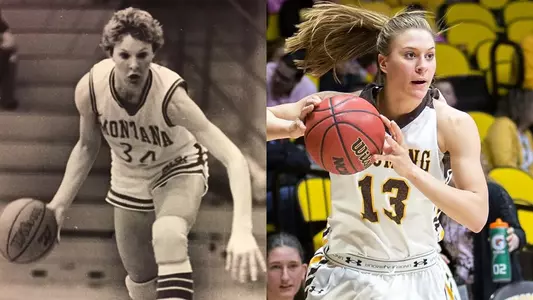
"When I was younger, I didn't realize how big of a stud she was," says Olivia, who grew up in Missoula before going on to play at Wyoming, where she was the Mountain West Conference Player of the Year as a senior in 2017-18.
"I didn't realize what it meant to be in the Hall of Fame. In college it really hit me. She's amazing."
It's Olivia who completes the story, one that began not with her mom, but Cheri's mom Kareen, who had no outlet other than playing sports with the neighborhood boys. She had no other options available to her.
"My mom didn't get to do what I did. She was pretty athletic and played with the boys a lot but never had the opportunity to play on a girls' team," Cheri says.
"So it went from my mom, not playing on any teams, to me getting a chance to play on a boys' team, getting to play in college, to my daughter starting in third grade and getting great coaching, going to camps all summer long, playing year-round."
What for Cheri was playing on gravel, in old Chuck Taylors, mostly on her own growing up, became advanced education for her daughter. Mom insisted. She would be no impartial observer of her children's futures, unafraid to invest a little time and sweat herself.
Let's hit the driveway! Today let's break down the screen and roll, both executing it and defending it! Let's go! Olivia was in the fifth grade. Her brothers, Ben and Mitch, who would go on to play Division I athletics as well, were swept up in their mom's excitement, her vision for them.
"Nobody in the fifth or sixth grade learns the screen and roll. Most people learn that late in high school or early in college," says Olivia, who scored 1,201 points in four years at Wyoming. She was voted All-Mountain West as a junior and senior, leading the Cowgirls to the WNIT both seasons.
"To always be playing basketball and to have an amazing coach who knows a lot of things, that just jumpstarted my abilities. The best thing about my mom was that she instilled confidence in me that (playing college basketball) was going to happen. She knows how she got there and raised us that way."
What Cheri never got, exposure, is what Olivia never lacked. She played in tournaments in Arizona, Las Vegas, Oregon, and her mom was there for all of it.
And if there was ever even the slightest hint or suggestion of Do I have to? when it came to athletics, Cheri had no trouble pulling out the When I Was Your Age card. She knew what they had. And what she never did.
"We started traveling with Livy in the fifth grade. I often thought to myself, gosh, if I would have had this opportunity. I often told them, you guys are doing drills I did in college. You're learning stuff I learned in college in fifth grade. The opportunities were totally different," says Cheri.
Both mother and daughter played college basketball, though it was different worlds. The clothes. The clothes! And the gear! Shoes for lifting. Shoes for running. Multiple pairs for the basketball court. Multiple outfits for traveling.
"What a cool thing to be treated so well. The mom in me was like, we wear the same size, can I have some of that?" says Cheri.
Mom had to rush from practice to get to the UM cafeteria before it closed. Daughter had dinners catered to the Wyoming locker room after practice.
Mom bussed, bussed and bussed, and occasionally flew, commercial of course. Daughter took charter flights.
"Games in the Mountain West were Wednesday and Saturday. They would leave after practice on Tuesday, charter out of Laramie, then fly back on Wednesday night after the game, so they miss one day of school," says Cheri.
Mom was on her own to finish rehabbing her ACL injury when she arrived as a freshman, her own physical therapist. Daughter had weekly massages available during the season as part of her spot on the team.
"It's come a long, long way. It was fun to see where I started to where my daughter was and the progression of it and to know they are being treated as well as the boys are," says Cheri.
And back in 1972, that's all anybody was asking.
He did it first as a coach, leading his men's track and field program to a Big Sky Conference championship in 1972. He later did it as Montana's Director of Athletics, most notably championing another cause: the inclusion of women into collegiate athletics.
What he learned first as a Griz athlete, later as a coach, he brought with him to his role as AD.
This he knew: "Participation in college athletics prepare young people for life, and that's what we're in the business for, to provide opportunity and to give young people experiences they'll remember for the rest of their lives," he said this week from his summer home on Michigan's Upper Peninsula.
"And it doesn't make a darn bit of difference who they are. It's as important to women as it is to men." Amen.
Today is the 50th anniversary of the day President Richard Nixon signed the Education Amendment Act, on June 23, 1972. Title IX of that legislation had 37 words that would change the world.
No person in the United States shall, on the basis of sex, be excluded from participation in, be denied the benefits of, or be subjected to discrimination under any education program or activity receiving Federal financial assistance.
It's just that nobody, particularly in college athletics, knew at the time how impactful it would be on that highly visible front porch of every campus across the country. After all, the terms sports and athletics are nowhere to be found among those 37 words.
Title IX was included in the legislation to make right the sex discrimination that was widely accepted as normal in that era of education and in that largely male bastion of a college campus. Title IX said gender equity in education was a right. It demanded action, compliance.
At some point, someone was the first to wonder: Hey, does this apply to athletics as well?
Because you have to know what life was like in 1972. Robin Selvig remembers. The coach who a decade later would have his women's basketball team catching eyes and drawing attention was on the men's squad at Montana, and he had no idea a women's team was even on campus.
"I didn't realize they had a team. They played in the old men's gym, so we never saw them," he says.
The women's basketball team, under the umbrella of the School of Education and coached over the years by physical education professors, played 19 games in 1974-75. Fourteen of them were held within the borders of Montana. The farthest the team traveled was to Pullman, Wash.
The team's season, from first game to last, spanned less than two months, from Jan. 10 to March 1. And when the final buzzer had sounded, coach Diane Westbrok went back to teaching and the players, who had very little athletics-related aid, if any, went back to being students.
It was athletics as a small part of the overall educational experience, a small part of making the student whole, well-rounded. To some, that was enough and all that it needed to be.
Lewis was named the interim AD at Montana in the mid-70s, a position he held while he continued coaching, then got the job on a full-time basis, right about the time it was being decided that yes, Title IX could be applied to college athletics.
Changes were coming. Some knew it and embraced it, some ignored it and hoped it would all go away. Others fought against it.
"When I interviewed, women's athletics was a big piece of it, and I was strongly in favor of expansion and increased financial aid and competitive opportunities and moving forward," Lewis says.
Working with then UM President Richard C. Bowers, himself a proponent of opportunities for all on campus, Lewis brought women's sports into the Department of Intercollegiate Athletics, which led to resignations and later lawsuits by those sports' coaches.
They didn't believe it was the right move or for the betterment of the women they had been coaching.
"It was an interesting transitional process. When they resigned, I had to go out and hire new coaches," says Lewis, who brought on a duo who would be Montana's most successful coaches of women's sports over the decades – Selvig and Dick Scott for volleyball – in the summer of 1978.
In the mid- to late 70s, Cheri Bratt, then a high school player at Flathead High, was dealing with her own issues. She wasn't fighting discrimination as much as she was trying to follow her passion for the game of basketball, a love that didn't go by the calendar, in a system that asked her to keep it seasonal.
After all, it wasn't until 1972 that Montana started offering state championship tournaments for high school girls' basketball. For two years it was a single classification for all. For the next three it was an A/B split before going AA/A/B/C starting in 1977.
"There was nothing in between (basketball seasons). You had no year-round training, no camps. They didn't think about it. You started in September, you ended in December and you left your sport," Bratt, now Roberts, says.
"I played at home. Our dad put a basketball hoop up on the barn. I loved it so much and had a passion for it, I shot baskets all year. I didn't learn any form. I didn't learn any fundamentals. I just played because I loved to play."
She was also right in the middle of a generational shift, from they can't to they can. Some accepted the sea change better than others.
Inspired by a coach in Kalispell who saw her talent and a principal at the middle school in Somers, where Bratt was a student in 1975-76, a principal who wanted to bring out the best in her, Bratt not only played on the girls' team, she moonlighted on the boys' team.
That's when the trouble started. "There were some teams in the valley who wouldn't play us because I was on the boys' team," she says. But that was nothing compared to some of the ingrained beliefs and attitudes she experienced playing at Flathead High.
"There were some dads who wouldn't go watch their daughters play, because it was girls' sports. That's really sad."
She wanted to go to UCLA, to Oregon to play collegiately, schools whose names flashed in big lights when she saw them in her mind, but recruiting was still mostly a localized thing. A girl, no matter how talented, still had to be a self-promoter. And willing to travel on her family's dime.
"I told my parents, I want to go to UCLA, I don't want to go in-state, so they took me to UCLA. We made a visit to Oregon, to Washington State. We had to do more of the outreach versus the coaches coming to us. There was no film," she says.
It wasn't until the summer before her senior year that she heard about an offseason opportunity, a basketball camp in Spokane. "That was a new thing," she says.
And there was this other opportunity, down in California, a tryout of sorts, to make a region team that would play at a national showcase against other region teams. Again, another new thing.
"My mom, bless her heart, drove me down to California to try out. She ended up talking to Cheryl Miller's dad in the stands," Roberts says. "I made the first cut to 15 players. They were going to cut it further to 12 the next day."
Except she tweaked her knee, what would turn out to be an ACL tear, and couldn't play on the day final cuts were being made. Who knows what would have happened had she made the team, had played at the national event, had been seen by some college coaches who probably would have been watching?
If she hadn't scared off others with the uncertainty, even more so in that era, of a knee injury?
"I'm pretty sure I would have made the team. I might have had more opportunities," she says. She had an offer from Montana State. It was pulled when they learned of her knee injury. She had an offer from Selvig and Montana. His offer stood, injury or no injury.
"Rob was the only one to hold up his end of the bargain."
That Selvig had left his coaching job at Plentywood High to take over the position at Montana prior to the 1978-79 season was not a decision he made easily. There was risk involved, because nobody knew where any of this was headed.
The NCAA – the NCAA! – was bringing lawsuit after lawsuit in the late 70s against the ramifications of Title IX and to try to keep women's athletics at the collegiate level from becoming a thing, from competing with men's sports for resources, for opportunities.
A lot of coaches and plenty of athletic directors believed it was the sounding of a death knell for men's athletics. Many of them voiced their opinions.
Even Nebraska football coach Tom Osborne testified, saying that college football had taken 100 years to get to this particular point of success and following. And shouldn't women have to go through the same growing process instead of just getting something handed to them?
At the time, women's sports were governed by the AIAW, the Association for Intercollegiate Athletics for Women. Its first three national championships in basketball, in 1972, '73 and '74, were won by tiny Immaculata, an all-women school near Philadelphia.
The next three were won by Delta State, a school in Mississippi.
Schools, no matter their size, that were putting an emphasis on women's athletics were getting a jump on everybody else. Indeed: Immaculata's first title came in a championship-game victory over West Chester State.
Nobody had heard of Connecticut or Tennessee or Stanford, at least as it related to women's basketball.
Selvig, after relocating from northeast Montana, was handed a salary of $13,000, a team that had gone 7-13 the season before, a dozen fee waivers and told to do his best. What he did was the stuff of movie legend. Literally.
"When I took the job, it was a little bit of a risk because women's athletics hadn't taken off. Nobody else had a lot either at that time," he says. "The worst thing is when other people have a lot more than you and that wasn't the case, because nobody had much."
It turned out to be one his program's secret weapons.
When Bratt arrived as a freshman for the 1980-81 season, for Selvig's third season as coach, she didn't focus on what the men's team had and she and her teammates didn't. Rather, she couldn't get over the fact she had been given the chance to play college basketball.
"I was just happy to play basketball at the next level. My eyes were this big, like, wow!" she says.
"We had practice gear but it wasn't like the men's practice gear. Our locker room, a teeny thing with two showers for 12 girls, was nowhere near the men's locker room, but at the time we were just happy to be there that you didn't care or even think about what the men had at the time."
While legislation signed into effect nearly a decade earlier said things needed to be equal, the story inside the fieldhouse on a winter's night revealed something else. In every practical sense, they were not equal, at least not yet.
"At that time, the men's games filled the stadium. I can remember having doubleheaders with them to get people to our games. We would come out after showering and you couldn't find a place to sit it was so packed," Roberts says.
She would take on the same mindset as Selvig. Let's put our heads down and see what we can do, see if we can earn something more. Let's not wait – or expect – something to just be handed to us because of what some law says. Let's own it. Let's determine our own destiny, write our own story.
"That's what was great about getting in at that time as a coach," says Selvig. "They were just excited about the opportunity and wanted to take advantage of it. And they did."
It started as little things. Once they had their own relatively modest following, they didn't want any more doubleheaders with the men. All that did was reinforce the notion that they were nothing more than a novelty act, something a person had to sit through to get to the REAL game, the men's game.
"But I didn't sit around thinking about (changes that needed to be made). I was always working to get more but my main focus was coaching these gals who I believed were talented and worthy of being watched," he says.
Once the NCAA realized in the early 80s that it was standing on the tracks and squaring off against an oncoming locomotive, it made the decision not simply to get out of the way but to hop aboard and take over the controls. My, how views had changed.
In March 1982, the AIAW held a national women's basketball tournament, won by Rutgers over Texas in Philadelphia. That same week, Louisiana Tech defeated Cheyney State in Norfolk, Va., in the NCAA's first national tournament.
Seventeen on the nation's top 20 teams opted for the NCAA tournament, mostly for financial reasons. The NCAA paid for a team's travel. To participate in the AIAW tournament, a school had to pay its own way.
It would be the final hurrah for the AIAW, that 1982 tournament, and Montana had a minor role. The Lady Griz made their first national tournament that season, opting for the AIAW, where it lost to Wayland Baptist, another early powerhouse that is no longer, in Berkeley, Calif.
After 1982, it was all NCAA all the time, for basketball and every other women's sport.
"Joining the NCAA opened doors for women to compete at the national level, for broader-based participation," says Lewis.
"It was that time that the transition really took off and the opportunities for women probably tripled once the NCAA took over the championships program. That's when you saw a major expansion of women in sport."
Yes, there is a dark side to Title IX that can't go unaddressed. At a place like Montana, the school did not fund Lewis's department in a way that he could just bring in and later add women's sports without a reciprocal action. There just wasn't enough money to go around, to support everything.
"It had the potential of doubling the cost of an athletic program. We couldn't afford to do that, so we had to make adjustments in our programming to distribute our funds in a different way, in a more equitable way," he says.
In other words, the department was forced to cut some men's sports.
"What happened early on were very, very hard choices had to be made. In order to improve opportunities for women, we had to reduce opportunities for men. This was difficult, painful to be honest," he says.
"We had to eliminate wrestling when it was such a popular sport in the high schools. That was hard. We had to eliminate swimming in order to shift the numbers to make sure women had a fair share.
"These weren't easy choices, and we weren't alone. This was a nationwide movement. There were a lot of sports that disappeared on a lot of campuses."
The knee-jerk reaction by those aggrieved was to simply point to Title IX and make that the culprit, the bogeyman. Schools didn't always say otherwise: We had to! There was no other way! Our hands were tied by this new legislation! Don't blame us, blame that!
Selvig was asked this week about that argument. He said, "(Harley) had to make hard choices. He made the right choices. But those were not easy."
Then he tells you he couldn't say it better than Arizona State women's basketball coach Charli Turner Thorne did back in an interview in 2012, on the 40th anniversary.
"I think there's still some sub-populations out there that feel like Title IX took opportunities away from male athletes, which is simply not true," she said in that interview. "That's a myth.
"Administrations at universities have made decisions based on how they want to spend their money, so men's sports may be cut as they started to fund women's sports. … Those are fiscal decisions, they're not what Title IX is about."
While Lewis was making the hard decisions as the 80s moved along, Selvig and Bratt were quickly turning the Lady Griz into something special, something that became a must-see, must-attend event.
Montana went 26-4 in 1982-83, the fourth loss coming at Louisiana-Monroe in the opening round of the program's first trip to the NCAA tournament.
In 1983-84, the breakthrough: Montana hosted a first-round game of the NCAA tournament. More than 4,000 fans showed up to watch the Lady Griz win 56-47.
It's one of Selvig's favorite memories from nearly four decades at Montana, of watching Lewis and other administrators hustle to pull out more and more bleachers for more and more fans who wanted in on the fun.
This wasn't Title IX in action. This was more organic, a team that started winning and then started to get a following, fans acknowledging through their attendance that this was a lot of fun, that these girls were really good, that they could play, just like the men.
Whether the Women's Basketball Hall of Fame wants to admit it or not, Selvig's was a hall-of-fame career. Twenty-one trips to the NCAA tournament, 24 conference championships, more and more girls who had the opportunity to play in front of one of the nation's most dedicated fan bases.
And more and more girls who got more and more, until one day it matched the men, the true spirit of Title IX.
Roberts, though, wants to believe it wasn't just about the legislation but that the Lady Griz also earned what they received, the more and more.
"Wow, these girls can play. We better provide them with what they need. I don't know if it was more, whoa, look at us go, let's give them more or if it was more, let's try to get some equity," she says. "I'd like to think we earned it a little bit.
"I don't want to think of it like they had to be forced to do those things. I want to feel like we earned it a little bit, at least at the University of Montana. I think we walked the walk at that time and built a program and earned some of our stuff. I kind of like to think that."
A Wade Award finalist as a senior, the short list of the top players in the nation, Roberts was the first Lady Griz player to be inducted into the Grizzly Sports Hall of Fame, in 1995.
That's where her daughter, born that same year, in 1995, saw her mom's photo, among all the other plaques in the Hall of Fame. Growing up it elicited nothing more than a shoulder shrug. After all, there were a lot of photos on that wall.
"When I was younger, I didn't realize how big of a stud she was," says Olivia, who grew up in Missoula before going on to play at Wyoming, where she was the Mountain West Conference Player of the Year as a senior in 2017-18.
"I didn't realize what it meant to be in the Hall of Fame. In college it really hit me. She's amazing."
It's Olivia who completes the story, one that began not with her mom, but Cheri's mom Kareen, who had no outlet other than playing sports with the neighborhood boys. She had no other options available to her.
"My mom didn't get to do what I did. She was pretty athletic and played with the boys a lot but never had the opportunity to play on a girls' team," Cheri says.
"So it went from my mom, not playing on any teams, to me getting a chance to play on a boys' team, getting to play in college, to my daughter starting in third grade and getting great coaching, going to camps all summer long, playing year-round."
What for Cheri was playing on gravel, in old Chuck Taylors, mostly on her own growing up, became advanced education for her daughter. Mom insisted. She would be no impartial observer of her children's futures, unafraid to invest a little time and sweat herself.
Let's hit the driveway! Today let's break down the screen and roll, both executing it and defending it! Let's go! Olivia was in the fifth grade. Her brothers, Ben and Mitch, who would go on to play Division I athletics as well, were swept up in their mom's excitement, her vision for them.
"Nobody in the fifth or sixth grade learns the screen and roll. Most people learn that late in high school or early in college," says Olivia, who scored 1,201 points in four years at Wyoming. She was voted All-Mountain West as a junior and senior, leading the Cowgirls to the WNIT both seasons.
"To always be playing basketball and to have an amazing coach who knows a lot of things, that just jumpstarted my abilities. The best thing about my mom was that she instilled confidence in me that (playing college basketball) was going to happen. She knows how she got there and raised us that way."
What Cheri never got, exposure, is what Olivia never lacked. She played in tournaments in Arizona, Las Vegas, Oregon, and her mom was there for all of it.
And if there was ever even the slightest hint or suggestion of Do I have to? when it came to athletics, Cheri had no trouble pulling out the When I Was Your Age card. She knew what they had. And what she never did.
"We started traveling with Livy in the fifth grade. I often thought to myself, gosh, if I would have had this opportunity. I often told them, you guys are doing drills I did in college. You're learning stuff I learned in college in fifth grade. The opportunities were totally different," says Cheri.
Both mother and daughter played college basketball, though it was different worlds. The clothes. The clothes! And the gear! Shoes for lifting. Shoes for running. Multiple pairs for the basketball court. Multiple outfits for traveling.
"What a cool thing to be treated so well. The mom in me was like, we wear the same size, can I have some of that?" says Cheri.
Mom had to rush from practice to get to the UM cafeteria before it closed. Daughter had dinners catered to the Wyoming locker room after practice.
Mom bussed, bussed and bussed, and occasionally flew, commercial of course. Daughter took charter flights.
"Games in the Mountain West were Wednesday and Saturday. They would leave after practice on Tuesday, charter out of Laramie, then fly back on Wednesday night after the game, so they miss one day of school," says Cheri.
Mom was on her own to finish rehabbing her ACL injury when she arrived as a freshman, her own physical therapist. Daughter had weekly massages available during the season as part of her spot on the team.
"It's come a long, long way. It was fun to see where I started to where my daughter was and the progression of it and to know they are being treated as well as the boys are," says Cheri.
And back in 1972, that's all anybody was asking.
Friday, June 19
Thursday, June 04
Friday, May 01
Friday, May 01