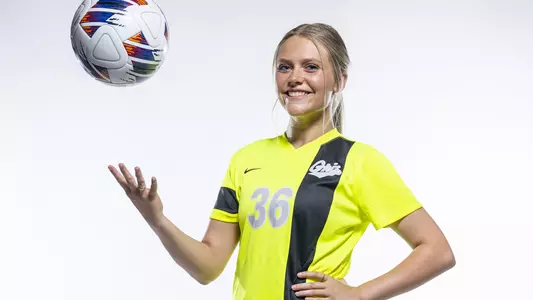
The Craig Hall Chronicles :: Shelby Stordahl
8/20/2022 3:37:00 PM | Soccer
When Damian Macias was hired away from Missouri Western in July to become Chris Citowicki's new associate head coach, it wouldn't have taken him long to get a handle on the position group he'd be taking over: the Griz goalkeepers.
Camellia Xu was the reigning Big Sky Conference Goalkeeper of the Year. Not a bad starting block, he would have thought, and only a sophomore. Sophia Pierce was Xu's backup last season. She was returning. And Ashlyn Dvorak was the hotshot freshman coming in, ready to make a name for herself.
Pretty straightforward. An established pecking order. Then there was incoming freshman Shelby Stordahl, who was a mystery then and continues to be one to Macias today, at least from a physical standpoint.
"Because she's been injured, the goalkeeping pieces have been really kind of an unknown for me," Macias says.
Because she entered the season injured, which she's been for more than a year – and that doesn't include the torn meniscus that shelved her for seven months in 2020 – Stordahl can't dive, she can't collapse, she can't do anything that requires her to go to the ground.
She can't do, you know, goalkeeper things, which is an issue when you're, you know, a goalkeeper. And when your position coach has never seen you at full strength or full health, that's not just an issue, that's an uphill battle.
Not to mention you're behind Xu, who posted career shutout No. 12 on Thursday evening against Creighton and still has nearly three full seasons left to play, and you're in the same class as Dvorak. And you're in a position that only has one of the group on the field at one time.
"Those are mind games for keepers," says Macias. "And by virtue of the situation, you know you're No. 4 because you're a freshman and you're injured."
Can we doubt her? Should we doubt her? Shelby Stordahl is begging you to.
That club coach in Southern California did, so many years ago, after Stordahl announced that she wanted to become a goalkeeper. They met, the coach and parents, and the coach acquiesced by putting her into games with less than a minute left in matches that had already been decided.
And that was worse, more insulting, than not putting her in at all.
"He basically told her she would never be a goalkeeper. Ever. He didn't want to lose her (from his team) but he said he didn't want to play her in goal," says Eric, Shelby's dad, who raised his family in Southern California before relocating the clan to Gig Harbor, Wash., because of a relocation for his work.
"She took that and ran with it. That's always stuck in her grill, that somebody told her she couldn't do something. Boy, that was a mistake. She's going to prove to everybody she can do it."
That's not to imply there is any doubt on Macias's part, just the recognition that he hasn't been able to see Stordahl do her thing.
"Who Shelby is as a keeper is still kind of a present I'm waiting to unwrap. There are so many things going on, I'm going to reserve my right to fully evaluate until we finally see the real kid and give her a chance to do the things you want freshmen to do," Macias says.
Now, think about the team's four goalkeepers at a typical training session, with three going all out, one doing what she can when the demands allow.
What are you picturing? Someone who is meekly waiting her turn, who is hanging on the fringes, not wanting to say something she can't back up through her play on the practice field? Someone who is straddling the line between wanting to be part of the group but not sure she truly is?
Wrong. "The activities she can do, she is fully committed to. The things she can do in a broader sense, like being a good teammate, being a presence and happy and smiling, she's been wonderful," says Macias.
"Even though she can't do everything, it's always, let's do this. Where do you need me? What can I do? What a contribution simply by not wallowing in self-pity. She's like, this is where I'm at, and that's okay."
Her dad has a tattoo on his left arm, a burgee flag with the name Axel within it. That's Eric and Allison's other child, who is on the sailing team at a school that takes its sailing pretty seriously, the College of Charleston.
Eric has an appointment next week at the tattoo place, this time for Shelby. Getting a permanent spot on his right arm will be a Griz logo with his daughter's name.
"I haven't even told my wife yet," he says, letting you in on the secret. Those Stordahls, when they go in on something, they go big and they don't look back.
"I told my kids at a very young age that I would get a tattoo of their school on either arm. I think it helped Alex's confidence knowing we were totally supportive of him. I can't wait to get the Griz tattoo and show it. That's going all in."
That's Shelby Stordahl, who was on her way to a storybook prep career before a shoulder injury in June 2021 derailed everything. And came at the cost of almost all her dreams. And then she landed at Montana, where she is all in, whether she is at full health or not.
"You can see the apple didn't fall far from the tree," says Eric.
Let's start with that injury, upon which her entire story pivoted. It was June 2021 and she was in goal for Washington Premier, playing up in age group at the Rainier Challenge.
It was the first half of her team's first game when she went up to punch a shot over the crossbar with two hands. An opponent ran through her legs, which left her as vulnerable as a goalkeeper can be. Her legs were flipping up while she was coming down. On her shoulder. Hard.
"I remember the ball coming in, then I don't remember anything else. My brain kind of shut off. The game kept going on until the ball went out of bounds. Then people came to check on me. Oh, she's not getting up," she recalls.
Eric had seen his daughter get injured a number of times throughout her career. It's part of soccer. It's part of playing goalkeeper. He'd never felt the need to sprint onto the field. That day was different.
"She was playing with some girls who were much bigger and stronger, and one girl felt like she was getting embarrassed and she took Shelby out," he says.
"She's a tough nut. She's had injuries since she started playing at 5 years old, but you could tell that this one was something different. My wife was not happy I ran out on the field but it was one of those deals you could tell she was seriously hurt."
The initial diagnosis on the sideline: a broken collarbone. If only she'd been so lucky. "It felt like it was the back of my shoulder. I've broken bones and it didn't feel like that," she says.
The family went from the site of the match, in Puyallup, to the hospital in Gig Harbor for x-rays. The technician read them and shared his opinion. Grade 1 injury, maybe 2, no surgery would be required. It would heal on its own with the right physical therapy. If only she'd been so lucky.
"I went to our game the next day and felt really good about it. It's going to be a breeze. No surgery. Two months of rehab and we're going to be back," she thought.
But the orthopedic surgeon hadn't had his input yet. When he did, it was as tough an emotional blow as the collision with the ground had been a physical one.
It was a Grade 3 AC separation, as bad as it gets. It wasn't a broken collarbone. It wasn't something that would heal on its own. All the ligaments had been torn. Surgery would be required, followed by a grueling and often frustrating eight-month recovery.
The family had plans to vacation in Florida. Those were canceled when surgery was scheduled for July 1. The ACL from a cadaver was used to wrap her shoulder back together and a pin was used to snap it all in place. Then it was time to rest.
For two months her left side was immobilized with a bulky brace. She was given one order: no movement. It felt like a death knell for her dreams.
"The summer before my senior year, I felt like I just started reaching my best. I was super excited to hit that peak of my senior year and win the state championship with my high school team," she says.
For a majority of the Division I soccer players out there, their high school team was a secondary priority if they even bothered to play prep soccer at all.
For Stordahl, the experience her freshman year changed her life. That will happen when your coach is Stephanie Cox, who should need no introduction.
If she does: She was a national champion at the University of Portland. She won an Olympic gold medal with the U.S. National Team in 2008 in Beijing. She played professionally for teams in Los Angeles and Boston before landing back in the Northwest for stints with the Seattle Sounders and Seattle Reign.
She retired in 2015 and became the head coach at Gig Harbor High, which is where she was in the fall of 2018, when Stordahl was a freshman and hopping between the JV and varsity while playing behind two more veteran goalkeepers.
Cox brought the golden touch, guiding Gig Harbor to one-goal victories over Edmonds-Woodway in the state tournament quarterfinals, Kamiakin in the semifinals and Holy Names Academy in the title match.
"She was one of the most amazing coaches I've had," says Stordahl. "One of our sayings was to unite to leave a lasting legacy. That was what we carried with us. That's what we wanted to carry on after she left the program," which Cox did after that season to give her playing career another shot.
But it wasn't just Cox who Stordahl looked up to. It was the senior leaders, like Hannah Carroll, who is now a distance runner at LSU. "I got to see that type of amazing leadership as a freshman. That's all I wanted to be. I knew that's the role I wanted to have. That's what I embraced."
But she couldn't embrace anything, not with her left arm and shoulder pinned tight to her body as her senior year opened. And the math just didn't work out. Two months of immobilization. Two months of introductory physical therapy, then four months of more aggressive PT that would take her into 2022.
The state tournament would be in November. "That was our one goal, to get back to that moment and have a full-circle moment," another 3A state title. "That's all I wanted, so desperately," says Stordahl, who was in uniform for the championship match in 2018 but didn't play.
Once the brace came off and physical therapy was set to begin, she thought back to that torn meniscus and how she got right to making it as strong as it had been. That's why rehabbing her shoulder was such a downer. She learned on Day 1 why it was scheduled to be eight months to full recovery.
"When I started PT for my knee, it was the best feeling in the world because you're starting to do stuff and seeing progress and building back strength," she says. "That was my expectation going back this time.
"I had no movement, no range of motion and my strength was out the window. Every day you're moving maybe a centimeter more. No weights, no bands. That was a huge letdown. It was a long process."
But it didn't affect her role of team leader. "I was the No. 1 benchwarmer," she says. "I brought pompoms to every match and went to every single practice. I loved high school soccer. That was kind of my baby."
That's why she's mostly sidelined at Montana, even a year later, because when the state playoffs rolled around, she was not going to be sidelined or denied. "Senior year was supposed to be my year," she says.
School pride and love of team won out over prudence and sound judgement. She was just four months removed from surgery and only halfway through an eight-month rehab plan that nowhere said to hit the ground on your injured shoulder just to test it out and see where it was at.
She put on her uniform and her cleats the first day of practice prior to the state playoffs and made it through one training session but not the second.
"We were warming up, doing knee dives. I dove on my left shoulder and it popped. It got super hot and started hurting so bad," she says.
A trainer told her she had simply broken up some scar tissue, which actually sounded like good news. Then why did it hurt when she ran, when she sneezed? Why did it feel like she had just had a major setback?
The bigger question was, who signed off on this, this return to practice? Both Shelby and her parents raise their hands. Guilty. All got caught up in the moment instead of keeping the big picture in mind.
She had been dreaming of soccer since the age of 6 after all. "I was going to say 5," says Eric. "She's been thinking about it for a long time. That's why we saw her dreams kind of fall apart. Maybe we could have paid more attention to her body.
"We were listening to her. We wanted to see her in her senior year. When we saw her wanting to get back on the field with her friends, we probably allowed her to do it faster than she probably should have."
Allison adds, "We allowed it. We didn't step in when we should have."
Stordahl wouldn't play in any state tournament matches as Gig Harbor finished a disappointing fourth place. And now she was reinjured.
"I take full ownership of it. I expected too much of myself in that moment and pushed myself over the limit," Shelby says. "That was all I'd wanted for the last three years of high school. I felt so close to being where I wanted to be that I kept pushing. I pushed myself way over the edge.
"I tried to be this heroic figure for my team that nobody expected me to be or needed me to be. When you remove yourself from that situation, it sounds stupid. You were given a timeline, you know the consequences. I was fully aware."
Still believing it was simply the breakup of scar tissue, she resumed practicing with Washington Premier. She was feeling better and getting through training sessions, until she dove and … repeat: Pop, hot. Must be more scar tissue. Give it a rest, get back at it. The pain was simply weakness leaving her body.
She had had college programs interested in her but then COVID hit, and she tore her meniscus and then the shoulder injury. She had drifted right off the radar. But she was just well enough last February to go to an ECNL event in Texas. Just barely well enough.
Even playing with one good arm and shoulder, and even playing only one half of each game while splitting time with another goalkeeper, college coaches all had the same thought: who was this girl and why wasn't she committed?
"I got so much exposure. I think I had 15 phone calls that week from coaches," she says. "You can send as many emails as you want to coaches, but if they are not seeing you play, you're not going to get committed."
She had a list of 20 Division II and III schools, mostly in the South, that she wanted to check out. She narrowed it down to three and took visits. "I didn't love them. They weren't the right fit, so I was getting super frustrated," she says. "They were kind of my last hope since I was so late in the process."
She held out hope but also started applying to schools where she would simply be a student. Ole Miss. Tennessee. She had blanket coverage of the SEC.
"We've encouraged our kids to try different things," says Eric, who works at the Port of Tacoma, where he transferred after previously working the same job in Long Beach, Calif. "Especially in college when it's four years, it's not life-dependent on where you live. You can have different experiences.
"She's always loved the appeal of the SEC and big football programs. She loves big football games, loves the energy. That's been big for her since she was a little kid."
Oh, how she was being torn, one side of her wanting to play collegiately, no matter the level, another part of her wanting to get a clear signal to hang it all up. Because that shoulder was showing no signs of ever allowing her to play again, at least like she had prior to June 18, 2021.
She had an appointment. This was going to be it. If they told her she was on her way to full health, she would take that as a sign of hope, that she should keep the dream of playing college soccer alive. If they said she should be done with contact sports, she was ready to take that path as well.
But she needed them to make that decision for her, based on their diagnosis. She needed them to make the tough call. "They came back very neutral," she says, which was the worst news of all. That gave her no direction and put the decision back on her.
There was some clarification at least. The original injury, the Grade 3 AC separation and the ensuring surgery and rehab? All that was fine and improving as expected.
What had happened at that practice with Gig Harbor, then with Washington Premier, then again, was a broken clavicle, masked, hidden within the larger injury. Except she had broken it, then broken it again before it had a chance to heal. Then broken it again, all in the same spot.
Her shoulder was fine but her collarbone was a mess. "The doctor thinks she could have broken it as many as four times," says Eric. "She was getting information that it was just scar tissue pulling away and that it was normal. But it wasn't scar tissue. It was the clavicle breaking again."
Those goalkeepers are a tough lot, eh?
She didn't know what to do, what direction to turn, what path to go down. Was soccer done or wasn't it? Did she want to play, even if meant at the Division II or Division III level, which were the only options she had now? Or should she just move on?
With all this weighing on her mind and the clock ticking, she found herself sitting at home one Thursday night last spring. She decided to send an email to Citowicki at Montana, with whom she had previously shared highlight videos.
Just about anybody could have told her: Why bother? As if a successful Division I program could possibly be looking for a random goalkeeper who was in the spring of her senior season. And injured. And without a solid timeline for a return to full health. Good grief, why waste the coach's time?
Except that very coach just happened to be in need of a goalkeeper, after Elizabeth Todd, who missed last fall with a knee injury, opted to graduate and give up her remaining eligibility.
"It was like two days after I sent that email my club coach texted me. Hey, I just had an amazing talk with the coach from Montana. He should be calling you soon," she says.
Things progressed quickly. Very quickly. She had a Zoom call with then goalkeeper coach J. Landham. Then the entire staff had a call with the Stordahl family. "I was super honest with my situation. They were so understanding and so amazing," Shelby says.
Citowicki told them, we need to get you here for a visit. What about tomorrow?
"My parents are my No. 1 supporters and will do anything crazy I ask them to do. My dad and I jumped in the car at like 3 in the morning and drove here," she says. "It was such an amazing experience. It was so perfect. It was too good to be wrong. I instantly knew this was my school.
"J. said, it's okay if you don't come in 100 percent. We'll work you up to that point. That was something I hadn't heard from any other school. I think it was a week later when I committed."
That led to her Instagram Moment, when a player announces to the world, via flashy graphic, that they too are wanted, they too are locked in, they too are committed.
"That post was all I've ever wanted for the past how many years," she says. "It was an on-top-of-the-world moment. I was the last to commit on my (Washington Premier) team. I'd seen every other player get to do it. To make that my own was so special."
She finally knew where her body was and what it would take to come all the way back, and she had a destination.
In a perfect world, they would have synced up, her return to full health and her arrival in Missoula, but nothing has been perfect or even easy thus far. Why should it be now?
"Get on the shelf, get yourself right and get yourself in a situation to play some soccer," Eric told her in the spring after she committed. "Now she's working harder than I've ever seen her work to completely heal. She's a tough little nut.
"People told her after this injury that she's not going to play Division I soccer. She's coming back with a vengeance. She's going to be dangerous."
It's going to take time, not just because she's behind Xu or because she's teammates with Pierce and Dvorak. You try diving on a shoulder that's been hurt, then hurt, then hurt again. Ligaments have been torn. A bone has been broken, maybe four times in the same location.
That all takes a body time to come back from. A mind? Even longer.
"I think her body is going to heal before her mind is going to heal," says Eric. "She's got to get in the right mindset if she's going to get back to that killer mentality and go back out there with the confidence that she can do all those things she did before."
That's why she's so pragmatic and why Macias has to just wait and see to discover what he has in Stordahl. She's got the long-term view now, not like last fall when everything began to unravel with a simple knee dive, when everything had to happen now or the world might just come to an end.
Had she sat out the fall and the winter, focused solely on her recovery, then returned and then arrived at Montana at full strength, things would be different. But that's not how it played out. She's not only accepted her role as it is, she's embraced it.
"My goal wasn't to come in and be the No. 1 goalkeeper. That spot is filled right now. My goal was to come in and raise practice intensity and push the whole group," she says.
"My goal is to push Cam to be her best self, push Soph and Ashlyn to be their best. My mindset is to be my best self so everyone else can be their best self."
And that's pretty cool for a dad to read, to know that this is about more than just soccer, just like he planned it all along.
"We're raising a kid, not a professional soccer player. You don't want your kid to be hurt, but sometimes you learn things by going through adverse situations," he says.
"If they didn't learn from them, we didn't do well from a parent standpoint. We've taught them to push through and persevere and not give up. Don't give up on your dream just because somebody says you can't do it. I think she is going to prove to everybody that she can."
Camellia Xu was the reigning Big Sky Conference Goalkeeper of the Year. Not a bad starting block, he would have thought, and only a sophomore. Sophia Pierce was Xu's backup last season. She was returning. And Ashlyn Dvorak was the hotshot freshman coming in, ready to make a name for herself.
Pretty straightforward. An established pecking order. Then there was incoming freshman Shelby Stordahl, who was a mystery then and continues to be one to Macias today, at least from a physical standpoint.
"Because she's been injured, the goalkeeping pieces have been really kind of an unknown for me," Macias says.
Because she entered the season injured, which she's been for more than a year – and that doesn't include the torn meniscus that shelved her for seven months in 2020 – Stordahl can't dive, she can't collapse, she can't do anything that requires her to go to the ground.
She can't do, you know, goalkeeper things, which is an issue when you're, you know, a goalkeeper. And when your position coach has never seen you at full strength or full health, that's not just an issue, that's an uphill battle.
Not to mention you're behind Xu, who posted career shutout No. 12 on Thursday evening against Creighton and still has nearly three full seasons left to play, and you're in the same class as Dvorak. And you're in a position that only has one of the group on the field at one time.
"Those are mind games for keepers," says Macias. "And by virtue of the situation, you know you're No. 4 because you're a freshman and you're injured."
Can we doubt her? Should we doubt her? Shelby Stordahl is begging you to.
That club coach in Southern California did, so many years ago, after Stordahl announced that she wanted to become a goalkeeper. They met, the coach and parents, and the coach acquiesced by putting her into games with less than a minute left in matches that had already been decided.
And that was worse, more insulting, than not putting her in at all.
"He basically told her she would never be a goalkeeper. Ever. He didn't want to lose her (from his team) but he said he didn't want to play her in goal," says Eric, Shelby's dad, who raised his family in Southern California before relocating the clan to Gig Harbor, Wash., because of a relocation for his work.
"She took that and ran with it. That's always stuck in her grill, that somebody told her she couldn't do something. Boy, that was a mistake. She's going to prove to everybody she can do it."
That's not to imply there is any doubt on Macias's part, just the recognition that he hasn't been able to see Stordahl do her thing.
"Who Shelby is as a keeper is still kind of a present I'm waiting to unwrap. There are so many things going on, I'm going to reserve my right to fully evaluate until we finally see the real kid and give her a chance to do the things you want freshmen to do," Macias says.
Now, think about the team's four goalkeepers at a typical training session, with three going all out, one doing what she can when the demands allow.
What are you picturing? Someone who is meekly waiting her turn, who is hanging on the fringes, not wanting to say something she can't back up through her play on the practice field? Someone who is straddling the line between wanting to be part of the group but not sure she truly is?
Wrong. "The activities she can do, she is fully committed to. The things she can do in a broader sense, like being a good teammate, being a presence and happy and smiling, she's been wonderful," says Macias.
"Even though she can't do everything, it's always, let's do this. Where do you need me? What can I do? What a contribution simply by not wallowing in self-pity. She's like, this is where I'm at, and that's okay."
Her dad has a tattoo on his left arm, a burgee flag with the name Axel within it. That's Eric and Allison's other child, who is on the sailing team at a school that takes its sailing pretty seriously, the College of Charleston.
Eric has an appointment next week at the tattoo place, this time for Shelby. Getting a permanent spot on his right arm will be a Griz logo with his daughter's name.
"I haven't even told my wife yet," he says, letting you in on the secret. Those Stordahls, when they go in on something, they go big and they don't look back.
"I told my kids at a very young age that I would get a tattoo of their school on either arm. I think it helped Alex's confidence knowing we were totally supportive of him. I can't wait to get the Griz tattoo and show it. That's going all in."
That's Shelby Stordahl, who was on her way to a storybook prep career before a shoulder injury in June 2021 derailed everything. And came at the cost of almost all her dreams. And then she landed at Montana, where she is all in, whether she is at full health or not.
"You can see the apple didn't fall far from the tree," says Eric.
Let's start with that injury, upon which her entire story pivoted. It was June 2021 and she was in goal for Washington Premier, playing up in age group at the Rainier Challenge.
It was the first half of her team's first game when she went up to punch a shot over the crossbar with two hands. An opponent ran through her legs, which left her as vulnerable as a goalkeeper can be. Her legs were flipping up while she was coming down. On her shoulder. Hard.
"I remember the ball coming in, then I don't remember anything else. My brain kind of shut off. The game kept going on until the ball went out of bounds. Then people came to check on me. Oh, she's not getting up," she recalls.
Eric had seen his daughter get injured a number of times throughout her career. It's part of soccer. It's part of playing goalkeeper. He'd never felt the need to sprint onto the field. That day was different.
"She was playing with some girls who were much bigger and stronger, and one girl felt like she was getting embarrassed and she took Shelby out," he says.
"She's a tough nut. She's had injuries since she started playing at 5 years old, but you could tell that this one was something different. My wife was not happy I ran out on the field but it was one of those deals you could tell she was seriously hurt."
The initial diagnosis on the sideline: a broken collarbone. If only she'd been so lucky. "It felt like it was the back of my shoulder. I've broken bones and it didn't feel like that," she says.
The family went from the site of the match, in Puyallup, to the hospital in Gig Harbor for x-rays. The technician read them and shared his opinion. Grade 1 injury, maybe 2, no surgery would be required. It would heal on its own with the right physical therapy. If only she'd been so lucky.
"I went to our game the next day and felt really good about it. It's going to be a breeze. No surgery. Two months of rehab and we're going to be back," she thought.
But the orthopedic surgeon hadn't had his input yet. When he did, it was as tough an emotional blow as the collision with the ground had been a physical one.
It was a Grade 3 AC separation, as bad as it gets. It wasn't a broken collarbone. It wasn't something that would heal on its own. All the ligaments had been torn. Surgery would be required, followed by a grueling and often frustrating eight-month recovery.
The family had plans to vacation in Florida. Those were canceled when surgery was scheduled for July 1. The ACL from a cadaver was used to wrap her shoulder back together and a pin was used to snap it all in place. Then it was time to rest.
For two months her left side was immobilized with a bulky brace. She was given one order: no movement. It felt like a death knell for her dreams.
"The summer before my senior year, I felt like I just started reaching my best. I was super excited to hit that peak of my senior year and win the state championship with my high school team," she says.
For a majority of the Division I soccer players out there, their high school team was a secondary priority if they even bothered to play prep soccer at all.
For Stordahl, the experience her freshman year changed her life. That will happen when your coach is Stephanie Cox, who should need no introduction.
If she does: She was a national champion at the University of Portland. She won an Olympic gold medal with the U.S. National Team in 2008 in Beijing. She played professionally for teams in Los Angeles and Boston before landing back in the Northwest for stints with the Seattle Sounders and Seattle Reign.
She retired in 2015 and became the head coach at Gig Harbor High, which is where she was in the fall of 2018, when Stordahl was a freshman and hopping between the JV and varsity while playing behind two more veteran goalkeepers.
Cox brought the golden touch, guiding Gig Harbor to one-goal victories over Edmonds-Woodway in the state tournament quarterfinals, Kamiakin in the semifinals and Holy Names Academy in the title match.
"She was one of the most amazing coaches I've had," says Stordahl. "One of our sayings was to unite to leave a lasting legacy. That was what we carried with us. That's what we wanted to carry on after she left the program," which Cox did after that season to give her playing career another shot.
But it wasn't just Cox who Stordahl looked up to. It was the senior leaders, like Hannah Carroll, who is now a distance runner at LSU. "I got to see that type of amazing leadership as a freshman. That's all I wanted to be. I knew that's the role I wanted to have. That's what I embraced."
But she couldn't embrace anything, not with her left arm and shoulder pinned tight to her body as her senior year opened. And the math just didn't work out. Two months of immobilization. Two months of introductory physical therapy, then four months of more aggressive PT that would take her into 2022.
The state tournament would be in November. "That was our one goal, to get back to that moment and have a full-circle moment," another 3A state title. "That's all I wanted, so desperately," says Stordahl, who was in uniform for the championship match in 2018 but didn't play.
Once the brace came off and physical therapy was set to begin, she thought back to that torn meniscus and how she got right to making it as strong as it had been. That's why rehabbing her shoulder was such a downer. She learned on Day 1 why it was scheduled to be eight months to full recovery.
"When I started PT for my knee, it was the best feeling in the world because you're starting to do stuff and seeing progress and building back strength," she says. "That was my expectation going back this time.
"I had no movement, no range of motion and my strength was out the window. Every day you're moving maybe a centimeter more. No weights, no bands. That was a huge letdown. It was a long process."
But it didn't affect her role of team leader. "I was the No. 1 benchwarmer," she says. "I brought pompoms to every match and went to every single practice. I loved high school soccer. That was kind of my baby."
That's why she's mostly sidelined at Montana, even a year later, because when the state playoffs rolled around, she was not going to be sidelined or denied. "Senior year was supposed to be my year," she says.
School pride and love of team won out over prudence and sound judgement. She was just four months removed from surgery and only halfway through an eight-month rehab plan that nowhere said to hit the ground on your injured shoulder just to test it out and see where it was at.
She put on her uniform and her cleats the first day of practice prior to the state playoffs and made it through one training session but not the second.
"We were warming up, doing knee dives. I dove on my left shoulder and it popped. It got super hot and started hurting so bad," she says.
A trainer told her she had simply broken up some scar tissue, which actually sounded like good news. Then why did it hurt when she ran, when she sneezed? Why did it feel like she had just had a major setback?
The bigger question was, who signed off on this, this return to practice? Both Shelby and her parents raise their hands. Guilty. All got caught up in the moment instead of keeping the big picture in mind.
She had been dreaming of soccer since the age of 6 after all. "I was going to say 5," says Eric. "She's been thinking about it for a long time. That's why we saw her dreams kind of fall apart. Maybe we could have paid more attention to her body.
"We were listening to her. We wanted to see her in her senior year. When we saw her wanting to get back on the field with her friends, we probably allowed her to do it faster than she probably should have."
Allison adds, "We allowed it. We didn't step in when we should have."
Stordahl wouldn't play in any state tournament matches as Gig Harbor finished a disappointing fourth place. And now she was reinjured.
"I take full ownership of it. I expected too much of myself in that moment and pushed myself over the limit," Shelby says. "That was all I'd wanted for the last three years of high school. I felt so close to being where I wanted to be that I kept pushing. I pushed myself way over the edge.
"I tried to be this heroic figure for my team that nobody expected me to be or needed me to be. When you remove yourself from that situation, it sounds stupid. You were given a timeline, you know the consequences. I was fully aware."
Still believing it was simply the breakup of scar tissue, she resumed practicing with Washington Premier. She was feeling better and getting through training sessions, until she dove and … repeat: Pop, hot. Must be more scar tissue. Give it a rest, get back at it. The pain was simply weakness leaving her body.
She had had college programs interested in her but then COVID hit, and she tore her meniscus and then the shoulder injury. She had drifted right off the radar. But she was just well enough last February to go to an ECNL event in Texas. Just barely well enough.
Even playing with one good arm and shoulder, and even playing only one half of each game while splitting time with another goalkeeper, college coaches all had the same thought: who was this girl and why wasn't she committed?
"I got so much exposure. I think I had 15 phone calls that week from coaches," she says. "You can send as many emails as you want to coaches, but if they are not seeing you play, you're not going to get committed."
She had a list of 20 Division II and III schools, mostly in the South, that she wanted to check out. She narrowed it down to three and took visits. "I didn't love them. They weren't the right fit, so I was getting super frustrated," she says. "They were kind of my last hope since I was so late in the process."
She held out hope but also started applying to schools where she would simply be a student. Ole Miss. Tennessee. She had blanket coverage of the SEC.
"We've encouraged our kids to try different things," says Eric, who works at the Port of Tacoma, where he transferred after previously working the same job in Long Beach, Calif. "Especially in college when it's four years, it's not life-dependent on where you live. You can have different experiences.
"She's always loved the appeal of the SEC and big football programs. She loves big football games, loves the energy. That's been big for her since she was a little kid."
Oh, how she was being torn, one side of her wanting to play collegiately, no matter the level, another part of her wanting to get a clear signal to hang it all up. Because that shoulder was showing no signs of ever allowing her to play again, at least like she had prior to June 18, 2021.
She had an appointment. This was going to be it. If they told her she was on her way to full health, she would take that as a sign of hope, that she should keep the dream of playing college soccer alive. If they said she should be done with contact sports, she was ready to take that path as well.
But she needed them to make that decision for her, based on their diagnosis. She needed them to make the tough call. "They came back very neutral," she says, which was the worst news of all. That gave her no direction and put the decision back on her.
There was some clarification at least. The original injury, the Grade 3 AC separation and the ensuring surgery and rehab? All that was fine and improving as expected.
What had happened at that practice with Gig Harbor, then with Washington Premier, then again, was a broken clavicle, masked, hidden within the larger injury. Except she had broken it, then broken it again before it had a chance to heal. Then broken it again, all in the same spot.
Her shoulder was fine but her collarbone was a mess. "The doctor thinks she could have broken it as many as four times," says Eric. "She was getting information that it was just scar tissue pulling away and that it was normal. But it wasn't scar tissue. It was the clavicle breaking again."
Those goalkeepers are a tough lot, eh?
She didn't know what to do, what direction to turn, what path to go down. Was soccer done or wasn't it? Did she want to play, even if meant at the Division II or Division III level, which were the only options she had now? Or should she just move on?
With all this weighing on her mind and the clock ticking, she found herself sitting at home one Thursday night last spring. She decided to send an email to Citowicki at Montana, with whom she had previously shared highlight videos.
Just about anybody could have told her: Why bother? As if a successful Division I program could possibly be looking for a random goalkeeper who was in the spring of her senior season. And injured. And without a solid timeline for a return to full health. Good grief, why waste the coach's time?
Except that very coach just happened to be in need of a goalkeeper, after Elizabeth Todd, who missed last fall with a knee injury, opted to graduate and give up her remaining eligibility.
"It was like two days after I sent that email my club coach texted me. Hey, I just had an amazing talk with the coach from Montana. He should be calling you soon," she says.
Things progressed quickly. Very quickly. She had a Zoom call with then goalkeeper coach J. Landham. Then the entire staff had a call with the Stordahl family. "I was super honest with my situation. They were so understanding and so amazing," Shelby says.
Citowicki told them, we need to get you here for a visit. What about tomorrow?
"My parents are my No. 1 supporters and will do anything crazy I ask them to do. My dad and I jumped in the car at like 3 in the morning and drove here," she says. "It was such an amazing experience. It was so perfect. It was too good to be wrong. I instantly knew this was my school.
"J. said, it's okay if you don't come in 100 percent. We'll work you up to that point. That was something I hadn't heard from any other school. I think it was a week later when I committed."
That led to her Instagram Moment, when a player announces to the world, via flashy graphic, that they too are wanted, they too are locked in, they too are committed.
"That post was all I've ever wanted for the past how many years," she says. "It was an on-top-of-the-world moment. I was the last to commit on my (Washington Premier) team. I'd seen every other player get to do it. To make that my own was so special."
She finally knew where her body was and what it would take to come all the way back, and she had a destination.
In a perfect world, they would have synced up, her return to full health and her arrival in Missoula, but nothing has been perfect or even easy thus far. Why should it be now?
"Get on the shelf, get yourself right and get yourself in a situation to play some soccer," Eric told her in the spring after she committed. "Now she's working harder than I've ever seen her work to completely heal. She's a tough little nut.
"People told her after this injury that she's not going to play Division I soccer. She's coming back with a vengeance. She's going to be dangerous."
It's going to take time, not just because she's behind Xu or because she's teammates with Pierce and Dvorak. You try diving on a shoulder that's been hurt, then hurt, then hurt again. Ligaments have been torn. A bone has been broken, maybe four times in the same location.
That all takes a body time to come back from. A mind? Even longer.
"I think her body is going to heal before her mind is going to heal," says Eric. "She's got to get in the right mindset if she's going to get back to that killer mentality and go back out there with the confidence that she can do all those things she did before."
That's why she's so pragmatic and why Macias has to just wait and see to discover what he has in Stordahl. She's got the long-term view now, not like last fall when everything began to unravel with a simple knee dive, when everything had to happen now or the world might just come to an end.
Had she sat out the fall and the winter, focused solely on her recovery, then returned and then arrived at Montana at full strength, things would be different. But that's not how it played out. She's not only accepted her role as it is, she's embraced it.
"My goal wasn't to come in and be the No. 1 goalkeeper. That spot is filled right now. My goal was to come in and raise practice intensity and push the whole group," she says.
"My goal is to push Cam to be her best self, push Soph and Ashlyn to be their best. My mindset is to be my best self so everyone else can be their best self."
And that's pretty cool for a dad to read, to know that this is about more than just soccer, just like he planned it all along.
"We're raising a kid, not a professional soccer player. You don't want your kid to be hurt, but sometimes you learn things by going through adverse situations," he says.
"If they didn't learn from them, we didn't do well from a parent standpoint. We've taught them to push through and persevere and not give up. Don't give up on your dream just because somebody says you can't do it. I think she is going to prove to everybody that she can."
Players Mentioned

G
/ Soccer
G
/ Soccer
G
/ Soccer
G
/ Soccer
G
/ SoccerTuesday, September 01
Monday, August 31
Monday, August 31
Monday, August 31