The Hall of Famers :: Ann (Lake) Rausch
9/1/2022 5:15:00 PM | Women's Basketball
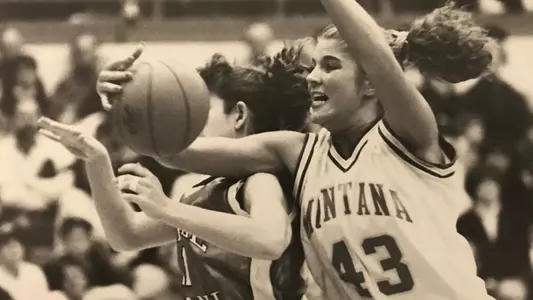
For her Lady Griz career, which spanned from a redshirt season in 1989-90 to the program's ninth NCAA tournament appearance in 1993-94, Ann Lake averaged 11.6 points and 7.6 rebounds per game.
They are the numbers of a player who did yeoman's work, reveled in it, the heavy lifting around the basket, a six-footer battling taller post players on a regular basis and still getting the job done.
"Absolutely tough as nails. Tough, strong, fast. She had it all," says her former teammate Kelly (Pilcher) Beattie.
"Six feet is tall for a woman, but she went against people three, four inches taller than her and she never backed down. She was as tough as you get."
She played in 117 games, starting 115 of them. Her 27 double-doubles rank third in program history. Her 338 offensive rebounds? No Lady Griz has ever fought through arms and bodies and traffic in the lane for more.
"When people remember Ann, they remember how tough she was," says her coach, Robin Selvig. "She'd go get tough rebounds in a crowd, big rebounds at big times when you didn't know how."
How tough was she? Well, there is the horse story.
At some point early in her Lady Griz career, a month or so before the season was set to begin in October, she was doing what she did when she wasn't a student or a Lady Griz. She was working with a horse.
That was her thing, training and showing horses.
With Lake atop this particular horse, it reared up, sending Lake to the ground. The horse followed, landing on Lake's legs.
"An average person, it would have broken her legs and she never would have played again," says Selvig.
But this was no average person. "Her legs, she has the strongest calves ever," says Pilcher. (We'll use her Lady Griz name going forward, same with Lake.) "For being her size, she ran the hurdles in high school, she high-jumped. She was a freak athlete to be able to do all that."
Her dad, George, arrived, saw his daughter's leg and whisked her off to the emergency room, certain it was broken, which would have been the best-case scenario given all the other possibilities, like dislocations and torn ligaments.
The x-ray came back. Nothing broken, just a gnarly bruise from ankle to mid-thigh. In a confrontation between woman and beast, Ann Lake came away with a flesh wound.
"It was before season, so I didn't miss any practice," she says. "Maybe fall training camp, I might have missed a couple of those, but I don't remember missing much of anything."
So, she didn't see her career flash before her eyes? "You always thought you were invincible, right?"
She isn't going to be inducted into the Grizzly Sports Hall of Fame on Friday night, Sept. 9, because she averaged 11.6 points and 7.6 rebounds. Or because she basically shrugged off an equine body slam.
She played on Montana teams that went 97-21, teams that went 47-2 inside Dahlberg Arena, teams that went 61-7 against Big Sky Conference opponents. That's part of it, the foundation of a Hall of Famer.
But what elevated Lake, now Ann Rausch, is what she did when the games meant the most, when the lights shone the brightest, when the crowds came. And kept coming and coming.
On the night of Friday, Feb. 25, 1994, when Lake was a senior, 20-3 Boise State met 20-3 Montana inside Dahlberg Arena. The Broncos were ranked No. 17 in the AP national poll, the Lady Griz No. 18.
More than 7,900 would make their way inside the building to witness a clash of Big Sky titans, teams that would both make the NCAA tournament, Montana as an automatic bid, Boise State as an at-large.
Within the game, a more personal battle, Lake against Boise State's 6-foot-4 center Lidiya Varbanova, who would score 1,834 points in her career as a Bronco.
Two hours later, the statistics told the story: Montana won 87-81. Ann Lake, who never left the court, playing all 40 minutes, took 19 shots, made 16 of them on her way to a 36-point, 11-rebound double-double.
"If you remember all the great performances in Lady Griz history, that was one of them," says Selvig, who speaks with a bit of authority. He coached 1,151 games over the years.
"That was her career night," adds Pilcher. "I don't think she missed in the first half. She was locked in and focused. She was not going to be denied that night. She just took the game. She was amazing."
The teams would meet again 15 days later on the same court, this time in the Big Sky tournament championship game.
Montana would win 81-65, with Lake going for 26 points and 15 rebounds on 10-of-16 shooting to earn tournament MVP honors.
In three meetings that season between the teams, Lake outscored Varbanova by 32 points, outrebounded her by 17. They would share Big Sky MVP honors.
"I always would get up for Boise. I always rose to the occasion," Lake says. "I just think it was the competition with the two Bulgarian girls. Some of my most memorable games were against Boise."
In Lake's 36-point game, Pilcher matched her own program record with 15 assists, a total that has been matched over the ensuing years but never topped.
"She was the reason I was so successful. She was such a good, unselfish point guard who loved to pass more than she loved to score," says Lake.
It was the least Pilcher could do for the player who got her into basketball in the first place.
One year apart, with Lake one grade older, the two met up at Hawthorne Elementary School in Missoula and were at C.S. Porter Middle School together before becoming teammates at Big Sky High, then later at Montana.
"I was out on the playground, I was in 4th grade, she was in 5th and she told me she was playing basketball, so I went home and told my parents I wanted to play basketball," says Pilcher.
"They went and signed me up, so we were on the same team that year. That's how I got started with basketball, because Ann was playing and I wanted to play."
Along with Trish Olson, who would join them on the Lady Griz, they led the Eagles to the state championship in the fall of 1987, with Lake earning MVP honors, and 1988, with Pilcher earning MVP accolades.
Lake would cap her prep career by earning Gatorade Montana Player of the Year honors as a senior. She also was named a Converse High School All-American.
Every school in the Big Sky Conference wanted her to sign, but it ultimately came down to Montana and Robin Selvig against Arizona and June Olkowski.
Arizona had a lot going for it, but so did the Lady Griz.
"I always went to Lady Griz basketball camp and I looked up to Doris Deden and Cheri Bratt. They were my idols and I wanted to be like them, so it was always a goal to play for the Lady Griz if I was good enough," says Lake.
What won the recruiting battle for Selvig was Lake's family: her parents, George and Joy, her older brother, Buck, her younger sisters, Holly and Heidi, and her younger brother, Scott.
Across town, from the family home on 7th Street, in the Orchard Homes neighborhood, or 1,300 miles away in Tucson? The lure of the sun, of flip-flops in January, of the Pac-10, couldn't quite get it done for Olkowski and the Wildcats.
The success of the Lady Griz, who were winning conference championships and making the NCAA tournament with regularity, played a big role. "Absolutely. The other big draw was my family would be here to be able to watch my games," Lake says.
"I was contemplating on whether I wanted to leave Montana or not leave Montana. I came to the conclusion that my family wouldn't be able to come see me in Arizona, and it was really important for me to be able to have my parents be able to watch my games."
Then, reality: she went from being the Gatorade Montana Player of the Year to entering the Lady Griz program at the bottom, a freshman on a team that had gone 27-4 the year before and won an NCAA tournament game.
"Coming out of high school, we all think that we're the best player," she says. "Then you get to the Lady Griz and you soon find out everybody on the team is a very good player."
In the end, the choice of whether or not to redshirt was always in the hands of the player, with Selvig serving as wise counselor.
"He kind of laid out where he saw my career path going and by redshirting, it would lead to more playing time, another year of experience, get bigger, better, faster, stronger," she says.
"At first it was disappointing, but in hindsight, it was the best thing I ever did."
And what a year to have a front-row seat. Montana has five times in its history had a player who has averaged at least 20 points per game. Two came that season, in 1989-90, when Jean McNulty averaged 20.4, Shannon Cate 20.3.
Because McNulty missed a game, Cate would outscore her teammate 609-591.
"It was fun to watch them and see two very outstanding basketball players," Lake says. "You're in awe seeing players like that as a freshman.
"The fans would always get into it. One of the fans wore a hat that said how many points Shannon scored, how many points Jean scored. It was quite the intrateam battle of who was scoring more points."
Finally, the next year, it was Lake's turn to move from the shadows and into the spotlight. She would start her first collegiate game, Montana's 58-55 win over St. John's at DePaul's tournament in Chicago, and go on to start all 30 games that season, one that ended with a loss to Iowa in the NCAA tournament.
It was one of only two losses Lake would suffer at Dahlberg Arena over 49 home games in her four-year playing career, the other a four-point loss to Boise State as a redshirt sophomore.
She was the team's second-leading scorer as a redshirt sophomore in 1991-92, in Cate's Kodak All-America season, averaging 11.5 points and 7.4 rebounds, because that's just what she did, season after season.
That team would finish second to Boise State in the Big Sky standings, going 13-3 in league to the Broncos' 14-2, but the Lady Griz would defeat Boise State on its home court in the tournament championship game, shooting 24 for 37 (.649) and hitting 30 free throws to win 82-67.
Montana, in one of the program's signature victories, traveled to Madison and defeated the favored Badgers 85-74 in the NCAA tournament before falling to USC in the second round.
Two years, two NCAA tournaments to make it five straight for the Lady Griz, who would advance to the NCAAs 10 times in 11 years overall from 1987-88 to 1997-98.
The outlier? That came in 1992-93, the junior season for Lake and Pilcher, who caught up to Lake in eligibility when she didn't redshirt her first season as a Lady Griz.
Montana tied atop the Big Sky standings with Montana State at 13-1, lost a coin flip to determine the tournament host, then lost 64-57 to the Bobcats in Bozeman in the title game. At the time, it was only Montana's fourth loss to its rival in 37 games with Selvig as coach.
"Losing at Montana State? That's horrible. I've tried to block that out of my memory," says Pilcher, whose daughter, Leia Beattie, in a fun twist of fate now plays for the Bobcats.
Montana was 23-5 and there was hope the Lady Griz might make the NCAA tournament as an at-large selection, but it wasn't to be.
"We were crossing our fingers, hoping we'd get in," says Lake. "When we didn't, it just made all of us go and work really hard over the summer and come back the next year and not let that happen again, not let history repeat itself."
Montana lost just four times during the regular season in Lake's senior year, in 1993-94. She was at her very best, herself plus a little bit more.
She averaged 15.0 points and 8.3 rebounds. The player who entered the program as a back-to-the-basket threat had extended her game to the perimeter.
"Her offensive game expanded through her career. She developed the ability to put it down, go to the basket, which creates fouls," says Selvig. "She was quick. She could put it down and beat people.
"From 15 feet on in, she became a pretty good face-the-basket shooter too."
Montana would roll through the Big Sky tournament in Missoula, defeating Northern Arizona 74-41 and Boise State 81-65. That was followed by a first-round win over UNLV at Dahlberg Arena in the NCAA tournament.
The ride would end against No. 2 seed Stanford in the second round in Palo Alto, 66-62.
"I remember it was jam-packed. Stanford loves its basketball. They had big, strong girls, but Ann could compete," says Pilcher.
"That's the thing about her. She could compete against anyone, even if she wasn't as tall. She was stronger than they were, I almost guarantee it. It was heartbreaking to lose, but I was glad we were able to compete."
Lake finished her career with 1,358 points, which ranked fourth in program history at the time, 10th today. Her 886 rebounds were a program record. Today they rank second behind Hollie Tyler's 952.
Lake was honorable mention All-Big Sky as a sophomore, All-Big Sky as a junior and senior, sharing MVP honors as a senior with Varbanova.
There were 25 wins for the Lady Griz in Lake's final year, with one additional in-season victory.
On the team's trip to Northern Arizona and Weber State in mid-February, she took a seat – things were a little looser on the airlines those days – next to Troy Rausch.
"It was fate that had us sit next to each other," she says. "We started talking and a couple months later he called me up and asked me out, and the rest is history."
Wait, a couple of months? "It took him a while, right? He said he didn't want to be a Lady Griz groupie. He wanted to wait until I was done playing."
She took her business management and marketing degree and put it to use in pharmaceutical sales, which she has been doing the last 22 years, while never leaving Missoula. Or wanting to.
She no longer wears a uniform, but she wouldn't be as successful at her job as she is without her time as a Lady Griz. Those lessons were about basketball but at the same time always bigger than basketball.
"I think it gives you a lot of direction in life, how to be competitive, how to be a good team player, to be self-motivated," she says. "I think that's helped me professionally because you want to win, you want to be successful.
"That's how you're wired. That's how we were wired with the Lady Griz, and that's how we were wired after we got done. You never lose that. There has always been a connection with the program that has never gone away."
She and Troy have two sons. TJ, a 6-foot-3, 196-pound safety, is a redshirt freshman on the Montana football team. Trevor is a football-playing senior at Sentinel High.
Their mom will become the seventh former Lady Griz to be inducted into the Grizzly Sports Hall of Fame on Sept. 9, joining Bratt (1995), Marti Leibenguth (1996), Cate (1998), Lisa McLeod (2011), Greta Koss (2016) and Skyla Sisco (2021).
"It's a great honor. I was extremely surprised when I got the phone call that I was being inducted. It's just an honor to go into the Hall of Fame with such great athletes and such great Lady Griz," she says.
The public announcement of this year's class of inductees was made back on a quiet Monday in June.
Kelly (Pilcher) Beattie saw the news in Midland, Texas, where she lives and raised four daughters, and sent her former teammate, the one who got her into basketball in the first place, a congratulatory text.
For as surprised at the news as the power forward was, the point guard was more like, what took so long? "Totally deserving," she says. "I saw it and I was like, well, no duh, of course."
They are the numbers of a player who did yeoman's work, reveled in it, the heavy lifting around the basket, a six-footer battling taller post players on a regular basis and still getting the job done.
"Absolutely tough as nails. Tough, strong, fast. She had it all," says her former teammate Kelly (Pilcher) Beattie.
"Six feet is tall for a woman, but she went against people three, four inches taller than her and she never backed down. She was as tough as you get."
She played in 117 games, starting 115 of them. Her 27 double-doubles rank third in program history. Her 338 offensive rebounds? No Lady Griz has ever fought through arms and bodies and traffic in the lane for more.
"When people remember Ann, they remember how tough she was," says her coach, Robin Selvig. "She'd go get tough rebounds in a crowd, big rebounds at big times when you didn't know how."
How tough was she? Well, there is the horse story.
At some point early in her Lady Griz career, a month or so before the season was set to begin in October, she was doing what she did when she wasn't a student or a Lady Griz. She was working with a horse.
That was her thing, training and showing horses.
With Lake atop this particular horse, it reared up, sending Lake to the ground. The horse followed, landing on Lake's legs.
"An average person, it would have broken her legs and she never would have played again," says Selvig.
But this was no average person. "Her legs, she has the strongest calves ever," says Pilcher. (We'll use her Lady Griz name going forward, same with Lake.) "For being her size, she ran the hurdles in high school, she high-jumped. She was a freak athlete to be able to do all that."
Her dad, George, arrived, saw his daughter's leg and whisked her off to the emergency room, certain it was broken, which would have been the best-case scenario given all the other possibilities, like dislocations and torn ligaments.
The x-ray came back. Nothing broken, just a gnarly bruise from ankle to mid-thigh. In a confrontation between woman and beast, Ann Lake came away with a flesh wound.
"It was before season, so I didn't miss any practice," she says. "Maybe fall training camp, I might have missed a couple of those, but I don't remember missing much of anything."
So, she didn't see her career flash before her eyes? "You always thought you were invincible, right?"
She isn't going to be inducted into the Grizzly Sports Hall of Fame on Friday night, Sept. 9, because she averaged 11.6 points and 7.6 rebounds. Or because she basically shrugged off an equine body slam.
She played on Montana teams that went 97-21, teams that went 47-2 inside Dahlberg Arena, teams that went 61-7 against Big Sky Conference opponents. That's part of it, the foundation of a Hall of Famer.
But what elevated Lake, now Ann Rausch, is what she did when the games meant the most, when the lights shone the brightest, when the crowds came. And kept coming and coming.
On the night of Friday, Feb. 25, 1994, when Lake was a senior, 20-3 Boise State met 20-3 Montana inside Dahlberg Arena. The Broncos were ranked No. 17 in the AP national poll, the Lady Griz No. 18.
More than 7,900 would make their way inside the building to witness a clash of Big Sky titans, teams that would both make the NCAA tournament, Montana as an automatic bid, Boise State as an at-large.
Within the game, a more personal battle, Lake against Boise State's 6-foot-4 center Lidiya Varbanova, who would score 1,834 points in her career as a Bronco.
Two hours later, the statistics told the story: Montana won 87-81. Ann Lake, who never left the court, playing all 40 minutes, took 19 shots, made 16 of them on her way to a 36-point, 11-rebound double-double.
"If you remember all the great performances in Lady Griz history, that was one of them," says Selvig, who speaks with a bit of authority. He coached 1,151 games over the years.
"That was her career night," adds Pilcher. "I don't think she missed in the first half. She was locked in and focused. She was not going to be denied that night. She just took the game. She was amazing."
The teams would meet again 15 days later on the same court, this time in the Big Sky tournament championship game.
Montana would win 81-65, with Lake going for 26 points and 15 rebounds on 10-of-16 shooting to earn tournament MVP honors.
In three meetings that season between the teams, Lake outscored Varbanova by 32 points, outrebounded her by 17. They would share Big Sky MVP honors.
"I always would get up for Boise. I always rose to the occasion," Lake says. "I just think it was the competition with the two Bulgarian girls. Some of my most memorable games were against Boise."
In Lake's 36-point game, Pilcher matched her own program record with 15 assists, a total that has been matched over the ensuing years but never topped.
"She was the reason I was so successful. She was such a good, unselfish point guard who loved to pass more than she loved to score," says Lake.
It was the least Pilcher could do for the player who got her into basketball in the first place.
One year apart, with Lake one grade older, the two met up at Hawthorne Elementary School in Missoula and were at C.S. Porter Middle School together before becoming teammates at Big Sky High, then later at Montana.
"I was out on the playground, I was in 4th grade, she was in 5th and she told me she was playing basketball, so I went home and told my parents I wanted to play basketball," says Pilcher.
"They went and signed me up, so we were on the same team that year. That's how I got started with basketball, because Ann was playing and I wanted to play."
Along with Trish Olson, who would join them on the Lady Griz, they led the Eagles to the state championship in the fall of 1987, with Lake earning MVP honors, and 1988, with Pilcher earning MVP accolades.
Lake would cap her prep career by earning Gatorade Montana Player of the Year honors as a senior. She also was named a Converse High School All-American.
Every school in the Big Sky Conference wanted her to sign, but it ultimately came down to Montana and Robin Selvig against Arizona and June Olkowski.
Arizona had a lot going for it, but so did the Lady Griz.
"I always went to Lady Griz basketball camp and I looked up to Doris Deden and Cheri Bratt. They were my idols and I wanted to be like them, so it was always a goal to play for the Lady Griz if I was good enough," says Lake.
What won the recruiting battle for Selvig was Lake's family: her parents, George and Joy, her older brother, Buck, her younger sisters, Holly and Heidi, and her younger brother, Scott.
Across town, from the family home on 7th Street, in the Orchard Homes neighborhood, or 1,300 miles away in Tucson? The lure of the sun, of flip-flops in January, of the Pac-10, couldn't quite get it done for Olkowski and the Wildcats.
The success of the Lady Griz, who were winning conference championships and making the NCAA tournament with regularity, played a big role. "Absolutely. The other big draw was my family would be here to be able to watch my games," Lake says.
"I was contemplating on whether I wanted to leave Montana or not leave Montana. I came to the conclusion that my family wouldn't be able to come see me in Arizona, and it was really important for me to be able to have my parents be able to watch my games."
Then, reality: she went from being the Gatorade Montana Player of the Year to entering the Lady Griz program at the bottom, a freshman on a team that had gone 27-4 the year before and won an NCAA tournament game.
"Coming out of high school, we all think that we're the best player," she says. "Then you get to the Lady Griz and you soon find out everybody on the team is a very good player."
In the end, the choice of whether or not to redshirt was always in the hands of the player, with Selvig serving as wise counselor.
"He kind of laid out where he saw my career path going and by redshirting, it would lead to more playing time, another year of experience, get bigger, better, faster, stronger," she says.
"At first it was disappointing, but in hindsight, it was the best thing I ever did."
And what a year to have a front-row seat. Montana has five times in its history had a player who has averaged at least 20 points per game. Two came that season, in 1989-90, when Jean McNulty averaged 20.4, Shannon Cate 20.3.
Because McNulty missed a game, Cate would outscore her teammate 609-591.
"It was fun to watch them and see two very outstanding basketball players," Lake says. "You're in awe seeing players like that as a freshman.
"The fans would always get into it. One of the fans wore a hat that said how many points Shannon scored, how many points Jean scored. It was quite the intrateam battle of who was scoring more points."
Finally, the next year, it was Lake's turn to move from the shadows and into the spotlight. She would start her first collegiate game, Montana's 58-55 win over St. John's at DePaul's tournament in Chicago, and go on to start all 30 games that season, one that ended with a loss to Iowa in the NCAA tournament.
It was one of only two losses Lake would suffer at Dahlberg Arena over 49 home games in her four-year playing career, the other a four-point loss to Boise State as a redshirt sophomore.
She was the team's second-leading scorer as a redshirt sophomore in 1991-92, in Cate's Kodak All-America season, averaging 11.5 points and 7.4 rebounds, because that's just what she did, season after season.
That team would finish second to Boise State in the Big Sky standings, going 13-3 in league to the Broncos' 14-2, but the Lady Griz would defeat Boise State on its home court in the tournament championship game, shooting 24 for 37 (.649) and hitting 30 free throws to win 82-67.
Montana, in one of the program's signature victories, traveled to Madison and defeated the favored Badgers 85-74 in the NCAA tournament before falling to USC in the second round.
Two years, two NCAA tournaments to make it five straight for the Lady Griz, who would advance to the NCAAs 10 times in 11 years overall from 1987-88 to 1997-98.
The outlier? That came in 1992-93, the junior season for Lake and Pilcher, who caught up to Lake in eligibility when she didn't redshirt her first season as a Lady Griz.
Montana tied atop the Big Sky standings with Montana State at 13-1, lost a coin flip to determine the tournament host, then lost 64-57 to the Bobcats in Bozeman in the title game. At the time, it was only Montana's fourth loss to its rival in 37 games with Selvig as coach.
"Losing at Montana State? That's horrible. I've tried to block that out of my memory," says Pilcher, whose daughter, Leia Beattie, in a fun twist of fate now plays for the Bobcats.
Montana was 23-5 and there was hope the Lady Griz might make the NCAA tournament as an at-large selection, but it wasn't to be.
"We were crossing our fingers, hoping we'd get in," says Lake. "When we didn't, it just made all of us go and work really hard over the summer and come back the next year and not let that happen again, not let history repeat itself."
Montana lost just four times during the regular season in Lake's senior year, in 1993-94. She was at her very best, herself plus a little bit more.
She averaged 15.0 points and 8.3 rebounds. The player who entered the program as a back-to-the-basket threat had extended her game to the perimeter.
"Her offensive game expanded through her career. She developed the ability to put it down, go to the basket, which creates fouls," says Selvig. "She was quick. She could put it down and beat people.
"From 15 feet on in, she became a pretty good face-the-basket shooter too."
Montana would roll through the Big Sky tournament in Missoula, defeating Northern Arizona 74-41 and Boise State 81-65. That was followed by a first-round win over UNLV at Dahlberg Arena in the NCAA tournament.
The ride would end against No. 2 seed Stanford in the second round in Palo Alto, 66-62.
"I remember it was jam-packed. Stanford loves its basketball. They had big, strong girls, but Ann could compete," says Pilcher.
"That's the thing about her. She could compete against anyone, even if she wasn't as tall. She was stronger than they were, I almost guarantee it. It was heartbreaking to lose, but I was glad we were able to compete."
Lake finished her career with 1,358 points, which ranked fourth in program history at the time, 10th today. Her 886 rebounds were a program record. Today they rank second behind Hollie Tyler's 952.
Lake was honorable mention All-Big Sky as a sophomore, All-Big Sky as a junior and senior, sharing MVP honors as a senior with Varbanova.
There were 25 wins for the Lady Griz in Lake's final year, with one additional in-season victory.
On the team's trip to Northern Arizona and Weber State in mid-February, she took a seat – things were a little looser on the airlines those days – next to Troy Rausch.
"It was fate that had us sit next to each other," she says. "We started talking and a couple months later he called me up and asked me out, and the rest is history."
Wait, a couple of months? "It took him a while, right? He said he didn't want to be a Lady Griz groupie. He wanted to wait until I was done playing."
She took her business management and marketing degree and put it to use in pharmaceutical sales, which she has been doing the last 22 years, while never leaving Missoula. Or wanting to.
She no longer wears a uniform, but she wouldn't be as successful at her job as she is without her time as a Lady Griz. Those lessons were about basketball but at the same time always bigger than basketball.
"I think it gives you a lot of direction in life, how to be competitive, how to be a good team player, to be self-motivated," she says. "I think that's helped me professionally because you want to win, you want to be successful.
"That's how you're wired. That's how we were wired with the Lady Griz, and that's how we were wired after we got done. You never lose that. There has always been a connection with the program that has never gone away."
She and Troy have two sons. TJ, a 6-foot-3, 196-pound safety, is a redshirt freshman on the Montana football team. Trevor is a football-playing senior at Sentinel High.
Their mom will become the seventh former Lady Griz to be inducted into the Grizzly Sports Hall of Fame on Sept. 9, joining Bratt (1995), Marti Leibenguth (1996), Cate (1998), Lisa McLeod (2011), Greta Koss (2016) and Skyla Sisco (2021).
"It's a great honor. I was extremely surprised when I got the phone call that I was being inducted. It's just an honor to go into the Hall of Fame with such great athletes and such great Lady Griz," she says.
The public announcement of this year's class of inductees was made back on a quiet Monday in June.
Kelly (Pilcher) Beattie saw the news in Midland, Texas, where she lives and raised four daughters, and sent her former teammate, the one who got her into basketball in the first place, a congratulatory text.
For as surprised at the news as the power forward was, the point guard was more like, what took so long? "Totally deserving," she says. "I saw it and I was like, well, no duh, of course."
Lady Griz Basketball Locker Room Unveiling - 5/1/26
Friday, May 01
Griz Track & Field - Montana Open Highlights - 4/25/26
Friday, May 01
Griz Softball vs. Idaho State Game-Winning Hit - 3/25/26
Friday, May 01
Griz Softball Championship Series Promo
Friday, May 01