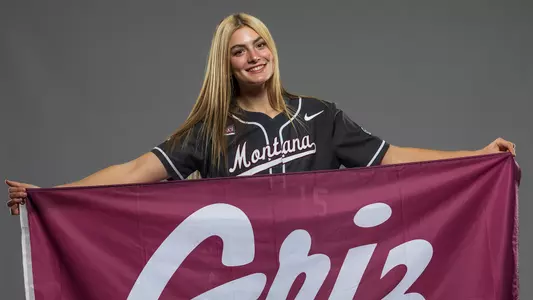
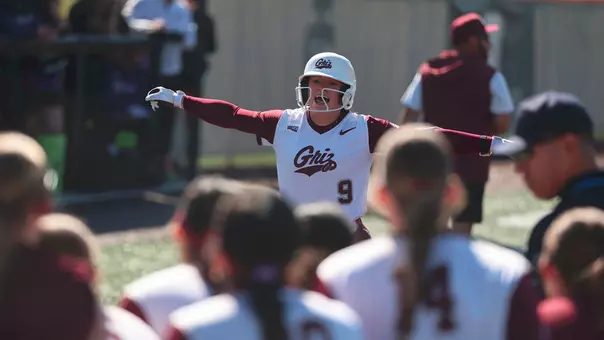
Photo by: Shanna Madison/UM Athletics
Origin Stories :: Grace Haegele
1/20/2023 4:59:00 PM | Softball
You probably weren't there that day. And if you were, you may have missed it, at least the significance of the moment.
Montana led Miles Community College 5-1 as the exhibition game on an overcast afternoon in early October moved to the top of the fourth inning.
The music would have been playing, the spectators in the stands would have distracted themselves with conversation, with their phones, with the surrounding sights of autumn available from Grizzly Softball Field, as one team went from field to dugout, the other from dugout to field.
An announcement was made, blending in with the music. Now playing right field for Montana, Presley Jantzi. Now pitching for the Grizzlies, Grace Haegele.
On a 1-2 pitch to the first batter she faced, Haegele forced an unassisted groundout to Hannah Jablonski at first base. Two pitches later, another unassisted groundout to first.
The third batter Haegele faced struck out swinging on a 1-2 pitch.
That's when the fun started, an outburst of emotion that didn't quite fit the moment, a championship celebration in the middle of a game against an overmatched fall opponent in an exhibition game.
It would have started with Haegele, who reacted like she had just fanned Jocelyn Alo. She stomped, she yelled, she pumped her fists and looked for someone to hug, to high-five, just to be with, to play nucleus to their electrons.
The chain continued with Riley Stockton, who would have jack-in-the-boxed from her crouch behind the plate and raced toward Haegele as the Grizzlies made their way excitedly toward the front of their dugout, the space they needed to host a mosh pit.
It reached centerfield, too, where Julie Phelps saw the swinging strikeout and raced in to join her teammates.
Because there are pitchers, and then there is Grace Haegele, who has the build of Tristin Achenbach but none of the former Griz pitcher's cool, laidback vibe. Haegele's heart is out there for all to see. She wouldn't have it any other way. She won't have it any other way.
"It's really cool to have a pitcher who matches everyone else's energy. Sometimes pitchers get in the zone and kind of block out what's around them, but (Grace) is in the zone while also bringing everyone else on the field along with her," said Phelps.
"It's cool having her energy on the mound. She didn't really show that she was a freshman and wanted to learn her place. She knew what her place was and she just went for it."
Haegele pitched the fifth as well, struck out the side on 14 pitches, all three strikeouts swinging. More fun, House of Pain providing the soundtrack whether it was playing on the sound system or not. Jump around!
That emotion? Its genesis could have been seen years ago, when she first started taking pitching lessons.
She didn't have to pitch. She was a corner infielder to start, someone they called Snae-gele Haegele because of her glove. And her bat? "The first time I was good at softball, it was because I could hit. I was strong and I hit it hard. I first started to love the game because of hitting," she said.
But you're tall, they told her, you should be a pitcher. So, she began to take lessons, which almost always left her in tears. She couldn't locate the pitches like she wanted. She couldn't throw the ball as hard as she wanted. Her mechanics weren't dialed in.
"Everything would overwhelm me. I was so mad I wasn't throwing perfectly," she said. Her parents, Tom and Kari, stepped in and offered some advice. Maybe this isn't the position for you if you're going to be this hard on yourself.
"We probably said that once," Kari says. "She was so determined to succeed that we didn't say that again. She made it pretty clear that's what she wanted to do.
"She expects a lot from herself. She is very driven. She just had high expectations for herself and wanted to be the best." Grace Haegele was 10 years old.
Through the tears, she saw something clearly in this new position, something that fit her. This position was like no other on the field. Every other defensive position was one of reaction. This one dictated that action, started it, ended it if everything went correctly.
"There is nothing I love more than having a batter in front of me and that moment when you've got a new batter and a fresh count, and you're about to go to work. The adrenaline, there is nothing better," she said. "It's control. I like having that control and the ball in my hand. I want to be the one to do it."
And the emotion that came from those one-on-one battles would spill over the edge, overflowing, unable to be contained. She was told to bottle it up, to keep her emotions under control. She couldn't. Wouldn't.
She had offers from colleges from all over coming out of Redmond High in Washington, out of Team Seattle. Those coaches talked about numbers, statistics, her pitches and what they could teach her. No one seemed to be interested in Grace Haegele the person as much as Grace Haegele's right arm.
That is, until she met Montana coach Melanie Meuchel.
There was the coach who saw Haegele's video and offered her without ever seeing her play or meeting her in person. "They didn't know about me. They weren't recruiting me because of who I was. They saw me as an asset. It was about the numbers, which I didn't like as much.
"That kind of red-flagged me," she said. "That's one of the reasons I chose to go here. Mel recruits people for who they are. I knew she wanted me for the energy and passion I bring and how I communicate with my teammates and how I lead."
Meuchel, who has been coaching college pitchers for nearly two decades, is asked about that emotion. Can too much be a bad thing for the position? Does it hinder a pitcher's ability to remain in the moment, remain focused on the task at hand? Is it a fire you don't want to allow the opponent to use as fuel?
Hardly. Meuchel wants more of it, more of Haegele. "I'm so happy she is not afraid to show it. I try to embrace letting them be themselves, whatever makes them tick. I want to give them freedom to be themselves and be the competitor they want to be."
That's what Haegele was announcing that day last fall, when two groundouts and an inning-ending strikeout looked like the Grizzlies had just won the Big Sky Conference championship. "Hey, Montana, here I am," she says. "This is the passion I'm going to bring every single game."
But there was more to that moment than just three up, three down, a freshman making her Griz debut. Way more. Only she truly knew what she had been through to be in that moment, she and her teammates and her coaches. You wouldn't have known.
You wouldn't have known about the stress fractures in her back that started developing not long after she began pitching and growing. How a year ago at this time she was saddled with a restrictive back brace, immobilized for seven months, banned from doing pretty much anything fun, anything softball.
How an MRI to check on the healing of those stress fractures revealed a tumor, and how that tumor stumped even the Mayo Clinic. How the family had to spend day after day waking up and going to bed with the sword of Damocles hanging over their heads, the unknown: Is it cancer?
How she pitched Redmond High to a state title in Spokane in May with that tumor along for the ride, then underwent surgery in June to remove it and to rebuild a section of her spine with two titanium rods and six screws.
So, yes, that inning-ending strikeout represented a lot, the dream of pitching in college, her first time pitching competitively since surgery. On top of that, it was Grace being Grace, fired up beyond what you would expect at the chance to play the game she loves.
"My husband and I always say, never count Grace out. She can do anything she sets her mind to," said Kari.
Bowling. That's what it looked like she was doing when she first started pitching. And the pressure of being the player on the field everyone was relying on? She didn't like it. Then she came to accept it. Then she came to embrace it. Then she came to love it, to need it.
"I looked up to older pitchers. That's who I want to be like. I want to be that strong, that powerful. I couldn't get over the adrenaline, that rush when it's just you against someone else," she says. "I get to trick you. I get to deceive you. I get to beat you. There is no other position that's like it."
But it came at a cost, the physical toll. She was growing faster and at a greater rate than her peers. That alone can stress a body out. Now she was torqueing it every time she threw a pitch toward home plate, her spine the fulcrum of all those moving parts.
It rebelled. It developed stress fractures by the time she was in middle school, when she would have to ask her teammates to give her a quick massage in the dugout so she could make it through another inning.
The stress fractures would arrive. Rest would make them recede into the background. And repeat.
"She had stress fractures on and off since she started pitching," says Kari, a teacher at Clara Barton Elementary. "The diagnosis always made sense. She grew so much so fast, then all that repetitive motion. She'd take time off and it would go away."
She grew up playing soccer, basketball, then she pitched for the Redmond all-stars at the Junior League World Series in Kirkland as an eighth grader. And everything changed. She was able to view the sport from a new perspective, of what it could mean, what it could do for her.
"We played a team from the Philippines, a team from Italy, Puerto Rico. It was shocking to me," she says. She saw what softball could provide, what opportunities the game could open. She wondered what she could do in the sport if she gave it 100 percent of her attention.
"It kind of set the tone for what softball meant for me. It was the first time I thought, okay, this is what competition really looks like. I'm ready to go. Once you see that competition, my love for the game just escalated after that."
Her middle school was going to feed into Redmond High, so the school's softball coach used the World Series to check out the player so many people had been telling her about.
"People say a lot of things about players, especially at the youth level, so I always like to get eyes on if I get the chance to get eyes on," says Alison Mitchell.
Mitchell would coach Haegele one season at Redmond High before taking the head job at Central Washington, before moving on to Montana, where she is in her second season as an assistant coach for Meuchel and the Grizzlies.
What did she see, when she got eyes on? "Potential. Tons of potential, tons of upside. Her body type, her size, her height, her limbs, the way she could move in space seemed more developed for her age than other players," Mitchell says.
"She had good velocity, especially for her age, then the way she interacted with other players on the field and her competitiveness in the circle."
And there was more. Middle schoolers, especially when they are playing sports, tend to be hyper-aware of their surroundings. Who's watching from the stands? Is the coach happy with that decision? How does this uniform fit me?
"Grace would lose herself in the game. She would pitch and be competitive and just lose herself in the game. That is unique to any player, no matter the age. That excited me," says Mitchell.
"There can be a lot going on at that age. Insecurities can show through. You're still learning who you are as a person. The games, they mattered to her, every game, every inning, every pitch. You could see that. It was a higher drive, a higher level of competitiveness that she carried within herself."
And then she arrived at Redmond High and found Kiki Milloy in her way, blocking her path to the pitcher's circle. There was no shame in that. Milloy was a senior and just happened to be the daughter of Lawyer and Claudine Milloy.
Her dad was a 15-year NFL veteran, a four-time Pro Bowl selection. Her mom ran sprints and hurdles at Washington and was a two-time all-American.
Milloy is now a senior at Tennessee. She was a second-team all-American as a sophomore and junior. It was good company to be with, even if it meant being a step behind.
"Grace had to spend her freshman year developing behind Kiki, kind of biding her time," says Mitchell. "She didn't want that role but she understood it.
"I told her to watch how Kiki interacted with her teammates in the circle, the way she carried herself in the circle no matter what was happening. It matters, so pay attention to that field presence. She was a sponge. She soaked it all in."
Haegele still remembers the lessons learned. "The biggest thing I got from watching Kiki was her competitive fire. My coach told me I had to have more swagger when I was on the mound. Okay, I'll take that and I'll do it.
"I learned a lot, how she played the sport, how she intimidated. I got to be in the box against Kiki. Okay, how can I intimidate people like she does? How can I take what she does and make it my own?"
Haegele got a few starts that season, a few more innings here and there, but once the Class 4A state tournament rolled around, Redmond hitched itself to Milloy, and the senior brought it and gave her team everything she had.
Because rain wiped out opening day, Redmond played five games the next day.
The Mustangs defeated Moses Lake in an 8 a.m. game, Chiawana at noon. They lost to eventual champion Jackson at 4. That evening Redmond defeated Battle Ground 3-1 for a chance to play one final game, for third place.
It was nighttime and Milloy was done. It had already been a long, long day.
"She was out of gas. No game was going to be worth throwing a kid to injure them," said Mitchell, who pulled Haegele aside and told her it was her time. Warm up. She was getting the start.
"I told her, we've made it this far and everybody believes in you. We can do this. She threw great. She was phenomenal. She tied (Richland) up. She provided our team a lot of energy on a day when everyone else was feeling kind of worn down. She dominated in the circle."
Milloy played center, then approached her protégé after the final out. "That was a passing-the-torch moment," Haegele says. "Kiki told me it was my team now. I remember that moment. It was the role I wanted and needed to play now."
She never got the chance, at least in the traditional high school timeline. Covid wiped out her sophomore season. Redmond went undefeated her junior year, but it was a shortened schedule without a state tournament as its conclusion.
Then the back pain returned, this time with a vengeance. She pitched through the summer, gutted it out so all the college recruiters could see her, evaluate her, then underwent an MRI. She had a stress fracture in her lumbar spine.
She was given a back brace to wear, molded perfectly to her frame, the best way to make it extra sweaty and tight against the skin.
"It was a nightmare. It was hard plastic with big straps. I had to wear it 23 hours a day. I could only take it off to shower," she says. "My spine wasn't supposed to move much at all. It was really hard when all your friends are playing basketball on the weekends. That was awful."
After three months, another MRI to check on the progress. Fingers crossed for an end of the back brace, for good news. Instead they discovered two additional stress fractures they hadn't seen before. And what was that mass?
The back brace remained on, and a biopsy of the tumor was sent to the Mayo Clinic. "We got the news it was a tumor, then we had to wait to find out if it was cancer," says Kari. "That was a really tough time."
There would be no answers, really for any of it. But an athlete knows her body better than anybody else, so Grace has some ideas.
"That was the weird thing, that is was all very mysterious," she says. "I have a theory that it was the tumor that put pressure on the bones and that's what gave me the fractures in the first place." And since the Mayo Clinic was stumped, Haegele gets naming rights. "I call it the Grace Tumor."
The back brace may have knocked her down, but it didn't defeat her. "Her mindset never changed," says her mom. "What can I do today to be better tomorrow? Can I watch game film? She studied her pitches, she still went to practices for the team she was on, even though she couldn't do much."
Finally, that light at the end of the tunnel, the one so hard to see for so long, was shining brightly in her face. She got to ditch the back brace. She got to start PT. She got to inch her way back on the field, first to take infield, then do a bit of hitting and finally some pitching.
It was halfway through her senior season when she was able to return to the circle.
"We were undefeated junior year, so I knew we were going to be good, but everything was up in the air," she says. "I wasn't expecting a state championship, but that doesn't mean we didn't keep it as our goal."
Redmond made state, and just because the universe wanted to see what one girl could possibly endure, she spent the first half of that week in bed, sick.
The No. 8 seed, Redmond defeated No. 9 Olympia 9-1 in the round of 16. "That first game I remember I was out of breath. I hit a home run and I was barely jogging around the bases," she says. "Just win this inning, win this pitch. It was a grind."
"We questioned if she was well enough to go play," says Kari. "Then her coaches questioned if she was able to play more than the first inning in Game 1. She went and pitched every inning over four games in two days.
"I used to get nervous because there is so much focus on the pitcher. What all this has taught me is, trust in Grace. She's got it. I never doubt her. That doesn't mean she is always going to win, but I believe in my kid."
Redmond upset top-seeded Kentwood and stud pitcher Sarah Wright in the quarterfinals, and that was it. The outcome was no longer in doubt, even before the outcome had been decided.
"Once we won our second game, that's when I knew we were going all the way. We've gone this far, we're going all the way," Haegele says.
The Mustangs defeated Puyallup 4-1 in the semifinals, Skyview 7-6 in the championship game. Haegele hit a tie-breaking home run in the top of the sixth, then pitched her only 1-2-3 inning in the bottom of the seventh with her team holding a one-run lead.
"That was everything paid off, the perfect ending," she says. "The girls I played all-stars with. I went to World Series with half that team. It was emotional. One of the best feelings ever."
She had surgery in late June. The tumor was of a size and in a location that they had to remove part of her spine to access all of it. Then they put her back together again, with a small cage inserted and secured, and with the words of her surgeon resting comfortably in their heads: "You will play again."
If you're thinking to yourself: Wait, haven't I heard that story before, a Montana pitcher who had to have her back fixed with titanium rods and screws? You'd be correct. Former Grizzly Colleen Driscoll had her own story to tell.
And she did just fine. She ranks second in program history in career ERA (3.35), third in wins (27) and made 96 appearances from 2016-19. Fifty-seven of those were starts.
"Mel talked to me a lot about her, how she came back stronger and all the adversity she faced," said Haegele. "That was very inspirational to me. I've been pitching since October and I haven't had any back pain, so I feel like I'm in better shape than I've ever been."
If you had passed by the Haegele home in Redmond in the weeks after her surgery, you wouldn't have put down a lot of money that you were looking at someone who would be pitching at the Division I level in three months.
For a week or two, she couldn't walk. Then she advanced to using a walker. Then she would simply walk up and down the driveway, getting her steps in. In between sessions was appointment after appointment, physical therapy session after physical therapy session.
"I have some pretty cool battle scars," she brags now.
Had you known all this back on October 1, you might have been stomping, yelling and pumping your fist as well when she went 1-2-3 in the top of the fourth against Miles Community College.
She is here despite being part of the great Covid disruption of 2020, which arrived when she was a sophomore. It couldn't have been worse timing for a recruit with aspirations of pitching in college.
She would have been seen as a freshman. Now, when coaches would have been following up on her progression, there was nothing to show them. At least live. So, she took matters into her own hands.
She had her list of two dozen schools that made up her wish list. She came up with a communications plan and started hitting send a few times per week.
"I was putting in my own work on my own time. That's really all you could do," she says, and she wanted to show it to everyone, or at least to the two dozen coaches she was trying to catch the eye of. "Okay, for a month, I'm going to commit myself to this. I'm going to send an email every other day."
At first it was just videos of her pitching and doing drills. Then she remembered a conversation she had with Mitchell, who knew how this all worked from her 13 years coaching Washington Ladyhawk teams and at Eastside Catholic, Skyline and Redmond high schools.
"She told me coaches like to see journal entries," says Haegele, so she let the coaches know she and her older sister Sophie, who is now a junior at Washington, studying psychology and creative writing, went on a cool hike today.
Maybe she mentioned her younger brother, the soccer player who won a club national championship, the one with Division I dreams himself. "Short, sweet, send it."
Montana was on her list because she was interested in going out of state, because she liked the idea of having a female head coach and because the school had football, a large stadium and a classic campus feel.
She would also come to love the support, which she saw firsthand on her visit, like the moment had been scripted. She was watching practice when a fire truck rolled by and blasted its horn, a loud tip of the cap to the Grizzlies. We're behind you, HOOOONNNNNKKKKK!!!
"This community, everybody loves Griz softball, everybody loves Griz athletics. They are all rooting for us. The community is different than anywhere else," Haegele says.
And she was on Montana's list, even if she didn't know it. Meuchel had seen her as a freshman and noted this would be someone to keep an eye on, even if she couldn't when Covid cut off her usual recruiting access.
Then, in the summer of 2020, those emails started arriving, from prospect to coach. When the calendar and rules finally allowed, Meuchel hit send herself, on Sept. 1, coach reaching out to prospect.
It landed in Haegele's email junk folder. It wasn't until later that day, when mom and daughter were driving home from travel-ball practice, that she decided to check that folder.
"I'll never forget her reaction. It was happy tears, it was excitement," said Kari, who has her own connection to the state. Her mom was from Montana and was a UM graduate decades ago.
"I'll never forget the sky. It was this beautiful sunset. Something just felt right that night. Anyone who wants to play in college dreams of that day, and Montana was one of the schools on her target list."
With some schools, it was a rush job. One phone call in and they wanted her to visit. Meuchel played the long game, as she tends to do, wanting to learn about the person before moving on to the next step.
"Mel talked to me for months before she talked about an offer. Then they came to a ton of games. I would always see Montana out of the corner of my eye. There's that maroon again," she said.
"She'd want to talk about how my life was going. It wasn't just softball, which was important. I was immediately drawn to that. I came on a visit and I was sold."
If Kari had the specifics of that moment in the car, when Grace first saw the email from Montana and responded with tears of joy, burned into her memory, Montana's coaches have the same type of story for the day Haegele called them and committed.
Meuchel, Mitchell and volunteer assistant Dennis Meuchel were leaving the indoor facility when Meuchel's phone rang.
It was deep into the process, now more than a year after they had started communicating. Either Haegele needed a bit more information, or she was going to make Meuchel the happiest person in Missoula or the saddest. Recruiting is like that.
Not even Kari and Tom, who works in marketing at Microsoft, knew who she was going to call from her room, only that she had made up her mind. She would tell them after the call had been made.
She said yes.
"I immediately just screamed," says Meuchel. "I put her on speaker phone and let everyone join in the celebration of committing here."
Mitchell can make it even clearer. "I remember where we were standing. The sun was kind of going down. It was a beautiful day. I was beyond excited," says the coach who first saw Haegele when she was an eighth grader, then coached her as a freshman at Redmond.
"I remember the potential and know where she was in middle school to where she is now and how hard she's worked. How cool is it for your life to take that kind of journey? Knowing what Coach Mel can do with Grace with them working together, I think it's going to be super special."
She was named the MaxPreps Washington Player of the Year as a senior, as much for her glove as for her arm. She led Class 4A in home runs (13) last spring and ranked second in RBI (48). She also was top 10 in strikeouts (130) and ERA (2.39), even with missed opportunities.
She could one day turn into the Maddy Stensby-type, the former Grizzly who pitched in 26 games as a senior in 2019 and also batted .303 in 109 at-bats.
But for now, she'll focus on pitching and getting stronger. Her body has earned some love and attention.
"On days when you're struggling as a pitcher, I can still help out my team on the other side with a bat in my hand," says Haegele. "All right, make up for it on the other side. I would separate the two. I was hitter Grace and pitcher Grace.
"At this point, pitching is too important. I don't want to put too much pressure on my back. I love hitting. It was my first love in softball. But I've appreciated this time to come back and focus on my fundamentals of pitching and getting a lot stronger."
Meuchel says Haegele will be ready to get starts as soon as the season opens next month in Riverside, Calif. She is ready physically and she is ready talent-wise.
"Grace shows the ability to be able to pitch at this level and perform at this level, so I plan to utilize her as much as possible within our staff," Meuchel says. "I see her eating up innings for us."
And if Haegele were to get the start in Eugene, when Montana plays at Oregon on April 3, she'd be fine with that.
"I saw that game and put a highlight star next to it," she says. "I'm ready. I've wanted that game since I was born. I've wanted to throw in a high-level game.
"(Meuchel) is going to decide who gets the start based on who's put in the work and who's looking the best and who's the best matchup against that team. If it's me, I'd be ready to go. If it's not, I'm sure as hell ready to cheer whoever gets to be in that position."
Imagine that scene, if Haegele made the start and set the Ducks down in order in the bottom of the first. You might feel the shaking all the way back to Missoula.
Because she is going to bring it, every game, every inning, every pitch. She knows of no other way of doing it. "I have all this emotion. I'm tired of being told I have to close it off, shut it down. I'm going to use it instead to pump me up, pump my team up," she said.
"I'm going to be louder on the field instead of trying to quiet down That's how I throw. That's the pitcher you're going to get."
Quick story about Kari. She was a standout soccer player at Lake Washington High. Good enough to earn a tryout at Washington. They liked her, asked her to return in the spring, after the fall season, for another look. She chose to go all in on her academics instead.
"She tells me she regrets that a lot. She could have made the team, could have played a college sport," says Grace. "Maybe part of that story stuck with me. I don't want to have any regrets. I want to make the most of where I'm at.
"So, I'm going to give every last bit I have to the game. I'm going to lose myself entirely in the process because I only have one chance to do it. I have one shot at this, to be an all-American, to be the best I can possibly be. I don't want to not get there.
"I'm going to leave the sport knowing I did absolutely everything in my power to win and give my teammates the best chance to win. I'm not going to waste any second, any pitch."
So, you'll have to excuse her if she seems a little fired up out there. She has a lot of reasons to be.
Montana led Miles Community College 5-1 as the exhibition game on an overcast afternoon in early October moved to the top of the fourth inning.
The music would have been playing, the spectators in the stands would have distracted themselves with conversation, with their phones, with the surrounding sights of autumn available from Grizzly Softball Field, as one team went from field to dugout, the other from dugout to field.
An announcement was made, blending in with the music. Now playing right field for Montana, Presley Jantzi. Now pitching for the Grizzlies, Grace Haegele.
On a 1-2 pitch to the first batter she faced, Haegele forced an unassisted groundout to Hannah Jablonski at first base. Two pitches later, another unassisted groundout to first.
The third batter Haegele faced struck out swinging on a 1-2 pitch.
That's when the fun started, an outburst of emotion that didn't quite fit the moment, a championship celebration in the middle of a game against an overmatched fall opponent in an exhibition game.
It would have started with Haegele, who reacted like she had just fanned Jocelyn Alo. She stomped, she yelled, she pumped her fists and looked for someone to hug, to high-five, just to be with, to play nucleus to their electrons.
The chain continued with Riley Stockton, who would have jack-in-the-boxed from her crouch behind the plate and raced toward Haegele as the Grizzlies made their way excitedly toward the front of their dugout, the space they needed to host a mosh pit.
It reached centerfield, too, where Julie Phelps saw the swinging strikeout and raced in to join her teammates.
Because there are pitchers, and then there is Grace Haegele, who has the build of Tristin Achenbach but none of the former Griz pitcher's cool, laidback vibe. Haegele's heart is out there for all to see. She wouldn't have it any other way. She won't have it any other way.
"It's really cool to have a pitcher who matches everyone else's energy. Sometimes pitchers get in the zone and kind of block out what's around them, but (Grace) is in the zone while also bringing everyone else on the field along with her," said Phelps.
"It's cool having her energy on the mound. She didn't really show that she was a freshman and wanted to learn her place. She knew what her place was and she just went for it."
Haegele pitched the fifth as well, struck out the side on 14 pitches, all three strikeouts swinging. More fun, House of Pain providing the soundtrack whether it was playing on the sound system or not. Jump around!
That emotion? Its genesis could have been seen years ago, when she first started taking pitching lessons.
She didn't have to pitch. She was a corner infielder to start, someone they called Snae-gele Haegele because of her glove. And her bat? "The first time I was good at softball, it was because I could hit. I was strong and I hit it hard. I first started to love the game because of hitting," she said.
But you're tall, they told her, you should be a pitcher. So, she began to take lessons, which almost always left her in tears. She couldn't locate the pitches like she wanted. She couldn't throw the ball as hard as she wanted. Her mechanics weren't dialed in.
"Everything would overwhelm me. I was so mad I wasn't throwing perfectly," she said. Her parents, Tom and Kari, stepped in and offered some advice. Maybe this isn't the position for you if you're going to be this hard on yourself.
"We probably said that once," Kari says. "She was so determined to succeed that we didn't say that again. She made it pretty clear that's what she wanted to do.
"She expects a lot from herself. She is very driven. She just had high expectations for herself and wanted to be the best." Grace Haegele was 10 years old.
Through the tears, she saw something clearly in this new position, something that fit her. This position was like no other on the field. Every other defensive position was one of reaction. This one dictated that action, started it, ended it if everything went correctly.
"There is nothing I love more than having a batter in front of me and that moment when you've got a new batter and a fresh count, and you're about to go to work. The adrenaline, there is nothing better," she said. "It's control. I like having that control and the ball in my hand. I want to be the one to do it."
And the emotion that came from those one-on-one battles would spill over the edge, overflowing, unable to be contained. She was told to bottle it up, to keep her emotions under control. She couldn't. Wouldn't.
She had offers from colleges from all over coming out of Redmond High in Washington, out of Team Seattle. Those coaches talked about numbers, statistics, her pitches and what they could teach her. No one seemed to be interested in Grace Haegele the person as much as Grace Haegele's right arm.
That is, until she met Montana coach Melanie Meuchel.
There was the coach who saw Haegele's video and offered her without ever seeing her play or meeting her in person. "They didn't know about me. They weren't recruiting me because of who I was. They saw me as an asset. It was about the numbers, which I didn't like as much.
"That kind of red-flagged me," she said. "That's one of the reasons I chose to go here. Mel recruits people for who they are. I knew she wanted me for the energy and passion I bring and how I communicate with my teammates and how I lead."
Meuchel, who has been coaching college pitchers for nearly two decades, is asked about that emotion. Can too much be a bad thing for the position? Does it hinder a pitcher's ability to remain in the moment, remain focused on the task at hand? Is it a fire you don't want to allow the opponent to use as fuel?
Hardly. Meuchel wants more of it, more of Haegele. "I'm so happy she is not afraid to show it. I try to embrace letting them be themselves, whatever makes them tick. I want to give them freedom to be themselves and be the competitor they want to be."
That's what Haegele was announcing that day last fall, when two groundouts and an inning-ending strikeout looked like the Grizzlies had just won the Big Sky Conference championship. "Hey, Montana, here I am," she says. "This is the passion I'm going to bring every single game."
But there was more to that moment than just three up, three down, a freshman making her Griz debut. Way more. Only she truly knew what she had been through to be in that moment, she and her teammates and her coaches. You wouldn't have known.
You wouldn't have known about the stress fractures in her back that started developing not long after she began pitching and growing. How a year ago at this time she was saddled with a restrictive back brace, immobilized for seven months, banned from doing pretty much anything fun, anything softball.
How an MRI to check on the healing of those stress fractures revealed a tumor, and how that tumor stumped even the Mayo Clinic. How the family had to spend day after day waking up and going to bed with the sword of Damocles hanging over their heads, the unknown: Is it cancer?
How she pitched Redmond High to a state title in Spokane in May with that tumor along for the ride, then underwent surgery in June to remove it and to rebuild a section of her spine with two titanium rods and six screws.
So, yes, that inning-ending strikeout represented a lot, the dream of pitching in college, her first time pitching competitively since surgery. On top of that, it was Grace being Grace, fired up beyond what you would expect at the chance to play the game she loves.
"My husband and I always say, never count Grace out. She can do anything she sets her mind to," said Kari.
Bowling. That's what it looked like she was doing when she first started pitching. And the pressure of being the player on the field everyone was relying on? She didn't like it. Then she came to accept it. Then she came to embrace it. Then she came to love it, to need it.
"I looked up to older pitchers. That's who I want to be like. I want to be that strong, that powerful. I couldn't get over the adrenaline, that rush when it's just you against someone else," she says. "I get to trick you. I get to deceive you. I get to beat you. There is no other position that's like it."
But it came at a cost, the physical toll. She was growing faster and at a greater rate than her peers. That alone can stress a body out. Now she was torqueing it every time she threw a pitch toward home plate, her spine the fulcrum of all those moving parts.
It rebelled. It developed stress fractures by the time she was in middle school, when she would have to ask her teammates to give her a quick massage in the dugout so she could make it through another inning.
The stress fractures would arrive. Rest would make them recede into the background. And repeat.
"She had stress fractures on and off since she started pitching," says Kari, a teacher at Clara Barton Elementary. "The diagnosis always made sense. She grew so much so fast, then all that repetitive motion. She'd take time off and it would go away."
She grew up playing soccer, basketball, then she pitched for the Redmond all-stars at the Junior League World Series in Kirkland as an eighth grader. And everything changed. She was able to view the sport from a new perspective, of what it could mean, what it could do for her.
"We played a team from the Philippines, a team from Italy, Puerto Rico. It was shocking to me," she says. She saw what softball could provide, what opportunities the game could open. She wondered what she could do in the sport if she gave it 100 percent of her attention.
"It kind of set the tone for what softball meant for me. It was the first time I thought, okay, this is what competition really looks like. I'm ready to go. Once you see that competition, my love for the game just escalated after that."
Her middle school was going to feed into Redmond High, so the school's softball coach used the World Series to check out the player so many people had been telling her about.
"People say a lot of things about players, especially at the youth level, so I always like to get eyes on if I get the chance to get eyes on," says Alison Mitchell.
Mitchell would coach Haegele one season at Redmond High before taking the head job at Central Washington, before moving on to Montana, where she is in her second season as an assistant coach for Meuchel and the Grizzlies.
What did she see, when she got eyes on? "Potential. Tons of potential, tons of upside. Her body type, her size, her height, her limbs, the way she could move in space seemed more developed for her age than other players," Mitchell says.
"She had good velocity, especially for her age, then the way she interacted with other players on the field and her competitiveness in the circle."
And there was more. Middle schoolers, especially when they are playing sports, tend to be hyper-aware of their surroundings. Who's watching from the stands? Is the coach happy with that decision? How does this uniform fit me?
"Grace would lose herself in the game. She would pitch and be competitive and just lose herself in the game. That is unique to any player, no matter the age. That excited me," says Mitchell.
"There can be a lot going on at that age. Insecurities can show through. You're still learning who you are as a person. The games, they mattered to her, every game, every inning, every pitch. You could see that. It was a higher drive, a higher level of competitiveness that she carried within herself."
And then she arrived at Redmond High and found Kiki Milloy in her way, blocking her path to the pitcher's circle. There was no shame in that. Milloy was a senior and just happened to be the daughter of Lawyer and Claudine Milloy.
Her dad was a 15-year NFL veteran, a four-time Pro Bowl selection. Her mom ran sprints and hurdles at Washington and was a two-time all-American.
Milloy is now a senior at Tennessee. She was a second-team all-American as a sophomore and junior. It was good company to be with, even if it meant being a step behind.
"Grace had to spend her freshman year developing behind Kiki, kind of biding her time," says Mitchell. "She didn't want that role but she understood it.
"I told her to watch how Kiki interacted with her teammates in the circle, the way she carried herself in the circle no matter what was happening. It matters, so pay attention to that field presence. She was a sponge. She soaked it all in."
Haegele still remembers the lessons learned. "The biggest thing I got from watching Kiki was her competitive fire. My coach told me I had to have more swagger when I was on the mound. Okay, I'll take that and I'll do it.
"I learned a lot, how she played the sport, how she intimidated. I got to be in the box against Kiki. Okay, how can I intimidate people like she does? How can I take what she does and make it my own?"
Haegele got a few starts that season, a few more innings here and there, but once the Class 4A state tournament rolled around, Redmond hitched itself to Milloy, and the senior brought it and gave her team everything she had.
Because rain wiped out opening day, Redmond played five games the next day.
The Mustangs defeated Moses Lake in an 8 a.m. game, Chiawana at noon. They lost to eventual champion Jackson at 4. That evening Redmond defeated Battle Ground 3-1 for a chance to play one final game, for third place.
It was nighttime and Milloy was done. It had already been a long, long day.
"She was out of gas. No game was going to be worth throwing a kid to injure them," said Mitchell, who pulled Haegele aside and told her it was her time. Warm up. She was getting the start.
"I told her, we've made it this far and everybody believes in you. We can do this. She threw great. She was phenomenal. She tied (Richland) up. She provided our team a lot of energy on a day when everyone else was feeling kind of worn down. She dominated in the circle."
Milloy played center, then approached her protégé after the final out. "That was a passing-the-torch moment," Haegele says. "Kiki told me it was my team now. I remember that moment. It was the role I wanted and needed to play now."
She never got the chance, at least in the traditional high school timeline. Covid wiped out her sophomore season. Redmond went undefeated her junior year, but it was a shortened schedule without a state tournament as its conclusion.
Then the back pain returned, this time with a vengeance. She pitched through the summer, gutted it out so all the college recruiters could see her, evaluate her, then underwent an MRI. She had a stress fracture in her lumbar spine.
She was given a back brace to wear, molded perfectly to her frame, the best way to make it extra sweaty and tight against the skin.
"It was a nightmare. It was hard plastic with big straps. I had to wear it 23 hours a day. I could only take it off to shower," she says. "My spine wasn't supposed to move much at all. It was really hard when all your friends are playing basketball on the weekends. That was awful."
After three months, another MRI to check on the progress. Fingers crossed for an end of the back brace, for good news. Instead they discovered two additional stress fractures they hadn't seen before. And what was that mass?
The back brace remained on, and a biopsy of the tumor was sent to the Mayo Clinic. "We got the news it was a tumor, then we had to wait to find out if it was cancer," says Kari. "That was a really tough time."
There would be no answers, really for any of it. But an athlete knows her body better than anybody else, so Grace has some ideas.
"That was the weird thing, that is was all very mysterious," she says. "I have a theory that it was the tumor that put pressure on the bones and that's what gave me the fractures in the first place." And since the Mayo Clinic was stumped, Haegele gets naming rights. "I call it the Grace Tumor."
The back brace may have knocked her down, but it didn't defeat her. "Her mindset never changed," says her mom. "What can I do today to be better tomorrow? Can I watch game film? She studied her pitches, she still went to practices for the team she was on, even though she couldn't do much."
Finally, that light at the end of the tunnel, the one so hard to see for so long, was shining brightly in her face. She got to ditch the back brace. She got to start PT. She got to inch her way back on the field, first to take infield, then do a bit of hitting and finally some pitching.
It was halfway through her senior season when she was able to return to the circle.
"We were undefeated junior year, so I knew we were going to be good, but everything was up in the air," she says. "I wasn't expecting a state championship, but that doesn't mean we didn't keep it as our goal."
Redmond made state, and just because the universe wanted to see what one girl could possibly endure, she spent the first half of that week in bed, sick.
The No. 8 seed, Redmond defeated No. 9 Olympia 9-1 in the round of 16. "That first game I remember I was out of breath. I hit a home run and I was barely jogging around the bases," she says. "Just win this inning, win this pitch. It was a grind."
"We questioned if she was well enough to go play," says Kari. "Then her coaches questioned if she was able to play more than the first inning in Game 1. She went and pitched every inning over four games in two days.
"I used to get nervous because there is so much focus on the pitcher. What all this has taught me is, trust in Grace. She's got it. I never doubt her. That doesn't mean she is always going to win, but I believe in my kid."
Redmond upset top-seeded Kentwood and stud pitcher Sarah Wright in the quarterfinals, and that was it. The outcome was no longer in doubt, even before the outcome had been decided.
"Once we won our second game, that's when I knew we were going all the way. We've gone this far, we're going all the way," Haegele says.
The Mustangs defeated Puyallup 4-1 in the semifinals, Skyview 7-6 in the championship game. Haegele hit a tie-breaking home run in the top of the sixth, then pitched her only 1-2-3 inning in the bottom of the seventh with her team holding a one-run lead.
"That was everything paid off, the perfect ending," she says. "The girls I played all-stars with. I went to World Series with half that team. It was emotional. One of the best feelings ever."
She had surgery in late June. The tumor was of a size and in a location that they had to remove part of her spine to access all of it. Then they put her back together again, with a small cage inserted and secured, and with the words of her surgeon resting comfortably in their heads: "You will play again."
If you're thinking to yourself: Wait, haven't I heard that story before, a Montana pitcher who had to have her back fixed with titanium rods and screws? You'd be correct. Former Grizzly Colleen Driscoll had her own story to tell.
And she did just fine. She ranks second in program history in career ERA (3.35), third in wins (27) and made 96 appearances from 2016-19. Fifty-seven of those were starts.
"Mel talked to me a lot about her, how she came back stronger and all the adversity she faced," said Haegele. "That was very inspirational to me. I've been pitching since October and I haven't had any back pain, so I feel like I'm in better shape than I've ever been."
If you had passed by the Haegele home in Redmond in the weeks after her surgery, you wouldn't have put down a lot of money that you were looking at someone who would be pitching at the Division I level in three months.
For a week or two, she couldn't walk. Then she advanced to using a walker. Then she would simply walk up and down the driveway, getting her steps in. In between sessions was appointment after appointment, physical therapy session after physical therapy session.
"I have some pretty cool battle scars," she brags now.
Had you known all this back on October 1, you might have been stomping, yelling and pumping your fist as well when she went 1-2-3 in the top of the fourth against Miles Community College.
She is here despite being part of the great Covid disruption of 2020, which arrived when she was a sophomore. It couldn't have been worse timing for a recruit with aspirations of pitching in college.
She would have been seen as a freshman. Now, when coaches would have been following up on her progression, there was nothing to show them. At least live. So, she took matters into her own hands.
She had her list of two dozen schools that made up her wish list. She came up with a communications plan and started hitting send a few times per week.
"I was putting in my own work on my own time. That's really all you could do," she says, and she wanted to show it to everyone, or at least to the two dozen coaches she was trying to catch the eye of. "Okay, for a month, I'm going to commit myself to this. I'm going to send an email every other day."
At first it was just videos of her pitching and doing drills. Then she remembered a conversation she had with Mitchell, who knew how this all worked from her 13 years coaching Washington Ladyhawk teams and at Eastside Catholic, Skyline and Redmond high schools.
"She told me coaches like to see journal entries," says Haegele, so she let the coaches know she and her older sister Sophie, who is now a junior at Washington, studying psychology and creative writing, went on a cool hike today.
Maybe she mentioned her younger brother, the soccer player who won a club national championship, the one with Division I dreams himself. "Short, sweet, send it."
Montana was on her list because she was interested in going out of state, because she liked the idea of having a female head coach and because the school had football, a large stadium and a classic campus feel.
She would also come to love the support, which she saw firsthand on her visit, like the moment had been scripted. She was watching practice when a fire truck rolled by and blasted its horn, a loud tip of the cap to the Grizzlies. We're behind you, HOOOONNNNNKKKKK!!!
"This community, everybody loves Griz softball, everybody loves Griz athletics. They are all rooting for us. The community is different than anywhere else," Haegele says.
And she was on Montana's list, even if she didn't know it. Meuchel had seen her as a freshman and noted this would be someone to keep an eye on, even if she couldn't when Covid cut off her usual recruiting access.
Then, in the summer of 2020, those emails started arriving, from prospect to coach. When the calendar and rules finally allowed, Meuchel hit send herself, on Sept. 1, coach reaching out to prospect.
It landed in Haegele's email junk folder. It wasn't until later that day, when mom and daughter were driving home from travel-ball practice, that she decided to check that folder.
"I'll never forget her reaction. It was happy tears, it was excitement," said Kari, who has her own connection to the state. Her mom was from Montana and was a UM graduate decades ago.
"I'll never forget the sky. It was this beautiful sunset. Something just felt right that night. Anyone who wants to play in college dreams of that day, and Montana was one of the schools on her target list."
With some schools, it was a rush job. One phone call in and they wanted her to visit. Meuchel played the long game, as she tends to do, wanting to learn about the person before moving on to the next step.
"Mel talked to me for months before she talked about an offer. Then they came to a ton of games. I would always see Montana out of the corner of my eye. There's that maroon again," she said.
"She'd want to talk about how my life was going. It wasn't just softball, which was important. I was immediately drawn to that. I came on a visit and I was sold."
If Kari had the specifics of that moment in the car, when Grace first saw the email from Montana and responded with tears of joy, burned into her memory, Montana's coaches have the same type of story for the day Haegele called them and committed.
Meuchel, Mitchell and volunteer assistant Dennis Meuchel were leaving the indoor facility when Meuchel's phone rang.
It was deep into the process, now more than a year after they had started communicating. Either Haegele needed a bit more information, or she was going to make Meuchel the happiest person in Missoula or the saddest. Recruiting is like that.
Not even Kari and Tom, who works in marketing at Microsoft, knew who she was going to call from her room, only that she had made up her mind. She would tell them after the call had been made.
She said yes.
"I immediately just screamed," says Meuchel. "I put her on speaker phone and let everyone join in the celebration of committing here."
Mitchell can make it even clearer. "I remember where we were standing. The sun was kind of going down. It was a beautiful day. I was beyond excited," says the coach who first saw Haegele when she was an eighth grader, then coached her as a freshman at Redmond.
"I remember the potential and know where she was in middle school to where she is now and how hard she's worked. How cool is it for your life to take that kind of journey? Knowing what Coach Mel can do with Grace with them working together, I think it's going to be super special."
She was named the MaxPreps Washington Player of the Year as a senior, as much for her glove as for her arm. She led Class 4A in home runs (13) last spring and ranked second in RBI (48). She also was top 10 in strikeouts (130) and ERA (2.39), even with missed opportunities.
She could one day turn into the Maddy Stensby-type, the former Grizzly who pitched in 26 games as a senior in 2019 and also batted .303 in 109 at-bats.
But for now, she'll focus on pitching and getting stronger. Her body has earned some love and attention.
"On days when you're struggling as a pitcher, I can still help out my team on the other side with a bat in my hand," says Haegele. "All right, make up for it on the other side. I would separate the two. I was hitter Grace and pitcher Grace.
"At this point, pitching is too important. I don't want to put too much pressure on my back. I love hitting. It was my first love in softball. But I've appreciated this time to come back and focus on my fundamentals of pitching and getting a lot stronger."
Meuchel says Haegele will be ready to get starts as soon as the season opens next month in Riverside, Calif. She is ready physically and she is ready talent-wise.
"Grace shows the ability to be able to pitch at this level and perform at this level, so I plan to utilize her as much as possible within our staff," Meuchel says. "I see her eating up innings for us."
And if Haegele were to get the start in Eugene, when Montana plays at Oregon on April 3, she'd be fine with that.
"I saw that game and put a highlight star next to it," she says. "I'm ready. I've wanted that game since I was born. I've wanted to throw in a high-level game.
"(Meuchel) is going to decide who gets the start based on who's put in the work and who's looking the best and who's the best matchup against that team. If it's me, I'd be ready to go. If it's not, I'm sure as hell ready to cheer whoever gets to be in that position."
Imagine that scene, if Haegele made the start and set the Ducks down in order in the bottom of the first. You might feel the shaking all the way back to Missoula.
Because she is going to bring it, every game, every inning, every pitch. She knows of no other way of doing it. "I have all this emotion. I'm tired of being told I have to close it off, shut it down. I'm going to use it instead to pump me up, pump my team up," she said.
"I'm going to be louder on the field instead of trying to quiet down That's how I throw. That's the pitcher you're going to get."
Quick story about Kari. She was a standout soccer player at Lake Washington High. Good enough to earn a tryout at Washington. They liked her, asked her to return in the spring, after the fall season, for another look. She chose to go all in on her academics instead.
"She tells me she regrets that a lot. She could have made the team, could have played a college sport," says Grace. "Maybe part of that story stuck with me. I don't want to have any regrets. I want to make the most of where I'm at.
"So, I'm going to give every last bit I have to the game. I'm going to lose myself entirely in the process because I only have one chance to do it. I have one shot at this, to be an all-American, to be the best I can possibly be. I don't want to not get there.
"I'm going to leave the sport knowing I did absolutely everything in my power to win and give my teammates the best chance to win. I'm not going to waste any second, any pitch."
So, you'll have to excuse her if she seems a little fired up out there. She has a lot of reasons to be.
Players Mentioned

P
/ Softball
INF
/ Softball
OF
/ Softball
OF
/ Softball
C
/ SoftballLady Griz Basketball Locker Room Unveiling - 5/1/26
Friday, May 01
Griz Track & Field - Montana Open Highlights - 4/25/26
Friday, May 01
Griz Softball vs. Idaho State Game-Winning Hit - 3/25/26
Friday, May 01
Griz Softball Championship Series Promo
Friday, May 01