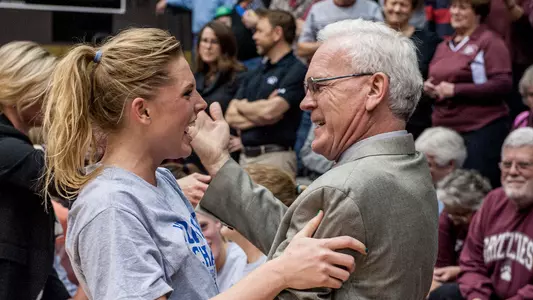
Photo by: Todd Goodrich
He built the house, he earned the floor
2/10/2023 9:36:00 AM | Women's Basketball
None of this had to happen, the 865 wins, the 36 winning and 30 20-win seasons, the 21 NCAA tournament appearances, the 38-year career that brings us to Friday night and the ceremony that will name the floor inside Dahlberg Arena "Robin Selvig Court."
Zoonie McLean could have changed the course of history, could have retired when he said he was going to step down from coaching the boys' basketball team at Plentywood High, could have made way for a young Robin Selvig to come in and take over McLean's program in northeast Montana.
The former Montana Grizzly, the former standout from Outlook, returning to Sheridan County, to his roots. What could have been more storybook than that? And who knows what would have happened?
That's what was expected when Robin and Jane Selvig, recent graduates of the University of Montana, signed contracts to teach at Plentywood, he high school PE and psychology, she fifth grade in a school system so small the entirety of it, from youngest to oldest, fit within the walls of a single building.
But then McLean looked at what he had coming up, the boys who could become state champions, which they did in 1976 and '78, and he couldn't resist. He wanted to stick around, to hang on to his position. It was a decision, made in 1975, that would have not just ripple effects but decades-long reverberations.
With McLean remaining in place, they just had to know: Robin, what would you think about coaching the girls' team instead?
Jane grew up on the family farm south of Redstone, went to a two-room school through seventh grade, then finished her schooling in Outlook, 10 miles to the northeast. That's northeast Montana, where Outlook – Outlook! – is the school that other smaller systems -- like two-room schools -- fed into.
She graduated from Outlook High in 1971, a year before anyone had heard the term Title IX, and Outlook mirrored that. Girls in the school had zero sports options. Robin, on the other hand, was the school's star athlete, with the looks to match, and he turned that into a spot with the Grizzlies.
When the Selvigs returned to Sheridan County in 1975, ready to begin their professional careers, they found a school at Plentywood that was progressing slowly, just like all the others that were wrestling with the idea of equal opportunities for girls, or even basic opportunities for girls.
"Basketball and track started maybe in 1973. By the time Rob got there in '75, girls' basketball had been going but people didn't take it seriously," says Jane. Of course, that wouldn't have mattered much to Selvig, who was going to take over the boys' basketball program.
Until McLean had second thoughts. "And the rest is history," says Jane.
What Selvig inherently knew back then, when he took over the program, that girls won't give you their absolute best, won't be all in until they know you care, really care, worked on teenagers in Plentywood back in the mid-70s, just like it would work decade after decade at Montana.
He aged over the years. The players he had on his latest team didn't. But that widening gap never mattered. His approach was timeless and it never changed. It didn't have to. Show them your heart, draw them in, then tell them they can do anything. And get out of the way because they will.
It's why he was able to push his players and teams like he did. While you were sitting in the stands wondering how his Lady Griz could handle that sort of in-game intensity, they were able to look past the delivery and hear the message: you're better than this. I believe in you. We can do this.
"He's a person that kids like. I think that appeals to the kid in him," says Jane. "But he also has extremely high expectations. Those girls in Plentywood had no expectations before that. I think they really appreciated being taken seriously, because they had not been.
"It was a level of coaching that those girls certainly hadn't had before. Once you start winning, then it becomes fun."
You may be wondering: what was 70s-era Robin Selvig like when he was coaching players who a few years before wouldn't have even had this opportunity? Did he take that into account? Did he soften his approach? "His behavior right out of college was really intense. I heard some whispers," says Jane.
And his former Lady Griz nod in solidarity. You too, eh?
His third team, in the fall of 1977, made the state tournament, held more than nine hours and 600 miles away in Dillon.
Up the road from Dillon, in Missoula, the University of Montana was coming to terms with Title IX itself and what that looked like in the world of college athletics. Harley Lewis got a jump on most of the rest of the country when the athletic director said, this is coming, let's embrace it. Let's get ahead of it.
The school's women's basketball team at the time was operating under the Department of Physical Education, which asked professors to double up as coaches. Lewis brought those women's sports into the Department of Intercollegiate Athletics. New coaches needed to be hired.
None of this had to happen, of course, all those wins, all those championships, all those NCAAs, because Lewis and men's basketball coach Mike Montgomery could have hosted Tara VanDerveer for her on-campus interview, then said, that's our future. No one would have second-guessed them.
But VanDerveer, who ended up at Idaho, wouldn't have been around either program for 38 years. She was going to head back to Ohio State when the Buckeyes called two years later, whether she was in Moscow or Missoula.
Instead, they went with the Montana guy, Selvig, the man with Grizzly already in him, who knew girls' basketball in the state after coaching at Plentywood for three years. He was hired in the summer of 1978. And if they hadn't tabbed Selvig, who knows what might have happened.
"If Rob hadn't gotten this job, we might still be in Plentywood," says Jane.
He arrived on campus, a Division I head coach, at the age of 25 and led his new team the only way he knew how, with passion, with intensity, all of it with love at the foundation. They knew he cared, so they never encountered a wall they didn't think they could run through.
"His knowledge of the game was so impactful for all of us, then his intensity and love of the game. He loves basketball, and that always came through when he was coaching," says Linda Deden Smith, who played two years prior to Selvig, then on his first two teams.
"He was a very different coach from what we had had. There was more structure to it. He knew basketball. We practiced differently. We learned so much. He was definitely intense in games but that didn't bother us. It was a welcome change."
The coach with 865 wins began his career 0-2, with losses at Utah State and Weber State, in December 1978, by a combined 48 points. That team still finished 13-13. His next 19 teams would all finish over .500, 18 of them would win at least 20 games, none finished lower than second in their conference.
Every one of his teams in the 80s won at least 20 games. The Lady Griz made their first national tournament appearance, in the AIAW, in 1982. In 1983, Montana played in its first NCAA tournament game. In 1984, the game arrived that changed everything: Oregon State.
That Montana team was 25-3 at the end of the regular season, the three losses by a total of 12 points. By the time March rolled around, Montana was on a 19-game winning streak and the NCAA decided, let's give Missoula a home game, just to see what happens.
Montana was generating more than 1,000 fans for its home games with regularity by then, so Lewis and his staff prepped for the Oregon State game, a first-round matchup in the NCAA tournament, thinking this one might bring in more than 2,000. Let's be prepared.
On game day, they arrived early, and they kept coming and coming and coming. No one was expecting this.
A week earlier, on the eve of the Mountain West Athletic Conference tournament, Robin and Jane's son Dan was born, joining Jeff to make a family of four. The next day, Selvig coached his team to a victory over Montana State in the semifinals, giving him a 14-0 record against the Bobcats.
A week later, Oregon State arrived for that NCAA tournament game, the first hosted by Montana. "I was thinking, I've got to go to the game. I had had a Cesarean, so I shouldn't have even left the house, but I had an older lady who came over to babysit, and I went to the game," says Jane.
What she saw was Lewis and everyone available pulling out more and more bleachers for fans who didn't stop streaming through the doors. They wanted to watch this team they'd been hearing about, reading about, the one creating all the buzz. When the last spectator had been counted: 4,030.
"It was really emotional seeing all these people," says Jane. "That whole game just brought tears to my eyes. That was really an emotional game for me. That felt like a turning point. Okay, this is a big deal. They were good, and people wanted to watch them."
It's what Selvig believed all along. Just get them in the door. We'll win them over, I know it. Then they'll come back and keep returning.
By 1987-88, Montana's average home attendance cracked 3,000. In back-to-back years in the mid-90s, it was more than 5,000. Missoula was a basketball city back then, and it had found a new team to follow, to get behind, to push forward.
"People started to realize how talented these kids were because they came out and saw them. Getting them in the gym for the first time was the hard thing in women's basketball," Selvig said.
"Then when you win, everything just grew. You get them there and they think, they're pretty good. Then they come back, because it was fun to be a part of. It was the ladies who did that. It was everything you wanted to see as a sports fan. They were competitive, they were talented."
Montana ranked in the top 15 in the nation in home attendance every season from 1984-85, when the NCAA first started tracking it, to 1996-97. For five straight years, from the late 80s to the early 90s, Montana was in the top 10.
Those fans and the team's success, which went hand-in-hand, put Missoula on the women's college basketball map. The coach and his team did the hard work and the winning, they lifted it up for all the nation to see, both sides in love with the other.
When Selvig was going head-to-head with a major program for a recruit, all he had to do was turn on the film. That's what a home game looks like? Sign me up!
"That was a great selling point," he said. "That other place you're looking, great program, great school, but nobody is there. We have people there, people who care. They're watching you."
Only a handful of people know where all this began, when it was in the dozens who sat in those bleachers, then, slowly, the hundreds before becoming what it evolved into.
"When Rob first started, there was no reserve seating. It was kind of sit wherever you want," Jane says.
"In the early days, you knew everybody or would recognize everybody who came to the games. People that now say, yeah, I've been going to Lady Griz games ever since they started. I'm like, no you didn't, I would have seen you."
As the crowds grew, the demand increased for the bleachers across from the team benches. At the time, that was still general admission, and it was the hottest ticket in town. Get there early, get in line, get ready for the doors to finally open.
"For years, when I went to the game when we started growing, 5 o'clock or whatever, there was always a line of people. People wanted those seats. Then the door would open and they would rush down and get those seats," said Selvig.
By the time the opposing team arrived for warmups, they must have been confused. Were they late? Why were all these fans already here? Did they get the start time wrong? Nope. That section was full and already in game mode, well before tip.
Did we mention that Montana had home winning streaks of 45 games, 35 games, 33 games and 29 games in the 1980s and 1990s? Are you ready for this, to have your mind blown? Between 1981-82 and 1997-98, the final year of the old arena configuration, Montana went 247-13 on its home court.
That was the reason Selvig wanted to get away from playing prelims before the men's games, which his team did from time to time early on. Not only did it send the wrong message, that one was inferior to the other, a warm-up act, he knew his team could stand on its own.
Could it ever. And those fans knew who to show up for, which games meant just a little bit more.
For five years, from 1991-92 to 1995-96, Montana and Boise State finished, in some order, first and second in the Big Sky. That led to both schools hyping up the matchup when they were hosting. In Missoula it became, "Get Noisy for Boise."
Those teams weren't just competitive within the Big Sky Conference. In 1994, both sides made the NCAA tournament. Montana won the league and the automatic bid with a victory over the Broncos in the title game (attendance: 6,327), Boise State made the cut as an at-large.
Those five games against the Broncos averaged 6,596 fans. Tricia Bader, now Tricia Binford and the coach at Montana State, was at all five. She played in four, spent one on the bench, injured that season.
Her first game in Missoula: an 81-77 win for Boise State, the first victory for the Broncos in 25 games against the Lady Griz. Attendance: just south of 5,000. It was Montana's only home loss over the course of three seasons. She had no idea at the time what a rare thing it was that had just happened.
"I still remember Get Noisy for Boise night. That was one of our most exciting battles we ever had," she said. "It was one of those places where it was really hard to win." Boise State hasn't won in Missoula since.
By then, Montana was a machine. The Lady Griz hosted their conference tournament 13 times between 1982-83 and 1997-98. Given the program's success at home, Jane says people began calling it the Lady Griz Invitational.
They weren't far off. Montana went 25-1 at home in the postseason those years. Twenty-one of those 25 wins came by 10 or more points.
It was a dominance that was born out of Selvig's approach to building experienced teams. Players came in, they redshirted and by the time they were fifth-year seniors, they were head and shoulders above most every other team they faced.
Indeed: Montana's last four Big Sky MVPs of the 1990s were all fifth-year seniors.
"The hard thing is to consistently win. I think the fact we were able to redshirt a lot of years helped us," Selvig said. "A lot of our players were fifth-year seniors. It was a real luxury as a coach."
Skyla Sisco was the Big Sky MVP in 1997-98 and is in the Grizzly Sports Hall of Fame, but as a true freshman in 1993-94, she wasn't going to take playing time from senior Kelly Pilcher. So even Sisco redshirted.
"If you're Skyla Sisco and Kelly Pilcher is ahead of you, it's a pretty smart move," Selvig said. "Instead of eight minutes a game as a freshman, your fifth year you're going to play 30. That helped us win consistently. I just believed a freshman-based program was the way to go.
"That might be all out the window now (with the transfer portal and player movement). Kids that play together for four years and are in your system for four years, maybe that's out the window. We were fortunate to be able to do it the way we did it."
It was the 80s that established the Lady Griz, their first NCAA tournament victory, their first win over a ranked team, their first perfect run through league, their first unbeaten record at home, their first national ranking, the program high coming at No. 13 in 1987-88 in the USA Today coaches' poll.
"I look at the 80s as becoming nationally competitive to a degree. We were usually getting some votes. We competed at a pretty high level consistently," Selvig said.
From 1987-88 to 1997-98, Montana went to the NCAA tournament 10 out of 11 seasons. It's a point of pride for Selvig that he never had a four-year player who didn't play in at least one NCAA tournament, once that became an option in the early 80s.
"I feel good about how many gals got to experience those things. It's a great experience for them and part of their experience going here," he said.
They made it look easy. It wasn't, and being a Lady Griz brought with it a pressure to perform, to come through in the biggest games. That history, that reputation, came with some heavy weight.
Every other program in the league was dialed in when it faced Montana. The game had the chance to become the highlight of their season. There were no off nights allowed. Other teams were always at their best. Montana had to be as well.
"I always felt bad, because we'd built expectations so high," said Selvig. "I never wanted the ladies to feel they had let anybody down. I didn't feel that was fair.
"I didn't want the ladies to feel those expectations. They naturally did. To be successful, you have to accomplish this or that. I just wanted our teams to give everything they had every night out and wherever that took us was fine with me."
Which is probably why so many teams took Montana so far. The Lady Griz won NCAA tournament games in 1984, 1986, 1989, 1992, 1994 and 1995. The last two second-round games Montana played, the Lady Griz lost by four and 11 points. They were that close to making the Sweet 16.
"I always dreamed to taking the next step. It was in our grasp a couple of times but it didn't happen," said Selvig.
The biggest compliment you can give the coach is that he made it look commonplace, all this winning, all these championships. It wasn't. The struggle to get up the mountain is a one-time thing. Staying there year after year, decade after decade, is the true challenge.
There is a photo of Selvig receiving a commemorative ball for his 300th win. He looks miserable, distracted, like he'd rather be anywhere else. Of course, it was right before a game, and he could only focus on that day's opponent, not on some career milestone.
"I was in the moment all the time until I retired. You don't get away from the next game, the next recruit," he said. "You wake up every morning nervous about something. I probably could have handled some things differently, but I wasn't able to. You're just consumed all the time."
Jane learned to live with it, being a coach's wife. She knew she would be a single parent of two boys for days at a time during the season, when Montana was on a road trip, that her husband was at his most consumed on game days, as he watched the clock on the wall tick down to tip.
It was the waiting that was the hardest. In a perfect world, every game would have started at noon, shrinking the time between a restless night and a chance to unburden himself. Night games were the worst, with too much free time and not enough patience to do anything but sit and think and worry.
His game-day routine: he got in his car, drove to the Rattlesnake trailhead and listened to music that he hoped would take the edge off. Adele, in the later years, may have smoothed some of the edges but even she couldn't extinguish the competitive fire.
The game would conclude and, win or lose, he would move on. Who's next? Who do we have to prepare for? What do they run? How should we defend them? Celebrations of the latest victory would be brief. It was always, what's next? What's next? What's next?
"He might be gone Wednesday through Sunday. Two kids, getting them to piano lessons or their activities, it was all on me if he was gone. That was the hardest part, for sure," Jane said.
She taught at Frenchtown when they first arrived in Missoula, stopped teaching when Jeff was born. Once Dan reached kindergarten, she started teaching preschool three days a week. She later job-shared a second-grade classroom as the boys moved through high school.
All the while she lived with a coach whose mind was always on his work, whether at the office, on the court or at the dinner table.
"He didn't want to talk about it when he came home. I knew things would still be on his mind, but he didn't want to talk about it," Jane says. "When I was teaching and I came home with stories, he couldn't deal with that either."
All of it to give you the Lady Griz you'd come to expect. Let's pause here for a moment of appreciation, for the sacrifices that were made behind the scenes.
When the 2000s arrived, challengers to the throne emerged, and they were stronger than ever. Idaho State, Weber State, Northern Arizona all took their shots, all landed body blows that the Lady Griz had mostly avoided for decades.
There was just a deeper pool of talented players now as the game's popularity grew. No longer could one program at the mid-major level corner the market on the best of them.
Even out-of-league opponents had Montana in their crosshairs. And when the occasional win did occur, it was a momentous occasion.
After a successful run at Lewis-Clark State, Mike Divilbiss arrived at Idaho in 2001. In his first matchup with the Lady Griz as head coach of the Vandals, his team pulled out a 59-58 win when Heather Thoelke had a four-point play in the closing seconds.
Didn't matter how it came to be. It was a victory over Montana, over the Lady Griz. "I had so much respect for Rob. If you beat Montana, that's something you put on your recruiting stuff the next year," Divilbiss said.
Selvig had his way against Montana State over the years, going 74-19 against a revolving door of MSU coaches. When Binford arrived, she finally gave the program some stability, and she knew what she was up against from her days at Boise State.
So, it meant something to her and her program when the Bobcats won in Missoula in 2010, only the Bobcats' second win ever over a Selvig-coached team in Dahlberg Arena.
"Those are really big moments when you know it's a really tough environment to win. It was a stepping stone for our program and where we were at," she said. "That was a big step for our program."
Montana made four NCAA tournaments in six years in the 2000s, made a surprising run to the Big Sky tournament title in Portland in 2011, then used its home-court advantage to make its last two tournaments, in 2013 and '15.
The Lady Griz won the regular-season title twice in Selvig's final seven seasons. The game hadn't passed him by. Other coaches were just doing what he had been doing for decades. Their programs were catching up.
The overall landscape of Division I basketball was changing. What it did was shine a light on what the Lady Griz had been able to do all those years, all those decades, how rare it was.
"There was always somebody. In the earliest days, there might not have been. There were legitimate challengers almost every year in the 2000s. We were pretty much always in the hunt, but in the 2010s, four or five teams might win it," he said. "I had good teams, but we weren't going 27-4."
The R word wasn't mentioned in the Selvig house until Jane finally got burned out on teaching a decade or so ago. The fall before she retired, she told her husband, this isn't fun anymore. I don't know if I can keep doing this. Well, he said, then retire.
When she did, it set in motion his own retirement. He saw as she was able to come and go to California when she wanted to visit their then only grandchild. He saw as she took trips that wouldn't have been possible when she was teaching. He saw his parents growing in age and in need back in Outlook.
He could see himself doing the same things, but what about his program? What about all those girls he had convinced to come play for him? What about them and their needs and their experience? It was always about the players for him, going back to Plentywood. He owed it to them to keep going.
Then he started saying the same things she had been saying, that he didn't think he could do it anymore. She told him to follow his own advice: then retire. So, he did in the summer of 2016.
As a teacher, you go out with a class you had for your final year. You haven't made any connections with the kids who would have been in your next class. It's an easy break from that perspective, the lack of personal ties with the next group coming through your door.
Selvig didn't have that break. He had seniors, juniors, sophomores, freshmen, all of whom had come to Montana to play for him, for the Lady Griz. There was never going to be a good time to step away. He was always going to leave someone before her time was complete. Or, in his mind, abandon.
"My deal when I retired, I had some guilt because I felt like I was quitting, and you don't want to perceive yourself as a quitter, but I knew," he said.
"My reasons were mostly personal. Mom and dad. They were getting older and I can help. Grandkids. Things I should be doing but because of basketball would have been hard to do. That was a big part of it."
Then it ended. And Jane had had a front-row seat for all of it, where he began, what it became, the memorable wins, the crushing losses. It's the life of a coach's wife, behind the scenes but living it just the same, just out of the spotlight but still feeling its glare.
"I do realize that it's really unique. Not every coach has had the opportunity to take a program from really nothing and build it," she said. "And it doesn't happen everywhere that a person stays in a program this long.
"It was a unique opportunity that he had that I don't think could be replicated just because I don't think the situation will ever be replicated again."
To put the span of his career in perspective, Linda Deden Smith, a player on his first team, retired three years ago after a long career as a teacher and coach at Sentinel High in Missoula.
McKenzie Johnston was a true freshman on his final team, in 2015-16. She got one year with the coach. In fine Lady Griz fashion, she redshirted that season. By the time her career was done, she was first-team All-Big Sky.
"I heard the news that he was retiring before he had a chance to call me. Word travels fast," she said. "So, when I saw his name pop up on my phone, I didn't even want to answer. I was in tears right as I said hello.
"I was bummed I never got to play in an actual game with him as my coach but was grateful I at least got a year to learn from Rob."
Then the countdown was on, for those things that come a coach's way only when he's finished doing what Selvig accomplished over those 38 years.
The call from the Women's Basketball Hall of Fame (still waiting!), for the idea of naming the floor inside the building he made a house of horrors for visiting teams to move up the chain of command.
Finally, last fall, that became a reality. Robin Selvig Court. "It's just an amazing recognition and more than well deserved," said Binford. "Robin has a legacy of impacting so many student-athletes. It's just a really special way to honor that and to honor him for what he's done as a leader."
Outsiders have certainly wondered over the years, why didn't he jump at the chance to move up, to a bigger school, to a bigger conference, to more money, to more fame? (Hint: it was the players, his loyalty to them, his love of his home state.)
Why would he keep trying to chase success at Montana? What, is he in love with the place or something?
"I view him as very, very smart and very fortunate. I think (Jim) Valvano said a long time ago, don't mess with happiness," said Divilbiss, the former Idaho coach.
"Rob and I talked about that one time. I think we were at the Final Four. I asked point blank why he never left. Certainly, he had other opportunities. He said, yeah, I did, then I'd go back home to Missoula and think, no, I'm right where I need to be."
He was. He was right where he needed to be. And the court that will soon bear his name will be the lasting testament to his dedication to place, to program, to university, to state. And to players, always the players, first and foremost, from day one until the very end.
Zoonie McLean could have changed the course of history, could have retired when he said he was going to step down from coaching the boys' basketball team at Plentywood High, could have made way for a young Robin Selvig to come in and take over McLean's program in northeast Montana.
The former Montana Grizzly, the former standout from Outlook, returning to Sheridan County, to his roots. What could have been more storybook than that? And who knows what would have happened?
That's what was expected when Robin and Jane Selvig, recent graduates of the University of Montana, signed contracts to teach at Plentywood, he high school PE and psychology, she fifth grade in a school system so small the entirety of it, from youngest to oldest, fit within the walls of a single building.
But then McLean looked at what he had coming up, the boys who could become state champions, which they did in 1976 and '78, and he couldn't resist. He wanted to stick around, to hang on to his position. It was a decision, made in 1975, that would have not just ripple effects but decades-long reverberations.
With McLean remaining in place, they just had to know: Robin, what would you think about coaching the girls' team instead?
Jane grew up on the family farm south of Redstone, went to a two-room school through seventh grade, then finished her schooling in Outlook, 10 miles to the northeast. That's northeast Montana, where Outlook – Outlook! – is the school that other smaller systems -- like two-room schools -- fed into.
She graduated from Outlook High in 1971, a year before anyone had heard the term Title IX, and Outlook mirrored that. Girls in the school had zero sports options. Robin, on the other hand, was the school's star athlete, with the looks to match, and he turned that into a spot with the Grizzlies.
When the Selvigs returned to Sheridan County in 1975, ready to begin their professional careers, they found a school at Plentywood that was progressing slowly, just like all the others that were wrestling with the idea of equal opportunities for girls, or even basic opportunities for girls.
"Basketball and track started maybe in 1973. By the time Rob got there in '75, girls' basketball had been going but people didn't take it seriously," says Jane. Of course, that wouldn't have mattered much to Selvig, who was going to take over the boys' basketball program.
Until McLean had second thoughts. "And the rest is history," says Jane.
What Selvig inherently knew back then, when he took over the program, that girls won't give you their absolute best, won't be all in until they know you care, really care, worked on teenagers in Plentywood back in the mid-70s, just like it would work decade after decade at Montana.
He aged over the years. The players he had on his latest team didn't. But that widening gap never mattered. His approach was timeless and it never changed. It didn't have to. Show them your heart, draw them in, then tell them they can do anything. And get out of the way because they will.
It's why he was able to push his players and teams like he did. While you were sitting in the stands wondering how his Lady Griz could handle that sort of in-game intensity, they were able to look past the delivery and hear the message: you're better than this. I believe in you. We can do this.
"He's a person that kids like. I think that appeals to the kid in him," says Jane. "But he also has extremely high expectations. Those girls in Plentywood had no expectations before that. I think they really appreciated being taken seriously, because they had not been.
"It was a level of coaching that those girls certainly hadn't had before. Once you start winning, then it becomes fun."
You may be wondering: what was 70s-era Robin Selvig like when he was coaching players who a few years before wouldn't have even had this opportunity? Did he take that into account? Did he soften his approach? "His behavior right out of college was really intense. I heard some whispers," says Jane.
And his former Lady Griz nod in solidarity. You too, eh?
His third team, in the fall of 1977, made the state tournament, held more than nine hours and 600 miles away in Dillon.
Up the road from Dillon, in Missoula, the University of Montana was coming to terms with Title IX itself and what that looked like in the world of college athletics. Harley Lewis got a jump on most of the rest of the country when the athletic director said, this is coming, let's embrace it. Let's get ahead of it.
The school's women's basketball team at the time was operating under the Department of Physical Education, which asked professors to double up as coaches. Lewis brought those women's sports into the Department of Intercollegiate Athletics. New coaches needed to be hired.
None of this had to happen, of course, all those wins, all those championships, all those NCAAs, because Lewis and men's basketball coach Mike Montgomery could have hosted Tara VanDerveer for her on-campus interview, then said, that's our future. No one would have second-guessed them.
But VanDerveer, who ended up at Idaho, wouldn't have been around either program for 38 years. She was going to head back to Ohio State when the Buckeyes called two years later, whether she was in Moscow or Missoula.
Instead, they went with the Montana guy, Selvig, the man with Grizzly already in him, who knew girls' basketball in the state after coaching at Plentywood for three years. He was hired in the summer of 1978. And if they hadn't tabbed Selvig, who knows what might have happened.
"If Rob hadn't gotten this job, we might still be in Plentywood," says Jane.
He arrived on campus, a Division I head coach, at the age of 25 and led his new team the only way he knew how, with passion, with intensity, all of it with love at the foundation. They knew he cared, so they never encountered a wall they didn't think they could run through.
"His knowledge of the game was so impactful for all of us, then his intensity and love of the game. He loves basketball, and that always came through when he was coaching," says Linda Deden Smith, who played two years prior to Selvig, then on his first two teams.
"He was a very different coach from what we had had. There was more structure to it. He knew basketball. We practiced differently. We learned so much. He was definitely intense in games but that didn't bother us. It was a welcome change."
The coach with 865 wins began his career 0-2, with losses at Utah State and Weber State, in December 1978, by a combined 48 points. That team still finished 13-13. His next 19 teams would all finish over .500, 18 of them would win at least 20 games, none finished lower than second in their conference.
Every one of his teams in the 80s won at least 20 games. The Lady Griz made their first national tournament appearance, in the AIAW, in 1982. In 1983, Montana played in its first NCAA tournament game. In 1984, the game arrived that changed everything: Oregon State.
That Montana team was 25-3 at the end of the regular season, the three losses by a total of 12 points. By the time March rolled around, Montana was on a 19-game winning streak and the NCAA decided, let's give Missoula a home game, just to see what happens.
Montana was generating more than 1,000 fans for its home games with regularity by then, so Lewis and his staff prepped for the Oregon State game, a first-round matchup in the NCAA tournament, thinking this one might bring in more than 2,000. Let's be prepared.
On game day, they arrived early, and they kept coming and coming and coming. No one was expecting this.
A week earlier, on the eve of the Mountain West Athletic Conference tournament, Robin and Jane's son Dan was born, joining Jeff to make a family of four. The next day, Selvig coached his team to a victory over Montana State in the semifinals, giving him a 14-0 record against the Bobcats.
A week later, Oregon State arrived for that NCAA tournament game, the first hosted by Montana. "I was thinking, I've got to go to the game. I had had a Cesarean, so I shouldn't have even left the house, but I had an older lady who came over to babysit, and I went to the game," says Jane.
What she saw was Lewis and everyone available pulling out more and more bleachers for fans who didn't stop streaming through the doors. They wanted to watch this team they'd been hearing about, reading about, the one creating all the buzz. When the last spectator had been counted: 4,030.
"It was really emotional seeing all these people," says Jane. "That whole game just brought tears to my eyes. That was really an emotional game for me. That felt like a turning point. Okay, this is a big deal. They were good, and people wanted to watch them."
It's what Selvig believed all along. Just get them in the door. We'll win them over, I know it. Then they'll come back and keep returning.
By 1987-88, Montana's average home attendance cracked 3,000. In back-to-back years in the mid-90s, it was more than 5,000. Missoula was a basketball city back then, and it had found a new team to follow, to get behind, to push forward.
"People started to realize how talented these kids were because they came out and saw them. Getting them in the gym for the first time was the hard thing in women's basketball," Selvig said.
"Then when you win, everything just grew. You get them there and they think, they're pretty good. Then they come back, because it was fun to be a part of. It was the ladies who did that. It was everything you wanted to see as a sports fan. They were competitive, they were talented."
Montana ranked in the top 15 in the nation in home attendance every season from 1984-85, when the NCAA first started tracking it, to 1996-97. For five straight years, from the late 80s to the early 90s, Montana was in the top 10.
Those fans and the team's success, which went hand-in-hand, put Missoula on the women's college basketball map. The coach and his team did the hard work and the winning, they lifted it up for all the nation to see, both sides in love with the other.
When Selvig was going head-to-head with a major program for a recruit, all he had to do was turn on the film. That's what a home game looks like? Sign me up!
"That was a great selling point," he said. "That other place you're looking, great program, great school, but nobody is there. We have people there, people who care. They're watching you."
Only a handful of people know where all this began, when it was in the dozens who sat in those bleachers, then, slowly, the hundreds before becoming what it evolved into.
"When Rob first started, there was no reserve seating. It was kind of sit wherever you want," Jane says.
"In the early days, you knew everybody or would recognize everybody who came to the games. People that now say, yeah, I've been going to Lady Griz games ever since they started. I'm like, no you didn't, I would have seen you."
As the crowds grew, the demand increased for the bleachers across from the team benches. At the time, that was still general admission, and it was the hottest ticket in town. Get there early, get in line, get ready for the doors to finally open.
"For years, when I went to the game when we started growing, 5 o'clock or whatever, there was always a line of people. People wanted those seats. Then the door would open and they would rush down and get those seats," said Selvig.
By the time the opposing team arrived for warmups, they must have been confused. Were they late? Why were all these fans already here? Did they get the start time wrong? Nope. That section was full and already in game mode, well before tip.
Did we mention that Montana had home winning streaks of 45 games, 35 games, 33 games and 29 games in the 1980s and 1990s? Are you ready for this, to have your mind blown? Between 1981-82 and 1997-98, the final year of the old arena configuration, Montana went 247-13 on its home court.
That was the reason Selvig wanted to get away from playing prelims before the men's games, which his team did from time to time early on. Not only did it send the wrong message, that one was inferior to the other, a warm-up act, he knew his team could stand on its own.
Could it ever. And those fans knew who to show up for, which games meant just a little bit more.
For five years, from 1991-92 to 1995-96, Montana and Boise State finished, in some order, first and second in the Big Sky. That led to both schools hyping up the matchup when they were hosting. In Missoula it became, "Get Noisy for Boise."
Those teams weren't just competitive within the Big Sky Conference. In 1994, both sides made the NCAA tournament. Montana won the league and the automatic bid with a victory over the Broncos in the title game (attendance: 6,327), Boise State made the cut as an at-large.
Those five games against the Broncos averaged 6,596 fans. Tricia Bader, now Tricia Binford and the coach at Montana State, was at all five. She played in four, spent one on the bench, injured that season.
Her first game in Missoula: an 81-77 win for Boise State, the first victory for the Broncos in 25 games against the Lady Griz. Attendance: just south of 5,000. It was Montana's only home loss over the course of three seasons. She had no idea at the time what a rare thing it was that had just happened.
"I still remember Get Noisy for Boise night. That was one of our most exciting battles we ever had," she said. "It was one of those places where it was really hard to win." Boise State hasn't won in Missoula since.
By then, Montana was a machine. The Lady Griz hosted their conference tournament 13 times between 1982-83 and 1997-98. Given the program's success at home, Jane says people began calling it the Lady Griz Invitational.
They weren't far off. Montana went 25-1 at home in the postseason those years. Twenty-one of those 25 wins came by 10 or more points.
It was a dominance that was born out of Selvig's approach to building experienced teams. Players came in, they redshirted and by the time they were fifth-year seniors, they were head and shoulders above most every other team they faced.
Indeed: Montana's last four Big Sky MVPs of the 1990s were all fifth-year seniors.
"The hard thing is to consistently win. I think the fact we were able to redshirt a lot of years helped us," Selvig said. "A lot of our players were fifth-year seniors. It was a real luxury as a coach."
Skyla Sisco was the Big Sky MVP in 1997-98 and is in the Grizzly Sports Hall of Fame, but as a true freshman in 1993-94, she wasn't going to take playing time from senior Kelly Pilcher. So even Sisco redshirted.
"If you're Skyla Sisco and Kelly Pilcher is ahead of you, it's a pretty smart move," Selvig said. "Instead of eight minutes a game as a freshman, your fifth year you're going to play 30. That helped us win consistently. I just believed a freshman-based program was the way to go.
"That might be all out the window now (with the transfer portal and player movement). Kids that play together for four years and are in your system for four years, maybe that's out the window. We were fortunate to be able to do it the way we did it."
It was the 80s that established the Lady Griz, their first NCAA tournament victory, their first win over a ranked team, their first perfect run through league, their first unbeaten record at home, their first national ranking, the program high coming at No. 13 in 1987-88 in the USA Today coaches' poll.
"I look at the 80s as becoming nationally competitive to a degree. We were usually getting some votes. We competed at a pretty high level consistently," Selvig said.
From 1987-88 to 1997-98, Montana went to the NCAA tournament 10 out of 11 seasons. It's a point of pride for Selvig that he never had a four-year player who didn't play in at least one NCAA tournament, once that became an option in the early 80s.
"I feel good about how many gals got to experience those things. It's a great experience for them and part of their experience going here," he said.
They made it look easy. It wasn't, and being a Lady Griz brought with it a pressure to perform, to come through in the biggest games. That history, that reputation, came with some heavy weight.
Every other program in the league was dialed in when it faced Montana. The game had the chance to become the highlight of their season. There were no off nights allowed. Other teams were always at their best. Montana had to be as well.
"I always felt bad, because we'd built expectations so high," said Selvig. "I never wanted the ladies to feel they had let anybody down. I didn't feel that was fair.
"I didn't want the ladies to feel those expectations. They naturally did. To be successful, you have to accomplish this or that. I just wanted our teams to give everything they had every night out and wherever that took us was fine with me."
Which is probably why so many teams took Montana so far. The Lady Griz won NCAA tournament games in 1984, 1986, 1989, 1992, 1994 and 1995. The last two second-round games Montana played, the Lady Griz lost by four and 11 points. They were that close to making the Sweet 16.
"I always dreamed to taking the next step. It was in our grasp a couple of times but it didn't happen," said Selvig.
The biggest compliment you can give the coach is that he made it look commonplace, all this winning, all these championships. It wasn't. The struggle to get up the mountain is a one-time thing. Staying there year after year, decade after decade, is the true challenge.
There is a photo of Selvig receiving a commemorative ball for his 300th win. He looks miserable, distracted, like he'd rather be anywhere else. Of course, it was right before a game, and he could only focus on that day's opponent, not on some career milestone.
"I was in the moment all the time until I retired. You don't get away from the next game, the next recruit," he said. "You wake up every morning nervous about something. I probably could have handled some things differently, but I wasn't able to. You're just consumed all the time."
Jane learned to live with it, being a coach's wife. She knew she would be a single parent of two boys for days at a time during the season, when Montana was on a road trip, that her husband was at his most consumed on game days, as he watched the clock on the wall tick down to tip.
It was the waiting that was the hardest. In a perfect world, every game would have started at noon, shrinking the time between a restless night and a chance to unburden himself. Night games were the worst, with too much free time and not enough patience to do anything but sit and think and worry.
His game-day routine: he got in his car, drove to the Rattlesnake trailhead and listened to music that he hoped would take the edge off. Adele, in the later years, may have smoothed some of the edges but even she couldn't extinguish the competitive fire.
The game would conclude and, win or lose, he would move on. Who's next? Who do we have to prepare for? What do they run? How should we defend them? Celebrations of the latest victory would be brief. It was always, what's next? What's next? What's next?
"He might be gone Wednesday through Sunday. Two kids, getting them to piano lessons or their activities, it was all on me if he was gone. That was the hardest part, for sure," Jane said.
She taught at Frenchtown when they first arrived in Missoula, stopped teaching when Jeff was born. Once Dan reached kindergarten, she started teaching preschool three days a week. She later job-shared a second-grade classroom as the boys moved through high school.
All the while she lived with a coach whose mind was always on his work, whether at the office, on the court or at the dinner table.
"He didn't want to talk about it when he came home. I knew things would still be on his mind, but he didn't want to talk about it," Jane says. "When I was teaching and I came home with stories, he couldn't deal with that either."
All of it to give you the Lady Griz you'd come to expect. Let's pause here for a moment of appreciation, for the sacrifices that were made behind the scenes.
When the 2000s arrived, challengers to the throne emerged, and they were stronger than ever. Idaho State, Weber State, Northern Arizona all took their shots, all landed body blows that the Lady Griz had mostly avoided for decades.
There was just a deeper pool of talented players now as the game's popularity grew. No longer could one program at the mid-major level corner the market on the best of them.
Even out-of-league opponents had Montana in their crosshairs. And when the occasional win did occur, it was a momentous occasion.
After a successful run at Lewis-Clark State, Mike Divilbiss arrived at Idaho in 2001. In his first matchup with the Lady Griz as head coach of the Vandals, his team pulled out a 59-58 win when Heather Thoelke had a four-point play in the closing seconds.
Didn't matter how it came to be. It was a victory over Montana, over the Lady Griz. "I had so much respect for Rob. If you beat Montana, that's something you put on your recruiting stuff the next year," Divilbiss said.
Selvig had his way against Montana State over the years, going 74-19 against a revolving door of MSU coaches. When Binford arrived, she finally gave the program some stability, and she knew what she was up against from her days at Boise State.
So, it meant something to her and her program when the Bobcats won in Missoula in 2010, only the Bobcats' second win ever over a Selvig-coached team in Dahlberg Arena.
"Those are really big moments when you know it's a really tough environment to win. It was a stepping stone for our program and where we were at," she said. "That was a big step for our program."
Montana made four NCAA tournaments in six years in the 2000s, made a surprising run to the Big Sky tournament title in Portland in 2011, then used its home-court advantage to make its last two tournaments, in 2013 and '15.
The Lady Griz won the regular-season title twice in Selvig's final seven seasons. The game hadn't passed him by. Other coaches were just doing what he had been doing for decades. Their programs were catching up.
The overall landscape of Division I basketball was changing. What it did was shine a light on what the Lady Griz had been able to do all those years, all those decades, how rare it was.
"There was always somebody. In the earliest days, there might not have been. There were legitimate challengers almost every year in the 2000s. We were pretty much always in the hunt, but in the 2010s, four or five teams might win it," he said. "I had good teams, but we weren't going 27-4."
The R word wasn't mentioned in the Selvig house until Jane finally got burned out on teaching a decade or so ago. The fall before she retired, she told her husband, this isn't fun anymore. I don't know if I can keep doing this. Well, he said, then retire.
When she did, it set in motion his own retirement. He saw as she was able to come and go to California when she wanted to visit their then only grandchild. He saw as she took trips that wouldn't have been possible when she was teaching. He saw his parents growing in age and in need back in Outlook.
He could see himself doing the same things, but what about his program? What about all those girls he had convinced to come play for him? What about them and their needs and their experience? It was always about the players for him, going back to Plentywood. He owed it to them to keep going.
Then he started saying the same things she had been saying, that he didn't think he could do it anymore. She told him to follow his own advice: then retire. So, he did in the summer of 2016.
As a teacher, you go out with a class you had for your final year. You haven't made any connections with the kids who would have been in your next class. It's an easy break from that perspective, the lack of personal ties with the next group coming through your door.
Selvig didn't have that break. He had seniors, juniors, sophomores, freshmen, all of whom had come to Montana to play for him, for the Lady Griz. There was never going to be a good time to step away. He was always going to leave someone before her time was complete. Or, in his mind, abandon.
"My deal when I retired, I had some guilt because I felt like I was quitting, and you don't want to perceive yourself as a quitter, but I knew," he said.
"My reasons were mostly personal. Mom and dad. They were getting older and I can help. Grandkids. Things I should be doing but because of basketball would have been hard to do. That was a big part of it."
Then it ended. And Jane had had a front-row seat for all of it, where he began, what it became, the memorable wins, the crushing losses. It's the life of a coach's wife, behind the scenes but living it just the same, just out of the spotlight but still feeling its glare.
"I do realize that it's really unique. Not every coach has had the opportunity to take a program from really nothing and build it," she said. "And it doesn't happen everywhere that a person stays in a program this long.
"It was a unique opportunity that he had that I don't think could be replicated just because I don't think the situation will ever be replicated again."
To put the span of his career in perspective, Linda Deden Smith, a player on his first team, retired three years ago after a long career as a teacher and coach at Sentinel High in Missoula.
McKenzie Johnston was a true freshman on his final team, in 2015-16. She got one year with the coach. In fine Lady Griz fashion, she redshirted that season. By the time her career was done, she was first-team All-Big Sky.
"I heard the news that he was retiring before he had a chance to call me. Word travels fast," she said. "So, when I saw his name pop up on my phone, I didn't even want to answer. I was in tears right as I said hello.
"I was bummed I never got to play in an actual game with him as my coach but was grateful I at least got a year to learn from Rob."
Then the countdown was on, for those things that come a coach's way only when he's finished doing what Selvig accomplished over those 38 years.
The call from the Women's Basketball Hall of Fame (still waiting!), for the idea of naming the floor inside the building he made a house of horrors for visiting teams to move up the chain of command.
Finally, last fall, that became a reality. Robin Selvig Court. "It's just an amazing recognition and more than well deserved," said Binford. "Robin has a legacy of impacting so many student-athletes. It's just a really special way to honor that and to honor him for what he's done as a leader."
Outsiders have certainly wondered over the years, why didn't he jump at the chance to move up, to a bigger school, to a bigger conference, to more money, to more fame? (Hint: it was the players, his loyalty to them, his love of his home state.)
Why would he keep trying to chase success at Montana? What, is he in love with the place or something?
"I view him as very, very smart and very fortunate. I think (Jim) Valvano said a long time ago, don't mess with happiness," said Divilbiss, the former Idaho coach.
"Rob and I talked about that one time. I think we were at the Final Four. I asked point blank why he never left. Certainly, he had other opportunities. He said, yeah, I did, then I'd go back home to Missoula and think, no, I'm right where I need to be."
He was. He was right where he needed to be. And the court that will soon bear his name will be the lasting testament to his dedication to place, to program, to university, to state. And to players, always the players, first and foremost, from day one until the very end.
Thursday, August 27
Tuesday, August 25
Tuesday, August 25
Saturday, August 22