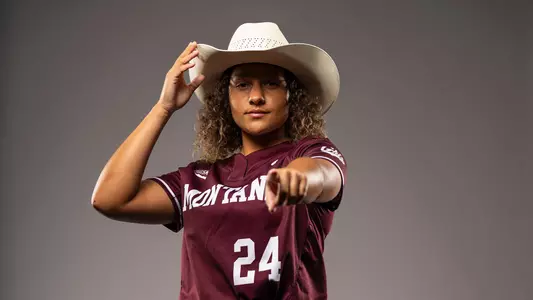
Origin Stories :: Madison Tarrant
1/22/2024 5:51:00 PM | Softball
Madison Tarrant can never have too many jokes at the ready.
Here's one for her: A guy at a dinner party goes back for dessert of cake and ice cream a second time, then a third, then a fourth, with everyone in the room taking notice. His wife finally asks him, "Doesn't that embarrass you?" "Why should it?" he replies. "I keep telling everyone it's for you."
Maybe she'll use it, maybe she won't. Probably not. After all, she has better ones than that from years spent in the dual role of amateur psychologist and softball catcher, a player only excelling in the latter if she has mastered the basics of the former.
A pitcher, just cruising through a game, gives up a three-run home run that shifts momentum from one team to the other. Or a pitcher has just walked back-to-back batters on eight pitches. Or a pitcher fields a bunt and throws it over the head of the first baseman. Now she needs to get refocused on pitching.
Beyond the situations, a catcher needs to know each of her pitchers and how they are likely to respond to the different stressors that arise in a game. One pitcher might be a wreck after a two-out error extends an inning. Another might be at her best, taking it as a challenge to overcome for her team.
Tarrant has to know which is which, has to know who needs a pat on the back and an encouraging word, who needs to hear a joke to lighten the tension, who needs to be challenged to pitch the way Tarrant knows the player can throw.
All in a day's work. "I enjoy it. I think I handle pressure pretty well. When a pitcher is doing amazing or middle or having a bit of a down day, it's understanding the role that I need to assume that day," she says.
It's one of the most unique dynamics in sports, the relationship between pitcher and catcher, playing their own game within the game, them against the batter, and if everything goes according to plan, the other players on the field not even being called upon to do anything but provide background chatter.
But strikeouts, especially at the college level, are more the exception than the rule. Balls are put in play, on the ground, in the air, runners get on base, sacrifices are attempted, plays are made at the bases, batted balls putting into action any number of potential outcomes, some predictable, others not.
"Every pitch, every single thing can come with something new. It's never the same thing over and over and over again," she says. "That's the beauty of catching and softball in general."
It's why she was hooked on the sport from her very first game, after tries at cheerleading, soccer, gymnastics didn't result in a love connection, not like softball. "Once she did softball, it was over," says her dad, Kevin. "This is my sport. This is what I want to do. This is what I want to dedicate my life to."
Catcher? She may have been born for it but came to it through happenstance, her first coach putting his eight-year-olds through a number of practices before the team's first game, then realizing not long before first pitch that he hadn't taught anyone how to play catcher.
It was rec league, so not a big deal. Does anyone here want to wear this gear and squat down behind the plate and play catcher? Tarrant's hand shot up, not really knowing what she was volunteering for but at the same time hopping on a track that would one day lead her to Montana and the Grizzlies.
"We got in the car when it was all said and done, and she looks at me, Hey, dad, can I have my own catcher's gear?" Kevin recalls. "That was it. From that moment, all she wanted to do is catch. That's always been her thing and her passion when she plays ball. That's all she's ever wanted to do."
It's not for everyone, catcher isn't. When a ball is in the pitcher's hand and she's looking in for the sign, the catcher has eight players looking at her, her battery-mate and seven defensive players behind her. Whether they know it or not, they are all taking their cues from the one behind the plate.
She is the focal point in that moment, the controller of everything.
"She has this presence about her, this leadership about her," says Kevin, who coached Madison at younger ages. "Her team kind of takes on her energy. She is able to control the game and its momentum from behind the plate with her mannerisms and her leadership and her determination.
"She doesn't let the emotional swings of the game get to her. Her team sees that and it gives her team the ability to remain calm even through some adversity. It was always meant to be her spot."
It could have been basketball instead of softball. Volleyball. Soccer. Cross country. Lacrosse. Any sport and Tarrant would have made her team better. That always came naturally, the understanding that she didn't succeed if the team didn't, a mindset few kids have.
In most cases it's forced on them against their will, this need to put self behind group. It largely goes against individual nature, making Tarrant an unnatural natural.
"I can never remember a time when she wasn't a good teammate," says Kevin. "She wants her team to succeed. She always puts team above herself. It's something as a parent I've never had to teach or instill in her. It just came naturally.
"She understood from early on that it was a team sport, that the team had to play well for them to win and she had to do her job, whatever it was in that moment or in that game, if it was cheering from the bench or it was her game to go behind the plate."
Tarrant saw action in four of eight exhibition games in the fall, all coming off the bench, mostly as a defensive replacement behind senior Riley Stockton and junior Kynzie Mohl. She made one at-bat. Still, she did her 1/19th, whatever was needed of her that day.
Doing the scorebook? Then she would alert her teammates what the batter had done in her previous plate appearances. A pitcher needed to be warmed up for a possible relief appearance? Get her prepared in the bullpen so she is game-ready from her very first pitch.
"Warming up pitchers in the bullpen can kind of be underrated. You are getting them mentally and physically prepared to go out in a relief situation or go close out the game. If their mind isn't right, then they are not going to perform as well as they need to," says Tarrant.
"I always try to remind myself that there is one thing I can control. It's myself. It's my attitude, it's my effort. I'm here and I'm going to help the team in whatever way I can and whenever I get my opportunity to step on the field, I'm going to do whatever I can for the team."
It's what Montana coach Melanie Meuchel thought she was getting from this freshman from Goodyear, Ariz. It's what she got in the fall.
"She will take on any role she is asked to do," says Meuchel. "There were times she didn't play as much as she wanted in the fall, but whatever she could do to make our team better, she did. That's really hard for a freshman to jump in and do.
"Maddie was always working the dugout, preparing herself and her team to succeed. She's making noise of what she is capable of doing. I saw a ton of growth from her in the fall, a ton of commitment."
Her parents started getting her to weekly sessions at Erin White's "Gear Up Catching" training facility, a pairing of a girl with a love of the position with those who had done it at the level she now wanted to reach: college.
They thought she was good but knew they saw her through parent-tinted goggles. They needed a sign. White gave them one, their personal ah-ha moment. Turns out, this one was a special talent.
White hailed them down after one session. Hey, I want you to know Madison hit 1.8 on her pop time. Pop time? Yeah, the time it takes from the moment a pitch hits the catcher's mitt until the ball reaches second base. Okay, and …? Well, she's doing that and she is only 13 years old.
"She told us, that's almost college-level pop time. That's when we thought, okay, maybe there's more to this than what we are realizing," Kevin says. "Maybe she's way better than what we think."
Pop time. It fits. It's her favorite thing to pull off as a catcher, to throw behind a runner at first or third, or better yet, throwing out a runner at second base on a steal attempt. It's a massive moment, either a runner in scoring position or sent back to the dugout, another out on the scoreboard, threat averted.
Wait, that might sound selfish, like it's just her getting it done, the perfect throw coming from HER arm, the result of HER hard work, everyone cheering for HER. Yeah, that's not going to cut it. She wants a new answer.
How about a close play at the plate? "Those are so fun," she says. "It's like a clock, your whole team working together to get the ball to the plate. You have your cuts, double cuts, a lot of different players contributing. When it works out and you get that out, it's so satisfying.
"I love when the team works together and something we've worked so hard on works out. Wow, that was awesome. We all did our job just like we needed to." Team. We. That's more like it.
The revelation from White, that their daughter had something special, was Kevin's call to invest more time and other resources to get her on the best competitive teams he could find. Luckily, the family lived in Goodyear, 15 miles due west of Phoenix. Talk about a competitive advantage.
The teams were out there. She just had to find the right landing spot, with teammates coming and going, coaches too, all of it part of the educational experience of being an up-and-comer.
"Having a coach who was a yeller. I don't really take well to that. Or the coach who was big on backhanded compliments. Hmmm, that doesn't really make me feel good about myself," she says.
Finally there was making the best of the best, the Arizona Storm Nationals team, a squad loaded with players going to the SEC, the Pac-12, and there was Riley Valentine, who spent one year at Texas A&M and is now a sophomore at Alabama, the player who got the lion's share of the starts at catcher.
Tarrant was in the perfect situation, on a top-10 travel-ball team that had college recruiters at its every stop (a blessing), but Tarrant would hardly be seen (not a blessing). Kevin had some work to do, handling his daughter like she handled pitchers, bringing whatever the situation asked of him.
"Some days she just needed me to be there to say, hey, it's okay, we all have tough days," he says. "Then there were days when I had to get on her. Hey, you need to get better or work a little harder here.
"She didn't always like the tough parts of it, but she always said she wanted to be a Division I softball player. This is what needs to happen for you to reach these goals and live out that dream. Sometimes there were tears, sometimes there was laughing. It was an experience we got to share together."
It challenged her, tested that of which she was made, her very being. Could she stay positive and team-first in an environment that is built on selfishness, of making sure you're seen by the right schools, me stepping over you?
"A lot of times I felt I was undercut on certain things, whether it be at-bats or being prepared for college. I felt like some of my opportunities got taken away from me for other people on the team," she says.
So, what, she was broken? Cynical of the whole thing, bad attitude to follow? Nah. Disappointed but still herself.
"Every athlete wants to be out there playing and contributing, so she had to deal with that and work through it," says Kevin. "She just had to make sure she was prepared for when she got her opportunities."
Because you never know when they will come your way or know who might be watching.
"Some of that adversity is the breaks and you're just trying to bide your time. When she got her chances, she would really try to take advantage," Kevin says. "That's when Montana saw her."
Assistant coach Alison Mitchell saw her first and reported back to Meuchel. You need to find a way to watch this catcher, Mitchell told her. Good rapport with her pitchers, a commanding presence behind the plate.
"Your first impression is how she carries herself and how she interacts with coaches and teammates," says Meuchel. "Once we got to know her personality, it was contagious. It's fun. She's engaging and competitive. People want to be around her. Just a really cool person."
There was that one minor detail. This was Montana. She's from Arizona. "We both had the same reaction. Montana? We didn't know they had softball in Montana," says Kevin. "Then she started to research the school. Hey, dad, look at this. Look at these pictures."
Then she started having conversations. "They were the first college to reach out to me," Tarrant says. "The first time we got to sit and talk, it felt like they were an extension of my family, and I'm such a big family person. They gave me such a good vibe. These are my people."
Then she visited. "I fell in love with it. I felt it in my soul. Yeah, this is where I'm supposed to be."
She went from the cut-throat environment of high-level travel ball, where the system is designed for individuals to largely look out for themselves, for the benefit of their futures – and you can't really blame them for that – to something different in Missoula.
"They were very welcoming, which you don't see in some programs. In any sport at the college level, sometimes when the new person is coming in, everybody can be a little standoffish," says Kevin. "Is that girl coming for my job? I never got that feeling at Montana. Very different vibe there.
"Coach Mel just seems like she is a very good coach who cares for the players outside of softball, cares for their wellbeing and about their success in life. Pro softball is not a big, lucrative thing. For most girls, this four years is it for them. This is their pinnacle. She seems to understand that.
"Madison started to fall in love with the place. It pulled her in, then it pulled me and my wife in along with it."
She arrived in the fall and did her thing, not caring that she was a freshman. A catcher needs to be herself, the jokes, a supportive clapping of her mitt, a walk to the mound for a little one-on-one time with her pitcher, whether that be a senior or a freshman.
"She'll connect with you," says Meuchel. "She has some spunk behind the plate and will let you know she is there for you."
She knows what last year was like, a season that nobody was satisfied with, but she wasn't here last spring. She was at Canyon View High, a team she helped to Arizona Class 5A runner-up finishes in 2021 and '22, a spot in the semifinals as a senior.
All she knows is what she has seen from her new team since September, like that day in October, beautiful but cold at practice at Grizzly Softball Field, a day when the Grizzlies' attention to detail was lacking.
The team noticed it, self-corrected it, proceeded to have one of its best practices of the entire fall, a sign of hope for 2024.
"I remember we turned something on and had focus and intent," says the future sports broadcaster. "Intent is the word I'm going to use for this upcoming season. I'm excited because I can see the intent and attention to detail and can feel myself really starting to focus on the big picture.
"One thing I've always told myself is that the little things make the big things, like winning the game. Fielding a ground ball, making a play, getting a base hit, getting an RBI. Those are small but they make the big things and those things win games at the end of the day. I think it's going to be fun to watch."
And whether she has the walk-off RBI base hit or has been watching the entire game from the dugout, she'll be the first person there to celebrate as the winning run crosses home plate. That will never change.
"Just being that teammate who's supportive and uplifting of my teammates, no matter what position I'm assuming," she says. "That's always how I've been, the kind of person I've been."
Here's one for her: A guy at a dinner party goes back for dessert of cake and ice cream a second time, then a third, then a fourth, with everyone in the room taking notice. His wife finally asks him, "Doesn't that embarrass you?" "Why should it?" he replies. "I keep telling everyone it's for you."
Maybe she'll use it, maybe she won't. Probably not. After all, she has better ones than that from years spent in the dual role of amateur psychologist and softball catcher, a player only excelling in the latter if she has mastered the basics of the former.
A pitcher, just cruising through a game, gives up a three-run home run that shifts momentum from one team to the other. Or a pitcher has just walked back-to-back batters on eight pitches. Or a pitcher fields a bunt and throws it over the head of the first baseman. Now she needs to get refocused on pitching.
Beyond the situations, a catcher needs to know each of her pitchers and how they are likely to respond to the different stressors that arise in a game. One pitcher might be a wreck after a two-out error extends an inning. Another might be at her best, taking it as a challenge to overcome for her team.
Tarrant has to know which is which, has to know who needs a pat on the back and an encouraging word, who needs to hear a joke to lighten the tension, who needs to be challenged to pitch the way Tarrant knows the player can throw.
All in a day's work. "I enjoy it. I think I handle pressure pretty well. When a pitcher is doing amazing or middle or having a bit of a down day, it's understanding the role that I need to assume that day," she says.
It's one of the most unique dynamics in sports, the relationship between pitcher and catcher, playing their own game within the game, them against the batter, and if everything goes according to plan, the other players on the field not even being called upon to do anything but provide background chatter.
But strikeouts, especially at the college level, are more the exception than the rule. Balls are put in play, on the ground, in the air, runners get on base, sacrifices are attempted, plays are made at the bases, batted balls putting into action any number of potential outcomes, some predictable, others not.
"Every pitch, every single thing can come with something new. It's never the same thing over and over and over again," she says. "That's the beauty of catching and softball in general."
It's why she was hooked on the sport from her very first game, after tries at cheerleading, soccer, gymnastics didn't result in a love connection, not like softball. "Once she did softball, it was over," says her dad, Kevin. "This is my sport. This is what I want to do. This is what I want to dedicate my life to."
Catcher? She may have been born for it but came to it through happenstance, her first coach putting his eight-year-olds through a number of practices before the team's first game, then realizing not long before first pitch that he hadn't taught anyone how to play catcher.
It was rec league, so not a big deal. Does anyone here want to wear this gear and squat down behind the plate and play catcher? Tarrant's hand shot up, not really knowing what she was volunteering for but at the same time hopping on a track that would one day lead her to Montana and the Grizzlies.
"We got in the car when it was all said and done, and she looks at me, Hey, dad, can I have my own catcher's gear?" Kevin recalls. "That was it. From that moment, all she wanted to do is catch. That's always been her thing and her passion when she plays ball. That's all she's ever wanted to do."
It's not for everyone, catcher isn't. When a ball is in the pitcher's hand and she's looking in for the sign, the catcher has eight players looking at her, her battery-mate and seven defensive players behind her. Whether they know it or not, they are all taking their cues from the one behind the plate.
She is the focal point in that moment, the controller of everything.
"She has this presence about her, this leadership about her," says Kevin, who coached Madison at younger ages. "Her team kind of takes on her energy. She is able to control the game and its momentum from behind the plate with her mannerisms and her leadership and her determination.
"She doesn't let the emotional swings of the game get to her. Her team sees that and it gives her team the ability to remain calm even through some adversity. It was always meant to be her spot."
It could have been basketball instead of softball. Volleyball. Soccer. Cross country. Lacrosse. Any sport and Tarrant would have made her team better. That always came naturally, the understanding that she didn't succeed if the team didn't, a mindset few kids have.
In most cases it's forced on them against their will, this need to put self behind group. It largely goes against individual nature, making Tarrant an unnatural natural.
"I can never remember a time when she wasn't a good teammate," says Kevin. "She wants her team to succeed. She always puts team above herself. It's something as a parent I've never had to teach or instill in her. It just came naturally.
"She understood from early on that it was a team sport, that the team had to play well for them to win and she had to do her job, whatever it was in that moment or in that game, if it was cheering from the bench or it was her game to go behind the plate."
Tarrant saw action in four of eight exhibition games in the fall, all coming off the bench, mostly as a defensive replacement behind senior Riley Stockton and junior Kynzie Mohl. She made one at-bat. Still, she did her 1/19th, whatever was needed of her that day.
Doing the scorebook? Then she would alert her teammates what the batter had done in her previous plate appearances. A pitcher needed to be warmed up for a possible relief appearance? Get her prepared in the bullpen so she is game-ready from her very first pitch.
"Warming up pitchers in the bullpen can kind of be underrated. You are getting them mentally and physically prepared to go out in a relief situation or go close out the game. If their mind isn't right, then they are not going to perform as well as they need to," says Tarrant.
"I always try to remind myself that there is one thing I can control. It's myself. It's my attitude, it's my effort. I'm here and I'm going to help the team in whatever way I can and whenever I get my opportunity to step on the field, I'm going to do whatever I can for the team."
It's what Montana coach Melanie Meuchel thought she was getting from this freshman from Goodyear, Ariz. It's what she got in the fall.
"She will take on any role she is asked to do," says Meuchel. "There were times she didn't play as much as she wanted in the fall, but whatever she could do to make our team better, she did. That's really hard for a freshman to jump in and do.
"Maddie was always working the dugout, preparing herself and her team to succeed. She's making noise of what she is capable of doing. I saw a ton of growth from her in the fall, a ton of commitment."
Her parents started getting her to weekly sessions at Erin White's "Gear Up Catching" training facility, a pairing of a girl with a love of the position with those who had done it at the level she now wanted to reach: college.
They thought she was good but knew they saw her through parent-tinted goggles. They needed a sign. White gave them one, their personal ah-ha moment. Turns out, this one was a special talent.
White hailed them down after one session. Hey, I want you to know Madison hit 1.8 on her pop time. Pop time? Yeah, the time it takes from the moment a pitch hits the catcher's mitt until the ball reaches second base. Okay, and …? Well, she's doing that and she is only 13 years old.
"She told us, that's almost college-level pop time. That's when we thought, okay, maybe there's more to this than what we are realizing," Kevin says. "Maybe she's way better than what we think."
Pop time. It fits. It's her favorite thing to pull off as a catcher, to throw behind a runner at first or third, or better yet, throwing out a runner at second base on a steal attempt. It's a massive moment, either a runner in scoring position or sent back to the dugout, another out on the scoreboard, threat averted.
Wait, that might sound selfish, like it's just her getting it done, the perfect throw coming from HER arm, the result of HER hard work, everyone cheering for HER. Yeah, that's not going to cut it. She wants a new answer.
How about a close play at the plate? "Those are so fun," she says. "It's like a clock, your whole team working together to get the ball to the plate. You have your cuts, double cuts, a lot of different players contributing. When it works out and you get that out, it's so satisfying.
"I love when the team works together and something we've worked so hard on works out. Wow, that was awesome. We all did our job just like we needed to." Team. We. That's more like it.
The revelation from White, that their daughter had something special, was Kevin's call to invest more time and other resources to get her on the best competitive teams he could find. Luckily, the family lived in Goodyear, 15 miles due west of Phoenix. Talk about a competitive advantage.
The teams were out there. She just had to find the right landing spot, with teammates coming and going, coaches too, all of it part of the educational experience of being an up-and-comer.
"Having a coach who was a yeller. I don't really take well to that. Or the coach who was big on backhanded compliments. Hmmm, that doesn't really make me feel good about myself," she says.
Finally there was making the best of the best, the Arizona Storm Nationals team, a squad loaded with players going to the SEC, the Pac-12, and there was Riley Valentine, who spent one year at Texas A&M and is now a sophomore at Alabama, the player who got the lion's share of the starts at catcher.
Tarrant was in the perfect situation, on a top-10 travel-ball team that had college recruiters at its every stop (a blessing), but Tarrant would hardly be seen (not a blessing). Kevin had some work to do, handling his daughter like she handled pitchers, bringing whatever the situation asked of him.
"Some days she just needed me to be there to say, hey, it's okay, we all have tough days," he says. "Then there were days when I had to get on her. Hey, you need to get better or work a little harder here.
"She didn't always like the tough parts of it, but she always said she wanted to be a Division I softball player. This is what needs to happen for you to reach these goals and live out that dream. Sometimes there were tears, sometimes there was laughing. It was an experience we got to share together."
It challenged her, tested that of which she was made, her very being. Could she stay positive and team-first in an environment that is built on selfishness, of making sure you're seen by the right schools, me stepping over you?
"A lot of times I felt I was undercut on certain things, whether it be at-bats or being prepared for college. I felt like some of my opportunities got taken away from me for other people on the team," she says.
So, what, she was broken? Cynical of the whole thing, bad attitude to follow? Nah. Disappointed but still herself.
"Every athlete wants to be out there playing and contributing, so she had to deal with that and work through it," says Kevin. "She just had to make sure she was prepared for when she got her opportunities."
Because you never know when they will come your way or know who might be watching.
"Some of that adversity is the breaks and you're just trying to bide your time. When she got her chances, she would really try to take advantage," Kevin says. "That's when Montana saw her."
Assistant coach Alison Mitchell saw her first and reported back to Meuchel. You need to find a way to watch this catcher, Mitchell told her. Good rapport with her pitchers, a commanding presence behind the plate.
"Your first impression is how she carries herself and how she interacts with coaches and teammates," says Meuchel. "Once we got to know her personality, it was contagious. It's fun. She's engaging and competitive. People want to be around her. Just a really cool person."
There was that one minor detail. This was Montana. She's from Arizona. "We both had the same reaction. Montana? We didn't know they had softball in Montana," says Kevin. "Then she started to research the school. Hey, dad, look at this. Look at these pictures."
Then she started having conversations. "They were the first college to reach out to me," Tarrant says. "The first time we got to sit and talk, it felt like they were an extension of my family, and I'm such a big family person. They gave me such a good vibe. These are my people."
Then she visited. "I fell in love with it. I felt it in my soul. Yeah, this is where I'm supposed to be."
She went from the cut-throat environment of high-level travel ball, where the system is designed for individuals to largely look out for themselves, for the benefit of their futures – and you can't really blame them for that – to something different in Missoula.
"They were very welcoming, which you don't see in some programs. In any sport at the college level, sometimes when the new person is coming in, everybody can be a little standoffish," says Kevin. "Is that girl coming for my job? I never got that feeling at Montana. Very different vibe there.
"Coach Mel just seems like she is a very good coach who cares for the players outside of softball, cares for their wellbeing and about their success in life. Pro softball is not a big, lucrative thing. For most girls, this four years is it for them. This is their pinnacle. She seems to understand that.
"Madison started to fall in love with the place. It pulled her in, then it pulled me and my wife in along with it."
She arrived in the fall and did her thing, not caring that she was a freshman. A catcher needs to be herself, the jokes, a supportive clapping of her mitt, a walk to the mound for a little one-on-one time with her pitcher, whether that be a senior or a freshman.
"She'll connect with you," says Meuchel. "She has some spunk behind the plate and will let you know she is there for you."
She knows what last year was like, a season that nobody was satisfied with, but she wasn't here last spring. She was at Canyon View High, a team she helped to Arizona Class 5A runner-up finishes in 2021 and '22, a spot in the semifinals as a senior.
All she knows is what she has seen from her new team since September, like that day in October, beautiful but cold at practice at Grizzly Softball Field, a day when the Grizzlies' attention to detail was lacking.
The team noticed it, self-corrected it, proceeded to have one of its best practices of the entire fall, a sign of hope for 2024.
"I remember we turned something on and had focus and intent," says the future sports broadcaster. "Intent is the word I'm going to use for this upcoming season. I'm excited because I can see the intent and attention to detail and can feel myself really starting to focus on the big picture.
"One thing I've always told myself is that the little things make the big things, like winning the game. Fielding a ground ball, making a play, getting a base hit, getting an RBI. Those are small but they make the big things and those things win games at the end of the day. I think it's going to be fun to watch."
And whether she has the walk-off RBI base hit or has been watching the entire game from the dugout, she'll be the first person there to celebrate as the winning run crosses home plate. That will never change.
"Just being that teammate who's supportive and uplifting of my teammates, no matter what position I'm assuming," she says. "That's always how I've been, the kind of person I've been."
Players Mentioned



Lady Griz Basketball Locker Room Unveiling - 5/1/26
Friday, May 01
Griz Track & Field - Montana Open Highlights - 4/25/26
Friday, May 01
Griz Softball vs. Idaho State Game-Winning Hit - 3/25/26
Friday, May 01
Griz Softball Championship Series Promo
Friday, May 01