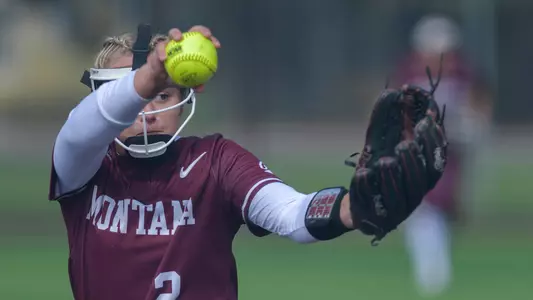
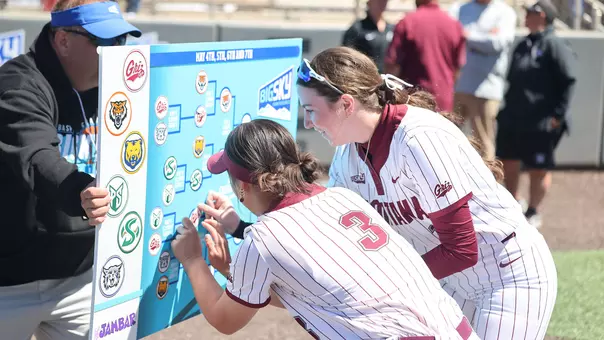
Photo by: Tanner Ecker/UM Photo
Origin Stories :: Rylee Rehbein
1/26/2024 1:04:00 PM | Softball
This is the Life of Rylee.
Montana's freshman pitcher was born and raised in Battle Ground, Wash., but she can't seem to walk the length of a Junior Bergen touchdown without bumping into family in her new stomping grounds of Missoula.
She and some friends attended the Montana football team's playoff win over Delaware in early December, another memorable snow game inside Washington-Grizzly Stadium. They wanted to capture the moment and, hey, there's a couple. Maybe they would be willing to take a picture for us.
You bet. Get together. Tighter. Smile. Done. The moment now permanent. Wait, the look of familiarity. What's your name? Rylee. Are you a Rehbein? Yes. Well, we're related. And she had almost made it all the way outside the stadium this time before meeting another relative.
"The family thing is a huge part of what brought me here. It's a huge deal for me," says Rylee, daughter of Garett and Jennifer, he of the Plains-based Rehbeins, the one who got away, following a job with Bonneville Power throughout the Northwest before ultimately landing in Battle Ground in 2000.
He was born in Minnesota, moved to Plains in the 70s when he was 11, when his family headed west to get into the highway construction business. He was always athletic but never had the chance to be an athlete. "I worked all the time. Growing up in Plains, you needed money, so you worked," he says.
His parents are still there – "Grandma Montana" for one – two brothers, one in construction, one the owner of the Ford dealership. His uncle, who lives in Arlee but operates out of Missoula, owns a contracting company. It's a family tree made strong by blue collars.
There is family all over the place, some Rylee has met, a bunch she hasn't. "We've been taking Rylee back there ever since she was born. She just fell in love with Montana. She always wanted to get back there," her dad says.
This, too, is the Life of Rylee.
She walks into the Adams Center on Thursday and gives off no suggestion that she is a standout pitcher. Because she doesn't stand out, not at 5-feet-4 inches tall. She looks more like a middle infielder, the position she played growing up when she wasn't pitching.
Go ahead. Get it over with. Throw out all your doubts. She's heard them before. OMG SHE'S SO TINY! Lay it on her, everything you've got. She relishes it, your doubts, your preconceived ideas of what a Division I pitcher is supposed to look like. She'll mulch it up and use it as more fuel.
"She was always the smallest girl on the team. Always," says Garett. "But that never stopped her. She might be the third-string pitcher when we started a team. She would work her way up. Always had to prove herself."
Why? For starters, she's a Rehbein. "No matter what, you better work hard," says her dad of the family's golden rule. "She had that. She sets her mind to something, she is going to work hard at it." And she landed in that sweet spot, the No. 2 child, always chasing No. 1, in this case older brother Jake.
He raced dirt bikes and quads? She rode dirt bikes and quads. She learned first how to do a handstand push-up? He had to learn how to do the same thing, to keep her in check. He became a state champion in high school for the skill of welding? She … okay, she got into singing. Big time, she did.
It was a starter kit for how she would later approach pitching. Discipline. Hard work. Lessons from instructors. Drills and exercises at home. Then: There she was one day, singing the national anthem at the USA Softball Hall of Fame Complex, home of the Women's College World Series.
She had made the Region 9 team at 12U. Before a tournament in Oklahoma City, the organizers sent out feelers. Anybody out there want to perform the anthem before it all begins? She auditioned, got picked.
Does that mean she'll do the same thing before this spring's home opener? "I don't sing anymore," she says, bursting our bubble. "You have to maintain that work and practice to stay good at it. If I took six or seven years off of pitching, I wouldn't be confident to go out and pitch in front of a whole stadium."
Her dad says Rylee is the only Rehbein he knows of that has done as well as she has in sports. But he and Jennifer had to do something with this girl, the one with only two settings: go and go faster. "We tried everything," he says. "Soccer. Basketball. She started playing softball and just loved it."
Credit the organizers of little-kid softball in Battle Ground for their everybody-tries-every-position approach to playing defense. Two innings here, two innings there, two innings at pitcher. Game over. "She tried pitching and fell in love with it," says Garett. "Pitching captured what she really likes."
And that is? "The pressure. That's something I've always loved about pitching, that and having the ball in my hand every single play," she says. "That's funny because that's what keeps some people away from the position. They don't want the pressure or all eyes on them. I thrive off of that."
This is who we're dealing with here: Would she rather have the ball in the seventh inning in a 2-1 game or an 8-1 game? Her parents would prefer the latter, Jennifer a pacer, Garett the still-sitting stoic, both getting through another pitching performance from their daughter as best they can.
Rylee? Give her the 2-1 game every time. "I live for that," she says. "I love being able to prove myself in those situations and working hard for my team to get out of those situations. Okay, you have a job to do. Go and get it done. Let's get out of here. It sets me up to create a mindset for that inning."
Her approach to improving wasn't just to throw and throw and throw some more. She wanted to master it, even at a young age. Her dad went online, found instructional videos, joined forums about the subject, sought out teachers who would be willing to take his daughter on as a student.
And then out to the shop they would go, working, working, working. "Okay, I want to be the best at what I do. How can I do that?" Rylee asked. "Let's expand your knowledge, let's learn more about it. Met a couple different pitching coaches, one out of Utah, one in New York."
The one in New York? Mike Muhleisen, softball's unknown Mr. Miyagi, who breaks pitching down into its simplest components, knowing a pitcher has three tools to get a batter out: speed, spin and spot.
Garett asked, could he bring Rylee out for one of his private mini-camps, teacher and student spending one-on-one time for eight or nine hours a day for three or four days straight? Not yet, Grasshopper, not before she can read the spin of the ball off a pitcher's hand and fingers.
But she's barely older than 10! She doesn't care. They take a ball, color over the seams with a dark marker until she can pick up the spin on slow pitches, then ones going faster and faster. Then, a thinner marking of the seams. Then, just one stripe around the ball. Then, nothing at all.
Her dad built a handheld tool, a handle she could stick into the ball, to learn spin up close. This is how a drop ball spins, a rise ball, a curve ball, a screw ball. "I wasn't allowed to work with him until I could read spin," she says. "I wanted to do it so bad, so I just sat down and learned."
Now? Muhleisen agreed. Now. Come to New York. "He really went in depth of mechanics and getting a ball to spin and move well. You don't have to be big to do that. She focused on what she could do, moving the ball and spinning the ball really well and hitting her spots," says her dad.
A full day, then another, then another, instructor and willing student, a sponge soaking in all the knowledge, throwing maybe one hour each day, the rest watching video of that hour, learning the physics of a round object traveling through 40-some-feet of space and how that could be manipulated.
"For as small as she is, she throws hard, and that surprises people. She studied and studied and worked on her softball IQ and knowledge. You control the controllables. You can't make yourself taller, so she got stronger. She'd work out and learn all she could. That served her well," Garett says.
"There is an amazing amount of math and such if you want to learn how the efficiency of a pitch works. He had Rylee figure out the angles and how efficient a pitch was."
Here's the thing: She didn't focus on the fine details of the position to help overcome her size. At an early age, it was hardly noticeable. She was just another kid in a bunch of kids playing ball.
"I didn't really notice the size thing until I got into 14U, 16U. That's when it was really obvious," Rylee says. "That's when everybody was hitting their growth spurts and I wasn't. I topped out at 5-4, but I never had a coach tell me I was too short to do something."
What she had spent years learning, then, helped bridge the gap between her and someone who was pitching from a position of size and strength. She had the latter if not the former, and she had the smarts. Why is the rabbit unafraid? asked Charles Morse. Because it's smarter than the panther.
"My size is not something that would give away being a softball pitcher," Rylee says. "More than anything, that didn't hold me back. If anything, it made me better because it always pushed me to work harder and get the most of what I was given. All the work I've put in gives me confidence."
Someone who throws in the mid-60s or higher can get away with being sloppy, speed overcoming technique. They can tip off their pitches, dipping their shoulder on a rise ball, get too over the top on a drop ball. Rehbein has a consistency with her delivery, a way of staying tall no matter the pitch called.
Fundamentals, fundamentals, fundamentals overcoming everything.
She tries to be smarter than the panther, keeping a notebook everywhere she goes, in the bullpen before a start, in the dugout during games, where she'll go between innings to jot down notes to herself about the hitters she's facing, what she's doing right, what's not working, where her mind is.
Always learning, always looking for small ways to improve.
"(Rylee and her dad) are students of the mastering of pitching," says Griz coach Melanie Meuchel. "They take time to understand biomechanics and how it works.
"Some pitchers go to a lesson and are told what to do but maybe don't understand how impactful it will be if they master it. With their knowledge and her skill, she has the ability to work different planes with pitches. She has a high spin rate and makes the ball spin and move."
She was three times voted first-team all-region at Battle Ground High, the region player of the year as a senior, but it's the travel-ball circuit where a bulk of college recruiting is done.
She spent four years with Northwest Thunder before her coach left. Went to the Oregon Blaze for a year before her coach retired. Got on with Bat Company, the Northwest Bullets, finally the Washington Ladyhawks, pipeline of future Grizzlies.
They thought she was good enough to pitch in college, her parents did, but this was a new world to them, this time before coaches could reach out and communicate and show their interest.
"You always think your kid is good," says Garett. "Then we started hearing comments from coaches at camps we would go to, how she had college-level spin rates for her rise ball and drop ball."
Jake, after graduating, started a welding and pipe-fitter apprenticeship in Portland before shifting gears and becoming a lineman apprentice for Pacific Power in Bend. No drama there.
Then Rylee comes along, potential college recruit, but nobody on the other end can say anything, not until Sept. 1 of a prospect's junior year. Was it eye-opening? Stressful? "All of the above," says Garett.
"Rylee may throw as hard as other girls but being 5-4 compared to being six-foot, she would just get overlooked. It was just a fact. You can't blame coaches because you can't train size. The bigger of a girl you are, the harder you throw.
"She had to find ways to impress people when she got an opportunity to throw in front of them. Her ability to spin the ball and move the ball are what kept people's eyes. She played all the big tournaments but we never really expected anything or took anything for granted."
Finally, Sept. 1 arrived. "It is nerve-racking. You're on the edge of your seat the whole day," Rylee says. "The whole recruiting process is a tough thing. You do whatever you can do to make the best impression on these coaches and give yourself a chance to play at the next level."
Ring-ring. OMG! It's Houston, calling on Sept. 1, the start of a year-long dance, of visits to the UH campus, of going to the program's camps, of we'd really like to have you here but hold on for an offer. A (maybe?) bird in the hand but a girl still has to look at those two in the bush.
She kept marketing herself, promoting her pitching on every social media outlet available, wanting to exhaust every option because this was a once-in-a-lifetime deal. She had to be all in and do whatever it took.
Houston called, said it had found what it needed in the transfer portal, a player with another year of eligibility because of the NCAA's COVID exemption, the blocker of dreams for a younger generation. Sorry. Good luck.
The Cougars hadn't necessarily been Option A but they had been the first and longest relationship. Trips were set up to Montana, with another scheduled for a week later to Canisius in upstate New York.
She fell for Montana as quickly as she did pitching the first time she had tried that on for size and fit. "Rylee goes, this is it," says Garett. "This is where I need to be. This is where I want to be. No need to even go to New York. They always tell you, when it's the right place, you'll feel it. That was it."
Montana had always been a happy place, her home away from home, but that was based more on the extended family she was able to see on her visits. This was Montana from a new perspective, a softball one, which she saw when she started coming to pitching camps.
"We would see the growth of her pitching ability. Then getting to know her as an individual during that time, learning how competitive she is, how much drive she has, it drew me to her even more," said Meuchel. "I don't think it was a shoo-in but the family connections helped."
She's here for softball. And she's here for a journalism degree, maybe one day doing professionally what she did all those years ago, at age 4 and 5, interviewing Jake on the family camera after another dirt bike race. What was the track like out there today? How did your race go?
Whatever she does for a career, she'll hang around softball. After all, she started coaching the art of pitching to wide-eyed Battle Ground youth a few years ago, because why would she keep all she's acquired to herself, when what she learned got her here, to Montana, to Division I softball?
"Every time I go home for breaks, I make time to see the girls I give lessons to," she says. "They have so much fun with it and are so passionate about learning.
"I worked hard to gain this knowledge. I want to be able to give back to the softball community. Softball has allowed me to go to college and set me up on my dream career path. It's opened a lot of doors for me. I want to help other girls get there and reach their dreams as well."
Of course, that's long term. For now, she is focused on the present, the season opening two weeks from today in Louisiana. Don't be surprised if she gets a start in one of Montana's five games at the Mardi Gras Mambo. And don't be surprised if she doesn't look like a freshman when she does.
"We worked a lot on mound presence," says Garett. "If you walked up to her during a game, you wouldn't be able to tell by looking at her if she was down by 10 or up by 10 or if it's tight and the bases are loaded and it's the last pitch of the game.
"You won't be able to tell by her demeanor. She holds her presence very well. The more a challenge is facing her, the more she is ready to go right at it. She has no fear and doesn't get intimidated."
Why would she? For years she was her team's alpha dog, the one everyone looked to at her team's most high-profile position. Now she is part of a staff, part of a team, a group of women holding a goal that tops any individual aspirations.
"The whole team, the end goal is we want to win a championship," she says. "It's all about knowing your role and doing your role the best you can to help your team get there. I'm going to do what I can for the team success and they are going to do the same for me.
"We need everybody to get to the end goal. We're all in this together." Rylee Rehbein just keeps finding more and more family in Montana, everywhere she turns.
Montana's freshman pitcher was born and raised in Battle Ground, Wash., but she can't seem to walk the length of a Junior Bergen touchdown without bumping into family in her new stomping grounds of Missoula.
She and some friends attended the Montana football team's playoff win over Delaware in early December, another memorable snow game inside Washington-Grizzly Stadium. They wanted to capture the moment and, hey, there's a couple. Maybe they would be willing to take a picture for us.
You bet. Get together. Tighter. Smile. Done. The moment now permanent. Wait, the look of familiarity. What's your name? Rylee. Are you a Rehbein? Yes. Well, we're related. And she had almost made it all the way outside the stadium this time before meeting another relative.
"The family thing is a huge part of what brought me here. It's a huge deal for me," says Rylee, daughter of Garett and Jennifer, he of the Plains-based Rehbeins, the one who got away, following a job with Bonneville Power throughout the Northwest before ultimately landing in Battle Ground in 2000.
He was born in Minnesota, moved to Plains in the 70s when he was 11, when his family headed west to get into the highway construction business. He was always athletic but never had the chance to be an athlete. "I worked all the time. Growing up in Plains, you needed money, so you worked," he says.
His parents are still there – "Grandma Montana" for one – two brothers, one in construction, one the owner of the Ford dealership. His uncle, who lives in Arlee but operates out of Missoula, owns a contracting company. It's a family tree made strong by blue collars.
There is family all over the place, some Rylee has met, a bunch she hasn't. "We've been taking Rylee back there ever since she was born. She just fell in love with Montana. She always wanted to get back there," her dad says.
This, too, is the Life of Rylee.
She walks into the Adams Center on Thursday and gives off no suggestion that she is a standout pitcher. Because she doesn't stand out, not at 5-feet-4 inches tall. She looks more like a middle infielder, the position she played growing up when she wasn't pitching.
Go ahead. Get it over with. Throw out all your doubts. She's heard them before. OMG SHE'S SO TINY! Lay it on her, everything you've got. She relishes it, your doubts, your preconceived ideas of what a Division I pitcher is supposed to look like. She'll mulch it up and use it as more fuel.
"She was always the smallest girl on the team. Always," says Garett. "But that never stopped her. She might be the third-string pitcher when we started a team. She would work her way up. Always had to prove herself."
Why? For starters, she's a Rehbein. "No matter what, you better work hard," says her dad of the family's golden rule. "She had that. She sets her mind to something, she is going to work hard at it." And she landed in that sweet spot, the No. 2 child, always chasing No. 1, in this case older brother Jake.
He raced dirt bikes and quads? She rode dirt bikes and quads. She learned first how to do a handstand push-up? He had to learn how to do the same thing, to keep her in check. He became a state champion in high school for the skill of welding? She … okay, she got into singing. Big time, she did.
It was a starter kit for how she would later approach pitching. Discipline. Hard work. Lessons from instructors. Drills and exercises at home. Then: There she was one day, singing the national anthem at the USA Softball Hall of Fame Complex, home of the Women's College World Series.
She had made the Region 9 team at 12U. Before a tournament in Oklahoma City, the organizers sent out feelers. Anybody out there want to perform the anthem before it all begins? She auditioned, got picked.
Does that mean she'll do the same thing before this spring's home opener? "I don't sing anymore," she says, bursting our bubble. "You have to maintain that work and practice to stay good at it. If I took six or seven years off of pitching, I wouldn't be confident to go out and pitch in front of a whole stadium."
Her dad says Rylee is the only Rehbein he knows of that has done as well as she has in sports. But he and Jennifer had to do something with this girl, the one with only two settings: go and go faster. "We tried everything," he says. "Soccer. Basketball. She started playing softball and just loved it."
Credit the organizers of little-kid softball in Battle Ground for their everybody-tries-every-position approach to playing defense. Two innings here, two innings there, two innings at pitcher. Game over. "She tried pitching and fell in love with it," says Garett. "Pitching captured what she really likes."
And that is? "The pressure. That's something I've always loved about pitching, that and having the ball in my hand every single play," she says. "That's funny because that's what keeps some people away from the position. They don't want the pressure or all eyes on them. I thrive off of that."
This is who we're dealing with here: Would she rather have the ball in the seventh inning in a 2-1 game or an 8-1 game? Her parents would prefer the latter, Jennifer a pacer, Garett the still-sitting stoic, both getting through another pitching performance from their daughter as best they can.
Rylee? Give her the 2-1 game every time. "I live for that," she says. "I love being able to prove myself in those situations and working hard for my team to get out of those situations. Okay, you have a job to do. Go and get it done. Let's get out of here. It sets me up to create a mindset for that inning."
Her approach to improving wasn't just to throw and throw and throw some more. She wanted to master it, even at a young age. Her dad went online, found instructional videos, joined forums about the subject, sought out teachers who would be willing to take his daughter on as a student.
And then out to the shop they would go, working, working, working. "Okay, I want to be the best at what I do. How can I do that?" Rylee asked. "Let's expand your knowledge, let's learn more about it. Met a couple different pitching coaches, one out of Utah, one in New York."
The one in New York? Mike Muhleisen, softball's unknown Mr. Miyagi, who breaks pitching down into its simplest components, knowing a pitcher has three tools to get a batter out: speed, spin and spot.
Garett asked, could he bring Rylee out for one of his private mini-camps, teacher and student spending one-on-one time for eight or nine hours a day for three or four days straight? Not yet, Grasshopper, not before she can read the spin of the ball off a pitcher's hand and fingers.
But she's barely older than 10! She doesn't care. They take a ball, color over the seams with a dark marker until she can pick up the spin on slow pitches, then ones going faster and faster. Then, a thinner marking of the seams. Then, just one stripe around the ball. Then, nothing at all.
Her dad built a handheld tool, a handle she could stick into the ball, to learn spin up close. This is how a drop ball spins, a rise ball, a curve ball, a screw ball. "I wasn't allowed to work with him until I could read spin," she says. "I wanted to do it so bad, so I just sat down and learned."
Now? Muhleisen agreed. Now. Come to New York. "He really went in depth of mechanics and getting a ball to spin and move well. You don't have to be big to do that. She focused on what she could do, moving the ball and spinning the ball really well and hitting her spots," says her dad.
A full day, then another, then another, instructor and willing student, a sponge soaking in all the knowledge, throwing maybe one hour each day, the rest watching video of that hour, learning the physics of a round object traveling through 40-some-feet of space and how that could be manipulated.
"For as small as she is, she throws hard, and that surprises people. She studied and studied and worked on her softball IQ and knowledge. You control the controllables. You can't make yourself taller, so she got stronger. She'd work out and learn all she could. That served her well," Garett says.
"There is an amazing amount of math and such if you want to learn how the efficiency of a pitch works. He had Rylee figure out the angles and how efficient a pitch was."
Here's the thing: She didn't focus on the fine details of the position to help overcome her size. At an early age, it was hardly noticeable. She was just another kid in a bunch of kids playing ball.
"I didn't really notice the size thing until I got into 14U, 16U. That's when it was really obvious," Rylee says. "That's when everybody was hitting their growth spurts and I wasn't. I topped out at 5-4, but I never had a coach tell me I was too short to do something."
What she had spent years learning, then, helped bridge the gap between her and someone who was pitching from a position of size and strength. She had the latter if not the former, and she had the smarts. Why is the rabbit unafraid? asked Charles Morse. Because it's smarter than the panther.
"My size is not something that would give away being a softball pitcher," Rylee says. "More than anything, that didn't hold me back. If anything, it made me better because it always pushed me to work harder and get the most of what I was given. All the work I've put in gives me confidence."
Someone who throws in the mid-60s or higher can get away with being sloppy, speed overcoming technique. They can tip off their pitches, dipping their shoulder on a rise ball, get too over the top on a drop ball. Rehbein has a consistency with her delivery, a way of staying tall no matter the pitch called.
Fundamentals, fundamentals, fundamentals overcoming everything.
She tries to be smarter than the panther, keeping a notebook everywhere she goes, in the bullpen before a start, in the dugout during games, where she'll go between innings to jot down notes to herself about the hitters she's facing, what she's doing right, what's not working, where her mind is.
Always learning, always looking for small ways to improve.
"(Rylee and her dad) are students of the mastering of pitching," says Griz coach Melanie Meuchel. "They take time to understand biomechanics and how it works.
"Some pitchers go to a lesson and are told what to do but maybe don't understand how impactful it will be if they master it. With their knowledge and her skill, she has the ability to work different planes with pitches. She has a high spin rate and makes the ball spin and move."
She was three times voted first-team all-region at Battle Ground High, the region player of the year as a senior, but it's the travel-ball circuit where a bulk of college recruiting is done.
She spent four years with Northwest Thunder before her coach left. Went to the Oregon Blaze for a year before her coach retired. Got on with Bat Company, the Northwest Bullets, finally the Washington Ladyhawks, pipeline of future Grizzlies.
They thought she was good enough to pitch in college, her parents did, but this was a new world to them, this time before coaches could reach out and communicate and show their interest.
"You always think your kid is good," says Garett. "Then we started hearing comments from coaches at camps we would go to, how she had college-level spin rates for her rise ball and drop ball."
Jake, after graduating, started a welding and pipe-fitter apprenticeship in Portland before shifting gears and becoming a lineman apprentice for Pacific Power in Bend. No drama there.
Then Rylee comes along, potential college recruit, but nobody on the other end can say anything, not until Sept. 1 of a prospect's junior year. Was it eye-opening? Stressful? "All of the above," says Garett.
"Rylee may throw as hard as other girls but being 5-4 compared to being six-foot, she would just get overlooked. It was just a fact. You can't blame coaches because you can't train size. The bigger of a girl you are, the harder you throw.
"She had to find ways to impress people when she got an opportunity to throw in front of them. Her ability to spin the ball and move the ball are what kept people's eyes. She played all the big tournaments but we never really expected anything or took anything for granted."
Finally, Sept. 1 arrived. "It is nerve-racking. You're on the edge of your seat the whole day," Rylee says. "The whole recruiting process is a tough thing. You do whatever you can do to make the best impression on these coaches and give yourself a chance to play at the next level."
Ring-ring. OMG! It's Houston, calling on Sept. 1, the start of a year-long dance, of visits to the UH campus, of going to the program's camps, of we'd really like to have you here but hold on for an offer. A (maybe?) bird in the hand but a girl still has to look at those two in the bush.
She kept marketing herself, promoting her pitching on every social media outlet available, wanting to exhaust every option because this was a once-in-a-lifetime deal. She had to be all in and do whatever it took.
Houston called, said it had found what it needed in the transfer portal, a player with another year of eligibility because of the NCAA's COVID exemption, the blocker of dreams for a younger generation. Sorry. Good luck.
The Cougars hadn't necessarily been Option A but they had been the first and longest relationship. Trips were set up to Montana, with another scheduled for a week later to Canisius in upstate New York.
She fell for Montana as quickly as she did pitching the first time she had tried that on for size and fit. "Rylee goes, this is it," says Garett. "This is where I need to be. This is where I want to be. No need to even go to New York. They always tell you, when it's the right place, you'll feel it. That was it."
Montana had always been a happy place, her home away from home, but that was based more on the extended family she was able to see on her visits. This was Montana from a new perspective, a softball one, which she saw when she started coming to pitching camps.
"We would see the growth of her pitching ability. Then getting to know her as an individual during that time, learning how competitive she is, how much drive she has, it drew me to her even more," said Meuchel. "I don't think it was a shoo-in but the family connections helped."
She's here for softball. And she's here for a journalism degree, maybe one day doing professionally what she did all those years ago, at age 4 and 5, interviewing Jake on the family camera after another dirt bike race. What was the track like out there today? How did your race go?
Whatever she does for a career, she'll hang around softball. After all, she started coaching the art of pitching to wide-eyed Battle Ground youth a few years ago, because why would she keep all she's acquired to herself, when what she learned got her here, to Montana, to Division I softball?
"Every time I go home for breaks, I make time to see the girls I give lessons to," she says. "They have so much fun with it and are so passionate about learning.
"I worked hard to gain this knowledge. I want to be able to give back to the softball community. Softball has allowed me to go to college and set me up on my dream career path. It's opened a lot of doors for me. I want to help other girls get there and reach their dreams as well."
Of course, that's long term. For now, she is focused on the present, the season opening two weeks from today in Louisiana. Don't be surprised if she gets a start in one of Montana's five games at the Mardi Gras Mambo. And don't be surprised if she doesn't look like a freshman when she does.
"We worked a lot on mound presence," says Garett. "If you walked up to her during a game, you wouldn't be able to tell by looking at her if she was down by 10 or up by 10 or if it's tight and the bases are loaded and it's the last pitch of the game.
"You won't be able to tell by her demeanor. She holds her presence very well. The more a challenge is facing her, the more she is ready to go right at it. She has no fear and doesn't get intimidated."
Why would she? For years she was her team's alpha dog, the one everyone looked to at her team's most high-profile position. Now she is part of a staff, part of a team, a group of women holding a goal that tops any individual aspirations.
"The whole team, the end goal is we want to win a championship," she says. "It's all about knowing your role and doing your role the best you can to help your team get there. I'm going to do what I can for the team success and they are going to do the same for me.
"We need everybody to get to the end goal. We're all in this together." Rylee Rehbein just keeps finding more and more family in Montana, everywhere she turns.
Players Mentioned

P
/ SoftballLady Griz Basketball Locker Room Unveiling - 5/1/26
Friday, May 01
Griz Track & Field - Montana Open Highlights - 4/25/26
Friday, May 01
Griz Softball vs. Idaho State Game-Winning Hit - 3/25/26
Friday, May 01
Griz Softball Championship Series Promo
Friday, May 01