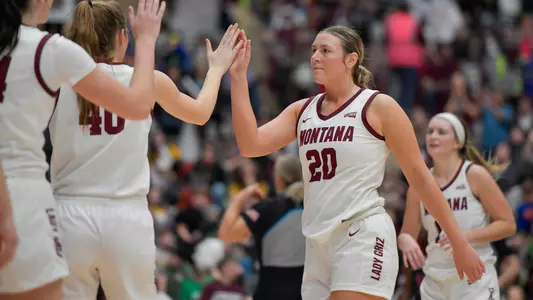
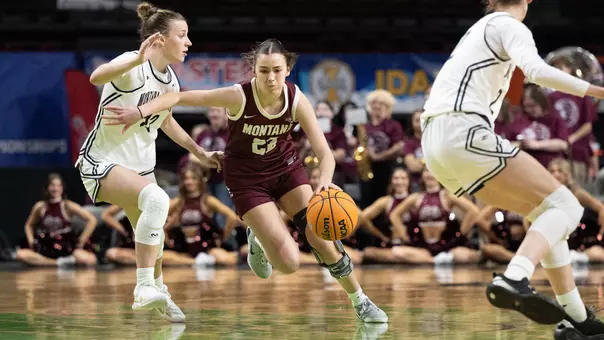
Photo by: Tanner Ecker/University of Montana
Carmen’s legacy
3/1/2024 6:15:00 PM | Women's Basketball
It was Carmen Gfeller's great-great-grandfather who hopped on the Oregon Trail and headed west, finally landing in Lind, setting down literal roots as a farmer and ensuring public-address announcers in tiny gyms across eastern Washington would be scratching their heads for generations as they attempted to anglicize the family's Swiss surname, the one that looked like it might be missing a vowel or two.
Her great-grandfather, in 1939, moved east a few dozen miles and established his home outside Colfax, a new plot of arable land – the same one on which Gfeller and her three older brothers were raised decades and decades later – but the same livelihood, farming, mostly wheat, the recipe for success never changing, the one as old and reliable as the vocation itself: plant, water, wait, harvest.
It requires patience, a belief in the process, hard work, the ability to adapt to changing circumstances. Then, one day, the payoff. "Basketball-wise, you can't rush the growing process," says Montana's sixth-year forward, who will be honored on Saturday on Senior Day when the Lady Griz host Idaho.
"It's something I've always correlated. You plant your seeds, you don't dig them up to see if they're growing. You just have to trust the work, the time and the effort you put in. I see that as applicable to basketball. I see that as applicable to life."
Oh, how that was tested in 2021 in the darkest days of the darkest period of Lady Griz program history, after an all-conference season for Gfeller ended with a loss to then 2-21 Sacramento State at the Big Sky tournament, after a national search was started to find what would be Gfeller's third head coach in three years, if she chose to remain.
She'd lost former teammates to the transfer portal, a once-proud program was reeling, a new coach, who she didn't sign up to play for, would soon be selected and then be arriving, and who knows what that meant for her?
She had people, people she trusted, people she loved, in her ear urging her to escape. Get out. Go. Find something new. Pick a program that can win, can make the NCAA tournament. Think about yourself and what's best for you. You deserve it. You don't owe anybody anything. In other words, pull up roots. Go plant yourself somewhere else.
She thought about it, thought about it a lot. But what she thought about more was giving this new guy, this new coach, Brian Holsinger, one year, her fourth year, then she was going to move on with life, into teaching, into the next phase of her life. Basketball would be over. "At that point I was thinking, it's one more year," she says. "I've been through enough already. I can get through one more year."
But something happened along the way, something that had her return for a fifth year, then this year, her sixth. "I don't know if rediscovering my love for basketball is the right way to put it, but my love for the game grew," she says. The right coach at the right time will do that for a player. "It's really incredible to see the growth this program has had from 2018, when I joined, to now."
A 19-win season in Holsinger's first year, a likely 20-win season in Year 3. Gfeller went from wanting to just make it through one more season to staying put, to wanting something Montana hadn't had for years. "My sophomore or junior year, I said, I'm not leaving until we win a conference championship."
And now her own season as a Lady Griz is growing short, her final year ending in March one way or the other. She sees the championship banners overhead in Dahlberg Arena, how they were an almost annual occurrence, the season ending, a new banner being ordered and hung.
She goes down the line, starting with the first, the 1981 Northwest Women's Basketball League Mountain Division title, won by then third-year coach Robin Selvig and a feisty freshman point guard by the name of Cheri Bratt. Down the line, the banners hardly ever take a break, either a conference title or NCAA tournament at the end of nearly every season.
Then it reaches 2015 and ends, the gap between then and now growing more noticeable by the passing year, soon coming up on a decade.
That she's here, still here, when the easiest thing to do would have been to find something else, something easier, something already established, ready-made for success instead of having to do the heavy lifting of building something new, from the ashes on up, that's Gfeller's legacy.
"She could have transferred when coaches changed, transferred when friends and teammates entered the portal. She could have quit with COVID, could have quit with her foot injury, but she just kept battling and persevering," says Bratt, now Cheri Roberts, who has taken Lady Griz 4 Life to heart, living and dying with the program's up and downs since the end of her own career 40 seasons ago.
"She came when it was at the lowest and she is leaving when it's getting back to its peak. She battled through all those things and she is still there. She battled through a period when it was a very difficult time for the Lady Griz. That's what I think of her legacy, seeing it through and helping the team get back to where it needed to be. She's been steady, determined, consistent, a team player."
Farmin' Carmen, indeed. Plant, water, wait, harvest. It's been that way for generations for the Gfellers, for Stan and Lori and their three boys, Nick, Brandon and Keith, and that was enough, enough that the nursery was being dismantled and remodeled into something more functional when Lori got the news: put it back together. You've got No. 4 on the way. Surprise! And it's a girl. Double surprise!
"I was excited to have a girl," says Stan. "The boys were great but every daddy's got to have a girl."
It was the best of both worlds, learning the work inherent in being raised on a farm while still being allowed to be a girl. She became another part of the operation that made everything run smoothly, not chores done to earn an allowance but the essential tasks of a farm, all hands on deck when all hands are needed, whether they belong to the boys or the girl, anything but hard work not an option.
"You did it because that's what you did," she says. "It was expected. Growing up on a farm taught me at a really young age things that can be applied to life in general. I don't want to paint this picture of a rough-and-tumble hardworking farm girl. I don't feel that way. You just do what's asked of you and get things done in a timely manner. Do them right the first time and do them well.
"I'm really appreciative to have grown up in that lifestyle. My parents were really great role models for what it means to be a hard worker and to be reliable and dependable."
Were there dirt bikes and four-wheelers and trying to keep up with the boys? Absolutely. Was there doll time, dress-up time? Absolutely. Were there mornings when she was awakened at 3 a.m. to haul hay because it was going to rain later in the day? Absolutely, all part of the experience.
"I don't think she was ever cut any slack when it came to work that needed to be done," says Stan. "At the same time, she was never a tomboy. She didn't try to do all the boys things with her brothers. She was very much her own person and loved to dance. That's what she spent most of her time at as a young girl, dance classes up in Spokane."
In wintertime, when the sun would set at 4 p.m. on the Palouse on a Sunday, Stan would take the key he'd gotten for the gym at the Steptoe Elementary School gym, three miles up the road from the Gfeller place, load up the kids and cut them loose with any other local families who wanted to join, basketball taking over their lives for an hour, or two, or three, or four, until someone finally said, well, we better be getting home. It's getting late.
"It was usually cold, so we'd turn the furnace on and sweep the floor. We used it all the time. It was a great asset to have three miles from our house. When we were there, it was only basketball. We didn't use it for anything else," Stan says.
All three boys were multi-sport athletes at Colfax High, the one sport in common among them being basketball, the family game. "By the time I got into sports, it was something I did just because I looked up to my brothers and I wanted to be like them," she says.
Early on in high school, she thought it would be volleyball that would be her ticket to college athletics. Then she saw Brandon land at Montana, wooed by coach Wayne Tinkle, then she saw other small-town Washington girls making it on the big stage, proving you can go anywhere you want if talent and heart and love of game have been blessed upon a girl in large enough quantities.
"Brandon, not only as a player but as a person, is someone I always really looked up to," says Gfeller, and if basketball was his primary sport, then it would be hers as well. "I saw how hard he worked and how humble he was. He was just so cool to me growing up. Everybody liked him because he was so kind and everybody liked him because he was so good at basketball."
She watched from a distance as Kelsey Moos went from Reardan High to Arizona State, Chandler Smith from Brewster to Nebraska then to Gonzaga. "I thought that was so cool. I thought, if (Moos) can make it, what's stopping me from doing that? Having those small-town female athletes go to these huge schools was really inspiring."
But it was Colfax. And for all the perks that came with small-town living and growing up on a farm, there were some disadvantages, particularly geographic and access to bigger-city basketball opportunities.
So, the Gfellers worked their way through the problem like they'd been doing for generations. Relying on family. "I owe a lot to my parents," Carmen says. "My dad would be in the middle of spring work and he would meet me at the gym every single day. My mom drove me every single place, to every single tournament."
She went from unknown to a bright light on everyone's recruiting radar the spring of her sophomore year, mostly by accident, when an AAU coach called and told her his team was short a player and would she want to go play at a weekend tournament in Yakima? She would love to and she did. And she balled out.
"Two days later, I had a bunch of letters in the mail from all these Division I coaches who had been there," she says. "That was the moment I thought, okay, maybe I could make something out of this if I decided to. From there, it really snowballed."
By then, the Gfellers knew how this all worked, how Brandon had been getting love letters from certain schools by the week, by the day, then they would abruptly stop arriving, the family learning the cold, hard way that a particular school had gotten the guy they wanted, so Brandon was no longer of interest to them. It was communicated to them most often not directly but by the end of all communications.
Oh, I guess they've moved on. "When he went through it, we knew nothing about how it all worked. When it came to Carmen, it made it easier to handle the ups and downs," Stan says. "We learned not to get too excited about things but take things as they come."
The lessons continued when Tinkle left Montana after Brandon's freshman season and decamped for Oregon State. He was replaced on the Griz sideline by Travis DeCuire.
Brandon stayed, made the most of it, four times being named Academic All-Big Sky, earning the prestigious Grizzly Cup as a senior and being named Montana's Big Sky Scholar-Athlete. And could he ever shoot it, hitting 203 3-pointers over four seasons on 39.0 percent shooting, the textbook jump shot on display after hours and hours of perfecting it at the Steptoe gym.
"You walk that tightrope in college athletics," says Lori. "You want a good program, but if it's too good, you have a chance of losing that coach to a larger program. If it's not going well, then you have the chance of losing a coach because they get replaced. It's hard to know if you'll have continuity. Unless you're Robin Selvig."
Brandon's freshman year with the Griz? The Lady Griz won 23 games and played in the WNIT. His sophomore year? The Lady Griz won the regular-season Big Sky title, hosted and won the tournament and made the NCAAs. His sister, then a freshman at Colfax High, was watching from a distance.
Selvig would retire after Gfeller's sophomore year at Colfax but she still committed in August before her senior year, believing that the good times and the winning with the Lady Griz would continue without a hiccup. "That was an appealing part of it, the stability I felt I was walking into," she says.
It was such a perfect fit with deep ties. Her great-grandfather on her mom's side was one-third of the first set of triplets ever born in the state of Montana, one boy, two girls, the Gfellers still in possession of and still treasuring the silver cup that was presented back then by the governor to honor the occasion.
But things were never quite the same, never close to reaching the standard that Selvig and his players had established over the years, over the decades. It was an impossible task, until the right coach at the right time arrived, finally giving Gfeller the stability she had been searching for.
She stayed for one year with Holsinger. Then another. Then another. "The last three years have been the most stable of my career. I'm understanding the benefits of having one coach stay in one place and having a culture and a team that wants to stay in one place," says Gfeller. "I've come to appreciate the last three years, having a tight-knit team, a tight-knit coaching staff and seeing the benefits of that.
"I've developed a lot as a player and a person under Brian. That's what made it so appealing. I'm learning, I'm growing, I'm really enjoying the people I'm surrounded with. I got to a point last spring, why stop something if it's so good? I didn't feel like I was in such a rush anymore."
For years they had been just 20 miles apart, Holsinger working as an assistant at Washington State, in Pullman, Gfeller coming of age right up the road in Colfax, his final year with the Cougars syncing up with Gfeller's freshman year at Colfax High.
He would end up at Oregon State but would hear that Washington State had offered a walk-on spot to the local Gfeller girl, who he would inherit as a (fingers crossed, hopes she stays) rising fourth-year junior with the Lady Griz.
"I knew who she was, how good she was, which was exciting coming in. I knew she was going to be a really good player for us," says Holsinger, who paired Gfeller and Abby Anderson together in his first season in a two-post offense that led to 19 wins and Gfeller earning first-team All-Big Sky honors.
While Gfeller was an undergrad – she's pursuing a master's degree these days in public administration – she majored in English education, intending to teach the subject at the high school level one day. It was during Holsinger's first season that she was deep into her education classes, classroom management, how to teach things, how to provide feedback.
It was the same thing she was experiencing with Holsinger on the court, coach as teacher of basketball. Something new. She was intrigued and slowly started getting hooked. "I was seeing a lot of parallels between what Brian was doing in practice with what I was expected to be doing in the classroom," she says. "That was really interesting to me."
Then one day former Lady Griz Alyssa (Smith) Pfahler invited Gfeller to come out to their gym, Pfahler Sport Specific, and try coaching youth basketball. She was intrigued and started getting even more hooked on the idea of coaching as a long-term pathway to staying in the game after her own playing days came to an end.
"That was something that really opened my eyes to coaching," Gfeller says. "I really enjoyed having a plan, then adapting it for kid A and kid B who have different experience levels and skill sets. And the relationships with the kids, that is really special to me. It opened my eyes. Maybe that's where I can have my impact on the court going forward."
She'd love to try college coaching but not before giving professional basketball a go next year, who knows where, but we're getting way too ahead of ourselves. This is a senior with only two regular-season games left as a Lady Griz, then the Big Sky tournament in Boise. "I'm working hard to stay present and absorb every moment I can and enjoy every moment I have left," she says.
Here's the thing about legacies. You don't get to decide what yours is. All you can do is put in the work and leave the debate to others.
Gfeller, who has played in more games than any other player in Lady Griz history, is aware of her career numbers and statistics and how they have benefited and ballooned from extra time as a Lady Griz that no one else has had. She doesn't want them to get mixed in with her legacy. After all, she's more than her numbers. Way more. "I'd want to be remembered more for the person I am than the player."
The person she is is the reason Montana was able to land a player the caliber of Maggie Espenmiller-McGraw, who played four years at Iowa State but last spring was looking for something different for her final season. She arrived in Missoula, met the coaches, the team, then spent some quality time with Gfeller, just one veteran college player to another, unfiltered.
"It started on my official visit. She was the one driving me around, so I had the chance to ask her lots of questions about her time here. That initially was one of the reasons I came here, I had that good connection with her," says Espenmiller-McGraw.
"Once I got on campus, I leaned on her and her knowledge. She kind of showed me the ropes of how things worked and that kind of blossomed into her being one of my best friends here. It feels like I've known her for longer than only a year."
Gfeller has become Holsinger's best ambassador, selling an experience that few other programs can match, the pairing of Holsinger's coaching style with his focus on culture and with his up-tempo style of play, all of it happening in front of one of the nation's top fan bases.
"The last few years have been really fun for me, and that's on all sorts of different levels," she says. "That's the team, the people I'm surrounded by, a style of play that is a lot of fun. It's been a really rewarding experience to be able to be a part of that."
One more win to No. 20 this season, the first time since Selvig was coaching, Gfeller one of the main planks in the bridge spanning the years, at least most of them. It's getting back, if not quite there then at least closer than it's ever been since Selvig retired. Now we're talking legacy. Gfeller's legacy.
"Her desire to help this program get back to its winning ways comes from the respect and admiration she has for this program," Holsinger said. "She wants her legacy to be getting this program back to its winning ways. She's put a lot into making that happen."
She was here in the darkness, when the light at the end of the tunnel was no longer visible, a proud program broken, stuck in place, gladly kept there by the rest of the Big Sky unaccustomed to having its way with the Lady Griz.
She has helped usher Lady Griz basketball into a new era, nearly out of the darkness. It's almost arrived, a future that she helped point the program toward, one as bright as the midday sun, a new day for the Lady Griz. And Carmen Gfeller was there through all of it. That's legacy.
"I hope my legacy will have more to do with my desire and my loyalty and my passion to bring this place back to what it was during the Robin Selvig era. I'm really proud to be a small part in that shift, in that change," she says.
Will she get that banner? A regular-season title has slipped away, but Gfeller's final team is as talented as any other in the league and still has Boise, three games from being able to hoist the next banner, the first one since 2015.
But does Gfeller need that banner? Does she need that as confirmation that all the time and all the effort and all the sweat and all the playing through injury have been worth it? Doesn't sound like it. This is the time of harvest, the reward for the patience and the hard work.
"I think there has already been so much good to come out of my time here that if everything ended tomorrow, I would still be very proud and grateful for everything," she says. "Of course, there is always that desire to be the best of the best but if that meant sacrificing everything else I've experienced, the relationships, the memories, the friendships, that's a hard question.
"If I walked away and we had a banner but I didn't have the friendships that I do, if I did not have the growth I've had as a person, if I had walked away without any sort of direction, I don't know that that would be worth it, because there has been so much joy in the journey that I've had. But having all that, then being able to hang a banner at the end? That would just be icing on the cake."
Her great-grandfather, in 1939, moved east a few dozen miles and established his home outside Colfax, a new plot of arable land – the same one on which Gfeller and her three older brothers were raised decades and decades later – but the same livelihood, farming, mostly wheat, the recipe for success never changing, the one as old and reliable as the vocation itself: plant, water, wait, harvest.
It requires patience, a belief in the process, hard work, the ability to adapt to changing circumstances. Then, one day, the payoff. "Basketball-wise, you can't rush the growing process," says Montana's sixth-year forward, who will be honored on Saturday on Senior Day when the Lady Griz host Idaho.
"It's something I've always correlated. You plant your seeds, you don't dig them up to see if they're growing. You just have to trust the work, the time and the effort you put in. I see that as applicable to basketball. I see that as applicable to life."
Oh, how that was tested in 2021 in the darkest days of the darkest period of Lady Griz program history, after an all-conference season for Gfeller ended with a loss to then 2-21 Sacramento State at the Big Sky tournament, after a national search was started to find what would be Gfeller's third head coach in three years, if she chose to remain.
She'd lost former teammates to the transfer portal, a once-proud program was reeling, a new coach, who she didn't sign up to play for, would soon be selected and then be arriving, and who knows what that meant for her?
She had people, people she trusted, people she loved, in her ear urging her to escape. Get out. Go. Find something new. Pick a program that can win, can make the NCAA tournament. Think about yourself and what's best for you. You deserve it. You don't owe anybody anything. In other words, pull up roots. Go plant yourself somewhere else.
She thought about it, thought about it a lot. But what she thought about more was giving this new guy, this new coach, Brian Holsinger, one year, her fourth year, then she was going to move on with life, into teaching, into the next phase of her life. Basketball would be over. "At that point I was thinking, it's one more year," she says. "I've been through enough already. I can get through one more year."
But something happened along the way, something that had her return for a fifth year, then this year, her sixth. "I don't know if rediscovering my love for basketball is the right way to put it, but my love for the game grew," she says. The right coach at the right time will do that for a player. "It's really incredible to see the growth this program has had from 2018, when I joined, to now."
A 19-win season in Holsinger's first year, a likely 20-win season in Year 3. Gfeller went from wanting to just make it through one more season to staying put, to wanting something Montana hadn't had for years. "My sophomore or junior year, I said, I'm not leaving until we win a conference championship."
And now her own season as a Lady Griz is growing short, her final year ending in March one way or the other. She sees the championship banners overhead in Dahlberg Arena, how they were an almost annual occurrence, the season ending, a new banner being ordered and hung.
She goes down the line, starting with the first, the 1981 Northwest Women's Basketball League Mountain Division title, won by then third-year coach Robin Selvig and a feisty freshman point guard by the name of Cheri Bratt. Down the line, the banners hardly ever take a break, either a conference title or NCAA tournament at the end of nearly every season.
Then it reaches 2015 and ends, the gap between then and now growing more noticeable by the passing year, soon coming up on a decade.
That she's here, still here, when the easiest thing to do would have been to find something else, something easier, something already established, ready-made for success instead of having to do the heavy lifting of building something new, from the ashes on up, that's Gfeller's legacy.
"She could have transferred when coaches changed, transferred when friends and teammates entered the portal. She could have quit with COVID, could have quit with her foot injury, but she just kept battling and persevering," says Bratt, now Cheri Roberts, who has taken Lady Griz 4 Life to heart, living and dying with the program's up and downs since the end of her own career 40 seasons ago.
"She came when it was at the lowest and she is leaving when it's getting back to its peak. She battled through all those things and she is still there. She battled through a period when it was a very difficult time for the Lady Griz. That's what I think of her legacy, seeing it through and helping the team get back to where it needed to be. She's been steady, determined, consistent, a team player."
Farmin' Carmen, indeed. Plant, water, wait, harvest. It's been that way for generations for the Gfellers, for Stan and Lori and their three boys, Nick, Brandon and Keith, and that was enough, enough that the nursery was being dismantled and remodeled into something more functional when Lori got the news: put it back together. You've got No. 4 on the way. Surprise! And it's a girl. Double surprise!
"I was excited to have a girl," says Stan. "The boys were great but every daddy's got to have a girl."
It was the best of both worlds, learning the work inherent in being raised on a farm while still being allowed to be a girl. She became another part of the operation that made everything run smoothly, not chores done to earn an allowance but the essential tasks of a farm, all hands on deck when all hands are needed, whether they belong to the boys or the girl, anything but hard work not an option.
"You did it because that's what you did," she says. "It was expected. Growing up on a farm taught me at a really young age things that can be applied to life in general. I don't want to paint this picture of a rough-and-tumble hardworking farm girl. I don't feel that way. You just do what's asked of you and get things done in a timely manner. Do them right the first time and do them well.
"I'm really appreciative to have grown up in that lifestyle. My parents were really great role models for what it means to be a hard worker and to be reliable and dependable."
Were there dirt bikes and four-wheelers and trying to keep up with the boys? Absolutely. Was there doll time, dress-up time? Absolutely. Were there mornings when she was awakened at 3 a.m. to haul hay because it was going to rain later in the day? Absolutely, all part of the experience.
"I don't think she was ever cut any slack when it came to work that needed to be done," says Stan. "At the same time, she was never a tomboy. She didn't try to do all the boys things with her brothers. She was very much her own person and loved to dance. That's what she spent most of her time at as a young girl, dance classes up in Spokane."
In wintertime, when the sun would set at 4 p.m. on the Palouse on a Sunday, Stan would take the key he'd gotten for the gym at the Steptoe Elementary School gym, three miles up the road from the Gfeller place, load up the kids and cut them loose with any other local families who wanted to join, basketball taking over their lives for an hour, or two, or three, or four, until someone finally said, well, we better be getting home. It's getting late.
"It was usually cold, so we'd turn the furnace on and sweep the floor. We used it all the time. It was a great asset to have three miles from our house. When we were there, it was only basketball. We didn't use it for anything else," Stan says.
All three boys were multi-sport athletes at Colfax High, the one sport in common among them being basketball, the family game. "By the time I got into sports, it was something I did just because I looked up to my brothers and I wanted to be like them," she says.
Early on in high school, she thought it would be volleyball that would be her ticket to college athletics. Then she saw Brandon land at Montana, wooed by coach Wayne Tinkle, then she saw other small-town Washington girls making it on the big stage, proving you can go anywhere you want if talent and heart and love of game have been blessed upon a girl in large enough quantities.
"Brandon, not only as a player but as a person, is someone I always really looked up to," says Gfeller, and if basketball was his primary sport, then it would be hers as well. "I saw how hard he worked and how humble he was. He was just so cool to me growing up. Everybody liked him because he was so kind and everybody liked him because he was so good at basketball."
She watched from a distance as Kelsey Moos went from Reardan High to Arizona State, Chandler Smith from Brewster to Nebraska then to Gonzaga. "I thought that was so cool. I thought, if (Moos) can make it, what's stopping me from doing that? Having those small-town female athletes go to these huge schools was really inspiring."
But it was Colfax. And for all the perks that came with small-town living and growing up on a farm, there were some disadvantages, particularly geographic and access to bigger-city basketball opportunities.
So, the Gfellers worked their way through the problem like they'd been doing for generations. Relying on family. "I owe a lot to my parents," Carmen says. "My dad would be in the middle of spring work and he would meet me at the gym every single day. My mom drove me every single place, to every single tournament."
She went from unknown to a bright light on everyone's recruiting radar the spring of her sophomore year, mostly by accident, when an AAU coach called and told her his team was short a player and would she want to go play at a weekend tournament in Yakima? She would love to and she did. And she balled out.
"Two days later, I had a bunch of letters in the mail from all these Division I coaches who had been there," she says. "That was the moment I thought, okay, maybe I could make something out of this if I decided to. From there, it really snowballed."
By then, the Gfellers knew how this all worked, how Brandon had been getting love letters from certain schools by the week, by the day, then they would abruptly stop arriving, the family learning the cold, hard way that a particular school had gotten the guy they wanted, so Brandon was no longer of interest to them. It was communicated to them most often not directly but by the end of all communications.
Oh, I guess they've moved on. "When he went through it, we knew nothing about how it all worked. When it came to Carmen, it made it easier to handle the ups and downs," Stan says. "We learned not to get too excited about things but take things as they come."
The lessons continued when Tinkle left Montana after Brandon's freshman season and decamped for Oregon State. He was replaced on the Griz sideline by Travis DeCuire.
Brandon stayed, made the most of it, four times being named Academic All-Big Sky, earning the prestigious Grizzly Cup as a senior and being named Montana's Big Sky Scholar-Athlete. And could he ever shoot it, hitting 203 3-pointers over four seasons on 39.0 percent shooting, the textbook jump shot on display after hours and hours of perfecting it at the Steptoe gym.
"You walk that tightrope in college athletics," says Lori. "You want a good program, but if it's too good, you have a chance of losing that coach to a larger program. If it's not going well, then you have the chance of losing a coach because they get replaced. It's hard to know if you'll have continuity. Unless you're Robin Selvig."
Brandon's freshman year with the Griz? The Lady Griz won 23 games and played in the WNIT. His sophomore year? The Lady Griz won the regular-season Big Sky title, hosted and won the tournament and made the NCAAs. His sister, then a freshman at Colfax High, was watching from a distance.
Selvig would retire after Gfeller's sophomore year at Colfax but she still committed in August before her senior year, believing that the good times and the winning with the Lady Griz would continue without a hiccup. "That was an appealing part of it, the stability I felt I was walking into," she says.
It was such a perfect fit with deep ties. Her great-grandfather on her mom's side was one-third of the first set of triplets ever born in the state of Montana, one boy, two girls, the Gfellers still in possession of and still treasuring the silver cup that was presented back then by the governor to honor the occasion.
But things were never quite the same, never close to reaching the standard that Selvig and his players had established over the years, over the decades. It was an impossible task, until the right coach at the right time arrived, finally giving Gfeller the stability she had been searching for.
She stayed for one year with Holsinger. Then another. Then another. "The last three years have been the most stable of my career. I'm understanding the benefits of having one coach stay in one place and having a culture and a team that wants to stay in one place," says Gfeller. "I've come to appreciate the last three years, having a tight-knit team, a tight-knit coaching staff and seeing the benefits of that.
"I've developed a lot as a player and a person under Brian. That's what made it so appealing. I'm learning, I'm growing, I'm really enjoying the people I'm surrounded with. I got to a point last spring, why stop something if it's so good? I didn't feel like I was in such a rush anymore."
For years they had been just 20 miles apart, Holsinger working as an assistant at Washington State, in Pullman, Gfeller coming of age right up the road in Colfax, his final year with the Cougars syncing up with Gfeller's freshman year at Colfax High.
He would end up at Oregon State but would hear that Washington State had offered a walk-on spot to the local Gfeller girl, who he would inherit as a (fingers crossed, hopes she stays) rising fourth-year junior with the Lady Griz.
"I knew who she was, how good she was, which was exciting coming in. I knew she was going to be a really good player for us," says Holsinger, who paired Gfeller and Abby Anderson together in his first season in a two-post offense that led to 19 wins and Gfeller earning first-team All-Big Sky honors.
While Gfeller was an undergrad – she's pursuing a master's degree these days in public administration – she majored in English education, intending to teach the subject at the high school level one day. It was during Holsinger's first season that she was deep into her education classes, classroom management, how to teach things, how to provide feedback.
It was the same thing she was experiencing with Holsinger on the court, coach as teacher of basketball. Something new. She was intrigued and slowly started getting hooked. "I was seeing a lot of parallels between what Brian was doing in practice with what I was expected to be doing in the classroom," she says. "That was really interesting to me."
Then one day former Lady Griz Alyssa (Smith) Pfahler invited Gfeller to come out to their gym, Pfahler Sport Specific, and try coaching youth basketball. She was intrigued and started getting even more hooked on the idea of coaching as a long-term pathway to staying in the game after her own playing days came to an end.
"That was something that really opened my eyes to coaching," Gfeller says. "I really enjoyed having a plan, then adapting it for kid A and kid B who have different experience levels and skill sets. And the relationships with the kids, that is really special to me. It opened my eyes. Maybe that's where I can have my impact on the court going forward."
She'd love to try college coaching but not before giving professional basketball a go next year, who knows where, but we're getting way too ahead of ourselves. This is a senior with only two regular-season games left as a Lady Griz, then the Big Sky tournament in Boise. "I'm working hard to stay present and absorb every moment I can and enjoy every moment I have left," she says.
Here's the thing about legacies. You don't get to decide what yours is. All you can do is put in the work and leave the debate to others.
Gfeller, who has played in more games than any other player in Lady Griz history, is aware of her career numbers and statistics and how they have benefited and ballooned from extra time as a Lady Griz that no one else has had. She doesn't want them to get mixed in with her legacy. After all, she's more than her numbers. Way more. "I'd want to be remembered more for the person I am than the player."
The person she is is the reason Montana was able to land a player the caliber of Maggie Espenmiller-McGraw, who played four years at Iowa State but last spring was looking for something different for her final season. She arrived in Missoula, met the coaches, the team, then spent some quality time with Gfeller, just one veteran college player to another, unfiltered.
"It started on my official visit. She was the one driving me around, so I had the chance to ask her lots of questions about her time here. That initially was one of the reasons I came here, I had that good connection with her," says Espenmiller-McGraw.
"Once I got on campus, I leaned on her and her knowledge. She kind of showed me the ropes of how things worked and that kind of blossomed into her being one of my best friends here. It feels like I've known her for longer than only a year."
Gfeller has become Holsinger's best ambassador, selling an experience that few other programs can match, the pairing of Holsinger's coaching style with his focus on culture and with his up-tempo style of play, all of it happening in front of one of the nation's top fan bases.
"The last few years have been really fun for me, and that's on all sorts of different levels," she says. "That's the team, the people I'm surrounded by, a style of play that is a lot of fun. It's been a really rewarding experience to be able to be a part of that."
One more win to No. 20 this season, the first time since Selvig was coaching, Gfeller one of the main planks in the bridge spanning the years, at least most of them. It's getting back, if not quite there then at least closer than it's ever been since Selvig retired. Now we're talking legacy. Gfeller's legacy.
"Her desire to help this program get back to its winning ways comes from the respect and admiration she has for this program," Holsinger said. "She wants her legacy to be getting this program back to its winning ways. She's put a lot into making that happen."
She was here in the darkness, when the light at the end of the tunnel was no longer visible, a proud program broken, stuck in place, gladly kept there by the rest of the Big Sky unaccustomed to having its way with the Lady Griz.
She has helped usher Lady Griz basketball into a new era, nearly out of the darkness. It's almost arrived, a future that she helped point the program toward, one as bright as the midday sun, a new day for the Lady Griz. And Carmen Gfeller was there through all of it. That's legacy.
"I hope my legacy will have more to do with my desire and my loyalty and my passion to bring this place back to what it was during the Robin Selvig era. I'm really proud to be a small part in that shift, in that change," she says.
Will she get that banner? A regular-season title has slipped away, but Gfeller's final team is as talented as any other in the league and still has Boise, three games from being able to hoist the next banner, the first one since 2015.
But does Gfeller need that banner? Does she need that as confirmation that all the time and all the effort and all the sweat and all the playing through injury have been worth it? Doesn't sound like it. This is the time of harvest, the reward for the patience and the hard work.
"I think there has already been so much good to come out of my time here that if everything ended tomorrow, I would still be very proud and grateful for everything," she says. "Of course, there is always that desire to be the best of the best but if that meant sacrificing everything else I've experienced, the relationships, the memories, the friendships, that's a hard question.
"If I walked away and we had a banner but I didn't have the friendships that I do, if I did not have the growth I've had as a person, if I had walked away without any sort of direction, I don't know that that would be worth it, because there has been so much joy in the journey that I've had. But having all that, then being able to hang a banner at the end? That would just be icing on the cake."
Players Mentioned

G
/ Women's Basketball
F
/ Women's BasketballLady Griz Basketball Locker Room Unveiling - 5/1/26
Friday, May 01
Griz Track & Field - Montana Open Highlights - 4/25/26
Friday, May 01
Griz Softball vs. Idaho State Game-Winning Hit - 3/25/26
Friday, May 01
Griz Softball Championship Series Promo
Friday, May 01