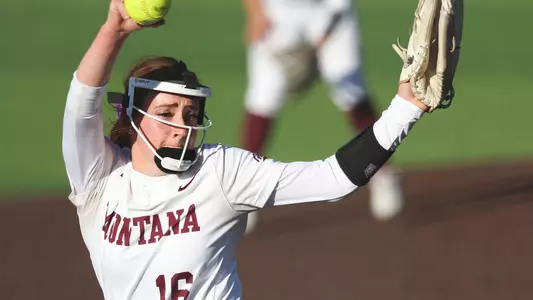
Photo by: Ella Palulis/University of Montana
Halwani brings international experience to Griz pitching staff
1/24/2025 4:33:00 PM | Softball
Fun fact: Gene Simmons was born in Israel. Who? Gene Simmons. You know, lead singer of the rock-and-roll band Kiss, whose stage name is The Demon and whose face becomes transformed through the heavy application of makeup before every performance, his personal signal that it's go time?
You know, Gene Simmons, who moved to the United States when he was eight, joined a band when he was 15 and helped establish Kiss in the early 70s, the group that's still relevant today? You know, "Detroit Rock City"? "God of Thunder"? Any of those ring a bell?
Wait, isn't this a softball story? Indeed, it is, but it has to start somewhere, and oddly enough Gene Simmons is coming along for the ride, with us from start to finish.
Siona Halwani, Montana's first-year pitcher from Half Moon Bay, Calif., kind of made it so last week, breaking out her own rendition of "Rock and Roll All Nite" at the Grizzlies' Meet the Team fundraiser, right up there on stage, right after she mentioned to the delighted audience that she is a proud member of Kiss Army.
And that she only plays softball because she can't play football, the sport that probably best fits her personality. And that she wants to work in football someday, at some level, preferably for the NFL but a college program would do, maybe as a recruiting coordinator.
You think you know someone, this pitcher who brings her glove and a big carry-on bag of intensity to the circle every time she goes out to compete, this pitcher who doesn't have overpowering stuff but does have uncommon control and placement, the result of all those backyard sessions with her dad, until that screwball that screwed a bit too much and caught him in the ribs, his chance to tap out for good.
That was the player who took the microphone last Friday and became the answer to the question she created herself: How fun is she going to be to have in the program the next two years?
"She is a fierce competitor, very serious on the field, then you see her off the field and she just has this shining personality," says her new coach, Stef Ewing. And that's the purpose of the Meet the Team event, to get past the netting that typically separates fan from player.
And then, when her group is called up, it's Siona Halwani's turn on the microphone and she commands the stage and grabs the audience and gives them some insight into the person behind the player. "I loved that moment for her," says Ewing.
But it's not just her Kiss fandom that weaves through this story, her love of classic rock-and-roll passed down from her father, blasting in the car, at the family's weight room at the back of the house, where he taught Siona and later Ronin that life pays back what you put into it, the hard work you invest.
Edward Halwani, too, Siona's dad, was born in Israel, moved to the U.S. when he was five, maybe six, his dad a glazier back in the old country but also a seventh-generation baker, so the family opened a donut shop in the Bay Area, young Edward working before school, after school, the weekends, not for pay but because it was expected, needed. And that shapes a kid, lessons he never forgot.
"My dad was military back in Israel. He was very tough. There were no please's or thank-you's. That's how he was, but everybody loved him. Hard work pays off. That's what I tell the kids," says Edward.
His would be the American dream, marrying Kristina, his high school sweetheart in San Mateo who he met at a school dance in storybook fashion, becoming an electrician, giving his two kids things and opportunities he never had but never allowing a watt of entitlement to ever get into the family home.
"Everything that was given to him growing up, he really cherished it," Siona says of her dad. "He never took anything for granted. He instilled that in me and my younger brother.
"They've always provided everything I've needed." But, also, these nuggets of wisdom: "If you don't work for something, you don't deserve it. Nothing is handed out in life. He came from nothing and built a strong foundation for his kids."
These two, then, this coach and this player were made for each other, the former a straight-talking leader who bundles every message she delivers in the love she has for her players, the latter a player who grew up with one directive: whatever you chose to do, whatever you chose to pursue, earn it.
It's no surprise that their initial recruiting phone call lasted all of maybe 20 minutes, coach in the process of moving from California to Missoula, player at the time in Poland and committing to the Grizzlies without even taking a visit. Sometimes a girl just knows.
"She's the ideal coach for me," says Halwani. "She is going to give you everything straight up, never sugarcoat anything. That's what I need. She holds everybody to a high standard and wants to win and wants everybody to be great.
"She's the best coach I've ever played for. She makes me love the game more than I already do. The positivity and sometimes the negativity push me to be better. She's awesome."
Wait, she was in Poland this past summer? Doing what? Well, if you must know, representing Israel at the U22 European Championship, but we're getting a bit ahead of ourselves. Shouldn't we at least get Halwani playing softball first?
It had to be softball, right? What else was the daughter of Kristina, a pitcher and catcher herself growing up, going to do, going to fall for, getting signed up at the age of five and putting everything we've learned about her so far into this new sport?
"She just kept playing and playing. Didn't realize it would turn out the way it did, which is great," says Edward. "She loved going to practice and would put in the hard work."
She was a catcher before she was ever a pitcher, either mom or dad packing Siona and her gear up and driving her over the hill from Half Moon Bay to Belmont, 25 minutes away. Then, later, joining a team in her hometown and the coaches after tryouts telling the players, we need some pitchers.
And who volunteers? "Siona raises her hand, says, I can pitch," recalls Edward, who wasn't there that fateful day but quickly got a phone call from Kristina, letting him know that they now had an aspiring pitcher on their hands. "I was like, okaaayyy," says Edward, who, because that's how these things work, with fathers and daughters and backyards and girls who want to pitch, became a catcher.
Before she became The Demon, she was Wild Thing, two well-thrown strikes followed by two pitches that had everybody near home plate – batter, catcher, umpire, fans – ducking for cover, as it is for most newcomers to the position.
But more and more time and work invested in the backyard paid off. She became so good that age-group coaches asked that she play up a level for the safety of her peers, which is why this 10-year-old was racing her best stuff past 12-year-olds.
"For me, that was it," says Edward. "The whole game just clicked." They would be in the car and Kristina would quiz her daughter. Okay, runners on first and second, one out, this is what happens. What do you do? Siona would ace the informal exam, every time. "I thought, okay, she's pretty good at this."
Kristina, who was very good herself, saw it too, the parents sitting at another game on another day and Edward asking, no, really, how does she compare to you at that age? "She said, 'She's way better than me. I was nowhere near that level at her age.' That's when I knew."
Sometimes these stories are just that simple, life lessons taking hold – work really hard and you'll get things given back to you – a kid falling for a sport, for a high-profile position within that sport, and those elements coming together to produce something special. No magic dust required.
"I really like the level of competition and how you have to compete every single pitch," says Siona of pitching. "I like knowing the game is in my control."
What wasn't in her control was the arrival of COVID and how it impacted her recruitment as a sophomore and junior in high school and how that landed her less than 30 minutes from home, at the high-level junior college team at the College of San Mateo.
Over two years she had a record of 27-6 and an ERA of 1.57, twice helping the Bulldogs to the California Community College Athletic Association State Championships.
For some players, junior college is the end of the road, two final years to play the sport they love. For others, it's a springboard, proof that there is more out there for them at a four-year school.
San Mateo coach Nicole Quigley-Borg knew Halwani was destined for more. "She told me if I'm going to play at the highest level, I'm going to have to compete, not just dominate like I did at the JC level," says Halwani. "That's why I think Division I softball is for me. I want to compete."
This is going to work because Halwani is not a pitcher who relies on overpowering the batter. She relies on her control, her location, forces the batter to accept she isn't going to get the exact pitch she wants, so she'll have to settle for just putting it in play and trying to make something happen that way.
"I take pride that I'm a pitch-to-contact pitcher. I don't need to strike out the whole lineup to be an effective pitcher," she says. "I'm really good at locating my pitches and trusting my defense. That's why I'm able to get good results."
Ewing and Halwani were connected by UC San Diego coach Nikki Palmer, a professional friend of Ewing's who knew that the new Montana coach last summer was on the lookout for pitchers to restock the Griz staff and that Halwani was available.
Ewing had phone conversations with pitchers from all over, those in the portal looking to make a Division I to Division I transfer, those looking to move up to Division I from a different level.
Ewing needed pitching depth badly but also wasn't going to take just anyone. It had to be the right fit. "You call them, feel them out, make your decision. Do I think this is somebody who would be a good fit in my program and would work well with me as their coach? I loved my conversation with Siona."
And she hadn't even met her yet, didn't until Halwani returned from Poland and made her own California-to-Missoula move, family meeting Ewing for the first time for coffee, maybe 30 minutes, no, make it two hours, this blind date turning out perfectly.
"I told them, we're going to take good care of your kid," says Ewing. "She wanted a place where she was going to be treated as a person first, a softball player second. We've seen her become very comfortable here, immediately gel with her teammates. She feels at home here."
The more they talked, the more Ewing knew she had found this diamond in the rough that she'll go to battle with on the softball diamond any day of the week.
"They've given their kids a great mentality. You're going to work hard and outwork people. That's an old-school mentality that I love and you don't find all the time," says Ewing. "If you want something, you have to work hard and beat everybody out who's around you.
"I see that in Siona. I love her work ethic. Her parents have created a really confident young lady who's articulate and smart and is a good human. She's just a bad-ass," the highest of honors in Ewing's hierarchy of praises.
Okay, here we go. Let's welcome Gene Simmons back into the story. Halwani fell for Kiss years ago, melted when her dad took her to see them live when she was a senior in high school, went head over heels when she found out, like her dad, that Simmons, aka The Demon, had been born in Israel.
It was all just too perfect. It crystalized everything for her, brought it all together. She'd long been taking a certain mindset onto the field with her when she pitched. Now she had a name for it. Now the eye black had a pregame purpose. She would be The Demon.
"It's my alter-ego. Off the field I'm pretty quiet, pretty reserved but when I'm on the field, The Demon comes out," she says. "I wear my eye black all over my face. It's an expressive way to show it's game time.
"It's a confidence thing. When I have that mentality, I feel like I can do anything. The Demon fears nothing and is going to come at you. I'm determined to get the job done, starting, relieving. When I step across the line, I transform into something else."
You can forgive the angst she felt in the fall, the internal battle, when assistant coach Tyler Jeske started referring to Montana's players as queens, in the best of ways. High royalty of the sport. So, they made an insider acronym out of it: QUEEN.
Halwani was all about it, but the acronym was missing something. As it stood, it was too regal, too elegant. After all, softball isn't a pageant, it's a battle, fueled by blood, sweat and, occasionally, some tears. The whole thing needed a touch of nastiness.
"Siona said, I'm not really the queen type. I'm more the demon type," says Ewing, whose team now uses QUEENS. "We added the S on the end, sometimes a demon, for Siona. I love that about her.
"We tell our players, it's okay to have that alter-ego when you step between the lines. She has that and I love it. You can be the nicest, most polite person in the world, but on the field you've got to have that gear. She's got it. She is an ultimate competitor."
They would have seen the same thing, a few years back, scouts from Team Israel, at a big travel-ball tournament in Colorado Springs that offered an international challenge, where players could compete for a country of secondary affiliation. If their mom happened to sign them up. Which Kristina did.
Before the family knew it, the phone call arrived. And soon enough she was off to the Czech Republic in 2022 to play in the U22 European Championship, after she had spent eight hours at the consulate in San Francisco becoming a dual citizen, both U.S. and Israel.
Imagine: all these years after her dad moved away from his home country, his daughter was wearing Israel Softball across her uniform front.
"It's a big deal and just as big a deal to my dad," she says. "It's an honor to represent Israel. It means the world to me that I'm able to represent my heritage through the sport I love."
In 2023, it was the U19 Canada Cup and U18 European Championship, again in the Czech Republic. This past summer it was the U19 Canada Cup and the U22 European Championship, this time in Poland and this time with Israel heavy in the international discourse.
The European Championship went off without incident, but protesters made themselves known at each of Team Israel's games at the Canada Cup.
"Israel always travels with security, but we had extra security with us at all times (over the summer)," Halwani says. "They don't look like security guards, but we know who they are and they know where we are at all times. We had someone sitting in the lobby of our hotel 24 hours a day keeping us safe.
"I've never felt ashamed or felt I can't show that I'm proud of being an Israeli athlete."
The current head coach of Israel's national team is Nikki Palmer, the coach at UC San Diego, the coach who is a friend of Ewing's, the coach who connected Ewing and Halwani, softballers who know what it means to play for a country, to represent a country.
Ewing was 16, just a high school baller getting lessons from a player at Arizona State, who happened to be Greek, just like Ewing, and that country's national team system was always on the lookout for up-and-comers and would she be interested?
A tryout led to a seven-day training camp at Arizona State, which led to a trip to Greece in the months leading up to that country hosting the 2004 Summer Games, competing for the country in a test event on the same field on which Olympic gold would be determined. She was named to the country's alternate team.
It wasn't until she went on her honeymoon two years ago to Greece that she truly understood what her 16-year-old self wasn't able to fully appreciate at the time.
"You're playing for more than yourself. When you put that jersey on, it just means something else. It's not just you. It's you representing your family, your family's heritage. When you go to the country that you wear that jersey for, it's incredible," says Ewing.
"I was too naïve at 16 to know what it meant. To know that Siona's doing that now, it's really special for her. I'm happy she gets to experience that."
Over winter break, Halwani attended the team's latest training camp in Southern California, was told she was now in the group of players who would make up the national team as Team Israel begins taking steps to qualify for the 2028 Summer Games in the U.S.
Is it a longshot? Certainly. Their region is a pool of death and only one country's team is going to make it out and play in Oklahoma City in '28. Should the team ever have its doubts, Halwani could fire up the first single ever released by Kiss, back in 1974, "Nothin' to Lose."
You know, Gene Simmons, who moved to the United States when he was eight, joined a band when he was 15 and helped establish Kiss in the early 70s, the group that's still relevant today? You know, "Detroit Rock City"? "God of Thunder"? Any of those ring a bell?
Wait, isn't this a softball story? Indeed, it is, but it has to start somewhere, and oddly enough Gene Simmons is coming along for the ride, with us from start to finish.
Siona Halwani, Montana's first-year pitcher from Half Moon Bay, Calif., kind of made it so last week, breaking out her own rendition of "Rock and Roll All Nite" at the Grizzlies' Meet the Team fundraiser, right up there on stage, right after she mentioned to the delighted audience that she is a proud member of Kiss Army.
And that she only plays softball because she can't play football, the sport that probably best fits her personality. And that she wants to work in football someday, at some level, preferably for the NFL but a college program would do, maybe as a recruiting coordinator.
You think you know someone, this pitcher who brings her glove and a big carry-on bag of intensity to the circle every time she goes out to compete, this pitcher who doesn't have overpowering stuff but does have uncommon control and placement, the result of all those backyard sessions with her dad, until that screwball that screwed a bit too much and caught him in the ribs, his chance to tap out for good.
That was the player who took the microphone last Friday and became the answer to the question she created herself: How fun is she going to be to have in the program the next two years?
"She is a fierce competitor, very serious on the field, then you see her off the field and she just has this shining personality," says her new coach, Stef Ewing. And that's the purpose of the Meet the Team event, to get past the netting that typically separates fan from player.
And then, when her group is called up, it's Siona Halwani's turn on the microphone and she commands the stage and grabs the audience and gives them some insight into the person behind the player. "I loved that moment for her," says Ewing.
But it's not just her Kiss fandom that weaves through this story, her love of classic rock-and-roll passed down from her father, blasting in the car, at the family's weight room at the back of the house, where he taught Siona and later Ronin that life pays back what you put into it, the hard work you invest.
Edward Halwani, too, Siona's dad, was born in Israel, moved to the U.S. when he was five, maybe six, his dad a glazier back in the old country but also a seventh-generation baker, so the family opened a donut shop in the Bay Area, young Edward working before school, after school, the weekends, not for pay but because it was expected, needed. And that shapes a kid, lessons he never forgot.
"My dad was military back in Israel. He was very tough. There were no please's or thank-you's. That's how he was, but everybody loved him. Hard work pays off. That's what I tell the kids," says Edward.
His would be the American dream, marrying Kristina, his high school sweetheart in San Mateo who he met at a school dance in storybook fashion, becoming an electrician, giving his two kids things and opportunities he never had but never allowing a watt of entitlement to ever get into the family home.
"Everything that was given to him growing up, he really cherished it," Siona says of her dad. "He never took anything for granted. He instilled that in me and my younger brother.
"They've always provided everything I've needed." But, also, these nuggets of wisdom: "If you don't work for something, you don't deserve it. Nothing is handed out in life. He came from nothing and built a strong foundation for his kids."
These two, then, this coach and this player were made for each other, the former a straight-talking leader who bundles every message she delivers in the love she has for her players, the latter a player who grew up with one directive: whatever you chose to do, whatever you chose to pursue, earn it.
It's no surprise that their initial recruiting phone call lasted all of maybe 20 minutes, coach in the process of moving from California to Missoula, player at the time in Poland and committing to the Grizzlies without even taking a visit. Sometimes a girl just knows.
"She's the ideal coach for me," says Halwani. "She is going to give you everything straight up, never sugarcoat anything. That's what I need. She holds everybody to a high standard and wants to win and wants everybody to be great.
"She's the best coach I've ever played for. She makes me love the game more than I already do. The positivity and sometimes the negativity push me to be better. She's awesome."
Wait, she was in Poland this past summer? Doing what? Well, if you must know, representing Israel at the U22 European Championship, but we're getting a bit ahead of ourselves. Shouldn't we at least get Halwani playing softball first?
It had to be softball, right? What else was the daughter of Kristina, a pitcher and catcher herself growing up, going to do, going to fall for, getting signed up at the age of five and putting everything we've learned about her so far into this new sport?
"She just kept playing and playing. Didn't realize it would turn out the way it did, which is great," says Edward. "She loved going to practice and would put in the hard work."
She was a catcher before she was ever a pitcher, either mom or dad packing Siona and her gear up and driving her over the hill from Half Moon Bay to Belmont, 25 minutes away. Then, later, joining a team in her hometown and the coaches after tryouts telling the players, we need some pitchers.
And who volunteers? "Siona raises her hand, says, I can pitch," recalls Edward, who wasn't there that fateful day but quickly got a phone call from Kristina, letting him know that they now had an aspiring pitcher on their hands. "I was like, okaaayyy," says Edward, who, because that's how these things work, with fathers and daughters and backyards and girls who want to pitch, became a catcher.
Before she became The Demon, she was Wild Thing, two well-thrown strikes followed by two pitches that had everybody near home plate – batter, catcher, umpire, fans – ducking for cover, as it is for most newcomers to the position.
But more and more time and work invested in the backyard paid off. She became so good that age-group coaches asked that she play up a level for the safety of her peers, which is why this 10-year-old was racing her best stuff past 12-year-olds.
"For me, that was it," says Edward. "The whole game just clicked." They would be in the car and Kristina would quiz her daughter. Okay, runners on first and second, one out, this is what happens. What do you do? Siona would ace the informal exam, every time. "I thought, okay, she's pretty good at this."
Kristina, who was very good herself, saw it too, the parents sitting at another game on another day and Edward asking, no, really, how does she compare to you at that age? "She said, 'She's way better than me. I was nowhere near that level at her age.' That's when I knew."
Sometimes these stories are just that simple, life lessons taking hold – work really hard and you'll get things given back to you – a kid falling for a sport, for a high-profile position within that sport, and those elements coming together to produce something special. No magic dust required.
"I really like the level of competition and how you have to compete every single pitch," says Siona of pitching. "I like knowing the game is in my control."
What wasn't in her control was the arrival of COVID and how it impacted her recruitment as a sophomore and junior in high school and how that landed her less than 30 minutes from home, at the high-level junior college team at the College of San Mateo.
Over two years she had a record of 27-6 and an ERA of 1.57, twice helping the Bulldogs to the California Community College Athletic Association State Championships.
For some players, junior college is the end of the road, two final years to play the sport they love. For others, it's a springboard, proof that there is more out there for them at a four-year school.
San Mateo coach Nicole Quigley-Borg knew Halwani was destined for more. "She told me if I'm going to play at the highest level, I'm going to have to compete, not just dominate like I did at the JC level," says Halwani. "That's why I think Division I softball is for me. I want to compete."
This is going to work because Halwani is not a pitcher who relies on overpowering the batter. She relies on her control, her location, forces the batter to accept she isn't going to get the exact pitch she wants, so she'll have to settle for just putting it in play and trying to make something happen that way.
"I take pride that I'm a pitch-to-contact pitcher. I don't need to strike out the whole lineup to be an effective pitcher," she says. "I'm really good at locating my pitches and trusting my defense. That's why I'm able to get good results."
Ewing and Halwani were connected by UC San Diego coach Nikki Palmer, a professional friend of Ewing's who knew that the new Montana coach last summer was on the lookout for pitchers to restock the Griz staff and that Halwani was available.
Ewing had phone conversations with pitchers from all over, those in the portal looking to make a Division I to Division I transfer, those looking to move up to Division I from a different level.
Ewing needed pitching depth badly but also wasn't going to take just anyone. It had to be the right fit. "You call them, feel them out, make your decision. Do I think this is somebody who would be a good fit in my program and would work well with me as their coach? I loved my conversation with Siona."
And she hadn't even met her yet, didn't until Halwani returned from Poland and made her own California-to-Missoula move, family meeting Ewing for the first time for coffee, maybe 30 minutes, no, make it two hours, this blind date turning out perfectly.
"I told them, we're going to take good care of your kid," says Ewing. "She wanted a place where she was going to be treated as a person first, a softball player second. We've seen her become very comfortable here, immediately gel with her teammates. She feels at home here."
The more they talked, the more Ewing knew she had found this diamond in the rough that she'll go to battle with on the softball diamond any day of the week.
"They've given their kids a great mentality. You're going to work hard and outwork people. That's an old-school mentality that I love and you don't find all the time," says Ewing. "If you want something, you have to work hard and beat everybody out who's around you.
"I see that in Siona. I love her work ethic. Her parents have created a really confident young lady who's articulate and smart and is a good human. She's just a bad-ass," the highest of honors in Ewing's hierarchy of praises.
Okay, here we go. Let's welcome Gene Simmons back into the story. Halwani fell for Kiss years ago, melted when her dad took her to see them live when she was a senior in high school, went head over heels when she found out, like her dad, that Simmons, aka The Demon, had been born in Israel.
It was all just too perfect. It crystalized everything for her, brought it all together. She'd long been taking a certain mindset onto the field with her when she pitched. Now she had a name for it. Now the eye black had a pregame purpose. She would be The Demon.
"It's my alter-ego. Off the field I'm pretty quiet, pretty reserved but when I'm on the field, The Demon comes out," she says. "I wear my eye black all over my face. It's an expressive way to show it's game time.
"It's a confidence thing. When I have that mentality, I feel like I can do anything. The Demon fears nothing and is going to come at you. I'm determined to get the job done, starting, relieving. When I step across the line, I transform into something else."
You can forgive the angst she felt in the fall, the internal battle, when assistant coach Tyler Jeske started referring to Montana's players as queens, in the best of ways. High royalty of the sport. So, they made an insider acronym out of it: QUEEN.
Halwani was all about it, but the acronym was missing something. As it stood, it was too regal, too elegant. After all, softball isn't a pageant, it's a battle, fueled by blood, sweat and, occasionally, some tears. The whole thing needed a touch of nastiness.
"Siona said, I'm not really the queen type. I'm more the demon type," says Ewing, whose team now uses QUEENS. "We added the S on the end, sometimes a demon, for Siona. I love that about her.
"We tell our players, it's okay to have that alter-ego when you step between the lines. She has that and I love it. You can be the nicest, most polite person in the world, but on the field you've got to have that gear. She's got it. She is an ultimate competitor."
They would have seen the same thing, a few years back, scouts from Team Israel, at a big travel-ball tournament in Colorado Springs that offered an international challenge, where players could compete for a country of secondary affiliation. If their mom happened to sign them up. Which Kristina did.
Before the family knew it, the phone call arrived. And soon enough she was off to the Czech Republic in 2022 to play in the U22 European Championship, after she had spent eight hours at the consulate in San Francisco becoming a dual citizen, both U.S. and Israel.
Imagine: all these years after her dad moved away from his home country, his daughter was wearing Israel Softball across her uniform front.
"It's a big deal and just as big a deal to my dad," she says. "It's an honor to represent Israel. It means the world to me that I'm able to represent my heritage through the sport I love."
In 2023, it was the U19 Canada Cup and U18 European Championship, again in the Czech Republic. This past summer it was the U19 Canada Cup and the U22 European Championship, this time in Poland and this time with Israel heavy in the international discourse.
The European Championship went off without incident, but protesters made themselves known at each of Team Israel's games at the Canada Cup.
"Israel always travels with security, but we had extra security with us at all times (over the summer)," Halwani says. "They don't look like security guards, but we know who they are and they know where we are at all times. We had someone sitting in the lobby of our hotel 24 hours a day keeping us safe.
"I've never felt ashamed or felt I can't show that I'm proud of being an Israeli athlete."
The current head coach of Israel's national team is Nikki Palmer, the coach at UC San Diego, the coach who is a friend of Ewing's, the coach who connected Ewing and Halwani, softballers who know what it means to play for a country, to represent a country.
Ewing was 16, just a high school baller getting lessons from a player at Arizona State, who happened to be Greek, just like Ewing, and that country's national team system was always on the lookout for up-and-comers and would she be interested?
A tryout led to a seven-day training camp at Arizona State, which led to a trip to Greece in the months leading up to that country hosting the 2004 Summer Games, competing for the country in a test event on the same field on which Olympic gold would be determined. She was named to the country's alternate team.
It wasn't until she went on her honeymoon two years ago to Greece that she truly understood what her 16-year-old self wasn't able to fully appreciate at the time.
"You're playing for more than yourself. When you put that jersey on, it just means something else. It's not just you. It's you representing your family, your family's heritage. When you go to the country that you wear that jersey for, it's incredible," says Ewing.
"I was too naïve at 16 to know what it meant. To know that Siona's doing that now, it's really special for her. I'm happy she gets to experience that."
Over winter break, Halwani attended the team's latest training camp in Southern California, was told she was now in the group of players who would make up the national team as Team Israel begins taking steps to qualify for the 2028 Summer Games in the U.S.
Is it a longshot? Certainly. Their region is a pool of death and only one country's team is going to make it out and play in Oklahoma City in '28. Should the team ever have its doubts, Halwani could fire up the first single ever released by Kiss, back in 1974, "Nothin' to Lose."
Players Mentioned

P
/ SoftballLady Griz Basketball Locker Room Unveiling - 5/1/26
Friday, May 01
Griz Track & Field - Montana Open Highlights - 4/25/26
Friday, May 01
Griz Softball vs. Idaho State Game-Winning Hit - 3/25/26
Friday, May 01
Griz Softball Championship Series Promo
Friday, May 01