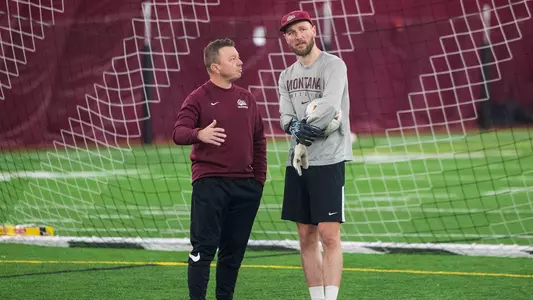
Photo by: Noah Epps/university of Montana
Gore’s new-look Grizzlies are off and running
7/16/2026 5:45:00 PM | Soccer
Heavy is the crown. And what if it's not just one but three sitting atop the Montana soccer program, both pride and burden, one for each of the last three regular seasons, when the Grizzlies played 24 Big Sky Conference matches and lost only once.
Then went out and won November's Big Sky tournament title as well in the most dramatic fashion possible, a shootout win in the semifinals, another in the championship match in front of a program-record 2,227 fans, a one-armed sniper scoring and going viral in the process.
No program in Big Sky history had won three consecutive outright regular-season titles, that is until Montana pulled it off in 2023, '24 and '25, that success propelling the coach and architect of those teams to a new opportunity.
Like a Pied Piper in black cleats, he had most of the players who had eligibility remaining follow him, leaving those crowns behind, suspended seemingly in midair, only a few remaining players and a Montana-'til-I-die associate head coach to hold them aloft.
But how long could that last? How long until they went from head, from a program actively wearing them, defending them, to the dusty shelf of history? One of Montana's most successful, high-profile programs quickly went dark, sliding into the shadows of the unknown.
When Stuart Gore was hired in early February and made the long drive from Alabama to Missoula, he knew the history, both recent and from long ago, when Betsy Duerksen started the program more than three decades ago and set what happened the last three seasons in motion, the latest run of success.
What he didn't know was what he'd find when he arrived, what he'd discover when he attended his first training session, a group not even large enough to face another 11 being led by an associate head coach he'd never met.
He didn't know what level of broken he'd have to take on, how much mending and building he'd need to do, how much championship DNA possibly could have survived such an upheaval that hit the program in December, when it felt like: last one out, please turn off the lights.
What he found wasn't postapocalyptic. It wasn't a program on life support. It was a core of players who had known only one thing as Grizzlies. And they weren't going to let that change, not on their watch, not as long as there were even two of them to kick the ball around.
"What I've learned about the team is they are still hungry for success. This team is like, we go again, we go again, we go aging, because it's all they know," Gore said this week as his first Montana squad held its first practice of the preseason.
"What I really like about the returners is they've taken on the mantra of: champions don't rebuild, they reload. Part of that might be because of what happened. They have a point to prove."
And what an on-the-fly reload it's had to be, with the Grizzlies returning only one starter from last year's team – Lucie Rokos – four other letter-winners and three players coming off redshirt seasons, a total of eight players who were on Montana's roster last season.
When Gore addressed his team at practice on Thursday morning at South Campus Stadium before the 2026 Grizzlies took the field for the first time, 17 players who have never worn the Montana uniform looked back at him, nearly 70 percent of the roster.
They know the history. They know every other team in the Big Sky has been awaiting the day that the Grizzlies would – in theory – come back to the pack, become beatable again and, oh, how they would celebrate when they did it. That's why they came, for the pressure, for the expectations, to be the next.
"The newcomers understand that you've got to come in and put the crown on your head. You can't run away from it, even though they weren't here last year," Gore said. "The moment you put the jersey on that says Montana on the front, it comes with an enormous target.
"Everybody is always going to play their hardest against you. You're always going to get everybody's A game."
It's easy to understand why the rest of the league is licking its chops simply given some of the realities of the situation Montana finds itself in.
Of the 29 players who stepped on the field of competition for the Grizzlies last season, only five are back. Of those five, only Rokos and Caylee (Kerr) Dowler contributed to the team's 31 goals and 27 assists. Rokos had one goal, one assist, same as Dowler. That's 29 lost goals, 25 lost assists.
If that cupboard was mostly bare when he was hired, Gore addressed it by opening a new door and finding not just freshmen but key transfers, players who have already proved it at the college level, Megan Wilson at Arizona State, Elli Lewis at Northwest College, where she was an all-American.
Transfer forwards Lexi Rabold (Middle Tennessee) and Shiana Samarasinghe (UC San Diego) joined the program in January, with force-of-nature Malli Rude, one of those five returners, moving from the defensive midfield to forward in the offseason, an Abby Wambach-type in waiting.
The situation reminds Gore of one of his previous coaching stops, when his scoring went from a lot to a little after a productive season, only for his next team, with mostly new faces, to exceed what its predecessor had done.
"Megan comes from playing at Arizona State. She's a little bit older and is a goal-scorer by trade. That's how she measures success in her world," said Gore. "Elli was an all-American. That's two players who have had the pressure of scoring goals for their teams and have backed it up."
It's the midfield where Montana will be young. Dowler and sophomore Liv Thorne-Thomsen, who averaged more than 70 minutes in the Grizzlies' three postseason matches last season, are back. Hayley Bass, who sat out the 2025 season with an injury, started 14 matches as a true freshman in 2024.
And new and young might work because Gore's team will be learning and employing a new style of play anyway. Everybody, from freshman to redshirt senior, will be starting from square one.
You might think of it as Tiki-taka. What it looked like on Thursday morning was one-touch passes into space, where the ball met a streaking teammate's foot, only for hers to be a one-touch pass into other space that a teammate filled like clockwork, like an intricate design with movement everywhere.
Done well, it would have an opponent's head spinning, not knowing who to mark or where the next pass was going or what space to defend.
"It's positional possession play with freedom," Gore said. "We're trying to keep the ball but it's also about consistent movement off the ball. It's about arriving at the time the ball is moving into space, intricacies of timing and movement. It's all about playing with a sense of freedom in a structure.
"The more movement there is off the ball, it creates headaches for the opposition because it creates more moving pieces. It makes it look like there are more players on the field than there are."
It was beautiful but also done without a defender in sight to clog things up or challenge a pass. But it was a start, opening day for a season that peaks in November, when Montana once again hosts the Big Sky Conference Championship at South Campus Stadium.
"You've got to trust the process," Gore said. "There are going to be great days, then there are going to be days when it feels like we went backwards. You've got to ride the wave until the crest of the wave starts to level out and becomes calmer seas."
The most intriguing position to watch will be what happens at goalkeeper, where the aforementioned J. Landham, Gore's associate head coach, has trained the Big Sky Goalkeeper of the Year four of the last five seasons he's been with the Grizzlies and those being four different players. Remarkable.
"If J. produces the goalkeeper of the year again, he could say he's the goalkeeper coach of the year across all (NCAA) divisions, men and women," said Gore.
That's not because Montana lacks talent at the position. It's because not one of the three goalkeepers on the roster has played a minute in goal for the Grizzlies, with two of them having yet to play a minute in a college game.
The most experienced of the trio is redshirt sophomore Avery Heeb, who spent one season at West Georgia, last fall at USC Upstate where she played limited minutes and won her only decision in a shutout. She was the Georgia Class 5A Player of the Year in 2022, '23 and '24 at McIntosh High.
The other newcomer is freshman Lorelei Rustay, from San Mateo, Calif. The returner is redshirt freshman Jill Miliffe, who trained last year alongside 2024 Big Sky Goalkeeper of the Year Bayliss Flynn and 2025 Big Sky Goalkeeper of the Year Ashlyn Dvorak. Good company for a then first-year player.
"Avery was a three-time player of the year in high school and could just go stratospheric," said Gore. "If you're building a goalkeeper, you build Lorelei. She's 5-9 and has got long limbs, like a young Dvorak in that way. Jill knows what this team is about and has been waiting to get her opportunity."
To pigeonhole Landham as simply a goalkeeper coach would be to minimize how he's built Montana's entire defense into one of the nation's strongest units, because, like Gore's with-the-ball approach, it takes everyone working together.
"J. would tell you the job of a goalkeeper coach is to have the goalkeeper not actually have to make a save because she commandeered everybody in front of her," said Gore.
The Grizzlies have finished in the top 13 in the nation the last three seasons in goals-against average and in 2024 led the country in shutout percentage. That they did that while the team's keepers averaged barely four saves per match reveals everything you need to know.
It starts up front and only gets to the goalkeeper in worst-case scenarios. Then, time after time, Landham's charges have come through with the big saves. It's how championships are won, again and again.
"Everybody thinks the head coach is the genius behind all decisions, but the defensive side of the game the last x number of years has been J.," said Gore. "The defensive structure was all J. He's a very good defensive coach.
"I tell recruits, if you're serious about goalkeeping, this is Goalkeeper U. This is the only place you want to go." As for this year, Landham's first without a Claire Howard, a Camellia Xu, a Flynn, a Dvorak? "He's going to have his work cut out for him, which I think he's excited about."
The season, once again, will kick off with an exhibition match in Columbia Falls, this time with Montana facing Mount Royal on Friday night, Aug. 7.
The regular season will open with a home match against Bucknell on Thursday, Aug. 13, at South Campus Stadium, where the Grizzlies have gone 24-3-6 the last three seasons.
Montana will face Washington, the team the Grizzlies played in November in the first round of the NCAA tournament, a match the Huskies won 2-0 on Alex Buck goals in the 11th and 90th minutes, on the road, in addition to Seattle, Air Force, Denver and Gonzaga.
Non-conference home matches, after the season opener against Bucknell, will come against Lethbridge, MSU Billings and Wyoming.
Montana will open league at Southern Utah on Oct. 1. The Grizzlies will close the regular season with home matches against Eastern Washington, Idaho and Portland State, then hopefully be one of the six teams playing at South Campus Stadium in mid-November when the postseason arrives.
"I feel quietly confident," said Gore, who has a team of 25, down from Montana's rosters of 30-plus players the last three years. "The roster is small, so we're going to have to manage time on people's legs. We're going to have to utilize the freshmen.
"Every non-conference match is a chance for us to get a little tidier, then we want to be playing our best soccer going into October. Making the (Big Sky) tournament with this team is a reasonable goal even with everything that's happened. Then you have to get a bit of a run going."
He's got some favorable Montana history on his side. In her first chance to win a Big Sky championship, in 1997, Duerksen's team got it done. In Neil Sedgwick's first year, in 2004, the Grizzlies finished third in the regular season and played in the tournament championship match.
In Mark Plakorus's first year, in 2011, when nobody expected anything from the Grizzlies, after they'd won just seven matches the previous two seasons combined, they finished fourth to grab the final tournament spot, then upset Northern Colorado and Weber State to make the NCAA tournament.
Chris Citowicki's first team, in 2018, tied for fifth before knocking off three higher-seeded teams, all by shutout, to win the conference tournament, what would be his first of nine regular-season or tournament titles over his eight-year tenure.
Now it's Gore's first go at it.
That crown? It's heavy. Has been for a long time for the Montana soccer program, handed down from coach to coach, now to Gore and his first team that could author one of the greatest stories in Griz soccer history over the coming months.
It's weighty, all that history, one that begs for the winning, the excellence, to continue: 11 regular-season titles. Eight tournament championships. Seven trips to the NCAA tournament.
That's why he's here. It's why Stuart Gore wanted the job, to compete with the pressure of expectations, to play in front of a fan base that helps make the pursuit of championships just a bit easier and a lot more fulfilling. He welcomes the crown. He found the right spot.
Then went out and won November's Big Sky tournament title as well in the most dramatic fashion possible, a shootout win in the semifinals, another in the championship match in front of a program-record 2,227 fans, a one-armed sniper scoring and going viral in the process.
No program in Big Sky history had won three consecutive outright regular-season titles, that is until Montana pulled it off in 2023, '24 and '25, that success propelling the coach and architect of those teams to a new opportunity.
Like a Pied Piper in black cleats, he had most of the players who had eligibility remaining follow him, leaving those crowns behind, suspended seemingly in midair, only a few remaining players and a Montana-'til-I-die associate head coach to hold them aloft.
But how long could that last? How long until they went from head, from a program actively wearing them, defending them, to the dusty shelf of history? One of Montana's most successful, high-profile programs quickly went dark, sliding into the shadows of the unknown.
When Stuart Gore was hired in early February and made the long drive from Alabama to Missoula, he knew the history, both recent and from long ago, when Betsy Duerksen started the program more than three decades ago and set what happened the last three seasons in motion, the latest run of success.
What he didn't know was what he'd find when he arrived, what he'd discover when he attended his first training session, a group not even large enough to face another 11 being led by an associate head coach he'd never met.
He didn't know what level of broken he'd have to take on, how much mending and building he'd need to do, how much championship DNA possibly could have survived such an upheaval that hit the program in December, when it felt like: last one out, please turn off the lights.
What he found wasn't postapocalyptic. It wasn't a program on life support. It was a core of players who had known only one thing as Grizzlies. And they weren't going to let that change, not on their watch, not as long as there were even two of them to kick the ball around.
"What I've learned about the team is they are still hungry for success. This team is like, we go again, we go again, we go aging, because it's all they know," Gore said this week as his first Montana squad held its first practice of the preseason.
"What I really like about the returners is they've taken on the mantra of: champions don't rebuild, they reload. Part of that might be because of what happened. They have a point to prove."
And what an on-the-fly reload it's had to be, with the Grizzlies returning only one starter from last year's team – Lucie Rokos – four other letter-winners and three players coming off redshirt seasons, a total of eight players who were on Montana's roster last season.
When Gore addressed his team at practice on Thursday morning at South Campus Stadium before the 2026 Grizzlies took the field for the first time, 17 players who have never worn the Montana uniform looked back at him, nearly 70 percent of the roster.
They know the history. They know every other team in the Big Sky has been awaiting the day that the Grizzlies would – in theory – come back to the pack, become beatable again and, oh, how they would celebrate when they did it. That's why they came, for the pressure, for the expectations, to be the next.
"The newcomers understand that you've got to come in and put the crown on your head. You can't run away from it, even though they weren't here last year," Gore said. "The moment you put the jersey on that says Montana on the front, it comes with an enormous target.
"Everybody is always going to play their hardest against you. You're always going to get everybody's A game."
It's easy to understand why the rest of the league is licking its chops simply given some of the realities of the situation Montana finds itself in.
Of the 29 players who stepped on the field of competition for the Grizzlies last season, only five are back. Of those five, only Rokos and Caylee (Kerr) Dowler contributed to the team's 31 goals and 27 assists. Rokos had one goal, one assist, same as Dowler. That's 29 lost goals, 25 lost assists.
If that cupboard was mostly bare when he was hired, Gore addressed it by opening a new door and finding not just freshmen but key transfers, players who have already proved it at the college level, Megan Wilson at Arizona State, Elli Lewis at Northwest College, where she was an all-American.
Transfer forwards Lexi Rabold (Middle Tennessee) and Shiana Samarasinghe (UC San Diego) joined the program in January, with force-of-nature Malli Rude, one of those five returners, moving from the defensive midfield to forward in the offseason, an Abby Wambach-type in waiting.
The situation reminds Gore of one of his previous coaching stops, when his scoring went from a lot to a little after a productive season, only for his next team, with mostly new faces, to exceed what its predecessor had done.
"Megan comes from playing at Arizona State. She's a little bit older and is a goal-scorer by trade. That's how she measures success in her world," said Gore. "Elli was an all-American. That's two players who have had the pressure of scoring goals for their teams and have backed it up."
It's the midfield where Montana will be young. Dowler and sophomore Liv Thorne-Thomsen, who averaged more than 70 minutes in the Grizzlies' three postseason matches last season, are back. Hayley Bass, who sat out the 2025 season with an injury, started 14 matches as a true freshman in 2024.
And new and young might work because Gore's team will be learning and employing a new style of play anyway. Everybody, from freshman to redshirt senior, will be starting from square one.
You might think of it as Tiki-taka. What it looked like on Thursday morning was one-touch passes into space, where the ball met a streaking teammate's foot, only for hers to be a one-touch pass into other space that a teammate filled like clockwork, like an intricate design with movement everywhere.
Done well, it would have an opponent's head spinning, not knowing who to mark or where the next pass was going or what space to defend.
"It's positional possession play with freedom," Gore said. "We're trying to keep the ball but it's also about consistent movement off the ball. It's about arriving at the time the ball is moving into space, intricacies of timing and movement. It's all about playing with a sense of freedom in a structure.
"The more movement there is off the ball, it creates headaches for the opposition because it creates more moving pieces. It makes it look like there are more players on the field than there are."
It was beautiful but also done without a defender in sight to clog things up or challenge a pass. But it was a start, opening day for a season that peaks in November, when Montana once again hosts the Big Sky Conference Championship at South Campus Stadium.
"You've got to trust the process," Gore said. "There are going to be great days, then there are going to be days when it feels like we went backwards. You've got to ride the wave until the crest of the wave starts to level out and becomes calmer seas."
The most intriguing position to watch will be what happens at goalkeeper, where the aforementioned J. Landham, Gore's associate head coach, has trained the Big Sky Goalkeeper of the Year four of the last five seasons he's been with the Grizzlies and those being four different players. Remarkable.
"If J. produces the goalkeeper of the year again, he could say he's the goalkeeper coach of the year across all (NCAA) divisions, men and women," said Gore.
That's not because Montana lacks talent at the position. It's because not one of the three goalkeepers on the roster has played a minute in goal for the Grizzlies, with two of them having yet to play a minute in a college game.
The most experienced of the trio is redshirt sophomore Avery Heeb, who spent one season at West Georgia, last fall at USC Upstate where she played limited minutes and won her only decision in a shutout. She was the Georgia Class 5A Player of the Year in 2022, '23 and '24 at McIntosh High.
The other newcomer is freshman Lorelei Rustay, from San Mateo, Calif. The returner is redshirt freshman Jill Miliffe, who trained last year alongside 2024 Big Sky Goalkeeper of the Year Bayliss Flynn and 2025 Big Sky Goalkeeper of the Year Ashlyn Dvorak. Good company for a then first-year player.
"Avery was a three-time player of the year in high school and could just go stratospheric," said Gore. "If you're building a goalkeeper, you build Lorelei. She's 5-9 and has got long limbs, like a young Dvorak in that way. Jill knows what this team is about and has been waiting to get her opportunity."
To pigeonhole Landham as simply a goalkeeper coach would be to minimize how he's built Montana's entire defense into one of the nation's strongest units, because, like Gore's with-the-ball approach, it takes everyone working together.
"J. would tell you the job of a goalkeeper coach is to have the goalkeeper not actually have to make a save because she commandeered everybody in front of her," said Gore.
The Grizzlies have finished in the top 13 in the nation the last three seasons in goals-against average and in 2024 led the country in shutout percentage. That they did that while the team's keepers averaged barely four saves per match reveals everything you need to know.
It starts up front and only gets to the goalkeeper in worst-case scenarios. Then, time after time, Landham's charges have come through with the big saves. It's how championships are won, again and again.
"Everybody thinks the head coach is the genius behind all decisions, but the defensive side of the game the last x number of years has been J.," said Gore. "The defensive structure was all J. He's a very good defensive coach.
"I tell recruits, if you're serious about goalkeeping, this is Goalkeeper U. This is the only place you want to go." As for this year, Landham's first without a Claire Howard, a Camellia Xu, a Flynn, a Dvorak? "He's going to have his work cut out for him, which I think he's excited about."
The season, once again, will kick off with an exhibition match in Columbia Falls, this time with Montana facing Mount Royal on Friday night, Aug. 7.
The regular season will open with a home match against Bucknell on Thursday, Aug. 13, at South Campus Stadium, where the Grizzlies have gone 24-3-6 the last three seasons.
Montana will face Washington, the team the Grizzlies played in November in the first round of the NCAA tournament, a match the Huskies won 2-0 on Alex Buck goals in the 11th and 90th minutes, on the road, in addition to Seattle, Air Force, Denver and Gonzaga.
Non-conference home matches, after the season opener against Bucknell, will come against Lethbridge, MSU Billings and Wyoming.
Montana will open league at Southern Utah on Oct. 1. The Grizzlies will close the regular season with home matches against Eastern Washington, Idaho and Portland State, then hopefully be one of the six teams playing at South Campus Stadium in mid-November when the postseason arrives.
"I feel quietly confident," said Gore, who has a team of 25, down from Montana's rosters of 30-plus players the last three years. "The roster is small, so we're going to have to manage time on people's legs. We're going to have to utilize the freshmen.
"Every non-conference match is a chance for us to get a little tidier, then we want to be playing our best soccer going into October. Making the (Big Sky) tournament with this team is a reasonable goal even with everything that's happened. Then you have to get a bit of a run going."
He's got some favorable Montana history on his side. In her first chance to win a Big Sky championship, in 1997, Duerksen's team got it done. In Neil Sedgwick's first year, in 2004, the Grizzlies finished third in the regular season and played in the tournament championship match.
In Mark Plakorus's first year, in 2011, when nobody expected anything from the Grizzlies, after they'd won just seven matches the previous two seasons combined, they finished fourth to grab the final tournament spot, then upset Northern Colorado and Weber State to make the NCAA tournament.
Chris Citowicki's first team, in 2018, tied for fifth before knocking off three higher-seeded teams, all by shutout, to win the conference tournament, what would be his first of nine regular-season or tournament titles over his eight-year tenure.
Now it's Gore's first go at it.
That crown? It's heavy. Has been for a long time for the Montana soccer program, handed down from coach to coach, now to Gore and his first team that could author one of the greatest stories in Griz soccer history over the coming months.
It's weighty, all that history, one that begs for the winning, the excellence, to continue: 11 regular-season titles. Eight tournament championships. Seven trips to the NCAA tournament.
That's why he's here. It's why Stuart Gore wanted the job, to compete with the pressure of expectations, to play in front of a fan base that helps make the pursuit of championships just a bit easier and a lot more fulfilling. He welcomes the crown. He found the right spot.
Players Mentioned

M
/ Soccer
G
/ Soccer
G
/ Soccer
G
/ Soccer
F
/ Soccer
G
/ Soccer
F
/ Soccer
D
/ Soccer
M
/ Soccer
G
/ Soccer
F
/ Soccer
M
/ Soccer
F
/ SoccerMonday, October 12
Monday, October 12
Saturday, October 10
Tuesday, October 06