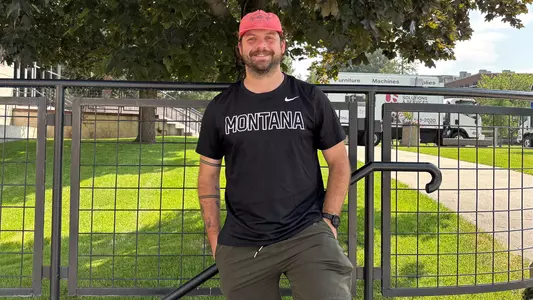
Mark Linnville is just living the dream
7/23/2026 6:06:00 PM | Soccer
He's a product of the mountains, Ivy League educated, with a degree in religion, the perfect major for an inquisitive mind, drawn to soccer early on because beyond the winning and the losing, the physical effort required, the camaraderie among teammates, it just wasn't like the other sports.
He fit the classic mold, the three-sport athlete, soccer in the fall, basketball in the winter, baseball in the spring in western North Carolina, the oldest of five of Ric and Barbara, the former having run the sprints for the Florida Gators back in his day, genes that led three-fifths of his children to college athletics.
Baseball became too boring, basketball too rigid, too defined, the coaches on the sideline acting as puppeteers, the players their marionettes, doing what the coach wanted, not reacting to what they saw happening on the court. He desired space, freedom, a little self-determination.
"The thing I love about soccer and the reason I started to focus on it more and more is I view it as a players' game. Every other sport, you're coached on almost every single part of the game. Soccer felt like solving puzzles on the fly," he says.
"Coaches can give frameworks, put you through drills, but at the end of the day you have to adjust to how you see things on the field. Every single moment can lead to something else and it's yours to figure out on your own. That made me want to lean in."
And why Mark Linnville stayed connected to the sport, after graduating from Princeton in the spring of 2013, after getting drafted by MLS's Philadelphia Union, after working in New York City for a hedge fund, then Nashville for a construction financial technology startup.
Why he started coaching the Vanderbilt women's soccer club team on the side, then club teams in Nashville, all while playing in adult leagues every chance he got. The sport had become part of him.
And now he's working with the Montana Grizzlies, this no-ego coach getting on board shortly after Stuart Gore was hired in February, the fourth member of a staff that includes Gore, associate head coach J. Landham and assistant coach Amanda Attanasi.
These days he works for a health-care tech startup that's headquartered in New York City but allows Linnville to work remotely, so last winter, after a number of reconnaissance trips to Missoula over the years, he rented a U-Haul trailer and headed west.
Missoula would be his new home, the Montana soccer team his new extended family.
"First and foremost, Stu, J. and Amanda are awesome. The program is in super great hands with all three of them," he says. "I like to think I fit in as the puzzle piece that can adjust accordingly for what needs to happen.
"I want to help in whatever way I can. What does Stu need? What does J. need? What does Amanda need in order to keep this a winning program and make this season awesome? It's going to be fun to see what we can build here."
North Carolina has a thriving soccer culture, but it tends to dissipate as one moves west from the urban hubs of Charlotte and Greensboro, up into the mountains, to places like Boone, where Linnville was raised.
But he had the good fortune of befriending Jennings Rex, whose dad, Art, a professor at Appalachian State, was a two-time All-American at Slippery Rock and for 17 years also was the head coach of App State's men's soccer team, three times earning Southern Conference Coach of the Year honors.
The saying rang true: Show me your friends and I'll show you your future. Ashley Rex would go on to play at UNC Charlotte, as would Jennings. The family's other daughter, Cassie, played at Wofford.
"He invested a lot of time into us, coached us when we were young. Sixth, seventh, eighth grade, Boone was getting too small for us. We need to play off the mountain. That's what we used to say," says Linnville, who joined a club team in Charlotte, then Greensboro for his high school years.
But Princeton? After spending his freshman and sophomore years at Watauga High in Boone, he finished his prep studies at North Carolina School of Science and Mathematics, boarding at the Durham-based school, the type of place that jumps off the page of a college applicant.
"It's one of the top-ranked academic schools in the country," says Linnville, who wasn't thinking the Northeast for college, home of the Ivy League's eight schools. "I think my mom sent my resume to a bunch of the Ivy schools without me knowing about it."
And when they showed interest, how could he not at least listen? "It became one of those things where if I could leverage good grades and soccer into a school where I could do both, it felt like a no-brainer."
On the field? All he did at Princeton was make first-team All-Ivy League as a center back all four years, at the time only the eighth player in league history to pull off such a four-peat.
He didn't miss a match over four seasons, starting all 69 the Tigers played from 2009 to '12, going to the NCAA tournament as a freshman and sophomore, totaling four goals and 13 assists for his career.
He arrived with dreams of going pre-med, then quickly came face-to-face with organic chemistry, Ivy League edition. That, plus the way soccer was gaining traction in the U.S. had him thinking four years of school would be good enough, because who knew where soccer might one day take him.
He opted to major in religion, not the type taught and studied on campus at Princeton Theological Seminary but the more generic version, where he could explore, mix and match different disciplines, degree path as soccer field. What would happen if I tried this? And then this?
"A religion degree is interesting. It's not theology, per se, more overarching. It was an opportunity for me to combine a lot of things I'm interested in. Philosophy and religion. Anthropology and religion. Politics and religion. I was able to jump into a number of different disciplines," he says.
He remembers sitting on his couch that late January day in 2013, three months after his senior season concluded, refreshing his screen on the site covering the ongoing MLS Supplemental Draft. In the second round, with the 24th overall pick, he was selected by the Philadelphia Union.
(If he kept refreshing, he later would have seen Jennings Rex get picked in the same draft, 73rd overall by the Seattle Sounders, quite a return on Art Rex's investment all those years ago on the fields of Boone.)
The Union's coaches called. They wanted him in Philadelphia for training camp. Meanwhile, he was in his final semester at Princeton, the two places just 45 miles but worlds apart, one the cutthroat setting of professional sports, one the nurturing but still competitive environment of an elite academic school.
Back and forth he went, trying to make the team, trying to finish his degree. The decision was made for him when he injured his hamstring in training camp. What to do? "Why did I go to Princeton? I went to Princeton to get a degree," he said, putting an end to his pursuit of professional soccer.
There is a well-worn path between Princeton, New Jersey, and New York City by new graduates ready to get on with life, to test themselves, to put their degrees to use. Linnville did the same thing, staying with friends, going from couch to couch as he applied for jobs.
Finally, Bridgewater Associates, today the world's largest hedge fund, called Linnville in and offered him one of two jobs, manager within their IT group or in recruiting. He chose the latter.
"To be good at recruiting, you have to understand people really well, you have to understand the business super well and you have to be really good operationally, because you're going to have to solve problems you haven't solved before. Perfect place for me to jump in," he says.
He was there eight years, then in Nashville for three, during which time he began making trips to Missoula, the feeling of Boone without moving back home.
"I moved because I wanted to get closer to the mountains in general. Do I move back to North Carolina or do I want to have one more adventure? I've been coming to Missoula the last four years vacationing and hanging out. I really fell in love with it," he says.
"When things aligned, I packed up a five-by-three U-Haul, attached it to my truck and drove on out. Seemed like a really good community to jump into and try to become a part of."
When he looked into the Montana soccer program before hitching trailer to truck and leaving Nashville in the rearview mirror, he saw one head coach was gone, the next yet to be hired. All that was left holding things down was Landham. So, he emailed him.
"Culturally as well as soccer-wise, we had a real mind meld," says Linnville, whose East Coast work schedule has him on his computer most days by 5 a.m., managing his team of 20 through group and one-and-one meetings.
It also will give him the flexibility to be at South Campus Stadium for most of Montana's practices this season.
"When you see his background from a playing standpoint, the fact he was a captain at Princeton, got drafted, he has the pedigree to be able to come in and help us," said Gore.
"As a center back, you're an organizer, you're a talker. He's very good at relaying information to the center backs and working with them. He's a super smart guy but has a very Montana vibe when you speak to him."
One of the things Linnville loved about his choice of majors was that he was one of maybe a dozen at Princeton pursuing the same thing. That kept things small, with all voices heard, a mutual experience.
He's found the same thing on Gore's staff. "It's a very democratic type of training atmosphere," he says. "If you have something to say, you go ahead and say it. It's very collaborative.
"I just want to be around the game and see the team succeed. It's a unique opportunity to be around a program that is going through what this one is. There is a lot of opportunity to imprint culture and really see strides quickly."
He fit the classic mold, the three-sport athlete, soccer in the fall, basketball in the winter, baseball in the spring in western North Carolina, the oldest of five of Ric and Barbara, the former having run the sprints for the Florida Gators back in his day, genes that led three-fifths of his children to college athletics.
Baseball became too boring, basketball too rigid, too defined, the coaches on the sideline acting as puppeteers, the players their marionettes, doing what the coach wanted, not reacting to what they saw happening on the court. He desired space, freedom, a little self-determination.
"The thing I love about soccer and the reason I started to focus on it more and more is I view it as a players' game. Every other sport, you're coached on almost every single part of the game. Soccer felt like solving puzzles on the fly," he says.
"Coaches can give frameworks, put you through drills, but at the end of the day you have to adjust to how you see things on the field. Every single moment can lead to something else and it's yours to figure out on your own. That made me want to lean in."
And why Mark Linnville stayed connected to the sport, after graduating from Princeton in the spring of 2013, after getting drafted by MLS's Philadelphia Union, after working in New York City for a hedge fund, then Nashville for a construction financial technology startup.
Why he started coaching the Vanderbilt women's soccer club team on the side, then club teams in Nashville, all while playing in adult leagues every chance he got. The sport had become part of him.
And now he's working with the Montana Grizzlies, this no-ego coach getting on board shortly after Stuart Gore was hired in February, the fourth member of a staff that includes Gore, associate head coach J. Landham and assistant coach Amanda Attanasi.
These days he works for a health-care tech startup that's headquartered in New York City but allows Linnville to work remotely, so last winter, after a number of reconnaissance trips to Missoula over the years, he rented a U-Haul trailer and headed west.
Missoula would be his new home, the Montana soccer team his new extended family.
"First and foremost, Stu, J. and Amanda are awesome. The program is in super great hands with all three of them," he says. "I like to think I fit in as the puzzle piece that can adjust accordingly for what needs to happen.
"I want to help in whatever way I can. What does Stu need? What does J. need? What does Amanda need in order to keep this a winning program and make this season awesome? It's going to be fun to see what we can build here."
North Carolina has a thriving soccer culture, but it tends to dissipate as one moves west from the urban hubs of Charlotte and Greensboro, up into the mountains, to places like Boone, where Linnville was raised.
But he had the good fortune of befriending Jennings Rex, whose dad, Art, a professor at Appalachian State, was a two-time All-American at Slippery Rock and for 17 years also was the head coach of App State's men's soccer team, three times earning Southern Conference Coach of the Year honors.
The saying rang true: Show me your friends and I'll show you your future. Ashley Rex would go on to play at UNC Charlotte, as would Jennings. The family's other daughter, Cassie, played at Wofford.
"He invested a lot of time into us, coached us when we were young. Sixth, seventh, eighth grade, Boone was getting too small for us. We need to play off the mountain. That's what we used to say," says Linnville, who joined a club team in Charlotte, then Greensboro for his high school years.
But Princeton? After spending his freshman and sophomore years at Watauga High in Boone, he finished his prep studies at North Carolina School of Science and Mathematics, boarding at the Durham-based school, the type of place that jumps off the page of a college applicant.
"It's one of the top-ranked academic schools in the country," says Linnville, who wasn't thinking the Northeast for college, home of the Ivy League's eight schools. "I think my mom sent my resume to a bunch of the Ivy schools without me knowing about it."
And when they showed interest, how could he not at least listen? "It became one of those things where if I could leverage good grades and soccer into a school where I could do both, it felt like a no-brainer."
On the field? All he did at Princeton was make first-team All-Ivy League as a center back all four years, at the time only the eighth player in league history to pull off such a four-peat.
He didn't miss a match over four seasons, starting all 69 the Tigers played from 2009 to '12, going to the NCAA tournament as a freshman and sophomore, totaling four goals and 13 assists for his career.
He arrived with dreams of going pre-med, then quickly came face-to-face with organic chemistry, Ivy League edition. That, plus the way soccer was gaining traction in the U.S. had him thinking four years of school would be good enough, because who knew where soccer might one day take him.
He opted to major in religion, not the type taught and studied on campus at Princeton Theological Seminary but the more generic version, where he could explore, mix and match different disciplines, degree path as soccer field. What would happen if I tried this? And then this?
"A religion degree is interesting. It's not theology, per se, more overarching. It was an opportunity for me to combine a lot of things I'm interested in. Philosophy and religion. Anthropology and religion. Politics and religion. I was able to jump into a number of different disciplines," he says.
He remembers sitting on his couch that late January day in 2013, three months after his senior season concluded, refreshing his screen on the site covering the ongoing MLS Supplemental Draft. In the second round, with the 24th overall pick, he was selected by the Philadelphia Union.
(If he kept refreshing, he later would have seen Jennings Rex get picked in the same draft, 73rd overall by the Seattle Sounders, quite a return on Art Rex's investment all those years ago on the fields of Boone.)
The Union's coaches called. They wanted him in Philadelphia for training camp. Meanwhile, he was in his final semester at Princeton, the two places just 45 miles but worlds apart, one the cutthroat setting of professional sports, one the nurturing but still competitive environment of an elite academic school.
Back and forth he went, trying to make the team, trying to finish his degree. The decision was made for him when he injured his hamstring in training camp. What to do? "Why did I go to Princeton? I went to Princeton to get a degree," he said, putting an end to his pursuit of professional soccer.
There is a well-worn path between Princeton, New Jersey, and New York City by new graduates ready to get on with life, to test themselves, to put their degrees to use. Linnville did the same thing, staying with friends, going from couch to couch as he applied for jobs.
Finally, Bridgewater Associates, today the world's largest hedge fund, called Linnville in and offered him one of two jobs, manager within their IT group or in recruiting. He chose the latter.
"To be good at recruiting, you have to understand people really well, you have to understand the business super well and you have to be really good operationally, because you're going to have to solve problems you haven't solved before. Perfect place for me to jump in," he says.
He was there eight years, then in Nashville for three, during which time he began making trips to Missoula, the feeling of Boone without moving back home.
"I moved because I wanted to get closer to the mountains in general. Do I move back to North Carolina or do I want to have one more adventure? I've been coming to Missoula the last four years vacationing and hanging out. I really fell in love with it," he says.
"When things aligned, I packed up a five-by-three U-Haul, attached it to my truck and drove on out. Seemed like a really good community to jump into and try to become a part of."
When he looked into the Montana soccer program before hitching trailer to truck and leaving Nashville in the rearview mirror, he saw one head coach was gone, the next yet to be hired. All that was left holding things down was Landham. So, he emailed him.
"Culturally as well as soccer-wise, we had a real mind meld," says Linnville, whose East Coast work schedule has him on his computer most days by 5 a.m., managing his team of 20 through group and one-and-one meetings.
It also will give him the flexibility to be at South Campus Stadium for most of Montana's practices this season.
"When you see his background from a playing standpoint, the fact he was a captain at Princeton, got drafted, he has the pedigree to be able to come in and help us," said Gore.
"As a center back, you're an organizer, you're a talker. He's very good at relaying information to the center backs and working with them. He's a super smart guy but has a very Montana vibe when you speak to him."
One of the things Linnville loved about his choice of majors was that he was one of maybe a dozen at Princeton pursuing the same thing. That kept things small, with all voices heard, a mutual experience.
He's found the same thing on Gore's staff. "It's a very democratic type of training atmosphere," he says. "If you have something to say, you go ahead and say it. It's very collaborative.
"I just want to be around the game and see the team succeed. It's a unique opportunity to be around a program that is going through what this one is. There is a lot of opportunity to imprint culture and really see strides quickly."
Monday, October 12
Monday, October 12
Saturday, October 10
Tuesday, October 06