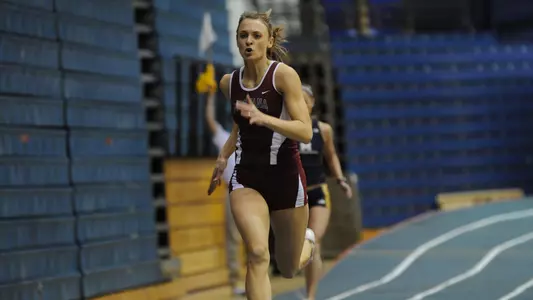
The Hall of Famers :: Loni Perkins-Judisch
9/4/2026 7:33:00 PM | General, Women's Track and Field
It's where roots run deep, literally, figuratively, people, ranchers and farmers mostly, grounded to place by family, by history. It's a generational thing, at odds with its greater surroundings, a world that is changing, shifting, where freedom of movement and upward mobility are championed.
It's a simple life made complex by important variables largely beyond their control, mostly the weather, bringer of sun, of rain, of snow, hopefully in the right amounts at the right time of the year. Patience isn't just a virtue, it's required: plant, pray, reap, repeat. Nothing is on-demand.
It leads to people who are gentle in spirit, giving by nature, tough as hell, bodies strengthened by the work, then broken down over the decades by those same demands, where community is everything, often the difference between life and death, where isolation can be more than a person can handle.
It's a good life, the best, but it's not for everyone. But it is for her. Always has been, always will be.
"I wasn't a full-on ranch kid but I always loved the ranch lifestyle," says Loni Perkins-Judisch, who will be inducted into the Grizzly Sports Hall of Fame on Friday, Sept. 11, making her way back to Missoula from her family's spot northeast of Conrad, where she lives with her husband, Ross, and three children.
"There has to be someone who feeds America. We produce excellent beef. My brother feeds America with his crops. It's a servant-type attitude and you want to keep it going from generation to generation. It's bred into you. You don't want to be the generation that ends it. You want to pass it on."
Roots that run deep? Her great-grandfather, Ira, began teaching at the Bynum School, southwest of Conrad, in 1933, believing if he could send a kid into the world who could read, do arithmetic and think critically, he had done his job. He would spend 53 years at the school.
In 1939 he added a second title: rancher, starting with 80 acres, Perkins Ranch later expanding to 17,000 that had a footprint in three counties, Perkins Road still bisecting the main highway that runs by Bynum and takes one to Conrad, to Ledger, to Judisch Road, families connected to land over generations.
Perkins Road and Judisch Road are both dirt, of the earth, nothing unnatural coming between foot and ground, ground around Conrad she would learn to cover like few others in Montana history, seven times winning the Big Sky Conference title in the 400 meters, collecting a dozen gold medals in all.
She became a Grizzly Sports Hall of Famer despite competing mainly on dirt tracks throughout her high school career, despite having to train not in spandex but Carhartt when she returned home between semesters, despite choosing the race that guaranteed one thing and one thing only: pain.
"It speaks to the character of Loni. She's a special individual because she had that type of mentality and she wasn't afraid of hard work," says Brian Schweyen, who was an assistant coach at Montana when Perkins-Judisch was competing for the Grizzlies.
"She didn't make excuses or find reasons to not do something. She always found a way to do it."
She was built for the quarter mile – "5-9-ish but she ran like she was six-foot and all legs. She made it look effortless," says Schweyen – and conditioned for the stark brutalness of the event. You, me, first one around the track and back to this spot wins.
It's raw and offers nowhere to hide, no out. Just get it done. Ranch life, anyone?
"There is a lot of dread that goes into it," she admits even today. "You try to lean into that dread because once you're in the blocks, you're not escaping where you're at. You have to decide: Am I going to get out of these blocks or am I going to be scared?
"You could start out afraid and not start out fast and it will still hurt at the end, so what's the point of that? Get out quick like it's the 200, hold that speed you built, the more relaxed the better. I tried to look like I wasn't in pain. I was very much in pain. I was in all the pain. It's gutsy, the 400."
The girl who would become the champion, the Hall of Famer, the ranch wife and mother today, is the daughter of two UM graduates, Rock returning to his roots, the family always tethered to the Perkins Ranch despite spending time in Great Falls, Billings, moving where banking jobs took him.
No matter where she lived, it was always calling her home.
"I always had that ranching background, helping with the branding, messing around the place as kids. I really identified with that rural background," she says, then starts telling the type of stories that leave you thinking, yeah, that sounds about right. I can see that.
"I was a fiery, active, wild child, especially for a girl. I had a little more adventurous side to me." Trees were meant for climbing, no matter how tall, roofs were meant to be climbed atop of, the view admired, trampolines were used to break falls as much as they were for bouncing and doing flips.
The scene: Her aunt's house. The window: Second story. The trampoline: Positioned right below. The result: A conga line, led by Loni, going into the house, jumping to the trampoline below and doing it all over again until her aunt figured out what was happening and glued the window shut.
Bodies weren't made for being protected and looked after as much as being vehicles for fun, so no one thought much about it the day she fell from a tree, landed on her backside, shook it off and went about playing some more, oblivious to the fact that she had just suffered a pars fracture of her spine.
Rock and Janeil met at the University of Montana, he there to study finance with a side of music, her also into music, both going to Europe one semester, the Vienna Experience with UM's Chamber Chorale, falling for each other, graduating and moving east, to his home grounds.
He helped keep the ranch on solid financial footing while working as an ag-business loan officer, the family finally maxing out at four kids – girl, girl (Loni), girl, boy – living in Great Falls, then back near Bynum, then twice to Billings for a year each time.
It wasn't until she was in sixth grade that the family finally settled in Conrad, giving the "Loni Perkins-Conrad" entry that would often show up in first place in track and field results its start. "It was nice to be a little bit more grounded after moving around a bunch," she says.
She was attending Bynum School in second grade when she came to realize, you know what? I'm pretty fast, as all the tiny schools in the area would gather and hold all-class races, shoes tossed to the side because barefoot in the grass just felt faster. It was only two fifth-grade boys who were swifter.
Then the family was off to Billings to live, where three times around Arrowhead School equaled a mile and she was still hanging with the top boys. And this was Billings! Wow, I'm beating people here, too, she thought.
To draw a straight line from there to the Grizzly Sports Hall of Fame, like there was nothing to it, no hardships, no time in junior high when this late-bloomer thought maybe track and field wasn't for her, no injuries that threatened to derail this entire story, would be to miss the most inspirational pieces.
"Was I fast in junior high? Yes, but I wasn't winning everything. Other girls were getting stronger before me," she says. "I could have decided, this isn't my thing, but I kept at it."
The coach who would witness her win seven golds at the 2002 Class B state meet as a junior at Conrad – the 100, 200 and 400, the long and high jumps, both relays, 55 points from one person – was the same one who noticed something special in the kid who had the doubts when she was in junior high.
"She did some good things as an eighth grader," Jim Carroll told the Great Falls Tribune in 2003. "You could see right away that she had good potential, but it would take a couple of years (to develop). The groundwork didn't happen overnight.
"Loni has natural ability but she has worked too. She works hard. She is very disciplined."
It's the only way to survive as a track and field athlete in that part of Montana. Most every track she competed on was dirt. Cut Bank had a rubber track but also winds that saved their 60-mile-per-hour gusts for meet days, seemingly always with some sideways-blowing snow added in just for fun.
"I don't know if I ever really got a time that was indicative of what I could do, so my dad said, hey, let's do this Junior Olympic thing," she says, traveling to Bozeman as an eighth grader and taking first in the 400 in nothing fancier than shorts and t-shirt, then going to regionals in Wyoming and winning there.
Then breaking 60 seconds on Cut Bank's track as a freshman in high school, which had college track and field programs mobilizing their recruiting efforts – mailing destination: Conrad, MT – which had Rock putting his numbers-based mind into overdrive, trying to put it in perspective for his daughter.
"Whoa, that's only a couple seconds slower than what they're running in college. My dad really started getting into it. He loved numbers, so he would calculate, how many inches per step would I have to increase to get a certain time?" she says.
"It was really encouraging. At the house is you. At the barn is where they'd be finishing. You have to make that distance up to be a collegiate runner. In my mind, I thought, that's what I'm going to do."
Her wins at the Junior Olympic level had for the first time gifted her actual medals instead of ribbons, signifying the weightiness of those accomplishments, and it had lit the pilot light on a confidence that she would run with through her final race at regionals as a Grizzly.
As a freshman at Conrad, it took Fairfield's Angela Ostberg running a Class B record in the 400 meters to hold off Perkins, who finished second in 58.11, while tying for second in the high jump and placing fifth in the 200.
When Perkins was a sophomore, it took Ostberg again running a Class B record to better Perkins' second-place 57.33, but it was clear the speedster from Conrad was coming, if only her body would hold up.
Her ankles, shins and quads may as well have come with a warning sign, so susceptible were they to getting injured her first two years of high school, perhaps payback for all those adventures of her youth or maybe just her rigorous track and field training plan, coming after volleyball and basketball seasons.
The summer after her sophomore year, she headed to Bozeman for an injury-prevention camp run by Clete Linebarger, a chiropractor and cousin of Ross Judisch. She spent three weeks there going through two-a-days of body-weight exercises, running in sand, throwing logs in the air, primal stuff.
Good stuff, exactly what she needed.
In the past, when the high school track season was done, she was done, ready to start whatever summer might have in store. This was the first time she had put in focused off-season work, and she felt the benefits immediately. And the state of Montana would hardly be able to believe what she'd do with it.
As a junior, at the 2002 Class B meet in Missoula, Perkins swept the sprints, setting a new all-class record of 55.99 in the 400, scoring enough points (55) that she would have defeated second-place Townsend by herself.
Montana High School Association rules would not have allowed her to score more points or golds than she did, maxing out at 55 with seven wins, the first female in state history to do so.
"I never really thought about it," she told the Great Falls Tribune in 2003, before winning six more titles as a senior, including crushing her own 400 record with a time of 54.62. "It was just something that happened. They were nice days. I felt perfect."
Today she adds, "Credit to Coach Carroll for having such tough interval workouts that got us in shape. Not sure other towns were in as good shape as we were." Conrad won team titles in both 2002 and '03, when Perkins was a junior and senior and doing some heavy lifting in the scoring column.
Schools across the country noticed and wanted her, including Harvard and other Ivies. "Oh, heck no, but thanks for thinking I'm that smart," she says today with a laugh at the memory. Washington State offered a full-ride scholarship, Nebraska nearly matched it. Arizona State wanted her, Iowa State.
But it hadn't been their schools that had her glued in place in front of the family television, all by herself, watching Montana play for a national championship in 1995, partly for the game, partly to think she might spot her dad, who had traveled to West Virginia to watch his Grizzlies win 22-20.
"I watched the whole thing by myself. I felt like such a Griz fan," she says, opening the door for Montana when then head coach Tom Raunig dialed up Perkins on the first day he could, catching the future Grizzly at her grandma's house, cleaning away. Yeah, I'm very interested, she told him.
"I liked the Nike sponsorship, I'm not going to lie. I thought their uniforms looked cool," she says. But it went deeper than that, of course. "I'm a Montana kid and being comfortable was huge for me. People come from all over to visit here. It's the best place there is. I wouldn't have changed it."
She committed and Montana's rivals all thought, this isn't good.
"She was a great get. We knew how good a get she was," says Schweyen. "She didn't need to chase anything. She was completely comfortable with herself, with her surroundings and confident enough to know that she could be who she was anywhere.
"She didn't need to chase what a lot of people think they need to chase. We were the lucky ones for her having that perspective."
The track and field program at the time was getting by but had no chance to maximize its potential, not without a decent place for its sprinters to train. The fall was fine but once the snow started to land and pile up, everyone had to get a little creative, which is a kind way of saying, they had to do what?
"We never really felt in shape during the indoor season," says Perkins-Judisch. "We did a lot of stadium stairs in the Adams Center. It was really hard. We struggled to stay in shape."
If the weather allowed for it, a lane on the outside track at Dornblaser Field would be blown clear, though patches of ice might remain. But if they had a lane and it was 20 degrees or warmer, that's where they trained for the – ahem – indoor season.
"Nobody is going to be running their best at 20 degrees," Perkins-Judisch said. "We did what we could. The coaches did what they could."
One place Perkins-Judisch won't be visiting during her time on campus next weekend will be Schreiber Gym, from which she almost ended up with no Big Sky titles and no Hall of Fame induction ceremony to prepare for.
Remember, she still had the pars defect, which can be brought on by overuse, sports, genetics … or falling out of trees. She had become a sought-after athlete even so, though the 150-meter banked track inside Schreiber had her and her sprinting teammates playing a high-stakes game of chicken.
They would challenge the combination of workout and venue until they had survived or catastrophe hit or something in between. It would be more about getting through than anything, a necessary evil with potential consequences, hardly any of them good.
"I remember the point (my back) got worse," she says. "That tiny little track was banked like NASCAR, like a bowl. There is a difference between jogging on a track like that and trying to sprint full force. When you add that force, it's much more body-weight pressure on yourself, your joints, your back."
Her teammates immediately headed for the ice, for their knees, their shins. Hers was more than just a little extra wear and tear. "After that workout, I felt little spasms going up my back." It would only get worse, until she had to face a dire question: Would she ever be able to run again? It was that bad.
When most of her teammates opened the 2004 indoor season at Montana State, a handful of Grizzlies headed to Seattle for a massive meet put on by the University of Washington. Five top-20 teams, more than 1,000 athletes, cheered on by more than 1,000 spectators.
It's the kind of event that brings out the best in an athlete. Racing in the first heat, alongside two athletes from Stanford, one from UCLA and one from BYU, Perkins ran a 59.98, finishing more than two seconds behind the rest of the small heat.
Something clearly wasn't right. The 54.62 she ran at the Class B state meet eight months prior would have won the race at Washington over its 33-athlete field. She was older, ready to run faster but couldn't.
She took the next week off, then looked like her normal self in mid-February in Bozeman. In her second collegiate 400, she ran a 56.30. All of a sudden, she was the favorite to win the Big Sky indoor title in the 400 as a freshman, the championship scheduled for two weeks later, also at Montana State.
All was right in the world. Finally. At least it looked that way from the outside.
She traveled to Bozeman, even warmed up for the 400 preliminaries but she couldn't get to the start line. Running at speed was fine but coming out of the blocks and slowing to a stop were excruciating and too much for her to bear. The title-winning time the next day ended up being 56.39.
"I was a tough girl trying to tough it out," she said, and if you've experienced debilitating back issues, you'll know what she was fighting through when x-rays revealed she had her original break plus two new ones, brought on by the banked track inside Schreiber.
The first specialist she went to in Missoula brought her worst nightmare as an athlete to the forefront, right into the open. There was no way around it. If they did surgery, she would never be able to run again.
"I remember thinking, what a tragedy if she can never run again. But I also remember thinking, whatever is best for her long-term future," said Schweyen.
"The most unfortunate thing in her career was the inability of her body to be on board with her mind. She was a tough one. She battled a lot of unfortunate things but she never complained about them."
By the time she arrived in Seattle for a second opinion, it had been a few months and, remarkably, her body, specifically her back, had begun the process of healing itself. An x-ray showed the progress, this Angel of Hope disguised by a white lab coat, saying, don't do surgery, you're going to be fine.
There was no flip to switch. She had to embrace the rancher's ways, of patience and trust that things are happening below the surface and that it's just going to take time and that a bountiful harvest of bushels of gold medals would one day pop through the surface and be the reward.
She wore a back brace, more as a reminder not to do anything silly, like climb a tree or jump out of a second-story window, took elevators when she could and did nothing more than walk for eight months, then started water-jogging, then … then … then? Let's go, Loni, what are you waiting for? You're clear.
"I maybe didn't need as long a break as I took, but I didn't feel ready for the longest time," she says. "I wasn't mentally prepared. The mental aspect of sprinting is huge. Your brain tells you, stop, you can't do that. You have to fight the voice that tells you that you can't."
While she didn't miss the 2004 indoor season, she didn't get to compete for a championship. She then sat out the 2004 outdoor and 2005 indoor seasons, finally getting cleared for the 2005 outdoor season two weeks before that spring's biggest home event, the Al Manuel Invitational.
"It was the first time in a long time I felt a lack of confidence," and who could blame her? "Oh no, I'm not who I was," she says. "I had two weeks to work out. I'd been sitting out for a year, now I'm going to get thrown in and run the 400?"
It's that scenario that still haunts her dreams from time to time, even now, pulled out of current everyday life and told, you're racing, let's go, lace 'em up. She isn't ready in her dreams and she wasn't ready then.
She ran a 56.95 at the Al Manuel and finished second. "Very humbling," she says. Two weeks later she ran 55.16 at Montana State. At the Big Sky outdoor championships in Flagstaff, Perkins raced a 54.33 in the preliminaries, then won gold the next day with a time of 54.64 in finals.
She was also on Montana's Big Sky-winning 4x400 relay team, its fourth-place 4x100 relay team and finished second in the 200 meters, individually scoring nearly 22 points.
Two weeks later, at her first appearance at NCAA regionals, she ran a 53.99 in the 400 preliminaries and the anchor leg of the Grizzlies' relay team. Loni Perkins was Loni again. "Okay, we're back to being an athlete again. There is hope," she says.
That hope was bad news for the rest of the Big Sky, as Perkins took a mostly clear path from there to the Grizzly Sports Hall of Fame.
She would win seven consecutive 400-meter championships between indoor and outdoor, claim the 200 at the indoor championships as a redshirt senior and four times anchor a winning 4x400 relay team, being named Athlete of the Meet at both championships in her final seasons in 2008.
She four times made NCAA regionals in the 400 and three times was part of a regional-qualifying relay team. One time around the track, whether on her own or as part of a team, was just her thing. She had all the necessary goods to make the event her own.
"The 400 is going to hurt. There is no secret. At some point in that race, everything is going to get heavy, everything is going to get hard," Schweyen says.
"If you ever watched her run, she had the most beautiful stride. It was effortless. She knew she couldn't be tight. She knew she couldn't run with anxiety. She ran smooth to conserve her energy so when things got heavy, she still had enough energy."
Schweyen loves his analogies, so he keeps rolling. "You have one gallon of gas when you start. You need a couple of drops to accelerate and attack the ground coming out of the blocks to get up to about 80 percent speed.
"Then you get to what Loni did better than anybody, that nice, comfortable stride. When you're on the backstretch, you need to feel like you're floating, where it's a tiny bit of gas, like cruise control.
"As you get into the back corner, you should have roughly three-quarters of a tank and you start using more because things are starting to get heavy. As you come into the last straight, I want you to still have half a tank of gas, because you're going to need every drop of it.
"Loni was a master at that. She knew how to get to her 80 percent, how to get to her recovery stride that made her look effortless and so smooth and knew when to start working off that gallon and have as much as possible to really accelerate home."
Imagine the burden she carried all those years, of being the favorite, of being the one athlete everyone wanted to take down so they could say, I BEAT LONI. And not just at the conference championships but at every single indoor and outdoor meet.
But champions don't get a day off, not from the expectations they created for themselves, the target they set in place.
Except she never carried that weight. "I always had a light touch on winning," she says. "Even though it felt like life and death, it wasn't. At the end of the day, it's a fun sport. You're blessed to get to do it. I wish I could go back and do it once more at the physical fitness I was."
And if she did, she'd think, oh yeah, I forgot what it was like to be corralled with the other athletes, right before heading to the blocks. Why did I wish this upon myself one more time? Uggghhh!!!
"It's the closest you can get to being nerve-racked out of your mind," she says. "It's a fight-or-flight nervousness. You're tempted to scope out all the other girls who look stronger and taller than you."
That's when she'd start in on her pre-race prayer, when the tension was the thickest, when only the strongest would dare make that walk to the blocks and only the best of them would be back to the finish line before any of the others.
"My prayer was for peace, to have faith that this feeling will subside, that it's just anticipation. You don't need to be afraid," she says. "I've always been a Christian. God could have given me any gift, but he chose to give me this gift and I'll do my best with it."
As dominant as she was in the open 400, there was rarely much drama to her races. She was untouchable at most of Montana's meets. It was the relays, then, that provided some of the best Loni Moments of her career.
Through two legs, Montana might be neck-and-neck with another team, then fall back in the third leg, five meters, 10, maybe 15. Imagine standing next to her, your teammate passing you the baton and a lead, knowing Loni was coming for you.
So, you go out too fast, trying to hold that advantage, only to use more of that gallon of gas than was wise. Now it's the backstretch and Loni is gaining, with those long, graceful strides of hers. The pain has set in way, way too early and you're fading, defeated before you'd even started your leg.
Defeat by reputation, at just the thought of what she might do.
"Watching her in that relay were some of the most impressive races. There is no way, and she would," said Schweyen. "Her teammates had such confidence in her. Everyone knew she was going to overcome whatever deficit there was.
"She would always do it with complete confidence. When you have complete confidence, you're not going to waste energy doing something different. If someone else led, they probably tightened up more than Loni did."
She married her high school sweetheart, Ross Judisch, after her third of five years racing for Montana, Judisch playing football at Montana State until he no longer could. "He was one of those kids who liked to hit as hard as he could every single time," Perkins-Judisch says.
His playing career over before it even had a chance to get going, he joined her in Missoula until his dad, who had lost his hired hand, called him home. The ranch needed him.
She would remain in school, getting dual degrees in fine arts and business administration, the former being a passion since she can remember. "It started out with Bob Ross," she says. "I'd watch him and tell myself, you're going to be an artist someday, so you'd better pay attention.
"When my parents were singing in church for something, I'd be on the floor drawing. Or any time I was waiting for them or on car rides. It was just my pastime."
Beyond the exceptional coach-exceptional athlete connection, it was art that also brought Schweyen and Perkins-Judisch into a tighter bond. She'd bring some of her drawings in and Schweyen, a painter, would give her suggestions, about how the eye is drawn to certain points, how to be a bit better.
"It's the ability to see certain things, no different than an athlete," Schweyen says. "She had the ability to see how a race was going to unfold in her mind, have that image, play it step by step before the gun went off.
"That put her at ease and gave her the confidence to be that effortless, smooth runner because she has the creative mind to see what needs to happen."
Harry Clark was her sprints coach, but it was Schweyen who Perkins-Judisch sought out at a meet, when doubts started to creep in, started to crowd out the confidence. She had to get in line. Schweyen was famous for his 10 seconds with any athlete, from multi-eventers to throwers. That's all it took.
"I've never met a more positive coach. He could really motivate. I'd seek him out if I felt blasé and he would amp me up with a pep talk," says Perkins-Judisch. "You've got this. You've worked hard for this. It would be a waste of your time if you didn't work hard right now and give it your all. He's awesome."
Her final event as a Grizzly was at the NCAA Midwest Regional in Lincoln, Nebraska, in late May 2008. She made it out of prelims for the first time and finished eighth in finals, the top five going to nationals.
She had asked for a one-way ticket, knowing Ross would be there to drive her home, a trip she made in the passenger seat, crying most of the way, that she didn't make nationals, that it was over, that a beloved grandmother had recently passed away. Life, happening.
They would have taken Highway 15, passing Conrad, where all this started to take shape, then driving farther on towards Ledger, where Ross's great-grandfather established the original homestead. The main farming operation is on Judisch Road. They live nearby, around the corner, focused on ranching.
"He knew he'd be a rancher, and I wanted to do that with him too," says Perkins-Judisch, who has a photography business on the side, her artistic outlet of the moment. "It's a lot harder than I thought, a lot more sacrifice but I'd do it again. Like sports taught me, that's life."
They have three children, a son, a junior at Conrad High, a daughter, who's a freshman, and the eight-year-old, the son Loni Perkins-Judisch probably had coming.
"He's more like me. I might find him on top of a tree," she says. "The other day he ran off to go play. When he came back, he said, 'Mom! A rattlesnake was chasing me!' Oh buddy, please don't go that far from the house. He'll be outside for hours. He needs an Apple AirTag."
When she was not yet 10, her parents took the family to Germany, Austria, Switzerland, where they had traveled while in college. In high school it was to Spain and Morocco. She might do something like that again, but it's not a life goal, the roots she's set down nourishing her in just the right ways.
"It's okay to stay humble and stay grounded and work hard," she says, a ranch wife and mother to her core and at times still the athlete who could get around a track faster than anyone else.
"I'll sprint after calves who try to escape when we're trying to move them. I laugh with my husband. That's the only reason I'm a sprinter, to cut those guys off and put them where they're supposed to go. I can sprint here and there and my back doesn't hurt. I stay fit by staying active on the ranch."
There is a question that comes to mind, as Perkins-Judisch prepares to return to Missoula, her induction ceremony taking place across the street from the Grizzly Indoor Practice Facility, with its climate-controlled conditions for the worst of winter and a track that doesn't need to be shoveled.
Just how good could she have been if she'd had that? "For as good as she was, we'd be having a different conversation about how she dominated at the next level," Schweyen says.
But she has no regrets. She had what she considered a gift and she used it to the best of her ability. No reason to focus on what could have been when what was, was pretty fantastic, Hall of Fame-worthy.
"That speaks to the character of Loni. Not many athletes have the mental wherewithal to look at it like she did," said Schweyen, who this week asked former Griz assistant track and field coach Adam Bork what he most remembered about Loni.
"He said, 'Even back then, she was the absolute nicest, kindest person. Still is.' To have people compliment you on what a nice human being you are but then be a fierce competitor, that's a tricky balance. She was the best of both and the best of everything."
It's a simple life made complex by important variables largely beyond their control, mostly the weather, bringer of sun, of rain, of snow, hopefully in the right amounts at the right time of the year. Patience isn't just a virtue, it's required: plant, pray, reap, repeat. Nothing is on-demand.
It leads to people who are gentle in spirit, giving by nature, tough as hell, bodies strengthened by the work, then broken down over the decades by those same demands, where community is everything, often the difference between life and death, where isolation can be more than a person can handle.
It's a good life, the best, but it's not for everyone. But it is for her. Always has been, always will be.
"I wasn't a full-on ranch kid but I always loved the ranch lifestyle," says Loni Perkins-Judisch, who will be inducted into the Grizzly Sports Hall of Fame on Friday, Sept. 11, making her way back to Missoula from her family's spot northeast of Conrad, where she lives with her husband, Ross, and three children.
"There has to be someone who feeds America. We produce excellent beef. My brother feeds America with his crops. It's a servant-type attitude and you want to keep it going from generation to generation. It's bred into you. You don't want to be the generation that ends it. You want to pass it on."
Roots that run deep? Her great-grandfather, Ira, began teaching at the Bynum School, southwest of Conrad, in 1933, believing if he could send a kid into the world who could read, do arithmetic and think critically, he had done his job. He would spend 53 years at the school.
In 1939 he added a second title: rancher, starting with 80 acres, Perkins Ranch later expanding to 17,000 that had a footprint in three counties, Perkins Road still bisecting the main highway that runs by Bynum and takes one to Conrad, to Ledger, to Judisch Road, families connected to land over generations.
Perkins Road and Judisch Road are both dirt, of the earth, nothing unnatural coming between foot and ground, ground around Conrad she would learn to cover like few others in Montana history, seven times winning the Big Sky Conference title in the 400 meters, collecting a dozen gold medals in all.
She became a Grizzly Sports Hall of Famer despite competing mainly on dirt tracks throughout her high school career, despite having to train not in spandex but Carhartt when she returned home between semesters, despite choosing the race that guaranteed one thing and one thing only: pain.
"It speaks to the character of Loni. She's a special individual because she had that type of mentality and she wasn't afraid of hard work," says Brian Schweyen, who was an assistant coach at Montana when Perkins-Judisch was competing for the Grizzlies.
"She didn't make excuses or find reasons to not do something. She always found a way to do it."
She was built for the quarter mile – "5-9-ish but she ran like she was six-foot and all legs. She made it look effortless," says Schweyen – and conditioned for the stark brutalness of the event. You, me, first one around the track and back to this spot wins.
It's raw and offers nowhere to hide, no out. Just get it done. Ranch life, anyone?
"There is a lot of dread that goes into it," she admits even today. "You try to lean into that dread because once you're in the blocks, you're not escaping where you're at. You have to decide: Am I going to get out of these blocks or am I going to be scared?
"You could start out afraid and not start out fast and it will still hurt at the end, so what's the point of that? Get out quick like it's the 200, hold that speed you built, the more relaxed the better. I tried to look like I wasn't in pain. I was very much in pain. I was in all the pain. It's gutsy, the 400."
The girl who would become the champion, the Hall of Famer, the ranch wife and mother today, is the daughter of two UM graduates, Rock returning to his roots, the family always tethered to the Perkins Ranch despite spending time in Great Falls, Billings, moving where banking jobs took him.
No matter where she lived, it was always calling her home.
"I always had that ranching background, helping with the branding, messing around the place as kids. I really identified with that rural background," she says, then starts telling the type of stories that leave you thinking, yeah, that sounds about right. I can see that.
"I was a fiery, active, wild child, especially for a girl. I had a little more adventurous side to me." Trees were meant for climbing, no matter how tall, roofs were meant to be climbed atop of, the view admired, trampolines were used to break falls as much as they were for bouncing and doing flips.
The scene: Her aunt's house. The window: Second story. The trampoline: Positioned right below. The result: A conga line, led by Loni, going into the house, jumping to the trampoline below and doing it all over again until her aunt figured out what was happening and glued the window shut.
Bodies weren't made for being protected and looked after as much as being vehicles for fun, so no one thought much about it the day she fell from a tree, landed on her backside, shook it off and went about playing some more, oblivious to the fact that she had just suffered a pars fracture of her spine.
Rock and Janeil met at the University of Montana, he there to study finance with a side of music, her also into music, both going to Europe one semester, the Vienna Experience with UM's Chamber Chorale, falling for each other, graduating and moving east, to his home grounds.
He helped keep the ranch on solid financial footing while working as an ag-business loan officer, the family finally maxing out at four kids – girl, girl (Loni), girl, boy – living in Great Falls, then back near Bynum, then twice to Billings for a year each time.
It wasn't until she was in sixth grade that the family finally settled in Conrad, giving the "Loni Perkins-Conrad" entry that would often show up in first place in track and field results its start. "It was nice to be a little bit more grounded after moving around a bunch," she says.
She was attending Bynum School in second grade when she came to realize, you know what? I'm pretty fast, as all the tiny schools in the area would gather and hold all-class races, shoes tossed to the side because barefoot in the grass just felt faster. It was only two fifth-grade boys who were swifter.
Then the family was off to Billings to live, where three times around Arrowhead School equaled a mile and she was still hanging with the top boys. And this was Billings! Wow, I'm beating people here, too, she thought.
To draw a straight line from there to the Grizzly Sports Hall of Fame, like there was nothing to it, no hardships, no time in junior high when this late-bloomer thought maybe track and field wasn't for her, no injuries that threatened to derail this entire story, would be to miss the most inspirational pieces.
"Was I fast in junior high? Yes, but I wasn't winning everything. Other girls were getting stronger before me," she says. "I could have decided, this isn't my thing, but I kept at it."
The coach who would witness her win seven golds at the 2002 Class B state meet as a junior at Conrad – the 100, 200 and 400, the long and high jumps, both relays, 55 points from one person – was the same one who noticed something special in the kid who had the doubts when she was in junior high.
"She did some good things as an eighth grader," Jim Carroll told the Great Falls Tribune in 2003. "You could see right away that she had good potential, but it would take a couple of years (to develop). The groundwork didn't happen overnight.
"Loni has natural ability but she has worked too. She works hard. She is very disciplined."
It's the only way to survive as a track and field athlete in that part of Montana. Most every track she competed on was dirt. Cut Bank had a rubber track but also winds that saved their 60-mile-per-hour gusts for meet days, seemingly always with some sideways-blowing snow added in just for fun.
"I don't know if I ever really got a time that was indicative of what I could do, so my dad said, hey, let's do this Junior Olympic thing," she says, traveling to Bozeman as an eighth grader and taking first in the 400 in nothing fancier than shorts and t-shirt, then going to regionals in Wyoming and winning there.
Then breaking 60 seconds on Cut Bank's track as a freshman in high school, which had college track and field programs mobilizing their recruiting efforts – mailing destination: Conrad, MT – which had Rock putting his numbers-based mind into overdrive, trying to put it in perspective for his daughter.
"Whoa, that's only a couple seconds slower than what they're running in college. My dad really started getting into it. He loved numbers, so he would calculate, how many inches per step would I have to increase to get a certain time?" she says.
"It was really encouraging. At the house is you. At the barn is where they'd be finishing. You have to make that distance up to be a collegiate runner. In my mind, I thought, that's what I'm going to do."
Her wins at the Junior Olympic level had for the first time gifted her actual medals instead of ribbons, signifying the weightiness of those accomplishments, and it had lit the pilot light on a confidence that she would run with through her final race at regionals as a Grizzly.
As a freshman at Conrad, it took Fairfield's Angela Ostberg running a Class B record in the 400 meters to hold off Perkins, who finished second in 58.11, while tying for second in the high jump and placing fifth in the 200.
When Perkins was a sophomore, it took Ostberg again running a Class B record to better Perkins' second-place 57.33, but it was clear the speedster from Conrad was coming, if only her body would hold up.
Her ankles, shins and quads may as well have come with a warning sign, so susceptible were they to getting injured her first two years of high school, perhaps payback for all those adventures of her youth or maybe just her rigorous track and field training plan, coming after volleyball and basketball seasons.
The summer after her sophomore year, she headed to Bozeman for an injury-prevention camp run by Clete Linebarger, a chiropractor and cousin of Ross Judisch. She spent three weeks there going through two-a-days of body-weight exercises, running in sand, throwing logs in the air, primal stuff.
Good stuff, exactly what she needed.
In the past, when the high school track season was done, she was done, ready to start whatever summer might have in store. This was the first time she had put in focused off-season work, and she felt the benefits immediately. And the state of Montana would hardly be able to believe what she'd do with it.
As a junior, at the 2002 Class B meet in Missoula, Perkins swept the sprints, setting a new all-class record of 55.99 in the 400, scoring enough points (55) that she would have defeated second-place Townsend by herself.
Montana High School Association rules would not have allowed her to score more points or golds than she did, maxing out at 55 with seven wins, the first female in state history to do so.
"I never really thought about it," she told the Great Falls Tribune in 2003, before winning six more titles as a senior, including crushing her own 400 record with a time of 54.62. "It was just something that happened. They were nice days. I felt perfect."
Today she adds, "Credit to Coach Carroll for having such tough interval workouts that got us in shape. Not sure other towns were in as good shape as we were." Conrad won team titles in both 2002 and '03, when Perkins was a junior and senior and doing some heavy lifting in the scoring column.
Schools across the country noticed and wanted her, including Harvard and other Ivies. "Oh, heck no, but thanks for thinking I'm that smart," she says today with a laugh at the memory. Washington State offered a full-ride scholarship, Nebraska nearly matched it. Arizona State wanted her, Iowa State.
But it hadn't been their schools that had her glued in place in front of the family television, all by herself, watching Montana play for a national championship in 1995, partly for the game, partly to think she might spot her dad, who had traveled to West Virginia to watch his Grizzlies win 22-20.
"I watched the whole thing by myself. I felt like such a Griz fan," she says, opening the door for Montana when then head coach Tom Raunig dialed up Perkins on the first day he could, catching the future Grizzly at her grandma's house, cleaning away. Yeah, I'm very interested, she told him.
"I liked the Nike sponsorship, I'm not going to lie. I thought their uniforms looked cool," she says. But it went deeper than that, of course. "I'm a Montana kid and being comfortable was huge for me. People come from all over to visit here. It's the best place there is. I wouldn't have changed it."
She committed and Montana's rivals all thought, this isn't good.
"She was a great get. We knew how good a get she was," says Schweyen. "She didn't need to chase anything. She was completely comfortable with herself, with her surroundings and confident enough to know that she could be who she was anywhere.
"She didn't need to chase what a lot of people think they need to chase. We were the lucky ones for her having that perspective."
The track and field program at the time was getting by but had no chance to maximize its potential, not without a decent place for its sprinters to train. The fall was fine but once the snow started to land and pile up, everyone had to get a little creative, which is a kind way of saying, they had to do what?
"We never really felt in shape during the indoor season," says Perkins-Judisch. "We did a lot of stadium stairs in the Adams Center. It was really hard. We struggled to stay in shape."
If the weather allowed for it, a lane on the outside track at Dornblaser Field would be blown clear, though patches of ice might remain. But if they had a lane and it was 20 degrees or warmer, that's where they trained for the – ahem – indoor season.
"Nobody is going to be running their best at 20 degrees," Perkins-Judisch said. "We did what we could. The coaches did what they could."
One place Perkins-Judisch won't be visiting during her time on campus next weekend will be Schreiber Gym, from which she almost ended up with no Big Sky titles and no Hall of Fame induction ceremony to prepare for.
Remember, she still had the pars defect, which can be brought on by overuse, sports, genetics … or falling out of trees. She had become a sought-after athlete even so, though the 150-meter banked track inside Schreiber had her and her sprinting teammates playing a high-stakes game of chicken.
They would challenge the combination of workout and venue until they had survived or catastrophe hit or something in between. It would be more about getting through than anything, a necessary evil with potential consequences, hardly any of them good.
"I remember the point (my back) got worse," she says. "That tiny little track was banked like NASCAR, like a bowl. There is a difference between jogging on a track like that and trying to sprint full force. When you add that force, it's much more body-weight pressure on yourself, your joints, your back."
Her teammates immediately headed for the ice, for their knees, their shins. Hers was more than just a little extra wear and tear. "After that workout, I felt little spasms going up my back." It would only get worse, until she had to face a dire question: Would she ever be able to run again? It was that bad.
When most of her teammates opened the 2004 indoor season at Montana State, a handful of Grizzlies headed to Seattle for a massive meet put on by the University of Washington. Five top-20 teams, more than 1,000 athletes, cheered on by more than 1,000 spectators.
It's the kind of event that brings out the best in an athlete. Racing in the first heat, alongside two athletes from Stanford, one from UCLA and one from BYU, Perkins ran a 59.98, finishing more than two seconds behind the rest of the small heat.
Something clearly wasn't right. The 54.62 she ran at the Class B state meet eight months prior would have won the race at Washington over its 33-athlete field. She was older, ready to run faster but couldn't.
She took the next week off, then looked like her normal self in mid-February in Bozeman. In her second collegiate 400, she ran a 56.30. All of a sudden, she was the favorite to win the Big Sky indoor title in the 400 as a freshman, the championship scheduled for two weeks later, also at Montana State.
All was right in the world. Finally. At least it looked that way from the outside.
She traveled to Bozeman, even warmed up for the 400 preliminaries but she couldn't get to the start line. Running at speed was fine but coming out of the blocks and slowing to a stop were excruciating and too much for her to bear. The title-winning time the next day ended up being 56.39.
"I was a tough girl trying to tough it out," she said, and if you've experienced debilitating back issues, you'll know what she was fighting through when x-rays revealed she had her original break plus two new ones, brought on by the banked track inside Schreiber.
The first specialist she went to in Missoula brought her worst nightmare as an athlete to the forefront, right into the open. There was no way around it. If they did surgery, she would never be able to run again.
"I remember thinking, what a tragedy if she can never run again. But I also remember thinking, whatever is best for her long-term future," said Schweyen.
"The most unfortunate thing in her career was the inability of her body to be on board with her mind. She was a tough one. She battled a lot of unfortunate things but she never complained about them."
By the time she arrived in Seattle for a second opinion, it had been a few months and, remarkably, her body, specifically her back, had begun the process of healing itself. An x-ray showed the progress, this Angel of Hope disguised by a white lab coat, saying, don't do surgery, you're going to be fine.
There was no flip to switch. She had to embrace the rancher's ways, of patience and trust that things are happening below the surface and that it's just going to take time and that a bountiful harvest of bushels of gold medals would one day pop through the surface and be the reward.
She wore a back brace, more as a reminder not to do anything silly, like climb a tree or jump out of a second-story window, took elevators when she could and did nothing more than walk for eight months, then started water-jogging, then … then … then? Let's go, Loni, what are you waiting for? You're clear.
"I maybe didn't need as long a break as I took, but I didn't feel ready for the longest time," she says. "I wasn't mentally prepared. The mental aspect of sprinting is huge. Your brain tells you, stop, you can't do that. You have to fight the voice that tells you that you can't."
While she didn't miss the 2004 indoor season, she didn't get to compete for a championship. She then sat out the 2004 outdoor and 2005 indoor seasons, finally getting cleared for the 2005 outdoor season two weeks before that spring's biggest home event, the Al Manuel Invitational.
"It was the first time in a long time I felt a lack of confidence," and who could blame her? "Oh no, I'm not who I was," she says. "I had two weeks to work out. I'd been sitting out for a year, now I'm going to get thrown in and run the 400?"
It's that scenario that still haunts her dreams from time to time, even now, pulled out of current everyday life and told, you're racing, let's go, lace 'em up. She isn't ready in her dreams and she wasn't ready then.
She ran a 56.95 at the Al Manuel and finished second. "Very humbling," she says. Two weeks later she ran 55.16 at Montana State. At the Big Sky outdoor championships in Flagstaff, Perkins raced a 54.33 in the preliminaries, then won gold the next day with a time of 54.64 in finals.
She was also on Montana's Big Sky-winning 4x400 relay team, its fourth-place 4x100 relay team and finished second in the 200 meters, individually scoring nearly 22 points.
Two weeks later, at her first appearance at NCAA regionals, she ran a 53.99 in the 400 preliminaries and the anchor leg of the Grizzlies' relay team. Loni Perkins was Loni again. "Okay, we're back to being an athlete again. There is hope," she says.
That hope was bad news for the rest of the Big Sky, as Perkins took a mostly clear path from there to the Grizzly Sports Hall of Fame.
She would win seven consecutive 400-meter championships between indoor and outdoor, claim the 200 at the indoor championships as a redshirt senior and four times anchor a winning 4x400 relay team, being named Athlete of the Meet at both championships in her final seasons in 2008.
She four times made NCAA regionals in the 400 and three times was part of a regional-qualifying relay team. One time around the track, whether on her own or as part of a team, was just her thing. She had all the necessary goods to make the event her own.
"The 400 is going to hurt. There is no secret. At some point in that race, everything is going to get heavy, everything is going to get hard," Schweyen says.
"If you ever watched her run, she had the most beautiful stride. It was effortless. She knew she couldn't be tight. She knew she couldn't run with anxiety. She ran smooth to conserve her energy so when things got heavy, she still had enough energy."
Schweyen loves his analogies, so he keeps rolling. "You have one gallon of gas when you start. You need a couple of drops to accelerate and attack the ground coming out of the blocks to get up to about 80 percent speed.
"Then you get to what Loni did better than anybody, that nice, comfortable stride. When you're on the backstretch, you need to feel like you're floating, where it's a tiny bit of gas, like cruise control.
"As you get into the back corner, you should have roughly three-quarters of a tank and you start using more because things are starting to get heavy. As you come into the last straight, I want you to still have half a tank of gas, because you're going to need every drop of it.
"Loni was a master at that. She knew how to get to her 80 percent, how to get to her recovery stride that made her look effortless and so smooth and knew when to start working off that gallon and have as much as possible to really accelerate home."
Imagine the burden she carried all those years, of being the favorite, of being the one athlete everyone wanted to take down so they could say, I BEAT LONI. And not just at the conference championships but at every single indoor and outdoor meet.
But champions don't get a day off, not from the expectations they created for themselves, the target they set in place.
Except she never carried that weight. "I always had a light touch on winning," she says. "Even though it felt like life and death, it wasn't. At the end of the day, it's a fun sport. You're blessed to get to do it. I wish I could go back and do it once more at the physical fitness I was."
And if she did, she'd think, oh yeah, I forgot what it was like to be corralled with the other athletes, right before heading to the blocks. Why did I wish this upon myself one more time? Uggghhh!!!
"It's the closest you can get to being nerve-racked out of your mind," she says. "It's a fight-or-flight nervousness. You're tempted to scope out all the other girls who look stronger and taller than you."
That's when she'd start in on her pre-race prayer, when the tension was the thickest, when only the strongest would dare make that walk to the blocks and only the best of them would be back to the finish line before any of the others.
"My prayer was for peace, to have faith that this feeling will subside, that it's just anticipation. You don't need to be afraid," she says. "I've always been a Christian. God could have given me any gift, but he chose to give me this gift and I'll do my best with it."
As dominant as she was in the open 400, there was rarely much drama to her races. She was untouchable at most of Montana's meets. It was the relays, then, that provided some of the best Loni Moments of her career.
Through two legs, Montana might be neck-and-neck with another team, then fall back in the third leg, five meters, 10, maybe 15. Imagine standing next to her, your teammate passing you the baton and a lead, knowing Loni was coming for you.
So, you go out too fast, trying to hold that advantage, only to use more of that gallon of gas than was wise. Now it's the backstretch and Loni is gaining, with those long, graceful strides of hers. The pain has set in way, way too early and you're fading, defeated before you'd even started your leg.
Defeat by reputation, at just the thought of what she might do.
"Watching her in that relay were some of the most impressive races. There is no way, and she would," said Schweyen. "Her teammates had such confidence in her. Everyone knew she was going to overcome whatever deficit there was.
"She would always do it with complete confidence. When you have complete confidence, you're not going to waste energy doing something different. If someone else led, they probably tightened up more than Loni did."
She married her high school sweetheart, Ross Judisch, after her third of five years racing for Montana, Judisch playing football at Montana State until he no longer could. "He was one of those kids who liked to hit as hard as he could every single time," Perkins-Judisch says.
His playing career over before it even had a chance to get going, he joined her in Missoula until his dad, who had lost his hired hand, called him home. The ranch needed him.
She would remain in school, getting dual degrees in fine arts and business administration, the former being a passion since she can remember. "It started out with Bob Ross," she says. "I'd watch him and tell myself, you're going to be an artist someday, so you'd better pay attention.
"When my parents were singing in church for something, I'd be on the floor drawing. Or any time I was waiting for them or on car rides. It was just my pastime."
Beyond the exceptional coach-exceptional athlete connection, it was art that also brought Schweyen and Perkins-Judisch into a tighter bond. She'd bring some of her drawings in and Schweyen, a painter, would give her suggestions, about how the eye is drawn to certain points, how to be a bit better.
"It's the ability to see certain things, no different than an athlete," Schweyen says. "She had the ability to see how a race was going to unfold in her mind, have that image, play it step by step before the gun went off.
"That put her at ease and gave her the confidence to be that effortless, smooth runner because she has the creative mind to see what needs to happen."
Harry Clark was her sprints coach, but it was Schweyen who Perkins-Judisch sought out at a meet, when doubts started to creep in, started to crowd out the confidence. She had to get in line. Schweyen was famous for his 10 seconds with any athlete, from multi-eventers to throwers. That's all it took.
"I've never met a more positive coach. He could really motivate. I'd seek him out if I felt blasé and he would amp me up with a pep talk," says Perkins-Judisch. "You've got this. You've worked hard for this. It would be a waste of your time if you didn't work hard right now and give it your all. He's awesome."
Her final event as a Grizzly was at the NCAA Midwest Regional in Lincoln, Nebraska, in late May 2008. She made it out of prelims for the first time and finished eighth in finals, the top five going to nationals.
She had asked for a one-way ticket, knowing Ross would be there to drive her home, a trip she made in the passenger seat, crying most of the way, that she didn't make nationals, that it was over, that a beloved grandmother had recently passed away. Life, happening.
They would have taken Highway 15, passing Conrad, where all this started to take shape, then driving farther on towards Ledger, where Ross's great-grandfather established the original homestead. The main farming operation is on Judisch Road. They live nearby, around the corner, focused on ranching.
"He knew he'd be a rancher, and I wanted to do that with him too," says Perkins-Judisch, who has a photography business on the side, her artistic outlet of the moment. "It's a lot harder than I thought, a lot more sacrifice but I'd do it again. Like sports taught me, that's life."
They have three children, a son, a junior at Conrad High, a daughter, who's a freshman, and the eight-year-old, the son Loni Perkins-Judisch probably had coming.
"He's more like me. I might find him on top of a tree," she says. "The other day he ran off to go play. When he came back, he said, 'Mom! A rattlesnake was chasing me!' Oh buddy, please don't go that far from the house. He'll be outside for hours. He needs an Apple AirTag."
When she was not yet 10, her parents took the family to Germany, Austria, Switzerland, where they had traveled while in college. In high school it was to Spain and Morocco. She might do something like that again, but it's not a life goal, the roots she's set down nourishing her in just the right ways.
"It's okay to stay humble and stay grounded and work hard," she says, a ranch wife and mother to her core and at times still the athlete who could get around a track faster than anyone else.
"I'll sprint after calves who try to escape when we're trying to move them. I laugh with my husband. That's the only reason I'm a sprinter, to cut those guys off and put them where they're supposed to go. I can sprint here and there and my back doesn't hurt. I stay fit by staying active on the ranch."
There is a question that comes to mind, as Perkins-Judisch prepares to return to Missoula, her induction ceremony taking place across the street from the Grizzly Indoor Practice Facility, with its climate-controlled conditions for the worst of winter and a track that doesn't need to be shoveled.
Just how good could she have been if she'd had that? "For as good as she was, we'd be having a different conversation about how she dominated at the next level," Schweyen says.
But she has no regrets. She had what she considered a gift and she used it to the best of her ability. No reason to focus on what could have been when what was, was pretty fantastic, Hall of Fame-worthy.
"That speaks to the character of Loni. Not many athletes have the mental wherewithal to look at it like she did," said Schweyen, who this week asked former Griz assistant track and field coach Adam Bork what he most remembered about Loni.
"He said, 'Even back then, she was the absolute nicest, kindest person. Still is.' To have people compliment you on what a nice human being you are but then be a fierce competitor, that's a tricky balance. She was the best of both and the best of everything."

Monday, October 12
Monday, October 12
Saturday, October 10
Tuesday, October 06