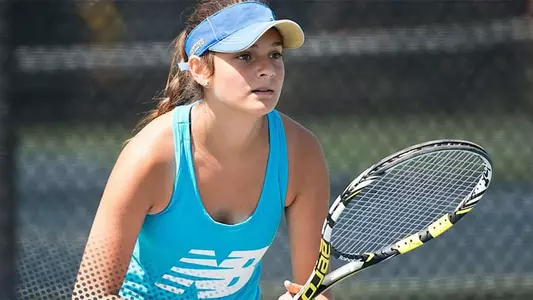
So you want to be a Division I women’s tennis player
6/12/2017 4:01:00 PM | Women's Tennis
Do you really? Because if you're serious, Julia Ronney is here to help by shedding some light on what it will take to turn your daydream into reality. Brace yourself, because it's not for the uncommitted.
And just who is Julia Ronney? For starters, she signed a National Letter of Intent last fall to play for Montana, as did Bianca Bostrom, of Malmo, Sweden, and Eimear Maher, of Newbridge, Ireland. All will join the Grizzlies as freshmen in the fall.
More recently Ronney, based on her results in USTA events, was named Most Improved Player for her age group by the Southern California Tennis Association, an organization that oversees the sport from San Luis Obispo in the north to the U.S.-Mexico border in the south.
That's an area that encompasses, what, maybe 25 of California's 39 million people and produces an even larger percentage of its college athletes?
Not all of them are female, of course. Not all are in Ronney's age group. Not all of them play tennis. But enough of them check those boxes that her Most Improved Player award is a pretty big deal. Actually it's a really big deal and gives added meaning to the sacrifices she's made to become a Division I player.
"The biggest one for teenagers, specifically those who have really big social lives, who go to school, then hang out with friends, and that's all they have to worry about, is that you have to sacrifice your social time," she says.
And Ronney did while being raised in San Diego, which brings with it its own challenges, given her city's attendant distractions. "I wasn't the one going and hanging out at the beach after school. I went from school to tennis to fitness to home for homework."
So, do you still want to be a Division I women's tennis player, with that kind of singular focus? You do? Then there's more. You also need to be willing to take chances and willing to step outside your comfort zone. Way outside. Ronney was willing to do both, and it paid off.
She spent last summer in Ireland, staying with some family friends and living in a country that has an active youth tennis scene and is smaller in size than Indiana, making travel between weekly ITF tournaments a breeze.
Ronney played enough that the Yank was at one point ranked as high as No. 9 in the country. More important than that, she returned home a new player.
"When the whole Ireland opportunity came about, I decided that's where my passion was, so I started working really hard and training every day," she says.
"I had a personal trainer to work on my fitness and strength, and I played every day over the summer. I just had a lot of dedication, and when I came back, I took that same determination into tournaments."
After her return, she started winning. A lot. Her ranking within the Southern California Tennis Association jumped from 115 to 24 in just four months. Thus the Most Improved Player award, which is based on points and the ranking of the people you're beating.
Players she couldn't hang with before were now getting stuck with an L and probably leaving the court wondering whatever happened to the old Julia Ronney.
Of course there are some things that you, Division I women's tennis hopeful, can't fully control.
It didn't hurt that Ronney was born and raised in San Diego instead of Bismarck. Or that her parents, Doug and Karen, were both standout tennis players themselves. Ronney's two older sisters played as well, so it was in her blood, but she didn't have eyes only for tennis until high school.
Early on there was soccer. And gymnastics. And track and field, "but tennis has always been the predominant sport for me," she says. "I've been playing in national tournaments since I was 12 years old. Maybe even 10. It was the family sport, so it was kind of a natural thing.
"But it wasn't until around sophomore year that playing tennis at the collegiate level really became something I wanted to do."
Southern California also offered plenty of role models to choose from -- like painters coming through Delft, themselves artists with instruments, albeit smaller, in their hands -- players who took a similar path that Ronney is on.
Asked about her favorite player, she doesn't go with the expected big-name pro, and that's instructive. Instead she picks Nicole Gibbs, a SoCal product who won both NCAA singles and doubles titles for Stanford in 2012, becoming one of only three players in history to achieve that double.
Gibbs has reached as high as No. 68 in the world since going professional.
"She's not a very well-known pro, but she is someone I look up to because of how hard she's worked to get to where she is," Ronney says. "She didn't just jump out of juniors to get there. She really worked for every single tournament she played.
"She's been an inspiration, because I can see myself doing the same kind of thing."
And if you still think you want to become a Division I women's tennis player after all of that, know this: The summer after your senior year, a time for most of last-chance this and last-chance that prior to the onset of early adulthood, can't be a last-hurrah celebration of freedom, tennis racket gathering dust.
Instead, there is more work to be done.
Ronney, who plans on studying biology at Montana with a goal of going on to veterinary school, will continue working with her personal trainer three times a week and inking in as many squares on her summer calendar as possible with competitions near and far.
There are the USTA Sectional Championships, a national tournament in Georgia, more tournaments in Southern California in July, including a hard-court nationals qualifier.
Then she will relocate to Missoula, her dreams packed for the 1,300-mile trip. "My goal is to do really well and make a name for Montana. I'd like to really do well in the NCAA tournament," she says.
And if all that sounds like something for you, then maybe you, too, can become a Division I women's tennis player and share in Ronney's anticipation for what's ahead.
Given a scale of one to 10 and asked to rate her level of excitement for her next chapter as a tennis player and in life, she says, "Definitely a 10. I've been excited for this since I signed."
And just who is Julia Ronney? For starters, she signed a National Letter of Intent last fall to play for Montana, as did Bianca Bostrom, of Malmo, Sweden, and Eimear Maher, of Newbridge, Ireland. All will join the Grizzlies as freshmen in the fall.
More recently Ronney, based on her results in USTA events, was named Most Improved Player for her age group by the Southern California Tennis Association, an organization that oversees the sport from San Luis Obispo in the north to the U.S.-Mexico border in the south.
That's an area that encompasses, what, maybe 25 of California's 39 million people and produces an even larger percentage of its college athletes?
Not all of them are female, of course. Not all are in Ronney's age group. Not all of them play tennis. But enough of them check those boxes that her Most Improved Player award is a pretty big deal. Actually it's a really big deal and gives added meaning to the sacrifices she's made to become a Division I player.
"The biggest one for teenagers, specifically those who have really big social lives, who go to school, then hang out with friends, and that's all they have to worry about, is that you have to sacrifice your social time," she says.
And Ronney did while being raised in San Diego, which brings with it its own challenges, given her city's attendant distractions. "I wasn't the one going and hanging out at the beach after school. I went from school to tennis to fitness to home for homework."
So, do you still want to be a Division I women's tennis player, with that kind of singular focus? You do? Then there's more. You also need to be willing to take chances and willing to step outside your comfort zone. Way outside. Ronney was willing to do both, and it paid off.
She spent last summer in Ireland, staying with some family friends and living in a country that has an active youth tennis scene and is smaller in size than Indiana, making travel between weekly ITF tournaments a breeze.
Ronney played enough that the Yank was at one point ranked as high as No. 9 in the country. More important than that, she returned home a new player.
"When the whole Ireland opportunity came about, I decided that's where my passion was, so I started working really hard and training every day," she says.
"I had a personal trainer to work on my fitness and strength, and I played every day over the summer. I just had a lot of dedication, and when I came back, I took that same determination into tournaments."
After her return, she started winning. A lot. Her ranking within the Southern California Tennis Association jumped from 115 to 24 in just four months. Thus the Most Improved Player award, which is based on points and the ranking of the people you're beating.
Players she couldn't hang with before were now getting stuck with an L and probably leaving the court wondering whatever happened to the old Julia Ronney.
Of course there are some things that you, Division I women's tennis hopeful, can't fully control.
It didn't hurt that Ronney was born and raised in San Diego instead of Bismarck. Or that her parents, Doug and Karen, were both standout tennis players themselves. Ronney's two older sisters played as well, so it was in her blood, but she didn't have eyes only for tennis until high school.
Early on there was soccer. And gymnastics. And track and field, "but tennis has always been the predominant sport for me," she says. "I've been playing in national tournaments since I was 12 years old. Maybe even 10. It was the family sport, so it was kind of a natural thing.
"But it wasn't until around sophomore year that playing tennis at the collegiate level really became something I wanted to do."
Southern California also offered plenty of role models to choose from -- like painters coming through Delft, themselves artists with instruments, albeit smaller, in their hands -- players who took a similar path that Ronney is on.
Asked about her favorite player, she doesn't go with the expected big-name pro, and that's instructive. Instead she picks Nicole Gibbs, a SoCal product who won both NCAA singles and doubles titles for Stanford in 2012, becoming one of only three players in history to achieve that double.
Gibbs has reached as high as No. 68 in the world since going professional.
"She's not a very well-known pro, but she is someone I look up to because of how hard she's worked to get to where she is," Ronney says. "She didn't just jump out of juniors to get there. She really worked for every single tournament she played.
"She's been an inspiration, because I can see myself doing the same kind of thing."
And if you still think you want to become a Division I women's tennis player after all of that, know this: The summer after your senior year, a time for most of last-chance this and last-chance that prior to the onset of early adulthood, can't be a last-hurrah celebration of freedom, tennis racket gathering dust.
Instead, there is more work to be done.
Ronney, who plans on studying biology at Montana with a goal of going on to veterinary school, will continue working with her personal trainer three times a week and inking in as many squares on her summer calendar as possible with competitions near and far.
There are the USTA Sectional Championships, a national tournament in Georgia, more tournaments in Southern California in July, including a hard-court nationals qualifier.
Then she will relocate to Missoula, her dreams packed for the 1,300-mile trip. "My goal is to do really well and make a name for Montana. I'd like to really do well in the NCAA tournament," she says.
And if all that sounds like something for you, then maybe you, too, can become a Division I women's tennis player and share in Ronney's anticipation for what's ahead.
Given a scale of one to 10 and asked to rate her level of excitement for her next chapter as a tennis player and in life, she says, "Definitely a 10. I've been excited for this since I signed."


Lady Griz Basketball Locker Room Unveiling - 5/1/26
Friday, May 01
Griz Track & Field - Montana Open Highlights - 4/25/26
Friday, May 01
Griz Softball vs. Idaho State Game-Winning Hit - 3/25/26
Friday, May 01
Griz Softball Championship Series Promo
Friday, May 01