Origin Stories :: Reilly Williams
3/29/2019 4:57:00 PM | Softball
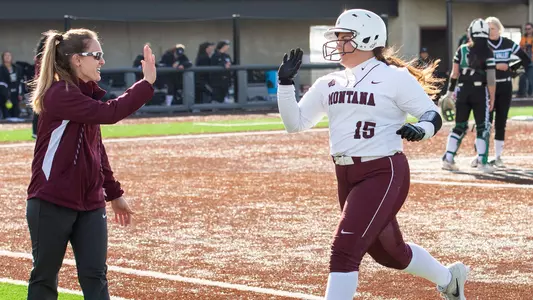
It was a little before 3 p.m. last Saturday when Reilly Williams ascended to nirvana.
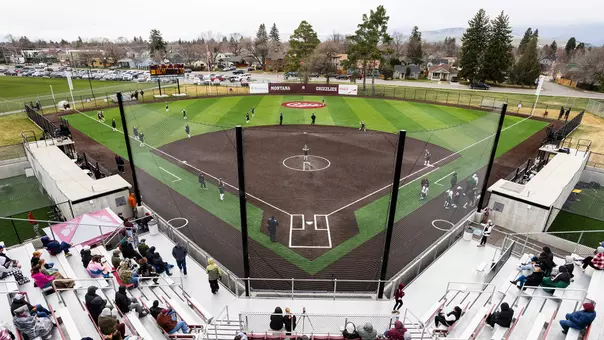
That is, with bat in hand, she walked up the three steps from the home-team dugout to field level at Grizzly Softball Field and strode toward the batter's box.
Montana, which had already won the first two games of the series, was tied with Nevada 3-3, the bases were loaded in the bottom of the seventh and there was one out.
Williams had been called upon to pinch hit.
She took her place in the right-hand box, went through her routine and zeroed in on the upcoming delivery. Everything was right in her world.
"Hitting is my happy place," says Williams, who wasn't born with a bat in her hands but wouldn't have to wait long to find one to start swinging. Her mom, Don Don, is the softball coach at North Idaho College in Coeur d'Alene, has been since she started the program for its debut in the spring of 1998.
Meaning she's cared for it longer than she's cared for her daughter, who came along a few years after the Cardinals played their first game.
This is not a story of free will. While she's been blessed with other talents, notably a singing voice that will give you goosebumps, she was bound to be a softball player. Call it environmental factors.
"When I was growing up, I just developed a passion for it," says Williams, who began traveling with North Idaho to its road games when she was four.
By the time she was six, she wouldn't let the sleeping Cardinals rest, not when the bus they were traveling home on was equipped with a microphone and speaker system and there were NIC cheers to be led from the front.
She's played every defensive position within 60 feet of home plate during her life, but it was always that spot at the plate, as a hitter, that nothing else in the game could quite replicate.
"She just naturally started swinging the bat. And we taught her all the right stuff, so she knows the swing inside and out," says Don Don.
"It's something we've worked really hard on. We've been perfecting her swing her whole life. It's been a lifelong journey for both of us."
So when Williams stepped in last Saturday against Nevada, she was more than prepared for the moment. It's what she'd been trained years and years to do, to make solid contact, to get on base, to advance the runners. To produce.
"When you get that good hit and it's really solid off the bat, it's a feeling that you can't really describe," she says. "You hit it so square on, you couldn't have hit it any better. That's a great feeling to have."
On this day, that great feeling would have to wait. The first pitch she saw landed in front of the plate and got away from the catcher. And home raced Cami Sellers from third with the game-winning run.
Photos that captured the moment show Williams, backed away from the plate, looking stunned.
"When she crossed the plate, I was kind of shocked. It took me a while to realize we'd just won," says Williams. "Yes, it would have been super awesome and cool to get the winning hit, but we won, so I wasn't that sad about it."
That reaction points to something else passed down from mother to daughter that's served the family so well over the years.
Like when Tony and Don Don Williams' made the decision to leave McMinnville, Ore., where they'd been living after graduating as student-athletes themselves at Linfield College, and move to Tony's hometown of Coeur d'Alene.
When Don Don chose to ignore the doubts and turn in her resume anyway when North Idaho announced it was starting a softball program and needed a builder.
And when Reilly broke her back the summer before her freshman year of high school, an injury that sent college recruiters running away scared and would require three surgeries and an entire year away from the sport.
"We always told Reilly, everything happens for a reason. Just trust in that and things will fall into place," says Don Don.
It was a simpler time, at least for female athletes, back in the mid-80s. You played your sport in its season, then put it aside in favor of the next sport, until its season returned and the cycle repeated itself.
Summer? It wasn't for weeklong softball tournaments at far-off locales. Nobody had even dreamed up such a thing yet.
"It was definitely a different era. We didn't play like they play now. You just had your short high school seasons," says Don Don, who played softball at Grants Pass High in southwest Oregon.
She played it well enough that she became an all-region player at Linfield. She would later work as an assistant coach for the Wildcats in the early 90s.
Then Tony, who played football at Linfield, and Don Don followed the family creed: make a decision, go all in, trust it and don't look back.
"We quit our jobs and moved to Coeur d'Alene, where my husband's whole family lives," says Don Don. "We just picked up odd jobs and tried to land on our feet."
It's about the time North Idaho made public its intention of adding a softball program. The job description: take nothing and make it into something.
"I decided to apply for it. I just threw my resume in. I think I was the only female who had college coaching experience who applied for it," she says.
"I was pleasantly surprised when I got it. Boy, it was a learning curve those early years. I didn't know what the heck I was doing."
Soon the first of two children arrived. Softball was never forced upon Reilly, but any family passion has a way of taking hold for as immersed in the sport as she became, if only by default.
"It never felt pushed on me. They did a really good job of that," she says. "But my mom's a coach and the coach was my mom.
"And I could see how much fun her team had playing the game and being on a team and going on fun road trips. Having an inside look at the team aspect was a huge deal for me."
It was natural ability meeting up with an opportunity to receive advanced training that led to that first ah-ha moment for Don Don Williams, when she saw her daughter not just as a mom but as any coach would have. The girl was good and was going places.
"It was probably when she was playing 12U ball. She was hitting it to the fence and hitting it over once in a while. I thought, if she continues to train and love the game and keep her passion for it, she could probably play at a pretty high level."
A level well beyond what North Idaho, a two-year college, had to offer.
The Cardinals would take bus trips each fall to Seattle to face Washington during the exhibition season. Reilly would go on the field. She would sit in the dugout. And she would dream.
"I knew back then that she was shooting higher than juco ball. And I knew she was good enough to do it," says Don Don.
"I knew she would never play for me, and deep down in my heart, I really didn't want to coach her. I wanted her to experience something more, something different."
She could always hit, but she was also making a name for herself as a pitcher. But something seemed off. As she devoured every game she could on the Pac-12 Network, Sesame Street provided the background to her thoughts.
One of these things is not like the others.
"All the pitchers had a certain look. They were super tall," says Williams, who's maxed out at 5-foot-6. It was at a tournament in Colorado where she saw someone more similarly sized playing catcher. And she was committed to a big-name school. Everything clicked.
"I loved pitching. I loved being in control of the game, but I thought maybe being a catcher would help me get to where I wanted to be. And I really wanted to go Division I."
She'd learned well: Make a decision, go all in, trust it and don't look back.
Regardless of position, it was always that bat and the sound the ball made when coming off it that drew recruiters to whatever field Williams was playing on.
By that time she'd moved on from her local travel team and joined the Northwest Bullets, a team based out of Portland. The same team fellow Griz freshman Maygen McGrath would later join.
She'd travel to Portland in the fall for her team's six-hour practices and fly to its tournaments. In the summer she would stay in the city for a month and a half, either with a cousin or with the mom of North Idaho's pitching coach.
Practice, tournament. Practice, tournament. Repeat.
"My eighth-grade year, I was doing really well with the Bullets," she says. "I was in a groove. I don't think I ever hit below .700 or something crazy."
Soon, Missouri and Oklahoma State began calling. Reilly Williams was an eighth grader, but that was the recruiting practice at the time. The minute someone showed talent, no matter their age, there was no time for a school to waste. Get her locked up to a long- (very long-term) commitment.
We like you. Do you like us?
Don Don Williams didn't like it. At all. But what other choice was there than to play along?
"It's ridiculous. You're asking these kids to make these decisions that are life decisions and they are 13 and 14 years old," she says. "I disagreed with the whole system, but we had no choice but to participate.
"She's always been a great people person, so she never had a hard time talking to those coaches, but it was nerve-racking for me to coach her through that."
And as quickly as those schools were on to Williams, it was just as quick that they seemed to lose her number once she was lying on the infield dirt on a field in Colorado, her back broken.
The pain had arrived previous to that, but the Bullets were playing five or six games at every tournament, with long travel between. Williams just thought it was the price a player had to pay to be seen, a small investment toward what she ultimately hoped would be the reward.
That day in Colorado -- June 13, because Williams won't ever forget it -- the Bullets were facing the Firecrackers, a well-known team from Southern California. Williams was playing first base.
"The girl was out by three or four steps, like way out, but she was very violent. She had already given our second baseman a concussion," says Williams.
"I was off the bag and she shoved me while she was running, so it was with a lot of force. I went up in the air and landed on my back. I don't know if that's what made the injury happen or if it had already developed and that just set it off."
She played on for two more weeks, but then the pain won. An x-ray didn't reveal anything, so she spent the fall of her freshman year going to physical therapy. And not playing softball.
When that proved ineffective, Williams was taken that winter to Shriners Hospitals for Children in Spokane for another x-ray.
"They said, 'Yeah, your back is essentially broken," says Williams, who had a fracture in one of the bones -- the L4 to be exact -- in her low back.
The surgery was on January 15, 2015, another date Williams recalls with ease. The surgery was the easy part of it. The staph infection that came along with it necessitated two additional surgeries, a much longer hospital stay and set back her recovery and return to the softball field even further.
"It was a really rough time for the whole family to get through," says Don Don. "At the time we were just devastated."
It would pass. And soon enough Williams was back, taking her first swings at North Idaho's indoor facility. Everything was right again. She had returned to the one place that made everything whole.
"There is something to be said for getting in a cage and just hitting off a tee and feeling that rhythm," she says. "That's always been fun for me. It's never felt like a chore or was something I dreaded."
She'd lost an entire year but none of what had so smitten the coaches at Missouri and Oklahoma State. But those schools had moved on.
Now there was a new player: Seton Hall. Sure, it was located in New Jersey, but it was the first school to make an actual offer instead of just showing interest. And it was closing in on time to make a decision.
"I kind of waited that one out. I really didn't want to go all the way to New Jersey," she says.
It was in June following her sophomore year when Montana came into the picture. Then assistant coach Melanie Meuchel was in Denver, watching the Bullets, and Williams was doing what she does best.
"I hit a home run that game. That's when they started to recruit me," Williams says. "A part of me is happy it didn't work out (in the eighth grade). Committing that young can lead to a lot of problems.
"Kids don't know what they want at that age, so they tend to transfer. I think (my back injury) was a blessing in disguise honestly."
Because how else could the scene have happened last fall, when Don Don Williams brought her team to Missoula for an exhibition game against Montana?
Not only was it a reunion of mother and daughter, it was friend playing against friends. Williams knows all the current Cardinals. She's known them all over the years, since she started traveling with the team at the age of four and practicing with them as soon as she was a sixth grader.
"It was very special to be on the same field and compete against her," says Don Don. "She knows my whole team, because she's trained with them for years, so it was a great experience for her dad and me."
If you thought Don Don might tip her daughter off to what pitch was coming when Reilly came to bat with the bases loaded in the bottom of the first and North Idaho leading 1-0, and if you thought Reilly would have even wanted that information, you don't know the women of the Williams family at all.
Both have a competitive streak that goes as deep as their love for softball. Family ties? What are those when wins and losses are at stake?
And don't forget about Madi Mott, the pitcher. Don't think last year's Northwest Athletic Conference Player of the Year was going to give an inch to the player she'd gone up against so many times before in a practice setting.
This time it meant something.
"Reilly's hit off my pitchers before, so she knew Madi was going to throw the backdoor to her," says Don Don, whose team would ultimately lose 2-1 on a walk-off home run.
Mott won the first pitch, going up 0-1. Her second pitch plunked Williams, sending her to first with an RBI. The hitter inside of her would just have to wait for some satisfaction.
And Williams continues to wait. She didn't get a chance back then. And she didn't get to take advantage of her opportunity last Saturday because of a wild pitch.
She takes her pinch-hitting opportunities when they come, but she's getting antsy to show her stuff. Everything happens for a reason, right? Maybe everything is leading up to this weekend, when Idaho State will be in town as Montana opens its Big Sky Conference schedule.
Will there be late-game dramatics? Williams will be ready if there are and if her number is called. She'll take the walk up those three steps, bat in hand, anytime her team needs. It leads her to her special place. And a moment she's been preparing for her entire life.
That is, with bat in hand, she walked up the three steps from the home-team dugout to field level at Grizzly Softball Field and strode toward the batter's box.
Montana, which had already won the first two games of the series, was tied with Nevada 3-3, the bases were loaded in the bottom of the seventh and there was one out.
Williams had been called upon to pinch hit.
She took her place in the right-hand box, went through her routine and zeroed in on the upcoming delivery. Everything was right in her world.
"Hitting is my happy place," says Williams, who wasn't born with a bat in her hands but wouldn't have to wait long to find one to start swinging. Her mom, Don Don, is the softball coach at North Idaho College in Coeur d'Alene, has been since she started the program for its debut in the spring of 1998.
Meaning she's cared for it longer than she's cared for her daughter, who came along a few years after the Cardinals played their first game.
This is not a story of free will. While she's been blessed with other talents, notably a singing voice that will give you goosebumps, she was bound to be a softball player. Call it environmental factors.
"When I was growing up, I just developed a passion for it," says Williams, who began traveling with North Idaho to its road games when she was four.
By the time she was six, she wouldn't let the sleeping Cardinals rest, not when the bus they were traveling home on was equipped with a microphone and speaker system and there were NIC cheers to be led from the front.
She's played every defensive position within 60 feet of home plate during her life, but it was always that spot at the plate, as a hitter, that nothing else in the game could quite replicate.
"She just naturally started swinging the bat. And we taught her all the right stuff, so she knows the swing inside and out," says Don Don.
"It's something we've worked really hard on. We've been perfecting her swing her whole life. It's been a lifelong journey for both of us."
So when Williams stepped in last Saturday against Nevada, she was more than prepared for the moment. It's what she'd been trained years and years to do, to make solid contact, to get on base, to advance the runners. To produce.
"When you get that good hit and it's really solid off the bat, it's a feeling that you can't really describe," she says. "You hit it so square on, you couldn't have hit it any better. That's a great feeling to have."
On this day, that great feeling would have to wait. The first pitch she saw landed in front of the plate and got away from the catcher. And home raced Cami Sellers from third with the game-winning run.
Photos that captured the moment show Williams, backed away from the plate, looking stunned.
"When she crossed the plate, I was kind of shocked. It took me a while to realize we'd just won," says Williams. "Yes, it would have been super awesome and cool to get the winning hit, but we won, so I wasn't that sad about it."
That reaction points to something else passed down from mother to daughter that's served the family so well over the years.
Like when Tony and Don Don Williams' made the decision to leave McMinnville, Ore., where they'd been living after graduating as student-athletes themselves at Linfield College, and move to Tony's hometown of Coeur d'Alene.
When Don Don chose to ignore the doubts and turn in her resume anyway when North Idaho announced it was starting a softball program and needed a builder.
And when Reilly broke her back the summer before her freshman year of high school, an injury that sent college recruiters running away scared and would require three surgeries and an entire year away from the sport.
"We always told Reilly, everything happens for a reason. Just trust in that and things will fall into place," says Don Don.
It was a simpler time, at least for female athletes, back in the mid-80s. You played your sport in its season, then put it aside in favor of the next sport, until its season returned and the cycle repeated itself.
Summer? It wasn't for weeklong softball tournaments at far-off locales. Nobody had even dreamed up such a thing yet.
"It was definitely a different era. We didn't play like they play now. You just had your short high school seasons," says Don Don, who played softball at Grants Pass High in southwest Oregon.
She played it well enough that she became an all-region player at Linfield. She would later work as an assistant coach for the Wildcats in the early 90s.
Then Tony, who played football at Linfield, and Don Don followed the family creed: make a decision, go all in, trust it and don't look back.
"We quit our jobs and moved to Coeur d'Alene, where my husband's whole family lives," says Don Don. "We just picked up odd jobs and tried to land on our feet."
It's about the time North Idaho made public its intention of adding a softball program. The job description: take nothing and make it into something.
"I decided to apply for it. I just threw my resume in. I think I was the only female who had college coaching experience who applied for it," she says.
"I was pleasantly surprised when I got it. Boy, it was a learning curve those early years. I didn't know what the heck I was doing."
Soon the first of two children arrived. Softball was never forced upon Reilly, but any family passion has a way of taking hold for as immersed in the sport as she became, if only by default.
"It never felt pushed on me. They did a really good job of that," she says. "But my mom's a coach and the coach was my mom.
"And I could see how much fun her team had playing the game and being on a team and going on fun road trips. Having an inside look at the team aspect was a huge deal for me."
It was natural ability meeting up with an opportunity to receive advanced training that led to that first ah-ha moment for Don Don Williams, when she saw her daughter not just as a mom but as any coach would have. The girl was good and was going places.
"It was probably when she was playing 12U ball. She was hitting it to the fence and hitting it over once in a while. I thought, if she continues to train and love the game and keep her passion for it, she could probably play at a pretty high level."
A level well beyond what North Idaho, a two-year college, had to offer.
The Cardinals would take bus trips each fall to Seattle to face Washington during the exhibition season. Reilly would go on the field. She would sit in the dugout. And she would dream.
"I knew back then that she was shooting higher than juco ball. And I knew she was good enough to do it," says Don Don.
"I knew she would never play for me, and deep down in my heart, I really didn't want to coach her. I wanted her to experience something more, something different."
She could always hit, but she was also making a name for herself as a pitcher. But something seemed off. As she devoured every game she could on the Pac-12 Network, Sesame Street provided the background to her thoughts.
One of these things is not like the others.
"All the pitchers had a certain look. They were super tall," says Williams, who's maxed out at 5-foot-6. It was at a tournament in Colorado where she saw someone more similarly sized playing catcher. And she was committed to a big-name school. Everything clicked.
"I loved pitching. I loved being in control of the game, but I thought maybe being a catcher would help me get to where I wanted to be. And I really wanted to go Division I."
She'd learned well: Make a decision, go all in, trust it and don't look back.
Regardless of position, it was always that bat and the sound the ball made when coming off it that drew recruiters to whatever field Williams was playing on.
By that time she'd moved on from her local travel team and joined the Northwest Bullets, a team based out of Portland. The same team fellow Griz freshman Maygen McGrath would later join.
She'd travel to Portland in the fall for her team's six-hour practices and fly to its tournaments. In the summer she would stay in the city for a month and a half, either with a cousin or with the mom of North Idaho's pitching coach.
Practice, tournament. Practice, tournament. Repeat.
"My eighth-grade year, I was doing really well with the Bullets," she says. "I was in a groove. I don't think I ever hit below .700 or something crazy."
Soon, Missouri and Oklahoma State began calling. Reilly Williams was an eighth grader, but that was the recruiting practice at the time. The minute someone showed talent, no matter their age, there was no time for a school to waste. Get her locked up to a long- (very long-term) commitment.
We like you. Do you like us?
Don Don Williams didn't like it. At all. But what other choice was there than to play along?
"It's ridiculous. You're asking these kids to make these decisions that are life decisions and they are 13 and 14 years old," she says. "I disagreed with the whole system, but we had no choice but to participate.
"She's always been a great people person, so she never had a hard time talking to those coaches, but it was nerve-racking for me to coach her through that."
And as quickly as those schools were on to Williams, it was just as quick that they seemed to lose her number once she was lying on the infield dirt on a field in Colorado, her back broken.
The pain had arrived previous to that, but the Bullets were playing five or six games at every tournament, with long travel between. Williams just thought it was the price a player had to pay to be seen, a small investment toward what she ultimately hoped would be the reward.
That day in Colorado -- June 13, because Williams won't ever forget it -- the Bullets were facing the Firecrackers, a well-known team from Southern California. Williams was playing first base.
"The girl was out by three or four steps, like way out, but she was very violent. She had already given our second baseman a concussion," says Williams.
"I was off the bag and she shoved me while she was running, so it was with a lot of force. I went up in the air and landed on my back. I don't know if that's what made the injury happen or if it had already developed and that just set it off."
She played on for two more weeks, but then the pain won. An x-ray didn't reveal anything, so she spent the fall of her freshman year going to physical therapy. And not playing softball.
When that proved ineffective, Williams was taken that winter to Shriners Hospitals for Children in Spokane for another x-ray.
"They said, 'Yeah, your back is essentially broken," says Williams, who had a fracture in one of the bones -- the L4 to be exact -- in her low back.
The surgery was on January 15, 2015, another date Williams recalls with ease. The surgery was the easy part of it. The staph infection that came along with it necessitated two additional surgeries, a much longer hospital stay and set back her recovery and return to the softball field even further.
"It was a really rough time for the whole family to get through," says Don Don. "At the time we were just devastated."
It would pass. And soon enough Williams was back, taking her first swings at North Idaho's indoor facility. Everything was right again. She had returned to the one place that made everything whole.
"There is something to be said for getting in a cage and just hitting off a tee and feeling that rhythm," she says. "That's always been fun for me. It's never felt like a chore or was something I dreaded."
She'd lost an entire year but none of what had so smitten the coaches at Missouri and Oklahoma State. But those schools had moved on.
Now there was a new player: Seton Hall. Sure, it was located in New Jersey, but it was the first school to make an actual offer instead of just showing interest. And it was closing in on time to make a decision.
"I kind of waited that one out. I really didn't want to go all the way to New Jersey," she says.
It was in June following her sophomore year when Montana came into the picture. Then assistant coach Melanie Meuchel was in Denver, watching the Bullets, and Williams was doing what she does best.
"I hit a home run that game. That's when they started to recruit me," Williams says. "A part of me is happy it didn't work out (in the eighth grade). Committing that young can lead to a lot of problems.
"Kids don't know what they want at that age, so they tend to transfer. I think (my back injury) was a blessing in disguise honestly."
Because how else could the scene have happened last fall, when Don Don Williams brought her team to Missoula for an exhibition game against Montana?
Not only was it a reunion of mother and daughter, it was friend playing against friends. Williams knows all the current Cardinals. She's known them all over the years, since she started traveling with the team at the age of four and practicing with them as soon as she was a sixth grader.
"It was very special to be on the same field and compete against her," says Don Don. "She knows my whole team, because she's trained with them for years, so it was a great experience for her dad and me."
If you thought Don Don might tip her daughter off to what pitch was coming when Reilly came to bat with the bases loaded in the bottom of the first and North Idaho leading 1-0, and if you thought Reilly would have even wanted that information, you don't know the women of the Williams family at all.
Both have a competitive streak that goes as deep as their love for softball. Family ties? What are those when wins and losses are at stake?
And don't forget about Madi Mott, the pitcher. Don't think last year's Northwest Athletic Conference Player of the Year was going to give an inch to the player she'd gone up against so many times before in a practice setting.
This time it meant something.
"Reilly's hit off my pitchers before, so she knew Madi was going to throw the backdoor to her," says Don Don, whose team would ultimately lose 2-1 on a walk-off home run.
Mott won the first pitch, going up 0-1. Her second pitch plunked Williams, sending her to first with an RBI. The hitter inside of her would just have to wait for some satisfaction.
And Williams continues to wait. She didn't get a chance back then. And she didn't get to take advantage of her opportunity last Saturday because of a wild pitch.
She takes her pinch-hitting opportunities when they come, but she's getting antsy to show her stuff. Everything happens for a reason, right? Maybe everything is leading up to this weekend, when Idaho State will be in town as Montana opens its Big Sky Conference schedule.
Will there be late-game dramatics? Williams will be ready if there are and if her number is called. She'll take the walk up those three steps, bat in hand, anytime her team needs. It leads her to her special place. And a moment she's been preparing for her entire life.
Players Mentioned



Monday, September 07
Tuesday, September 01
Monday, August 31
Monday, August 31