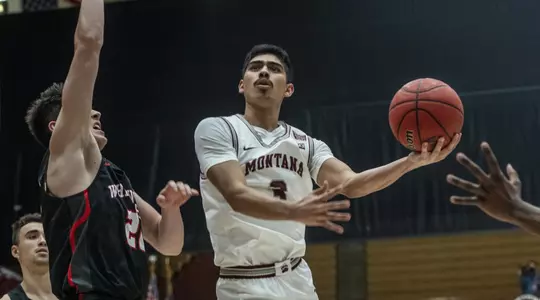
Photo by: Todd Goodrich
Grizzlies get up to speed with full summer of workouts
8/6/2021 10:25:00 AM | Men's Basketball
While November through March are the months in which college basketball teams get to display their talents and compete for championships, most coaches would say that the spring and summer is the biggest period of time that positively or negatively impacts the upcoming season.
Eighth-year head coach Travis DeCuire is no different, knowing the importance of spring and summer workouts.
"In a lot of ways, it's a make-or-break period of time and really sets the tone for us going into our season," DeCuire said.
The spring – after a brief reprieve following the conclusion of one season – is when coaches can work with student-athletes individually, or in very small groups, to break down specific skills. They go back to the basics. They fix what's not working or improve on what is. It's a vital period of time in which the focus is much more narrow, and the attention is at an even ratio.
Then there are the summer months, a period that the Grizzlies wrapped up last week. The student-athletes – and coaches – now get a break for the majority of August, allowing them to recharge, visit family and get away from basketball before revving back up for preseason practices, which will begin next month.
But the summer months are a time to take some of what was worked on individually or in small groups and put it together as a full team. It's a period of time that's so important because there isn't the pressure to figure everything out under a time crunch, weeks before a season. Instead, plans can be altered. If a specific skill is taking longer to master, the coaching staff can spend extra time on it. If they want to implement a new defense, now is the time.
It's so important that several years ago, DeCuire chose to use funds from his excellence group to go toward summer-school classes, not only helping the student-athletes get ahead on their studies (which has paid off in a big way) but also keeping them in Missoula during the summer months for additional training, not to mention team bonding away from the court.
Unlike a half-decade ago, when student-athletes would often times go home for most of the summer, now they're enjoying time – together – in Missoula.
"The workouts definitely help from a basketball sense, but just being with the team for a long period of time, that also builds chemistry, whether it's on the court or off of it," junior guard Josh Vazquez said. "We love being together away from the court, and then on it, having access to the facilities and weight room here at Montana are really helpful."
Several years ago, this might not have been the case, and last year – even though the student-athletes wanted to – it couldn't be done due to the pandemic.
That vital spring season where skills are broken down to the core? Non-existent, as everyone was sent home, most without access to a gym or any formal training. Even in the summer, once things started to open up, to a degree, it was different.
The summer period was shortened and, due to social distancing rules, needed to be in smaller groups rather than as a full team. It was intermittent, as there were several shutdowns due to positive cases or contact tracing. Masks were involved.
Mostly, it wasn't effective, as the coaching staff spent most of the time trying to get players back into physical form after several months of limited or no basketball activity.
Not to make excuses, because every team across the country was dealing with the same circumstances, but Montana missed out on this period a year ago.
"We needed it, especially being such a young group," DeCuire said. "It's a vital period of time, and without it, we were behind."
The Grizzlies' talented and record-setting freshman class of Vazquez, Kyle Owens and Big Sky Conference Freshman of the Year Derrick Carter-Hollinger didn't have a spring or traditional summer. So they went into their sophomore seasons, in some senses, still feeling partially like freshmen.
The Grizzlies also added a handful of transfers and new freshmen who didn't get the traditional orientation, putting them further behind where DeCuire would have liked.
Entering last season, only three players had been through a traditional spring and summer – the most pivotal months of the season, according to DeCuire – and those three accounted for just six career starts.
"Our sophomores were still playing as if they were still in an extended freshman season, and the same with our juniors and seniors," DeCuire said. "There just wasn't vast improvement from one season to the next, which is unlike us as a program."
To most fans, it might not have made a difference, and by the end of the year, the results were there. But it did take time.
Montana's 2020-21 freshman class took things to a whole new level, setting school records for scoring, minutes played and starts. But again, it took time.
Robby Beasley III missed the first several weeks of the season due to a knee injury, and was inconsistent through the first two months. By mid-February, however, he had hit his stride, scoring in double figures in six of eight games from that point forward, including 23 in a quarterfinal win over Weber State.
Brandon Whitney became a scorer from the jump – totaling 17 in his collegiate debut – but became a better all-around player as the season progressed, upping his assists totals while minimizing his turnovers. In his first 16 games, he averaged 2.3 assists per game, but also recorded a negative assist-to-turnover ratio. Over the final 12 contests, his assists-per-game average saw a bump to 2.8, but even bigger, he posted a 1.8 assist-to-turnover ratio.
Transfer Cameron Parker scored in double figures two times through the first half of the season before doing so eight times in the back half. His assists also went up, his turnovers went down and he became one of the league's top players off the bench while averaging starter minutes.
Growth was perhaps best seen in freshman Josh Bannan, who shot .290 – including 1-of-13 at one point – and averaged 3.6 points per game during a seven-game stretch midway through the season, before busting out in a series vs. Weber State. Over the next five games, he shot .620 from the floor and averaged 15.3 points per game while also leading the Grizzlies in rebounding. By the end of the year, he not only was one of Montana's best players, but also ranked ninth in the Big Sky for rebounding.
"We were behind, no doubt about it," DeCuire said. "It took us some time to get going, and then by the end of the year, you started to see some guys begin to figure things out."
The same was true for Vazquez, who despite playing an entire freshman season, could have benefited from a traditional spring and summer to continue to develop and make adjustments following his first collegiate season.
The Torrance, California, native averaged 7.9 points across 25.3 minutes during his sophomore campaign, leading the Grizzlies with 44 made 3-pointers and 24 steals.
Vazquez scored in double figures nine times in 2020-21, with three of them coming in the final two weeks of the season, including a career-high 21 against Idaho in the Big Sky tournament. That afternoon, he knocked down a season-high five 3-pointers and stole four passes.
On the year, Vazquez connected on three or more 3-pointers eight times, with three coming across the final five games. Nearly half of his steals came in the final seven games, totaling 11 down the stretch.
"I think it (the lack of spring and summer training) definitely played a part," Vazquez said. "As the season goes on, you get more seasoned, but especially last year, the beginning of the season was hard to get in a groove. You're dealing with empty gyms, but you're also just trying to get going after less time in the gym."
It's not just from an individual sense, either. It could easily be argued that Montana was playing its best basketball of the season at the end of the year, posting a season-best six-game winning streak and earning two victories at the Big Sky tournament.
Montana now turns its attention to 2021-22, where it has a veteran presence returning, yet in some senses is still young. The Grizzlies added three freshmen – signing Las Vegas native Johnny Braggs while also bringing on John Solomon and Jack Wetzel. They went and got a pair of transfers in Scott Blakney (Idaho) and Lonnell Martin Jr. (Otero Junior College).
In addition to the five newcomers, there's the aforementioned trio of 2020-21 freshmen, who are now just entering their second year in Missoula.
But the Grizzlies also have the pieces to again work their way toward the top of the Big Sky Conference. They return 86.5 percent of the team's minutes from last season, 85.8 percent of its scoring, 82.7 percent of its rebounding, 94.1 percent of its assists, 89.8 percent of its steals, 77.8 percent of its blocked shots and 84.3 percent of its starts.
"Knowing that everybody is coming back is extremely exciting," Vazquez said. "I don't want to say we had a bad season last year, but it didn't end the way we wanted it to. But right after the season ended, we really grinded through the spring and went through some really hard workouts, and that carried over into the summer.
"We all know what we want, and we know what it takes to come out on top."
More than anything, the thing that gives DeCuire confidence is that he and his staff have had time with their group this season.
He's seen growth on the floor, particularly in three or four players. He's seen a change in bodies, with players getting stronger in the weight room.
"We've been able to pinpoint a couple of things in terms of ball handling, shooting and decision making… Skillsets that will allow guys to be more productive offensively," DeCuire said. "We've improved a little bit in each area.
"This summer, it was important to improve as much as we could and make up for as much lost time as possible, and I think we did that for the most part."
Eighth-year head coach Travis DeCuire is no different, knowing the importance of spring and summer workouts.
"In a lot of ways, it's a make-or-break period of time and really sets the tone for us going into our season," DeCuire said.
The spring – after a brief reprieve following the conclusion of one season – is when coaches can work with student-athletes individually, or in very small groups, to break down specific skills. They go back to the basics. They fix what's not working or improve on what is. It's a vital period of time in which the focus is much more narrow, and the attention is at an even ratio.
Then there are the summer months, a period that the Grizzlies wrapped up last week. The student-athletes – and coaches – now get a break for the majority of August, allowing them to recharge, visit family and get away from basketball before revving back up for preseason practices, which will begin next month.
But the summer months are a time to take some of what was worked on individually or in small groups and put it together as a full team. It's a period of time that's so important because there isn't the pressure to figure everything out under a time crunch, weeks before a season. Instead, plans can be altered. If a specific skill is taking longer to master, the coaching staff can spend extra time on it. If they want to implement a new defense, now is the time.
It's so important that several years ago, DeCuire chose to use funds from his excellence group to go toward summer-school classes, not only helping the student-athletes get ahead on their studies (which has paid off in a big way) but also keeping them in Missoula during the summer months for additional training, not to mention team bonding away from the court.
Unlike a half-decade ago, when student-athletes would often times go home for most of the summer, now they're enjoying time – together – in Missoula.
"The workouts definitely help from a basketball sense, but just being with the team for a long period of time, that also builds chemistry, whether it's on the court or off of it," junior guard Josh Vazquez said. "We love being together away from the court, and then on it, having access to the facilities and weight room here at Montana are really helpful."
Several years ago, this might not have been the case, and last year – even though the student-athletes wanted to – it couldn't be done due to the pandemic.
That vital spring season where skills are broken down to the core? Non-existent, as everyone was sent home, most without access to a gym or any formal training. Even in the summer, once things started to open up, to a degree, it was different.
The summer period was shortened and, due to social distancing rules, needed to be in smaller groups rather than as a full team. It was intermittent, as there were several shutdowns due to positive cases or contact tracing. Masks were involved.
Mostly, it wasn't effective, as the coaching staff spent most of the time trying to get players back into physical form after several months of limited or no basketball activity.
Not to make excuses, because every team across the country was dealing with the same circumstances, but Montana missed out on this period a year ago.
"We needed it, especially being such a young group," DeCuire said. "It's a vital period of time, and without it, we were behind."
The Grizzlies' talented and record-setting freshman class of Vazquez, Kyle Owens and Big Sky Conference Freshman of the Year Derrick Carter-Hollinger didn't have a spring or traditional summer. So they went into their sophomore seasons, in some senses, still feeling partially like freshmen.
The Grizzlies also added a handful of transfers and new freshmen who didn't get the traditional orientation, putting them further behind where DeCuire would have liked.
Entering last season, only three players had been through a traditional spring and summer – the most pivotal months of the season, according to DeCuire – and those three accounted for just six career starts.
"Our sophomores were still playing as if they were still in an extended freshman season, and the same with our juniors and seniors," DeCuire said. "There just wasn't vast improvement from one season to the next, which is unlike us as a program."
To most fans, it might not have made a difference, and by the end of the year, the results were there. But it did take time.
Montana's 2020-21 freshman class took things to a whole new level, setting school records for scoring, minutes played and starts. But again, it took time.
Robby Beasley III missed the first several weeks of the season due to a knee injury, and was inconsistent through the first two months. By mid-February, however, he had hit his stride, scoring in double figures in six of eight games from that point forward, including 23 in a quarterfinal win over Weber State.
Brandon Whitney became a scorer from the jump – totaling 17 in his collegiate debut – but became a better all-around player as the season progressed, upping his assists totals while minimizing his turnovers. In his first 16 games, he averaged 2.3 assists per game, but also recorded a negative assist-to-turnover ratio. Over the final 12 contests, his assists-per-game average saw a bump to 2.8, but even bigger, he posted a 1.8 assist-to-turnover ratio.
Transfer Cameron Parker scored in double figures two times through the first half of the season before doing so eight times in the back half. His assists also went up, his turnovers went down and he became one of the league's top players off the bench while averaging starter minutes.
Growth was perhaps best seen in freshman Josh Bannan, who shot .290 – including 1-of-13 at one point – and averaged 3.6 points per game during a seven-game stretch midway through the season, before busting out in a series vs. Weber State. Over the next five games, he shot .620 from the floor and averaged 15.3 points per game while also leading the Grizzlies in rebounding. By the end of the year, he not only was one of Montana's best players, but also ranked ninth in the Big Sky for rebounding.
"We were behind, no doubt about it," DeCuire said. "It took us some time to get going, and then by the end of the year, you started to see some guys begin to figure things out."
The same was true for Vazquez, who despite playing an entire freshman season, could have benefited from a traditional spring and summer to continue to develop and make adjustments following his first collegiate season.
The Torrance, California, native averaged 7.9 points across 25.3 minutes during his sophomore campaign, leading the Grizzlies with 44 made 3-pointers and 24 steals.
Vazquez scored in double figures nine times in 2020-21, with three of them coming in the final two weeks of the season, including a career-high 21 against Idaho in the Big Sky tournament. That afternoon, he knocked down a season-high five 3-pointers and stole four passes.
On the year, Vazquez connected on three or more 3-pointers eight times, with three coming across the final five games. Nearly half of his steals came in the final seven games, totaling 11 down the stretch.
"I think it (the lack of spring and summer training) definitely played a part," Vazquez said. "As the season goes on, you get more seasoned, but especially last year, the beginning of the season was hard to get in a groove. You're dealing with empty gyms, but you're also just trying to get going after less time in the gym."
It's not just from an individual sense, either. It could easily be argued that Montana was playing its best basketball of the season at the end of the year, posting a season-best six-game winning streak and earning two victories at the Big Sky tournament.
Montana now turns its attention to 2021-22, where it has a veteran presence returning, yet in some senses is still young. The Grizzlies added three freshmen – signing Las Vegas native Johnny Braggs while also bringing on John Solomon and Jack Wetzel. They went and got a pair of transfers in Scott Blakney (Idaho) and Lonnell Martin Jr. (Otero Junior College).
In addition to the five newcomers, there's the aforementioned trio of 2020-21 freshmen, who are now just entering their second year in Missoula.
But the Grizzlies also have the pieces to again work their way toward the top of the Big Sky Conference. They return 86.5 percent of the team's minutes from last season, 85.8 percent of its scoring, 82.7 percent of its rebounding, 94.1 percent of its assists, 89.8 percent of its steals, 77.8 percent of its blocked shots and 84.3 percent of its starts.
"Knowing that everybody is coming back is extremely exciting," Vazquez said. "I don't want to say we had a bad season last year, but it didn't end the way we wanted it to. But right after the season ended, we really grinded through the spring and went through some really hard workouts, and that carried over into the summer.
"We all know what we want, and we know what it takes to come out on top."
More than anything, the thing that gives DeCuire confidence is that he and his staff have had time with their group this season.
He's seen growth on the floor, particularly in three or four players. He's seen a change in bodies, with players getting stronger in the weight room.
"We've been able to pinpoint a couple of things in terms of ball handling, shooting and decision making… Skillsets that will allow guys to be more productive offensively," DeCuire said. "We've improved a little bit in each area.
"This summer, it was important to improve as much as we could and make up for as much lost time as possible, and I think we did that for the most part."
Players Mentioned
F
/ Men's Basketball
G
/ Men's Basketball
F
/ Men's Basketball
G
/ Men's Basketball
F
/ Men's Basketball
G
/ Men's Basketball
F
/ Men's Basketball
G
/ Men's Basketball
F
/ Men's Basketball
G
/ Men's Basketball
G
/ Men's Basketball
G
/ Men's BasketballMonday, March 30
Monday, March 30
Monday, March 30
Monday, March 30