Grizzlies will have their voices heard
9/15/2020 3:19:00 PM | Men's Basketball
Travis DeCuire can distinctly recall the first time he voted. He was 37 years old.
In the nearly two decades prior, DeCuire never cast a vote because he didn't think it mattered. He was one person, and his single vote wasn't going to make a difference. Plus, no candidate, he thought, represented his ideal, so why bother?
Now 49, DeCuire has learned from his past, and he doesn't want others to fall for the same traps.
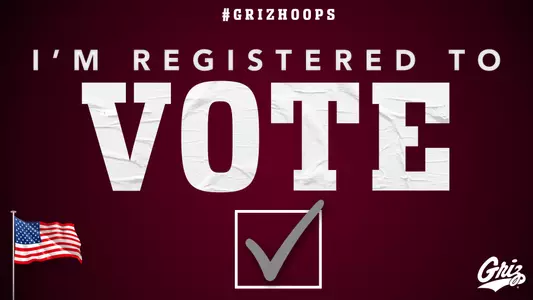
Behind DeCuire's leadership, and several impactful and informative team meetings, every eligible member of Montana's men's basketball program is now registered to vote, and will utilize their civic duty at the polls in November – nearly all for the first time.
First off, there are two things one should know:
The conversation began over the summer in the wake of George Floyd's death in Minneapolis. The country was at a crossroad, citizens were learning how to amplify their voices and people everywhere were searching for ways to make a difference.
Many Griz student-athletes took to social media, offering opinions. DeCuire used his platform to become vocal, both on social media and through a variety of news outlets.
Words help, but change needs action.
While seemingly still small on the grand scale, voting is one action that is accessible to nearly every American.
"There's a ton of dialogue taking place right now in America about what's wrong, and even what's right, but what there haven't been are very many solutions thrown out for conversation," DeCuire said. "We, as a program, want to be part of the solution. Voting isn't going to solve everything, but we feel it can be the next step."
For a variety of reasons, both in one's control and out of it, many Americans do not vote.
During the 2016 election, just north of 60 percent of eligible American voters actually did so. The numbers were even more startling for young voters and minority voters.
While the percentage is on the rise, less than half of those ages 18-24 voted in 2016. Across the board, while roughly two-thirds of white voters participated, just 53 percent of minorities did, with Black voter turnout declining for the first time in 20 years.
"People don't see the importance of voting, especially at our age, because we don't see how impactful it can be," said freshman Robby Beasley, a Dublin, California, native. "We don't always see direct effects on our lives, so we deem it unimportant.
"That's the complete opposite, though; it's extremely important to be involved and informed about different people, not only in the federal government, but also in your local governments. That's where it can be really impactful on your community, and maybe not for yourself, but you have to look past your own life and how decisions affect those around you, because for some, this is life or death."
The statistics for young and minority voters are alarming to members of the Montana men's basketball team because they are classifications many of them align with.
Among the 18 student-athletes and coaches who are eligible to vote (Montana has two Australian student-athletes and one graduate manager), 15 identify as a minority voter.
"Voter suppression exists," DeCuire said. "If you're not out seeking information and you're not creating a means to get to the poll, it's not going to happen for you if you're in an area that is suppressed."
Montana isn't always in that category, but the Seattle suburb that DeCuire grew up in is.
"I came from a community that didn't have the information, so I never understood the value of a vote," he said. "I was the one who thought it didn't matter. My vote doesn't matter, because it's just one vote. Who I vote for doesn't matter, because neither candidate represents me.
"I didn't understand that the information was right there for me to search for the right candidate, and then fight for the right candidate."
DeCuire's perspective changed in 2008. He saw history in front of him and began focusing a little closer to campaigns and debates, and started to realize how different candidate are.
At the time, DeCuire was interested in the presidential race, but that led to seeing the value in local issues. It's also what made him passionate about the future generation.
The conversation with the Montana basketball program started over the summer. Seeing the country in a state of unrest, sophomore Kyle Owens called his coach to talk about what he was seeing. That led to a conversation with the entire team over Zoom. It was supposed to be a one-hour open forum, but ended up lasting 3 hours.
"We spent time talking about what is going on and sharing ideas about what we think we can do," Beasley said. "I think the main thing that stood out is that everyone had personal experiences that were really valuable. There were people learning and soaking it up, but everyone had input of what they can do for the Missoula community and our communities back home.
"It was eye-opening to see everyone offer input and be so engaged."
That conversation led to a meeting with Dr. Sara Rinfret, Montana's chair of the Department of Public Administration. She taught the team about the political system and how to use resources around them educate themselves and others.
They were given a packet of information, not to influence who or what to vote for, but as an educational resource to learn about what will be on the upcoming ballot.
With guidance from Rinfret and the Griz coaching staff, every eligible Griz basketball student-athlete is now registered to vote. At the time of the 2016 presidential election, only redshirt senior Michael Steadman was old enough to vote, so nearly every student-athlete will cast a vote for the first time in November.
Registering was the easy part. Now the hard part begins, but also the part that is most rewarding.
The first step is to recruit others. Voter turnout among the youth won't change overnight, but like those who abstain from voting because they simply don't believe their single vote will make a difference, the same apathy won't incite change either.
So each player was challenged to get 10 others to register to vote. They even were shown an app that will locate who among their contacts is not yet registered, so they can directly reach out to them.
For a roster the size of Montana's, nearly all first-time voters, if they all stand up to the challenge, that's close to 200 new voters just from a single team.
"I've learned that when we open up and talk about these issues, it can lead to some good conversation," said Owens, a California native who originally had the phone conversation with DeCuire. "When I've been open about telling people I'm registered to vote, and why, I've found others are more interested in registering. We just don't always have the conversations, so a lot of times it doesn't lead anywhere."
The same thing goes for issues and candidates, and talking about why they're of importance.
The men's basketball program knows that not everyone will vote the same way they would, and even not everyone on the team will vote the same. That is OK; that is not the point.
"We're just trying to use our platform as basketball players to make slight changes that will lead to a big change," Owens said. "Every voice matters and every vote matters."
The next step is the most time consuming, but also one of the most important: Research.
Some student-athletes chose to register in their hometowns, while others elected to cast a vote in Missoula.
Owens was one of the few who was previously registered to vote, but changed his affiliation from California to Montana this summer.
"After talking with my dad, we just talked about how Missoula is where I spend most of my time now," the 19-year-old said. "I decided that Montana needs my vote more than California does."
Some of each player's research comes from educating themselves, be it from newspapers to websites to even social media. But a lot of it has come from conversations amongst each other.
"The biggest thing is just being together and being willing to share," said junior Mack Anderson, a Bozeman native who is one of the few white voters within the program. "My current teammates, and even former teammates like Kendal (Manuel) and Jamar (Akoh) have very different backgrounds than I do. These guys are my brothers, so I think it's important to learn and understand why someone is passionate a certain way, and then deciding how I want to vote."
Understanding each other – and it goes all ways – is big for DeCuire, as well.
The demographic of Mercer Island, where DeCuire attended high school, is much different from his nearby Seattle neighborhood just a few miles west. Some of the stories DeCuire would share with his classmates just didn't seem to resonate with them.
"They would say, 'Oh you're just making up stories' or 'That sounds like a movie.' A lot of people live in a bubble, and I don't mean coronavirus," DeCuire said.
So DeCuire would invite friends home with him for a weekend. They'd cross the bridge into Seattle, play basketball at the rec center and spend time together in his neighborhood.
"They'd go home eyes wide open," DeCuire said.
As arguably the most prominent Black man in the state of Montana, DeCuire still experiences it today. He'll talk with neighbors or boosters who don't get it, because they haven't experienced it. It's why he has begun sharing his stories and having open dialogue with those around him.
"It's very easy to say that systemic oppression doesn't exist if you've never been oppressed, or if you're not the oppressor," the seventh-year head coach said. "It doesn't mean it doesn't exist just because you personally haven't experienced it."
The easy part, now that everyone is registered, will be to actually vote.
Sparked by conversations from college basketball coaches across the country, the NCAA recently recommended Election Day on Nov. 3 to be a date free of athletic activity.
Just one week before the 2020-21 basketball season is scheduled to begin, Montana will take a break from the X's and O's for something more important that day.
It's something DeCuire is proud of, hopeful that the next generation is the one that will enact permanent change.
"By the time a lot of people learn, it's too late, and I'm an example of that," DeCuire said. "I never realized the importance of civic power, civic engagement."
But it's not too late for his team.
"As young student-athletes, I think that these guys are in a very powerful position to help create or start the process of change that they can eventually see and experience in their lifetime."
Which is the ultimate goal.
This isn't about one candidate or one issue. It's not even about the presidential election, as a whole. It's about creating systemic change and being part of the solution moving forward.
"We're good at identifying issues and complaining about them, but we're not always good about impacting a change or helping someone come up with a solution," DeCuire said. "The thing I've enjoyed most is seeing others join the movement. This isn't just a Black or African-American movement; this is a national movement.
"We want to play a role in change. We want to be part of the solution, and I think this is an opportunity for us to do that, now.
The deadline to register to vote in the state of Montana is on Election Day (Nov. 3), although some states require registration as early as Oct. 5. Those in Montana who wish to register by mail must have their application postmarked by Oct. 4. Eligible U.S. citizens can register to vote in the matter of minutes by visiting www.vote.org.
In the nearly two decades prior, DeCuire never cast a vote because he didn't think it mattered. He was one person, and his single vote wasn't going to make a difference. Plus, no candidate, he thought, represented his ideal, so why bother?
Now 49, DeCuire has learned from his past, and he doesn't want others to fall for the same traps.
Behind DeCuire's leadership, and several impactful and informative team meetings, every eligible member of Montana's men's basketball program is now registered to vote, and will utilize their civic duty at the polls in November – nearly all for the first time.
First off, there are two things one should know:
- This isn't just about social injustice. Yes, the majority of Montana's team comes from a minority background, and yes, racial tension is a driving force in this because it's personal to so many of the Grizzlies, but no, this is not merely a ploy to push a singular agenda.
- This isn't about getting one candidate in or out of office. No one is telling each student-athlete how to vote or trying to politicize the concept. It, instead, is an opportunity to show the value in using one's voice in this capacity.
The conversation began over the summer in the wake of George Floyd's death in Minneapolis. The country was at a crossroad, citizens were learning how to amplify their voices and people everywhere were searching for ways to make a difference.
Many Griz student-athletes took to social media, offering opinions. DeCuire used his platform to become vocal, both on social media and through a variety of news outlets.
Words help, but change needs action.
While seemingly still small on the grand scale, voting is one action that is accessible to nearly every American.
"There's a ton of dialogue taking place right now in America about what's wrong, and even what's right, but what there haven't been are very many solutions thrown out for conversation," DeCuire said. "We, as a program, want to be part of the solution. Voting isn't going to solve everything, but we feel it can be the next step."
For a variety of reasons, both in one's control and out of it, many Americans do not vote.
During the 2016 election, just north of 60 percent of eligible American voters actually did so. The numbers were even more startling for young voters and minority voters.
While the percentage is on the rise, less than half of those ages 18-24 voted in 2016. Across the board, while roughly two-thirds of white voters participated, just 53 percent of minorities did, with Black voter turnout declining for the first time in 20 years.
"People don't see the importance of voting, especially at our age, because we don't see how impactful it can be," said freshman Robby Beasley, a Dublin, California, native. "We don't always see direct effects on our lives, so we deem it unimportant.
"That's the complete opposite, though; it's extremely important to be involved and informed about different people, not only in the federal government, but also in your local governments. That's where it can be really impactful on your community, and maybe not for yourself, but you have to look past your own life and how decisions affect those around you, because for some, this is life or death."
The statistics for young and minority voters are alarming to members of the Montana men's basketball team because they are classifications many of them align with.
Among the 18 student-athletes and coaches who are eligible to vote (Montana has two Australian student-athletes and one graduate manager), 15 identify as a minority voter.
"Voter suppression exists," DeCuire said. "If you're not out seeking information and you're not creating a means to get to the poll, it's not going to happen for you if you're in an area that is suppressed."
Montana isn't always in that category, but the Seattle suburb that DeCuire grew up in is.
"I came from a community that didn't have the information, so I never understood the value of a vote," he said. "I was the one who thought it didn't matter. My vote doesn't matter, because it's just one vote. Who I vote for doesn't matter, because neither candidate represents me.
"I didn't understand that the information was right there for me to search for the right candidate, and then fight for the right candidate."
DeCuire's perspective changed in 2008. He saw history in front of him and began focusing a little closer to campaigns and debates, and started to realize how different candidate are.
At the time, DeCuire was interested in the presidential race, but that led to seeing the value in local issues. It's also what made him passionate about the future generation.
The conversation with the Montana basketball program started over the summer. Seeing the country in a state of unrest, sophomore Kyle Owens called his coach to talk about what he was seeing. That led to a conversation with the entire team over Zoom. It was supposed to be a one-hour open forum, but ended up lasting 3 hours.
"We spent time talking about what is going on and sharing ideas about what we think we can do," Beasley said. "I think the main thing that stood out is that everyone had personal experiences that were really valuable. There were people learning and soaking it up, but everyone had input of what they can do for the Missoula community and our communities back home.
"It was eye-opening to see everyone offer input and be so engaged."
That conversation led to a meeting with Dr. Sara Rinfret, Montana's chair of the Department of Public Administration. She taught the team about the political system and how to use resources around them educate themselves and others.
They were given a packet of information, not to influence who or what to vote for, but as an educational resource to learn about what will be on the upcoming ballot.
With guidance from Rinfret and the Griz coaching staff, every eligible Griz basketball student-athlete is now registered to vote. At the time of the 2016 presidential election, only redshirt senior Michael Steadman was old enough to vote, so nearly every student-athlete will cast a vote for the first time in November.
Registering was the easy part. Now the hard part begins, but also the part that is most rewarding.
The first step is to recruit others. Voter turnout among the youth won't change overnight, but like those who abstain from voting because they simply don't believe their single vote will make a difference, the same apathy won't incite change either.
So each player was challenged to get 10 others to register to vote. They even were shown an app that will locate who among their contacts is not yet registered, so they can directly reach out to them.
For a roster the size of Montana's, nearly all first-time voters, if they all stand up to the challenge, that's close to 200 new voters just from a single team.
"I've learned that when we open up and talk about these issues, it can lead to some good conversation," said Owens, a California native who originally had the phone conversation with DeCuire. "When I've been open about telling people I'm registered to vote, and why, I've found others are more interested in registering. We just don't always have the conversations, so a lot of times it doesn't lead anywhere."
The same thing goes for issues and candidates, and talking about why they're of importance.
The men's basketball program knows that not everyone will vote the same way they would, and even not everyone on the team will vote the same. That is OK; that is not the point.
"We're just trying to use our platform as basketball players to make slight changes that will lead to a big change," Owens said. "Every voice matters and every vote matters."
The next step is the most time consuming, but also one of the most important: Research.
Some student-athletes chose to register in their hometowns, while others elected to cast a vote in Missoula.
Owens was one of the few who was previously registered to vote, but changed his affiliation from California to Montana this summer.
"After talking with my dad, we just talked about how Missoula is where I spend most of my time now," the 19-year-old said. "I decided that Montana needs my vote more than California does."
Some of each player's research comes from educating themselves, be it from newspapers to websites to even social media. But a lot of it has come from conversations amongst each other.
"The biggest thing is just being together and being willing to share," said junior Mack Anderson, a Bozeman native who is one of the few white voters within the program. "My current teammates, and even former teammates like Kendal (Manuel) and Jamar (Akoh) have very different backgrounds than I do. These guys are my brothers, so I think it's important to learn and understand why someone is passionate a certain way, and then deciding how I want to vote."
Understanding each other – and it goes all ways – is big for DeCuire, as well.
The demographic of Mercer Island, where DeCuire attended high school, is much different from his nearby Seattle neighborhood just a few miles west. Some of the stories DeCuire would share with his classmates just didn't seem to resonate with them.
"They would say, 'Oh you're just making up stories' or 'That sounds like a movie.' A lot of people live in a bubble, and I don't mean coronavirus," DeCuire said.
So DeCuire would invite friends home with him for a weekend. They'd cross the bridge into Seattle, play basketball at the rec center and spend time together in his neighborhood.
"They'd go home eyes wide open," DeCuire said.
As arguably the most prominent Black man in the state of Montana, DeCuire still experiences it today. He'll talk with neighbors or boosters who don't get it, because they haven't experienced it. It's why he has begun sharing his stories and having open dialogue with those around him.
"It's very easy to say that systemic oppression doesn't exist if you've never been oppressed, or if you're not the oppressor," the seventh-year head coach said. "It doesn't mean it doesn't exist just because you personally haven't experienced it."
The easy part, now that everyone is registered, will be to actually vote.
Sparked by conversations from college basketball coaches across the country, the NCAA recently recommended Election Day on Nov. 3 to be a date free of athletic activity.
Just one week before the 2020-21 basketball season is scheduled to begin, Montana will take a break from the X's and O's for something more important that day.
It's something DeCuire is proud of, hopeful that the next generation is the one that will enact permanent change.
"By the time a lot of people learn, it's too late, and I'm an example of that," DeCuire said. "I never realized the importance of civic power, civic engagement."
But it's not too late for his team.
"As young student-athletes, I think that these guys are in a very powerful position to help create or start the process of change that they can eventually see and experience in their lifetime."
Which is the ultimate goal.
This isn't about one candidate or one issue. It's not even about the presidential election, as a whole. It's about creating systemic change and being part of the solution moving forward.
"We're good at identifying issues and complaining about them, but we're not always good about impacting a change or helping someone come up with a solution," DeCuire said. "The thing I've enjoyed most is seeing others join the movement. This isn't just a Black or African-American movement; this is a national movement.
"We want to play a role in change. We want to be part of the solution, and I think this is an opportunity for us to do that, now.
The deadline to register to vote in the state of Montana is on Election Day (Nov. 3), although some states require registration as early as Oct. 5. Those in Montana who wish to register by mail must have their application postmarked by Oct. 4. Eligible U.S. citizens can register to vote in the matter of minutes by visiting www.vote.org.
Players Mentioned

F
/ Men's Basketball
G
/ Men's Basketball
F
/ Men's Basketball
F
/ Men's BasketballMonday, March 30
Monday, March 30
Monday, March 30
Monday, March 30